
Step 6: Praise and reward
Every month, reward the best units, present certificates and trophies to the entire unit. The 5S Cup should be circulated among the best units to create competition between units. At the end of the year, reward the best unit of the year, give gifts and acknowledge the contributions of each individual in that unit.
1.6.3.2. Content of KAIZEN application
The steps of KAIZEN implementation follow the PDCA cycle. Steps 1 to 4 are P (plan), step 5 is D (do), the step in that process is C (Check) and the next step is A (corrective or improvement action). The steps of KAIZEN implementation help us solve problems based on data analysis. The steps of KAIZEN implementation are standardized as follows:
Maybe you are interested!
-
 Mechanism, Policy and Investment Environment for Sustainable Tourism Development in the Central Highlands
 -
 Research on physical education content for students of Thanh Hoa University of Culture, Sports and Tourism - 30
 -
 Guide and Encourage Self-Study Through the Research Topic of Tourism Psychology
 -
 Research on Content, Influencing Factors and Experience in Developing Tourism Market
 -
 About the Organization and Management Mechanism of Urban Tourism Infrastructure
Step 1: Select a topic; Step 2: Understand the current situation and define goals; Step 3: Analyze collected data to identify root causes; Step 4: Determine measures to be taken based on data analysis; Step 5: Implement measures; Step 6: Confirm results of implementing measures
Step 7: Develop or revise standards to prevent recurrence Step 8: Review the above processes and determine next project.
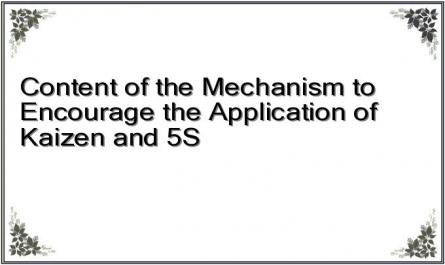
The steps to implement KAIZEN are presented through a diagram.
Step 1: Choose a topic
Step 2: Find out the current situation
Step 3: Analyze the collected data to determine the root cause
Step 4: Determine implementation measures based on data analysis
Step 5: Implement the solution
Step 6: Confirm the results of the implementation of the measure
Step 7: Develop standards to prevent recurrence
Step 8: Review the above processes and identify next projects
Figure 1.6: Steps to implement KAIZEN [09, p. 2]
1.6.4. Content of incentive mechanism for applying KAIZEN and 5S
Building an incentive mechanism when applying KAIZEN and 5S will help your employees have more motivation when complying with the principles as well as a way to commend and reward individuals with outstanding achievements in implementing KAIZEN and 5S in the company.
The content is as follows:
There are two forms of encouragement: material encouragement and spiritual encouragement.
Material incentives can be in the form of cash given directly to employees and departments that perform well in KAIZEN and 5S so that employees feel that their good implementation of KAIZEN and 5S is always recognized by the business and helps them have more motivation to perform and strive.
Motivate with spirit: you can reward the team with items, gifts or trips so that they always feel honored in their organization for the improvements in their work when applying KAIZEN and 5S to their own work. Help disseminate knowledge about KAIZEN and 5S to each department as well as create more motivation for different departments to compete with each other.
Every month, reward the best units, present certificates and trophies to the entire unit. The 5S Cup should be circulated among the best units to create competition between units. At the end of the year, reward the best unit of the year, give gifts and acknowledge the contributions of each individual in that unit.
1.7. Experience in improving competitiveness in enterprises through applying KAIZEN and 5S improvement tools
1.7.1. Cai Lan Vietnam Japan Paper Production Company Limited (Ha Long) [26 pp. 30-31]
As a company operating in the field of paper production and paper product trading, the application of KAIZEN and 5S improvement tools has been thoroughly understood and applied by the company since its inception to improve the company's production and business efficiency.
The company always applies and maintains the implementation of 5S and KAIZEN according to the principles.
block:
+ Each individual needs to seriously implement KAIZEN and 5S right at the workplace.
keeping the work area tidy and clean.
+ All working areas are neatly organized, clean, and have lines indicating each working area so that employees can follow the regulations.
+ In the production area, teams and groups regularly inspect and urge groups and individuals who do not follow 5S and KAIZEN regulations to find timely solutions.
+ Every year, the company holds a meeting to summarize experiences in implementing 5S and KAIZEN, and to praise individuals and groups that are good at implementing 5S and KAIZEN.
1.7.2. Ha Long Dream Hotel[26 pp. 35-36]
Located in the center of Bai Chay Tourist Area, with 184 luxurious guest rooms meeting 4-star standards. A system of convenient restaurants and bars. The hotel can serve you dishes and drinks with European, Asian, Thai culinary styles and local specialties.
Over the years, Ha Long Dream Hotel has been considered one of the hotels managed by Vietnamese people that can compete with high-end hotels of foreign corporations in providing high-quality accommodation services for luxury tourists to Ha Long. The hotel has a system of additional services including: Swimming pool, beauty care room, gym, Sauna Massage service, souvenir shop, car rental service, airport pick-up and drop-off, child care service, laundry service, ADSL Internet system in rooms... creating many favorable conditions in serving international tourists.
Staff, professional expertise and hotel management capacity: The hotel staff is regularly trained to improve their customer service skills through short-term training courses, especially from the Ha Long College of Culture, Arts and Tourism. In addition, the hotel sends staff to high-end hotels in Ho Chi Minh City for training.
The training of professional standards according to ISO quality standards is always of interest to the Board of Directors and is considered a strategic activity in improving competitiveness and attracting tourists. Determined to build a green, clean and beautiful working environment, thereby creating a culture and style of serving tourists.
Ha Long Dream Hotel is one of the hotels with competitive capacity.
High competitiveness is demonstrated through room occupancy, business efficiency and customer satisfaction. Ha Long Dream Hotel can compete directly with other high-end hotels with profit margins and room occupancy rates that are superior to competitors. In addition, with the experience of Saigon Tourist, a joint venture partner, Ha Long Dream Hotel is highly appreciated by most tourists for its distribution policy, the ability to recognize and meet customer needs of the hotel staff. This is truly a strength of the hotel because the ability to recognize and meet customer needs will stimulate customers to have new needs at a higher and more diverse level.
The joint venture strategy of Ha Long Dream Hotel is a very reasonable business strategy between domestic enterprises to create competitiveness with foreign business corporations in the context of fierce competition. The joint venture strategy with Saigon Tourist is a right choice because it has created the following strengths:
- Create a system of distribution and cross-linking cooperation between member hotels of Saigon Tourist. In the hotel business, participating in the distribution network and cooperating to send guests to each other is important for business success, especially for hotels located in cities and tourist destinations on typical tour routes in the tourism product system of a country. Saigontourist Corporation has a chain of dozens of joint venture hotels scattered across the country, especially in major tourist destinations. This is a great advantage of Ha Long Dream Hotel when participating in the network of sending guests and introducing guests to each other in the network. With the joint venture strategy with Saigontourist, Ha Long Dream Hotel has created a number of competitive advantages:
- Join the large hotel chain of Saigontourist (guaranteed efficiency like joint venture with large hotels).
- Building high quality human resources thanks to regular support from Saigontourist training programs. Especially sharing management experience.
With many executives of famous hotels of Saigontourist have a lot of experience in the hotel industry.
- Create a strategic link with the distribution channel from Saigontourist travel company. For many years, Saigontourist travel company has always been the leading travel company in Vietnam, welcoming the largest number of international visitors in Vietnam. With the association with Saigontourist, Ha Long Dream Hotel not only creates a traditional customer base from Saigontourist travel company but also participates in the global distribution network of this company as well as relationships with major international travel companies in the world. In addition, the number of cross-Vietnam tourists (coming to Vietnam via Tan Son Nhat border gate) through Saigontourist and then to Ha Long continuously increases, which is also one of the factors that ensures the room occupancy rate of Ha Long Dream Hotel is always high and is not affected by the tourist season like other hotels in Ha Long.
- In particular, Ha Long Dream Hotel still maintains its traditional brand when participating in joint ventures with domestic partners. This will be the premise for Vietnamese hotels to refer to in building increasingly strong brands to be able to compete with other major hotel brands in the world.
1.7.3. Lessons learned from applying KAIZEN and 5S for Ha Long Trade Union Hotel Tourism Company Limited:
Through the experience of applying KAIZEN and 5S at Viet Nhat Paper Company and Dream Ha Long Hotel, the author has drawn some lessons as follows to successfully apply KAIZEN and 5S at Ha Long Trade Union Tourism Hotel as follows:
- On the conditions for applying KAIZEN and 5S in hotel businesses;
+ 5S and KAIZEN are improvement tools that need to be applied long-term and the improvement will not be seen immediately but must be applied over a long period of time as well as continuous improvement.
+ To successfully apply 5S and KAIZEN, there must be a consensus on goals.
Implementation between departments as well as individuals in the organization must seriously implement 5S and KAIZEN requirements.
- About the roadmap for applying KAIZEN and 5S in hotel businesses;
Through the experience of applying KAIZEN and 5S in the hotel businesses mentioned above, the author can give a roadmap for applying KAIZEN and 5S at Ha Long Trade Union Hotel and Tourism Company Limited as follows:
Provide general awareness training for all officers and employees in the company about implementing KAIZEN and 5S in the enterprise.
Next, give the conditions for successful application of KAIZEN and 5S at your company: what are the goals of implementing KAIZEN and 5S?, principles for successful implementation of KAIZEN and 5S...
How to apply KAIZEN and 5S includes: The organization needs to clearly define the goal of implementing 5S; How to define the functions and tasks of the 5S Committee; How to notify, propagate and train about 5S; Issue a general cleaning order throughout the unit and finally conduct monthly inspections and scoring as well as commend and reward individuals with good achievements in practicing KAZIEN and 5S well in their business.
Provide incentive mechanisms for applying KAIZEN and 5S in hotel businesses.
- On the mechanism to encourage the application of KAIZEN and 5S in hotel businesses.
The incentive mechanism in the application of KAIZEN and 5S must ensure two basic factors: both material and spiritual encouragement to motivate officers, employees as well as departments to have the motivation to implement and maintain the implementation of KAIZEN and 5S in their business.
1.2.3. Summary of chapter 1 and direction of chapter 2
Through analyzing the characteristics of accommodation services, food services... in the hotel business. To improve the competitiveness of hotels, it is necessary to ensure the following criteria: service must not only be good but also fast and timely. In which, the application of KAIZEN and 5S is a method applied in many businesses.
business, organization. By applying KAIZEN and 5S, it brings image, prestige and brand of the hotel in the eyes of tourists...
Chapter 1 has presented an overview of the nature of competition, competitiveness, and factors affecting hotel competitiveness. In particular, Chapter 1 has presented criteria for evaluating hotel competitiveness, factors to ensure improving hotel competitiveness, and experiences in improving the competitiveness of some hotels.
+ Quantitative assessment criteria system:
- Group of indicators to evaluate financial capacity: Financial situation directly affects business performance and business efficiency in each stage of hotel development. To evaluate financial capacity, the indicators used are total revenue, profit, return on revenue, return on equity, return on investment capital, etc.
- Group of indicators to evaluate market share: The indicators used for evaluation are total number of hotel rooms, total number of rooms according to design, total number of rooms put into use, market share, equally divided market share, actual market share, market share coefficient, average room price coefficient, revenue generation coefficient, revenue per room put into use.
- Group of evaluation coefficients on technical facilities and technology: Depending on the type of hotel, the system of indicators for quantitative evaluation of technical facilities has its own characteristics. However, the hotel technical facilities system is often evaluated according to basic requirements on comfort, aesthetics, safety and hygiene.
- Evaluation criteria for human resource quality: human resource quality is evaluated through the hotel's human resource management programs, the workforce meets standards in terms of appearance, age, professional qualifications, knowledge, foreign language proficiency, etc.
+ Group of qualitative indicators: Used to evaluate the quality, diversity and utility of products and services.