
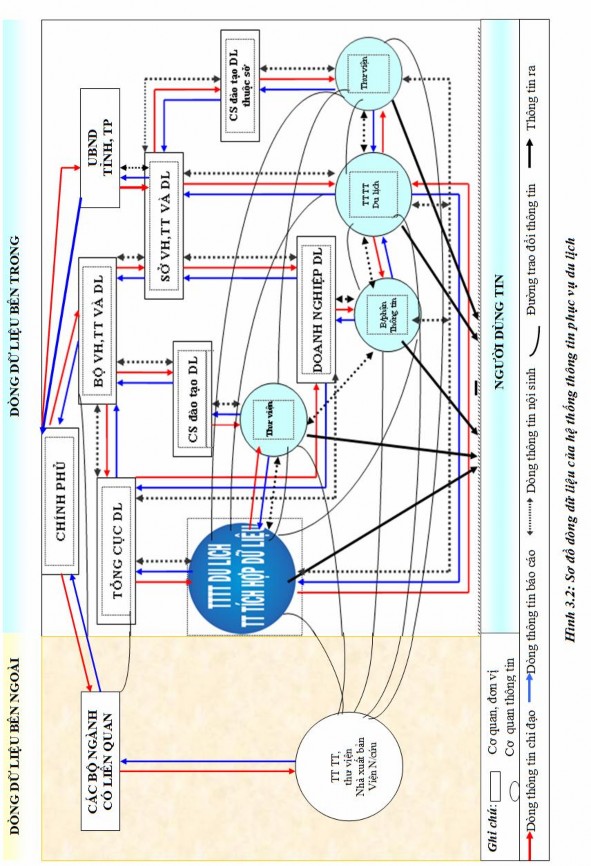
Tourism businesses, tourism participants, tourists, etc. Directive information is communicated and disseminated to units and individuals to implement tourism policies of the state and localities; that is information on laws, directives, resolutions, and guiding circulars, aiming to guide processes and procedures in tourism activities in accordance with common goals.
Reporting information (data flow from bottom to top): Data flow from lower level units to higher level units. Lower level units are responsible for collecting and processing information for internal work, and are also responsible for synthesizing reports to direct superiors. Reporting information is mainly statistics on the number of tourists, tourism staff, tourism revenue, quality of accommodation facilities, etc.
Endogenous information (horizontal data flow) is edited and published by units in the industry to serve tourism activities, tourism propaganda and promotion activities such as information: strategies, topics, projects, theses, textbooks, plans, reports, tourism products and services, tour prices, tourist destinations, tourist routes, etc.
- External data flow : This is understood as the data flow about tourism, related to tourism and tourism management, edited and published by units outside the tourism industry, moving to units within the industry (horizontal data flow), including:
Maybe you are interested!
-
 The Impact of Accounting Information System Quality on Operational Performance
 -
 Benefits of Bank Credit Information System
 -
 Solutions for developing application information systems in the current Vietnamese banking system - 17
 -
 Identifying and controlling factors affecting the quality of accounting information in the environment of applying enterprise resource planning system ERP in Vietnamese enterprises - 12
 -
 Brief History of the Formation and Development of Accounting Information System in Vietnam
Management and guidance information: data streams originating from non-tourism management agencies such as culture, diplomacy, police, customs, transportation, environmental management, providing data/information on guiding documents on immigration procedures, baggage declaration, environmental landscape, business licenses, sightseeing; standards for tourist transport vehicles... This is a horizontal data stream that is very necessary for the tourism industry to plan and direct tourism development close to social reality.
Information for reference and research purposes: Data streams originating from publishing agencies, publishers; research agencies, libraries, and information centers not in the tourism industry that process and store data/information about history, geography, tourist attractions, customs and practices of ethnic groups, countries, foreign tourism information, etc.
The collected data is processed and analyzed by the information systems to create information, which is then stored in various forms in the database system.
Internal data streams and external data streams are data entering the system. Through the processing process, these input data will become output information. Output information is understood as data synthesized from input, processed by the information management agency to create purposeful and meaningful information for users. Output information ensures quick lookup of an object of interest. Information search tools and procedures may vary, but output information must be accurate and fast. Based on the user's search request, the information management agency/system will analyze and provide search results that match the needs.
With the hierarchical structure and data flow as above, it shows that the information systems in the system are closely related and interact with each other, they rely on each other, depend on each other, the change of one unit will lead to the change of all other units in the system, making the data management system manifest itself as a unified "unity", creating unity and synchronization in the system. ( Data flow in the data management system is described in Figure 3.2, p.119 ).
3.1.3. Operation mechanism of tourism information system
It can be said that structure is the core part that creates the framework of the system, data is the nutrients that ensure the system exists. However, for the HTTTDL to operate, it needs a mechanism that clearly defines the functions, tasks, powers and obligations of each level, each CQTT. In other words, the mechanism is the interaction between CQTT in the system, it is shown through the decentralization in management and operation as well as the coordination with each other in the HĐTT to ensure the system operates and develops. This is shown as follows:
3.1.3.1. System management and operation mechanism
System management and operation is an essential activity to ensure synchronous coordination between units in the industry to achieve the set goals. Based on the state's tourism development orientation, from the current reality of the industry's organizational structure
tourism, and from the structure of the system, the management and operation of the tourism system is divided into three levels as follows:
* Central management level : Has the authority to manage, organize, direct and solve major issues of the system, specifically as follows:
Management agency : Government, Ministry of Culture, Sports and Tourism, General Department of Tourism
Government: Issue directives, resolutions, circulars to guide and direct the implementation of the National Tourism Administration nationwide.
Ministry of Culture, Sports and Tourism: Unify state management of tourism information nationwide, issue mechanisms and policies on tourism information to ensure consistency and synchronization throughout the industry, direct units to develop programs, projects and plans in accordance with their functions and tasks to meet the general technical requirements of the entire system; clearly identify the agency coordinating the activities of the entire system as the General Department of Tourism and sanctions for entities participating in the system.
General Department of Tourism: Develop a strategy for developing the tourism information system and implement an implementation plan to submit to the Ministry of Culture, Sports and Tourism, propose and recommend to competent state management agencies to implement necessary solutions for the tourism information system to operate, directly manage and direct the tourism information center under the General Department of Tourism.
Information agency:Tourist Information Center of the General Department of Tourism
The center is the brain of the system, the data integration center of the industry. In addition to its existing functions (see section 2.1.1), the center is also responsible for organizing, directing, operating the entire tourism information system, providing professional and technical advice, providing professional guidance and information management in the entire industry; building a model and a network to support tourism information nationwide; being the focal point for organizing, building and managing the shared database of the tourism industry to meet the information retrieval needs of agencies, units and investors, receiving information from the provincial and municipal tourism information centers; supporting and controlling the information activities of subordinate units; being the focal point connecting the tourism industry's information network with the information networks of the Government, ministries and relevant sectors; building national-level information products.
* Management level of provinces and centrally-run cities: has the authority to manage, organize, direct and resolve issues related to tourism activities according to the orientation of the industry, according to the tourism development policy of the province or city specifically as follows:
Management agency : People's Committee of province, centrally-run city, Department of Culture, Sports and Tourism.
People's Committees of provinces and centrally run cities: Direct and issue documents on mechanisms and policies for tourism cooperation within the province and city; clearly identify the agency coordinating tourism cooperation and sanctions for entities participating in tourism cooperation, which is the Department of Culture, Sports and Tourism.
Department of Culture, Sports and Tourism: Develop strategies and implement plans to manage tourism activities and submit them to the People's Committees of provinces and cities, directly manage and direct tourism centers under the department.
Information agency : The Tourism Information Center is under the Department of Culture, Sports and Tourism, and is also under the information management of the Tourism Information Center under the General Department of Tourism. In addition to its existing functions and tasks, the center also has the task of directing, providing technical advice, and guiding information operations for information departments (library, information center, network administration and operation department, etc.) in grassroots units located in the province or city; supporting and controlling the Tourism Information Center of the province or city; being the focal point for building, storing data, editing and publishing tourism products in the province or city, managing and exploiting data warehouses with local characteristics.
* Base unit level
Including research institutes, training facilities, and tourism businesses directly directing the information department at the unit.
- Libraries/IT/network management and operation departments of grassroots units are under the direct direction of the unit and are also under the management and supervision of the IT activities of the local IT center. These information departments are responsible for collecting, processing and providing information to directly serve the unit's activities, providing information and supporting coordination with the provincial and municipal IT centers to build information products at the provincial, regional and national levels.
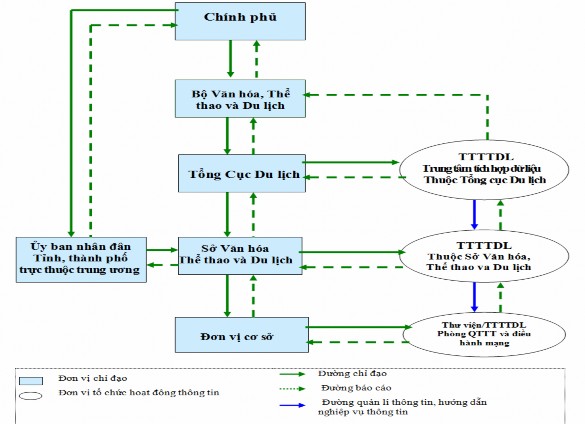
Figure 3.3. Diagram describing the management and operation mechanism of the tourism information system
With the above management and operation mechanism [Figure 3.3], the Tourism Information System will ensure operations in accordance with the direction of the Government and the tourism industry, ensuring the decision-making power of the central level, the initiative of the provincial and centrally-run city levels, and the autonomy of grassroots units, thereby ensuring technical unity and synchronization, easy control of information and tourism information systems throughout the system.
3.1.3.2. Mechanism for unified coordination of information activities
The unity of operations among the CQTTs in the system is not only reflected in the management and operation mechanism but also in the coordination and unification of the HĐTT through long-term and annual plans. This is shown as follows:
1) Unify the mechanism for collecting and processing data/information
To update the system regularly, ensure reliability and consistency in content, the tourism industry should build a computer-based data transmission network.
Internally, the units of the industry issue legal documents requiring the units to periodically provide information to the same-level information management agency. The information management agencies are responsible for selecting, processing and providing information to the directly superior information management agency. In addition, the Tourism Information Center under the General Department of Tourism connects with the information centers of ministries and sectors related to tourism management to collect and exchange information according to the content agreed by both parties. With each different type of data/information, the collection and processing of information is also different:
- For tourism management information
+ Directive information: Tourism management agencies at all levels review the tourism document system, documents that have expired or are no longer appropriate must be suspended, abolished, replaced, amended, supplemented or issued new documents to ensure constitutionality and legality. These agencies are responsible for designing clear forms, consistent between the tourism industry and relevant ministries, completing licenses and signs for each tourism activity sector, allowing data to be synthesized and analyzed by management level, or by content appropriate to tourism indicators. Units issuing documents and forms transfer this information to the same-level tourism management agency for collection and processing.
+ Reporting information: Unify reporting forms and build an automatic reporting regime with regulations on the subjects of implementation, scope, report content, period, implementation deadline, especially focusing on reporting according to tourism statistical indicators.
With the basic statistical reporting regime: Applied to basic units to provide information on tourism indicators, collected from initial recorded data according to a unified form system and reported to local state tourism management agencies, units send periodic data reports for management agencies to synthesize data.
With the general statistical reporting regime: Applied to the Departments of Culture, Sports and Tourism to provide information on the situation of local tourism activities, synthesize statistical information from basic statistical reports. Results of statistical surveys and other information sources according to a unified form system, compile a system of tourism statistical indicators within the country.
Tourism statistical indicators are assigned to the General Department of Tourism to be responsible for synthesizing from basic statistical reports and general statistical reports. The data integration center processes them into a tourism statistical database, periodically updating information including the following groups of indicators:
Group of indicators reflecting the role of the tourism industry : Number of domestic tourists, average spending per Vietnamese tourist going abroad, total revenue from international tourists, total revenue from domestic tourists, number of workers directly involved in tourism activities, periodic reports compiled once a year.
Group of indicators reflecting tourism business activities: Room occupancy rate and revenue of ranked tourist accommodation establishments, number of visitors served by travel agencies and tour operators, number of visitors served by tourist areas and spots. Reports are made periodically every quarter.
Group of indicators reflecting the operational capacity of the tourism industry: Number of ranked tourist accommodation establishments, number of licensed travel agencies and businesses, number of licensed tour guides, number of tourist areas and spots serving visitors. Reports are made every 6 months.
Group of indicators reflecting tourism investment and development activities : Investment in tourism promotion, investment capital for tourism activities, number of new tourism investment projects, new tourism investment capital. Reported periodically once a year.
Tourism statistical report data is collected from the grassroots units to the Departments of Culture, Sports and Tourism, the General Department of Tourism synthesizes reports to the Ministry of Culture, Sports and Tourism in the form of tables, charts, and statistical methods are implemented according to the formula for calculating the indicators specified in Decision No. 5139/QD-BVHTTDL dated December 28, 2012 of the Ministry of Culture, Sports and Tourism " Regarding the promulgation of the system of statistical indicators for the culture, sports and tourism sector" [12]. Data is synthesized and processed through management levels. To ensure accurate data and avoid duplication, statistical work needs the support of software. The software is built on the principle of automation, ensuring the relationship between the functions and tasks of units in the sector and tasks.