
This is difficult to determine, the calculation period can be taken as the lowest common multiple of the life spans of construction machines, or as the life span of the construction machine with the largest index. However, the calculation period should not be taken too long to avoid inaccurate predictions compared to the fluctuating situation of the market and the progress of construction techniques.
The number of types of machinery and the quantity of each type can be large, and machinery may have to be replaced midway through its life. This machinery system must be optimally combined.
Since machines must be replaced when they reach the end of their useful life, the capital investment in purchasing machines may arise at intermediate points in the cash flow. Therefore, the cash flow may change sign many times and the application of the internal rate of return will encounter many difficulties.
Specific case
Maybe you are interested!
-
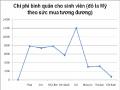
 Compare Annual Expenditures for Education Based on Purchasing Power Parity
 -
 Which of the following information channels did you get your knowledge about business management (corporate governance) from? (You can choose more than one option)
 -
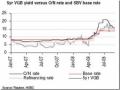 Compare Listed and Trading Bond Values at Hanoi Stock Exchange
 -
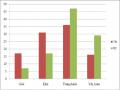 Compare Test Scores Between the Experimental Class and the Control Class
 -
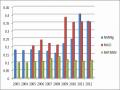 Compare Vietnam's Loan-to-Deposit Ratio to Some Other Countries
The case of establishing a business to carry out a multi-year construction contract is a specific case, because the construction task has been affirmed for the construction enterprise.
In this case, cash flow must be determined on the basis of the construction schedule design, which indicates sales (estimated construction value according to the contract), costs, construction machinery and labor requirements for each year of construction.
The financial and socio-economic analysis here is similar to that when analyzing investment projects for individual construction machines, but with one difference:
The calculation time here is not the life of individual machines but the construction time of the project.
Construction machinery can be of many types and often has to be brought into or taken out of the construction process. Therefore, the cash flow changes sign many times; construction machinery is not used up completely for the construction process, so the method of calculating the investment capital for purchasing construction machinery for the construction process
The construction process is different from the case of establishing an investment project to purchase individual construction machinery.
2.3.3. Compare the option of importing machines with the option of domestic production
Here, the issue is considered from the following two benefit perspectives:
Compare options from the perspective of a machine manufacturing enterprise
The core issue for domestic machinery manufacturing enterprises in this case is to affirm their competitiveness against imported construction machinery. To do so, machinery manufacturing enterprises must carry out investment project preparation steps according to current regulations, including the following main tasks:
Establish an investment project to build a construction machinery manufacturing factory, in which it is necessary to confirm the number of machines that can be sold annually despite the pressure of imported goods, as well as to confirm the effectiveness of the project.
At the same time, it is necessary to establish an investment project to purchase a specific construction machine that will be manufactured by the factory, in which it must be compared with a machine of the same type but imported. The purpose of this is to convince construction enterprises to buy domestically produced machines.
Make recommendations to the State on policies to encourage or require the use of domestically produced construction machinery, especially in cases where domestically produced machinery has proven to be significantly more effective than imported machinery.
In the socio-economic analysis section, it is necessary to explain the effectiveness of using domestic machinery, especially the contribution to reducing unemployment, saving foreign currency, and enhancing economic independence.
Compare options from the perspective of construction business benefits
In this case, construction enterprises must prepare investment projects for two options: purchasing domestic construction machinery and importing construction machinery according to the method in sections 3.2, 3.3, chapter 3.
Imported construction machinery often has the advantage of being of better quality, but the disadvantage is that it requires large investment capital, must use foreign currency and does not encourage domestic production. Domestically produced machinery has the advantage of requiring small investment capital, does not use foreign currency, contributes to stimulating domestic production and thus contributes to solving unemployment better, but at the same time, domestically produced machinery often has lower quality. The choice of option here must be based on the financial efficiency criteria of the enterprise, taking into account the socio-economic benefits brought about by using domestic goods.
If a construction enterprise wants to manufacture machines domestically and ensure that it can sell most of its products, it must establish an investment project for a construction machine manufacturing factory and an investment project for the construction machines it intends to manufacture based on comparison with the construction machines it intends to import. If the above investment projects are both more effective, then the domestic production option is reasonable.
2.3.4. Comparison of self-purchase and rental options
In construction, finding work largely depends on the ability to win bids. In the case of not finding work and purchasing too much construction machinery, enterprises will face the risk of losses due to capital stagnation. On the other hand, if there are not some necessary machinery and equipment, construction enterprises will have difficulty in bidding. Therefore, the comparison of self-purchased machinery and renting machinery must be based not only on financial efficiency, but also on standards to ensure the reputation of the construction enterprise in participating in bidding in the construction market, as well as on the bidding regulations and capital regulations of the enterprise.
When comparing options here, the following cases must be distinguished:
When making an investment project to establish a construction enterprise, with the construction machinery needed for the annual construction process of the enterprise according to the forecast, if they have too little annual construction work volume due to the structure of the work volume required to make the finished product,
We need to consider whether these construction machines can guarantee an annual output greater than the break-even output. If this condition is not guaranteed, the business should rent the machine (if the rental conditions are guaranteed).
When setting up an investment project to carry out a construction process that lasts for many years, we must base on the construction progress design to determine which machines do not guarantee the break-even output as well as the expected profit target when signing the contract if purchased by ourselves. Any machines that violate these conditions should be rented.
When comparing options to carry out a specific short-term construction process, the comparison of options here is mainly based on profit and cost indicators. The option of self-purchasing machines here is stipulated that the machines are fully used during the year not only for the construction work under consideration but also for other projects.
2.3.5. Method of preparing investment project for purchasing construction machinery for rental
In a market economy, construction enterprises are allowed to operate nationwide, so it is necessary to develop enterprises specializing in renting construction machinery everywhere to facilitate construction enterprises to operate easily, reducing the need for investment capital to purchase construction machinery for enterprises.
When making an investment project in this case, the following points should be noted:
Regarding the project content , it is similar to when establishing an investment project for purchasing construction machinery, including important points such as:
Research the market demand for construction equipment rental.
Select the type and quantity of construction machines to buy for rent.
Choose a location to rent the machine.
Determine the need for technical facilities to store machines, maintain and repair (if any).
Management and human resources structure.
Financial and socio-economic analysis of the project.
Regarding the method of calculating efficiency, the calculation formulas are similar to sections 3.2 and 3.3 in chapter 3, but are more complicated because there may be many construction machines purchased for rent. The calculation time here can be taken in two ways:
Taken according to the life of the entire machine leasing enterprise. In this case, the machine can be replaced halfway due to the end of its specified life. The calculation time here can be taken as the life of the machine with the largest index, or taken as the smallest common multiple of the lives of the machines. The project's cash flow here is the sum of the cash flows of the individual machines.
For each construction machine, we establish a separate project and therefore the calculation period is taken as the life of the machine. In this case, common costs for the whole enterprise must be allocated to each machine depending on the annual sales of each machine according to the estimate to establish the cash flow.
Regarding investment capital, this indicator may be larger than in the case of purchasing individual construction machines, because in addition to the warehouses for storing the machines here, there may also be a need for capital to build other storage and repair facilities.
CHAPTER 3: CRITERIA FOR EVALUATING INVESTMENT PROJECTS IN PURCHASING AND EQUIPING CONSTRUCTION MACHINERY
A project is considered very good when it must generate absolute profit - that is, the largest amount of net wealth; have a high rate of return - at least higher than the interest rate or the desired rate of return or the average discount rate of the industry or market; low break-even volume and revenue and the project must quickly recover capital - to limit unexpected risks.
Based on that simple and common thinking, there are corresponding criteria to evaluate the effectiveness of investment projects in purchasing and equipping construction machinery.
3.1. SYSTEM OF INDICATORS FOR EVALUATING CONSTRUCTION MACHINERY OPTIONS
To evaluate and select construction machinery in the purchasing stage, people often use a system of criteria consisting of 3 main groups:
Economic indicators group (or economic and financial)
Group of indicators on technical level and functionality
Social indicators group
The first group of indicators includes mainly value indicators, the remaining two groups of indicators are mainly indicators of use value.
3.1.1. Group of financial and economic indicators
3.1.1.1. Financial and economic performance indicators
Financial performance indicators
These indicators reflect the interests of the business, including:
Static indicators (calculated for one year)
Cost per unit of machine product.
Profit calculated for one unit of machine product.
Profit level of one capital invested in buying a machine.
Time to recover capital for purchasing the machine.
Dynamic indicators (calculated for the entire machine life)
Income-expenditure ratios, including: Present value of income-expenditure ratio (NPW); Future value of income-expenditure ratio (NFW) calculated for perfect and imperfect capital market conditions; Annual smoothing value of income-expenditure ratio (NAW).
Payback period is calculated based on the dynamic NPW index.
Rate of return indicators: Internal rate of return (IRR); External rate of return (ERR); Explicit reinvestment rate of return (ERRR); Mixed rate of return for imperfect capital markets (CRR).
Income/expenditure ratio (B/C_BCR).
Financial safety indicators.
Safety of capital to buy machines.
Break-even point of profit and loss when using the machine.
Debt repayment ability, debt repayment quota, debt repayment period, debt repayment break-even point and break-even point when debt repayment ability begins (cash break-even).
Sensitivity of the machine purchase project.
Economic efficiency indicators
These indicators reflect the interests of the entire national economy, including:
Tax contribution to the State when using the machine.
Increased product value of the machine.
Speed up construction and the resulting economic benefits for other industries.
Improve construction quality.
Contribute to promoting the industrialization and modernization of the construction industry and other industries.
Save foreign currency.
Stimulate domestic mechanical production to develop and replace imports.
Increase the ability to compete internationally.
3.1.1.2. Cost indicators (general and per unit of product)
Financial and economic efficiency indicators play a synthetic role, while cost indicators generally play only a supplementary role (except in the case of small projects, the cost indicator for a machine product can play a role as one of the synthetic indicators for comparison). Cost indicators include:
Indicators of equipment procurement
Main indicators:
Investment capital for purchasing construction machinery.
Cost of transportation and installation of machine.
Additional indicators:
Foreign currency cost of purchasing machines.
International cooperation costs related to machine import.
Cost of training workers to use the machine (if any).
Indicators of machine operation
Main indicators
Machine usage cost.
Cost of rare materials and foreign currency for operations.
Additional indicators
Proportion of material costs, labor costs, depreciation costs, maintenance and repair costs in total costs.
Costs for moving, disassembling, investment capital for machinery and accompanying equipment related to moving and disassembling machines.
Cost for temporary construction to serve the machine (if any).
Some indicators calculated in kind such as:
Fuel and energy costs per unit of machine output. Labor costs per unit of output (labor productivity).
Machine hour cost per product (machine productivity). Rare and valuable labor cost (high-skilled workers).
Cost indicators for maintenance and repair
Cost is calculated for one repair of each type.