
+ For products of images, paintings, diagrams, and maps collected, students can design them into magazines, wall newspapers, and videos with an introduction.
- Preliminary round: Social subject teachers of each class collect and score the products, selecting the best, most beautiful and meaningful paintings, letters, and other collected products that meet the requirements of the organizing committee.
(3) Product report
- Presentation contest on paintings between classes, meeting the requirements of the organizing committee: Color, content, meaning of the painting and brief presentation.
- Writing letters: Teachers mark and announce good and quality articles and may read some good articles in front of the whole school.
- Organize a ranking contest and display students' paintings and collections during flag salute time so that all students in the school have the opportunity to participate in voting and evaluation.
(4) Evaluation, summary, awarding
- The organizing committee summarizes points and arranges awards.
- The teacher presents a summary of the basic content of the extracurricular topic.
- Award prizes to students and groups that actively participate in activities.
After announcing and awarding prizes to students, their paintings and collections will be displayed in the school yard so that all students can see and learn about the sea and island issues of the Fatherland.
Thus, through organizing competitions, students will be interested in learning about the sovereignty of the sea and islands of the Fatherland, training students in skills such as collecting and researching documents, thereby stimulating creative thinking in students. And more importantly, through knowledge about the sea and islands, it has contributed to educating students about the issue of protecting the sovereignty of the sea and islands of the Fatherland in the new era.
103
help children realize the role and mission of young people towards the country's sovereignty over seas and islands.
2.4. Pedagogical experiment
2.4.1. Purpose and experimental subjects
Experimental purpose
- Affirm the correctness and appropriateness of educating awareness of national sea and island sovereignty for 12th grade students.
- Through experimental teaching, use test results and feedback from teachers and students to analyze and determine the effectiveness of educating students about the country's sovereignty over seas and islands in teaching history for grade 12.
- It is an important basis for us to draw conclusions about the use of methods and documents to educate students about the sovereignty of the sea and islands of the Fatherland in teaching History to high school students.
Experimental subjects
We chose Tran Hung Dao High School, Ha Dong District, Hanoi as the place to conduct the experiment.
After researching the students and consulting with subject teachers, we selected the following experimental classes:
Class 12A5 is the experimental class, class 12A7 is the control class. These classes were selected to conduct the experiment based on the principle: equal quality and level of subject awareness, with a not too different number of students.
deviated .
2.4.2. Experimental content
We conduct an experiment on Lesson 23: Restoring and developing the socio-economy in the North, completely liberating the South (1973 - 1975) (Lesson 2)
Grade 12 standard program.
The experimental content includes the following basic tasks:
104
Prepare 2 lesson plans, 2 types
Type 1: Experimental lesson plan, using documents on the sovereignty of the sea and islands of the Fatherland to educate students' awareness as proposed in the thesis (Appendix 3).
Type 2: The control lesson plan is prepared and taught using the normal method without using documents on the sovereignty of the sea and islands of the Fatherland with the two archipelagos of Hoang Sa and Truong Sa.
Check the quality by giving students in the control and experimental classes a quick test and a student opinion survey after the lesson (Appendix 4, Appendix 5).
2.4.3. Experimental results
After the experiment, we conducted a knowledge test and surveyed students' opinions about the experimental lesson.
About knowledge:
The students' understanding of the lesson is shown in the test results through the excellent and fair scores of the experimental class being higher than the control class, shown in the summary table below:
Table 2.1. Summary table of test scores between experimental class and control class
Class
Excellent Score 9-10 | Good Score 7-8 | Average score 5-6 | Weak Points <5 | ||
TN Class (42hs) | Quantity | 7 | 13 | 15 | 7 |
Ratio % | 17% | 31% | 36% | 16% | |
DC Class (42hs) | Quantity | 3 | 7 | 20 | 12 |
Ratio % | 7% | 17% | 47% | 29% |
Maybe you are interested!
-
 Statistics of 1-Period Test Scores of Grade 10 Students at Some High Schools in Bac Kan Province.
 -
 Absolute growth rate of experimental chickens over weeks of age
 -
 Compare Annual Expenditures for Education Based on Purchasing Power Parity
 -
 Test Results of Optimal Mode Effect on Mechanical Properties
 -
 Preliminary Test of Reliability of Scale in Research Model
Good scores are those that answer correctly, but not fully, with scores from 9 to 10.
105
Fairly good essays are those that answer correctly, but do not include all the ideas, with scores ranging from 5 to 6.
Weak essays are essays that do not answer 50% of the questions correctly and have a score below 5.
Through table 2.1, based on the results of pedagogical experiments through data processing, we see that: the learning quality of students in the experimental class is always higher than that of students in the control class, shown by the following specific results:
In the experimental class, most students answered the given questions relatively well, so the percentage of students with good scores in the experimental class was 17% (10% higher than the control class); the percentage of good scores was 31% (14% higher than the control class); the percentage of average scores was 36% (while this percentage in the control class was 47%); only 16% of students had poor scores (29% in the control class).
To specify the difference in learning outcomes between the experimental class and the control class, we can represent it through the following diagram:
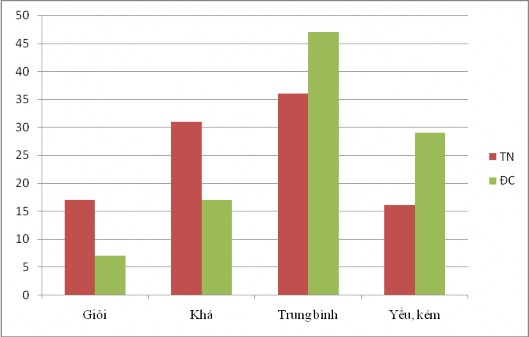
Chart 2.1 Comparison of test scores between experimental class and control class
Thus, through the two statistical tables and comparison charts above, we can easily see the difference in test results between the two control classes and
106
Experimental. In the control class, without using educational materials on sovereignty over the sea and islands with the two archipelagos of Hoang Sa and Truong Sa, most of the students could not choose the correct answer and could not generalize the basic knowledge. Therefore, the test results were not high: The percentage of excellent scores was 7%, the percentage of good scores was 17%, the percentage of average scores was up to 47%, the percentage of weak and poor scores was also quite high at 31%.
The test results showed that with the documents on the sovereignty of the sea and islands of the Fatherland prepared and provided by teachers to educate students in History class, it helped them understand more about the sovereignty of the sea and islands of the Fatherland today, thereby helping them understand the responsibility of the younger generation in protecting the sea and islands of the Fatherland. The students understood the lesson, understood the requirements of the test and answered relatively completely.
About skills
Skill training is one of the three most important goals of a lesson. With the conventional teaching method in the control class, most of the students' activities are following the textbook and answering the teacher's questions. The teacher does not organize and stimulate the content about the sea and islands, so the students cannot develop their learning ability and initiative.
Through analyzing data collected from student information questionnaires after experimental teaching hours, we obtained the following results:
All students showed interest in the lesson, 87% felt they understood the lesson, 92% of students said that the lesson was interesting because of the way the teacher expanded their knowledge about the sea and islands. After participating in learning activities about the sovereignty of the sea and islands of the Fatherland, 43% of students achieved the goal of equipping themselves with more knowledge about the sovereignty of the sea and islands of the Fatherland, 38% said that they need to try harder to study to contribute to the cause of building the country, protecting the territorial integrity of the Fatherland. As for the effects of knowledge about the sovereignty of the sea and islands of our country, the majority of students, 59%, said that it helps educate students as well as
107
young generation about the awareness of respecting and protecting the sovereignty of the sea and islands of the Fatherland. 34% said that it helps students expand their knowledge and learn more information about the country's sea and islands.
Thus, through the lesson using documents on sovereignty over seas and islands for teaching, it has helped students to access documents that are not mentioned in textbooks. Through that, students are aware of the role of students and the young generation in the work of protecting the sacred sovereignty of the Fatherland.
About attitude
A positive learning attitude is the result of interest and passion for learning. 66% of students said that the lesson when the teacher expanded information about the sovereignty of the sea and islands of the Fatherland was more interesting, with more information about the sea and islands of the Fatherland. 30% of students said that it was easier to understand than the textbook. When asked about their wishes for teachers to educate students about the awareness of the sovereignty of the sea and islands of the Fatherland, 35% of students said that teachers should actively guide and provide documents about the sovereignty of the sea and islands for students to have the opportunity to access. 40% of students wanted to participate in extracurricular activities and the remaining 25% of students wanted to participate in presentations and debates about past and present sea and island issues. It can be said that the issue of educating students about the sovereignty of the sea and islands of the Fatherland has received some attention from the majority of students. They also want to understand more about the sea and islands of the Fatherland, thereby propagating to relatives and friends to contribute to protecting the country's sovereignty.
108
CHAPTER 2 SUMMARY
Based on the research and analysis of the objectives and content structure of the 12th grade History textbook, we identify some educational contents on the awareness of the sovereignty of the sea and islands of the Fatherland for students in teaching 12th grade history in high schools.
Chapter 2 has pointed out some measures to educate students about the sovereignty of the sea and islands of the Fatherland in teaching history for grade 12 in high schools.
In addition, teachers need to invest more in the process of designing educational activities on the awareness of national sovereignty over the sea in their lessons, especially extracurricular activities, so that they not only aim at knowledge goals, but also discover and foster students' History learning abilities.
Along with providing more information about the sovereignty of the sea and islands of the Fatherland to students in History teaching, the activities also increase the positivity and initiative of students. Students are aware of their role in the learning process. The concept of relying on teachers is gradually eliminated, replaced by the awareness of self-study, self-discovery, self-setting of goals and striving to achieve them based on the comments, guidance of teachers and support tools.
109
CONCLUSION AND RECOMMENDATIONS
1. CONCLUSION
The results of theoretical and practical research on educating students on the awareness of national sovereignty over seas and islands in teaching history in grade 12 high schools are the basis for drawing the following conclusions:
1. For Vietnam, the East Sea plays an important role in the cause of building and defending the Fatherland in the past, present and future. Reclaiming the sea to expand the territory and using the sea to defend the country is a unique feature of Vietnam in the process of fighting and defending the Fatherland. It is also the cultural identity that Vietnam needs to preserve and promote further in the era of science and technology, globalization and international integration. Therefore, in educating students about sovereignty over seas and islands in high schools, the position and role of History is extremely important.
2. In the practice of teaching history in high schools, the issue of sovereignty over the sea and islands of the Fatherland has been known to teachers and students, however, teachers need to have measures as well as forms of organization to make teaching and learning about the issue of sovereignty over the sea and islands effective. Documents on Vietnam's sovereignty over the sea and islands, especially for the two archipelagos of Hoang Sa and Truong Sa, have also been published a lot, teachers need to choose reliable sources of documents to guide and provide information to students, thereby stimulating their exploration and learning to increase their initiative and self-awareness.
3. The topic also proposed a number of measures to educate students about the sovereignty of the sea and islands of the Fatherland in the internal lessons such as using reference materials on the sovereignty of the sea and islands, using literary materials, visual aids such as documentaries, paintings, photos, maps... and in the extracurricular lessons such as listening to history stories, organizing exhibitions of pictures, documents, designing and displaying wall newspapers about Vietnam's sea and islands, launching competitions to learn and create about the sovereignty of the homeland's sea and islands. The above measures are completely suitable in teaching History. In addition, if implemented according to the measures
110