
socialism
Through lessons and sections related to sea and island sovereignty in the curriculum, we will use teaching methods and documents on sea and island sovereignty using pedagogical methods to highlight and help students deeply perceive the following main issues:
First: Historical evidence and legal basis affirm Vietnam's sovereignty over the Hoang Sa and Truong Sa archipelagos from 1956 to 1975.
Second: Some issues of sovereignty disputes over seas and islands in the East Sea between Vietnam and other countries in the region.
Third: The economic and social values and potentials of the sea and islands for national construction and development.
Maybe you are interested!
-

 Research on determining varieties and some technical measures to increase productivity and economic efficiency in tomato production in the Red River Delta - 1
 -
 Some Basic Requirements for Secondary School Teachers When Organizing Experiential Teaching of History
 -
 Basic Features of Exoneration Measures in Vietnamese Criminal Law
 -
 Basic Contents of Revenue Accounting and Determining Business Results.
 -
 Basic Requirements for Ecotourism
Fourth: Educate awareness of protecting sea and island sovereignty.
Students not only realize the extent of the country's sovereignty over the sea and islands, but also realize the struggle to protect the sovereignty of the sea and islands of the Fatherland. That is to fight by peaceful means such as negotiation, diplomacy and application of international law on the basis of the rule of law, responding to the peaceful aspirations of the Vietnamese people and the international people.
Faced with developments in the world and domestic situation, especially in the face of sabotage by hostile forces, the 12th Party Congress affirmed: "Resolutely and persistently fight to maintain the independence, sovereignty, unity and territorial integrity of the Fatherland". Our Party emphasized the goal and requirement of protecting national and ethnic interests; putting national and ethnic interests at the top position; in which affirming the determination, "resolutely and persistently" fighting to maintain the sacred sovereignty of the sea and islands of the Fatherland; not allowing the country to be passive, surprised, not losing land, islands, or people:
63
Firstly, strengthen propaganda and education to raise awareness more fully and deeply about the goals, requirements and tasks of protecting the Fatherland in the new situation. The documents of the 12th National Party Congress emphasize the need to be calm, clear-headed, proactive, creative, resolute and persistent in resolving disagreements and disputes over national and ethnic sovereignty and territory by peaceful means to maintain and preserve national and ethnic interests, considering peace the highest value. At the same time, it is clearly stated that it is necessary to be proactive and actively prepare in all aspects to have good strategies and successfully respond to other situations that may arise, when peaceful negotiation and bargaining measures are no longer effective. Therefore, it is necessary to step up research, forecasting, grasp the situation, and promptly propose to the Party and State appropriate policies for each partner, object and each possible situation.
Second, if in the past, we only emphasized the combination of national defense and security with economy and economy with national defense and security, the 12th Congress requires the close combination of economy, culture and society with national defense and security and national defense and security with economy, culture and society. This is a practical solution to resolve the relationship between building and protecting the socialist Fatherland. This combination needs to be implemented in every strategy, planning and socio-economic development, and needs to be resolutely and persistently implemented in all regions of the Fatherland, focusing on large cities, remote areas, border areas and islands.
Third, it is necessary to build a national defense posture associated with building and consolidating a people's security posture, building a people's heart posture, especially in key strategic areas, large cities, remote areas, border areas, seas and islands. Adjusting the posture, arranging combat forces is increasingly reasonable and more effective; building a people's security posture, a people's heart posture has developed steadily. As a result, national security, social order and safety are maintained, proactively preventing and preparing well for all plans, successfully dealing with all possible situations.
64
Therefore, in some hot spots, important and strategic areas, national security, social order and safety have gradually stabilized. Thanks to that, the national defense and security potential has been increasingly consolidated, gaining the trust, support and assistance of the people. This is the basis for us to firmly protect the Socialist Republic of Vietnam in the new situation.
2.2. Basic requirements when determining measures to educate students about the sovereignty of the sea and islands of the Fatherland in teaching History grade 12 - standard program
2.2.1. Correctly identify the basic knowledge that needs to be taught
Based on the general training objectives and the role and significance of the subject, teaching History in high schools must provide students with systematic basic knowledge about the history of the development of the nation and human society in accordance with the laws. On that basis, educating students with correct thoughts and feelings (beliefs, ideals, national traditions, patriotism, gratitude, respect for predecessors, etc.) and training cognitive abilities, action abilities, skills, and techniques. That is, the History subject in high schools must perform three tasks: fostering awareness, educating ideology, moral feelings, and developing students. Therefore, correctly identifying basic knowledge in the subject program is an important requirement for effective teaching of History. Adhering to the goals and content mentioned in the process, the standards of knowledge and skills to be achieved will help teachers determine what needs to be taught and how to teach it. In which, textbooks are the main documents for teachers to use in the teaching, testing, and evaluating students' learning outcomes and are the main documents for students to study.
Regarding the content of the sovereignty of the sea and islands of the Fatherland, the amount of information is also extremely rich and massive. However, not everything must be provided to students or guided for students to exploit in class.
65
carefully selected, it must be knowledge that directly serves the lesson and is consistent with the general concept of today's society.
2.2.2. Suitable for the characteristics and psychology of school-age children
Each age group of students has different psychological characteristics. According to researchers, high school students in general and grade 12 students in particular are young people, their intellectual development or thinking ability has changed strongly and rapidly in a positive direction, independence and strong development of logical thinking. They have the ability and are very fond of generalizing problems. The strong development of logical thinking of high school students is closely related to creativity. Thanks to the ability to generalize, they can discover new things by themselves. They appreciate and respect smart friends and teachers with positive teaching methods, respect students' independent thinking, criticize the constraints and mechanics in pedagogical methods […..]. This characteristic is different from that of primary school students and secondary school students. For primary school students: Primary school students' perception and evaluation of space are not yet accurate, especially for objects that are too large or too small. For time symbols, perception is still limited. Concepts such as century, decade... are still very vague and abstract; the ability to think in general is only at the beginning stage of formation... As for secondary school students, compared to primary school students, all aspects of their psychology, emotions, and cognition have developed to a new level, with deeper and more typical differentiation. The characteristic of thinking at this stage is that students are aware of their own intellectual operations and can control them. This is also a characteristic of other psychological phenomena. However, the types of reasoning, analysis, and formal thinking are still at the beginning stage, not yet complete and at a lower level than that of high school students.
Therefore, when teaching, teachers must clearly understand the psychological characteristics of different students to apply appropriate teaching methods. However, at any time, with any subject, creativity is needed.
66
Promoting students' positivity and initiative is even more necessary for high school students.
2.2.3. Ensure specificity, imagery, and rich historical symbolism
Based on the law of perception and the characteristics of historical perception, which is to go from vivid intuition to abstract thinking, therefore, when teaching History, ensuring specificity, richness in images, and historical symbols is extremely important. It not only helps the lesson become more vivid but also actively supports the cognitive process of students. Specificity and richness in symbols are formed in many different ways. In teaching History about the sovereignty of the sea and islands of the Fatherland, to create symbols for students, concretize events and overcome the state of historical modernization in students, teachers can use reference materials such as historical documents, literary documents, documents of the Party, State, works of Ho Chi Minh, etc.
Selected events and specific figures that illustrate the lesson content can also be quite effective. Through these materials, students can also perceive the importance of our people's struggle.
Example 1: When teaching section IV.1, lesson 23: Restoring and developing the socio-economy in the North, completely liberating the South (1973-1975) - learning about the reasons for the victory of the resistance war against the US to save the country, including the role of the Northern rear in the resistance war against the US during this period, teachers can provide the following rich visual materials about the legendary Ho Chi Minh trail at sea: "Thus, during the 15 years of carrying out the task of strategic military transport at sea (1961 - 1975), Group 125 mobilized 1,879 ships and boats, transporting 152,876 tons of weapons, technical equipment, medicine and 80,026 officers and soldiers from the North to the South, fighting hundreds of battles with US aircraft and warships and the Saigon army.
67
With its achievements, the 125th Naval Group was honored by the Party and State twice as a Hero of the People's Armed Forces (in 1967 and 1976), 5 Military Exploit Medals, 12 War Exploit Medals. 5 ships and 8 individuals were honored as Heroes of the People's Armed Forces". (Based on: Major General, Associate Professor, Dr. Vu Quang Dao (2011) Ho Chi Minh Trail at sea - a unique creation of the people's war in the resistance war against the US, saving the country. Communist magazine ( http://www.tapchicongsan.org.vn ), November 8, 2011)
From the above documents, students can perceive the importance of the Ho Chi Minh sea route in the resistance war against the US to save the country.
To increase the effectiveness of the materials, teachers can combine the use of different types of visual aids such as: illustrations, maps, documentaries, etc.
Example 2 : The following is an image that teachers can use to clarify the fierce nature of the war to destroy the North by navy and air force, and to destroy our seas:
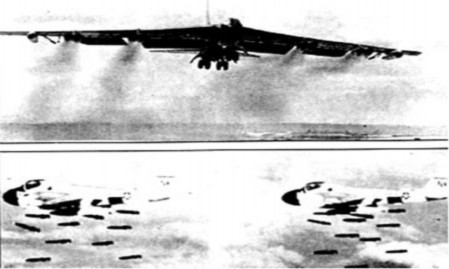
Figure 2.1. American B52 and 6A6 aircraft day and night bombed and dropped torpedoes to blockade river mouths and seaports in many northern provinces.
( Source : http://www.baophuyen.com.vn/76/91470/viec-ky-hiep-dinh-paris-va-cuoc-nem-bom-b-52-cua-my.html )
68
The teacher provides additional information combined with just the image: This is an image of the B52 aircraft considered the super flying fortress, the idol of the US Air Force and the A6A tactical aircraft that the US used in bombing the North of our country. From May 11, 1972, US aircraft continued to lay mines to block the entrances to the ports of Hong Gai, Cam Pha, river mouths and coastal areas of our country. From May 9, 1972 to January 1973, the enemy dropped mines in 8 provinces and cities in the North with 166 points, including tens of thousands of magnetic bombs, torpedoes, mines of all kinds; the blockaded area in key areas is nearly 478km, from Quang Ninh, Hai Phong to Cua Tung, Cua Viet...
Thus, by using visual images and necessary information, students were able to clearly visualize the plots and evil tricks of the US empire in this war of destruction against the North.
2.2.4. Ensuring pedagogical, scientific and ideological qualities
Teaching is a process organized according to a standard program with the aim of training people who are both red and professional for the cause of building, protecting and developing the country. In other words, any educational activity must aim at the goal of developing the personality of students. Therefore, even when organizing teaching content about the sovereignty of the sea and islands of the Fatherland for students, it must ensure the above goal. That is the top principle in education.
Pedagogical qualities are demonstrated through the activities of teachers: they must demonstrate the exemplary and disciplined qualities of a teacher who sets an example for students to follow; teaching methods ensure the promotion of students' positivity and creativity, arouse students' passion for learning, encourage self-cultivation and training in life; build a favorable pedagogical environment for students to compete, cooperate, and support each other in learning and training. In general, the teaching and learning process must ensure the goal of
69
The goal is to form in students civic awareness and the qualities of creative workers.
Scientific and ideological aspects are closely linked to pedagogical aspects in teaching. Scientific aspects are expressed through teaching tasks, teaching methods, and lecture content.
The task of teaching in general and teaching History in particular is to equip students with a system of basic knowledge about human society with the latest achievements of science and technology, close to real life; contributing to the formation of a philosophy of life, a scientific worldview, and scientific working methods for students.
When applying methods in teaching, teachers need to rely on the laws of development and psychological characteristics of students to organize appropriately and effectively. All of these bases are the results of scientific research.
Teaching in general is influenced by the directions of our Party and State. Teaching content must be consistent with the goals of the set educational levels and grades, and consistent with the Party's policies and guidelines.
Thus, above are some basic requirements when determining measures to organize teaching content about the sovereignty of the sea and islands of the Fatherland for students. Each requirement emphasizes an aspect, an aspect of the teaching and learning process. In teaching, teachers need to thoroughly understand the above basic requirements, doing so will help bring high efficiency in education.
2.2.5. Ensure to promote students' active learning, initiative and creativity
Faced with the current need for innovation in history teaching, enhancing students’ initiative and positivity is considered the key to improving the quality of history teaching. If history lessons create interest, positivity, and attraction for students, they will be motivated to learn and study on their own without the need for pressure or external influences.
70