
Solution:
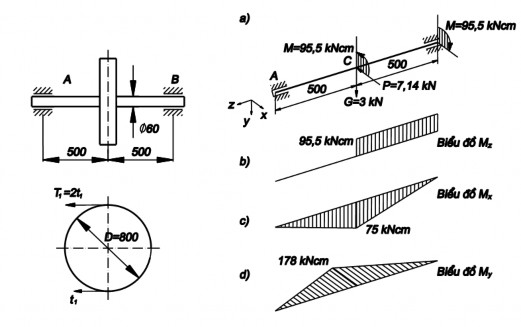
Figure 4.60
The shaft load diagram is shown in Figure 4.60a, in which:
Maybe you are interested!
-
 Applied Mechanics - 1
 -
 Applied microbial genetics - 1
 -
 Reference Values Drawn From Practice That Can Be Applied To Dak Mil District, Dak Nong Province
 -
 Local industrial development policy research applied to Bac Ninh province - 25
 -
 Fostering students' self-study ability in teaching some knowledge of Mechanics and Electromagnetism in high school Physics with the support of social network Facebook - 21
n 3.14 500 52.4 rad / s
30 30
M W
0, 955 10 3 Nm 95.5 kNcm
Belt tension is determined by the torque equilibrium condition:
M T 1 D t 1 D t 1 D
2 2 2
t 1
2M
D
2 95, 5 2, 38 kN
80
T 1 2 t 1 2 2, 38 4, 76 kN
P T 1 t 1 4, 76 2, 38 7,14 kN
Equivalent stress calculated according to the theory of shape change potential energy stability:
M 2M 2 0.75 M 2
x
y
z
M
td
td
W x
0.1d3
Dangerous cross-section at C towards CB, where:
M Gl 75 kNcm ;
x4
M Pl 178 kNcm ;
y4
M z 95.5 kNcm
The internal force diagrams are shown in figures 4.60b, c, d. Substituting the numbers in, we get:
td
9.72 kN / cm 2 12 kn / cm 2
75 2 178 2 0.75 95.5 2
0.1 6 3
So the shaft satisfies the durability condition.
4.5.5. General bearing bars
A bar is called a general load-bearing bar when its cross-section has all 6 internal force components. According to the principle of combined effects, the normal stress on the cross-section is due to the internal force components such as the longitudinal force N z , bending moment M x , My , and the shear stress is due to the internal force components such as the torsional moment M z, shear force Q x , Q y . The checking of the durability condition of a general load-bearing bar is carried out in the following order:
- Select a dangerous or suspected dangerous point on a dangerous cross-section or suspected dangerous cross-sections. The dangerous point is the point with the largest equivalent stress calculated according to a certain strength theory.
- Write the durability condition.
REVIEW QUESTIONS
1. State the hypothesis about plane cross-section. What conclusion does this hypothesis give us when studying stress on the cross-section?
2. What are the axial and transverse deformations of a tension and compression bar at the center? Expressions to calculate these deformations.
3. State the characteristics and stages of the force-elongation graph when testing tensile specimens made from plastic materials.
4. State the mechanical characteristics of ductile and brittle materials.
5. Write the strength and stiffness conditions of a circular cross-sectional bar subjected to torsion. State three basic problems corresponding to these conditions when calculating a bar subjected to torsion.
6. What cases are called pure bending, flat bending?
7. State the basic assumptions when calculating bars subjected to pure bending and flat horizontal bending.
8. Write and explain the formula for calculating normal stress and shear stress on the cross-section of a flat horizontal bending bar.
9. Explain and state the conditions for applying the principle of combined action when calculating stress and deformation of complex load-bearing bars.
10. The calculation of the maximum normal stress value on a complex cross-section of a load-bearing bar is complicated when the cross-section has any shape and when the cross-section of the bar has a special shape such as a rectangle or a circle.
11. Beam AB with rectangular cross-section b h = (0.1 0.2) m 2 , length l = 4m subjected to oblique bending as shown in figure 4.66. Ignore the weight of the beam. Let.
- Draw bending moment diagrams for beams.
- Determine the maximum stress generated at the cross-section of the bar.


Figure 4.66
12. A square cross-section column is eccentrically compressed on the y-axis. The stress at point A is 500 N/cm 2 , at B is zero. (Figure 4.67)
P x
y
DO
ABC
40 cm
10 cm
40 cm
Figure 4.67
- Ask about the load acting on the column, the eccentricity and the maximum stress on the column.
- Find the maximum normal stress value generated at the column foot. Dimensions in the figure are in cm .
REFERENCES
[1]. Do Sanh – Nguyen Van Khang. Mechanics, volume 1, 2. Education Publishing House 2004.
[2]. Associate Professor, Dr. Le Ngoc Hong – Strength of materials – Science and Technology Publishing House 2002 [3]. Do Sanh. Mechanics exercises, volume 1, 2. Vocational Education Publishing House 2000.
[4]. Nguyen Trong, Tong Danh Dao, Le Thi Hoang Yen. Theoretical mechanics, volume 2. Science and Technology Publishing House 2006.
[5]. Bui Trong Luu - Strength of materials, volume 1 - University and vocational high school publishing house [6]. Bui Trong Luu - Strength of materials, volume 2 - University and vocational high school publishing house [7]. Bui Trong Luu, Nguyen Van Vuong - Strength of materials exercises - Education publishing house 2004 [8]. Le Quang Vinh, Nguyen Van Vuong - Strength of materials, volume 1 - Education publishing house 2004 [9]. Le Quang Vinh, Nguyen Van Vuong - Strength of materials, volume 2 - Education publishing house 2004 [10]. Nguyen Van Dao - Analytical mechanics - National University publishing house, Hanoi 2002.
[11]. Nguyen Van Dao - Analytical Mechanics Exercises - National University Publishing House, Hanoi 2002. [12]. Nguyen Van Khang - Dynamics of multi-body systems - Science and Technology Publishing House, Hanoi 2006.
[13]. Thai The Hung (Editor-in-Chief) and authors - Material strength exercises - Science and Technology Publishing House, Hanoi 2005.
[14]. Dang Viet Cuong - Collection of pre-solved problems in strength of materials, Volume 1-
Science and Technology Publishing House, Hanoi, 2008
[15]. Dang Viet Cuong - Collection of pre-solved problems in strength of materials, Volume 2-
Science and Technology Publishing House, Hanoi, 2008
[16]. Nguyen Van Khang - Fundamentals of engineering mechanics - Hanoi National University Publishing House, 2005. [17]. Prof. Dr. Do Sanh - Engineering mechanics, volume 2, Dynamics - Education Publishing House, 2008. [18]. XM Targ - Concise textbook of theoretical mechanics (translated by Pham Huyen) - Hanoi University and Vocational College Publishing House and "Mir" Moscow Publishing House 1979.
[19] Dinh Gia Tuong, Ta Khanh Lam - Principles of machines , volume 1 - Science and Technology Publishing House, Hanoi 1995.
[20] Nguyen Trong Hiep - Machine details , volume 1 - Education Publishing House.
[21] Do Sanh, Nguyen Van Vuong - Applied Mechanics - Education Publishing House, 2006.