
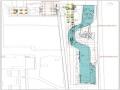
The excavation pit in 2017 identified 05 architectural vestiges of the Ly Dynasty running in the East-West direction in the excavation pit. The current status of the architectural ground of the Ly Dynasty was almost completely destroyed by the pond/lake relic of the Le Trung Hung period, leaving only a part of the base of the architectural column foundation. The vestiges of the column foundation began to appear from excavation layer 09 and excavation layer 15 in the area of the pond/lake relic that was cut and destroyed. The architectural vestiges appeared in the yellow clay layer, pure soil, tight structure and almost no artifacts. The column foundation relics are composed of gravel, bricks, tiles and yellow clay compacted together to form solid layers of reinforcing materials.
The excavation pit in 2018 discovered 03 architectural vestiges of the Ly Dynasty in the northern and southern areas of the excavation pit. The architectural ground of the Ly Dynasty was almost completely destroyed by the Le-Nguyen Dynasty relics, leaving only a part of the architectural foundation. The column foundation relics are made of gravel, ceramic materials, bricks, tiles and compacted yellow clay to form solid reinforcement layers.
- Architectural relics of Dinh - Tien Le period
Exposed ceramic cluster located close to the soil, in the southwest corner of the excavation pit, in excavation layer 15, at the excavation pit in 2017
Maybe you are interested!
-
 15th-18th century architectural materials in the Kinh Thien Hoang Palace area of Thang Long citadel through excavation documents in 2017-2019 - 16
 -
 15th-18th century architectural materials in the Kinh Thien Hoang Palace area of Thang Long citadel through excavation documents in 2017-2019 - 17
 -
 Overview of Materials Used in the Project
 -
 Completing the management and supply of raw materials at the training equipment manufacturing factory X55 - 7
 -
 Prices of Recyclable Materials
The black hole was cut into two parts by the foundation wall of the pond/lake 17.DKT.H1.AH.01 of the Later Le Dynasty. The black hole shows that the exposed material and ash layer form a basin, running long in the East-West direction, wide in the North-South direction, the western border continues to dig deep into the wall of the hole. The ceramic materials such as pieces of can mouths, jar mouths, pieces of smooth, hard ceramic bodies and bottoms, gray-brown, light gray mixed with a few small grains of sand, materials typical of the Dinh-Tien Le period. These traces are scattered in clusters, below the layer of yellow clay covering the foundation and the layer of curved tile material of the Ly Dynasty. The size of the black hole in the North-South direction is 8m, the exposed East-West direction is 2m. Related relics,
To the south of the excavation pit is a red brick foundation dating back to the 7th-8th centuries. This shows the presence of successive cultural layers from early to late.
- Architectural relics of Dai La period
The Dai La cultural layer has revealed a section of brick sewer. The sewer runs in the North-South direction, 9.45m long, 57cm wide (the sewer is 36cm wide). Regarding the materials, this vestige was built with broken bricks and tiles including: red and gray bricks; yin-yang tiles and red-gray flat tiles 1-1.5cm thick. Currently, the vestige continues to develop into the two North and South walls of exploration pit 1 (PLIII, H3: 6).
1.2.2.4. Relics and construction materials of the 15th - 18th centuries in 2017-2019
The excavations have recovered a large number of relics with many types and materials including architectural materials, porcelain, ceramics, terracotta, fired sacks, wooden objects, and metal objects. Notable among them are the 15th-18th century architectural materials found over 3 years of excavation (2017-2019) with a total of 119,238 artifacts, of which 54,456 were bricks, 46,956 were tiles, 16,459 were architectural decorations, 70 were wood specimens, and 297 were stone pieces. Although the number was very large, most of them were fragments, and the original and various-shaped artifacts were insignificant.
These relics are edited in the excavation reports of the years. Some authors initially studied and researched the types of architectural materials in the NPHMVKCH such as: inscriptions on VLKT, archaeological excavation results of the Kinh Thien Palace area in 2017 in the NPHMVKCH in 2018, archaeological excavation results of the Kinh Thien Palace area in 2018 in the NPHMVKCH in 2019, some wooden architectural structures in the Kinh Thien Palace area (through the excavation in 2017-2019), stone wells from the Le Trung Hung period discovered at the Kinh Thien Palace site in 2017, archaeological excavation results of the Kinh Thien Palace area in 2019, and some scattered articles.
other. However, all of these articles have not yet collected a complete and systematic collection of the types of VLKT relics of the XV-XVIII centuries in this area. Therefore, with the approach to the entire mass of relics, the author will divide each type of artifact corresponding to each early and late stage in the most detailed and complete way with the hope of initially researching the construction materials of the XV-XVIII centuries in the Kinh Thien Palace area.
Chapter Summary
Architectural materials from the XV-XVIII centuries were discovered quite early, which was also the beginning of Vietnamese archaeology in the early 20th century by French scholars. However, the discoveries were all sporadic and not in stratigraphy. The research results were not really accurate due to limitations in excavation methods and documents.
By the 1970s, discoveries and studies on VLKT appeared more frequently and were conducted by Vietnamese scholars. Besides the random discoveries, there were discoveries of VLKT from the 15th-18th centuries in the stratigraphy of excavations. Studies on them were approached from many directions such as history, fine arts, production techniques, materials... which were the initial documents for a general understanding of VLKT from the 15th-18th centuries.
From the end of the 20th century to the present, many excavations have been conducted in the Thang Long - Hanoi area. Through which, the 15th-18th century artifacts have been discovered more and more, richer and more diverse. The artifacts discovered in the excavation pit strata provide reliable information about the age and development of the types.
CHAPTER 2. ARCHITECTURAL MATERIALS OF THE 15TH-18TH CENTURY IN THE MAIN AREA OF KINH THIEN PALACE THROUGH EXCAVATIONS
YEAR 2017-2019
During the excavation from 2017-2019, many types of relics were discovered in the excavations at Kinh Thien Palace area with many different types and materials from many periods. In which, architectural materials include many types of materials such as terracotta, wood, stone from the 15th-18th century.
2.1. Architectural materials of the 15th-16th centuries
2.1.1. Terracotta materials
Terracotta is the type of artifact discovered in greater quantity than any other type. It includes bricks, tiles and architectural decorations.
2.1.1.1. Bricks
Compared to previous periods, the 15th-16th century bricks discovered in Kinh Thien Palace were much larger in quantity, specifically from 2017-2019, 35,309 pieces were collected. However, the bricks of this period were also in a state of great fragmentation. Based on shape and size, Le Dynasty bricks can be divided into 5 basic types: rectangular bricks, square bricks, trapezoidal bricks, tile bricks, and box-shaped bricks (PLI, Table 01-2).
a. Rectangular bricks
Rectangular tiles are tiles with rectangular cross-sections. The cross-section of the tiles comes in many types to suit each location, such as square, nearly square or rectangular tiles. They include undecorated tiles, tiles printed with Chinese characters and tiles decorated with patterns.
- Bricks without decorative patterns
Based on the size and shape of rectangular tiles without decorative patterns, they can be divided into two types: The first type is large-sized tiles with a thickness close to or equal to the width, also known as bricks, the second type is thinner with a thickness of 3-7 cm, also known as cover tiles.
+ Type 1: Rectangular bricks with square or nearly square cross-sections, also known as bricks . In reality, the so-called bricks have many sizes, especially in terms of cross-sectional shape: there are square cross-sections, rectangular cross-sections, but they have many different thicknesses - making it so that in many cases, the so-called "brick" or "thick rectangular brick" does not have a clear boundary. That is a very unavoidable limitation in classifying brick types - between bricks and rectangular bricks.
For consistency, in the classification system at Dien Kinh Thien site, rectangular bricks with square or nearly square cross-sections are called vó bricks.
The number of undecorated Le Dynasty bricks collected at the Kinh Thien Palace site is quite large, but most of them are in a broken state and their sizes are undetermined. The number of intact bricks is very small, only 35. This is the basis for studying the main characteristics of Le Dynasty bricks at this site.
In general, like other types, Le Dynasty bricks have two types of materials: red bricks and gray bricks. In terms of materials, bricks are often not carefully filtered, the brick bones contain a lot of large stones or may be mixed with plant residue.
It is worth noting that most of the bricks with the above sizes coincide with the bricks with Chinese characters printed on them from the Le Dynasty, such as the bricks with the words "Huu", "Ta" or "Trung" discovered at the site at 18 Hoang Dieu.
Compared with other relics, the Le Dynasty bricks of Kinh Thien Palace site are almost the same size as the Le Dynasty brick collection at Doan Mon Gate or Lam Kinh (Thanh Hoa), but are much larger than the Nguyen Dynasty bricks at Cua Bac Gate of Tran Bac Citadel, Hanoi.
+ Type 2: Rectangular brick
Unlike box bricks, rectangular bricks are thinner, about 3-7 cm thick. In terms of function, rectangular bricks are the most common and popular type of construction material. This type of brick can be used to build foundations, build sewers, pave sidewalks, etc. Therefore, in any architectural work, rectangular bricks account for a large number, with 2,222 pieces collected. The number of bricks remaining in their original form is almost negligible.
Specimen with symbol 17.DKT.H1.V02, intact brick (38cm x 20cm x 6cm) with flat cut edges. Brick is made of red clay, fired at a fairly high temperature.
- Chinese character printed tiles
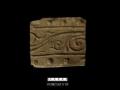
Bricks with Chinese characters printed on them identified as belonging to the Le Dynasty were discovered at the Kinh Thien Palace site, with 5 pieces. The outstanding features of this group of bricks are mostly of the type of bricks and rectangular bricks with large sizes and very thick. Regarding the technique of printing letters on bricks of the Le Dynasty, there are also many types: raised letters, sunken letters, large letters, small letters, letters enclosed in a seal frame, and letters not surrounded by a border.
Statistics on the content of Chinese characters printed on bricks show that during the Le Dynasty there were the following types (Table 01).
+ Brick printed with Chinese characters "右"
The common feature of this group of bricks with letters is that they are all large and thick rectangular bricks. Many of them are gray bricks of the Le Dynasty. Each brick has only one letter and all are embossed letters located on the short edge of the brick. The letters are clear, 0.5-0.6 cm thick and created right in the brick mold. That is the difference compared to the seal script on bricks of the Ly-Tran Dynasty.
The only brick specimen printed with the Chinese character "Huu" coded 17.DKT.H1.V71 is a rectangular brick with full shape and dimensions of 40 x 21.5 x 9cm.
On one edge is embossed the Chinese character "右". This type of brick is made
made of gray clay, the bricks are quite solid, the brick bones are mixed with many fly-head grit (PLIII, H4: 01).
This is the insignia of a department of the 4 Hieu Luc guards. The bricks with the word Huu were produced by the Hieu Luc guard's Huu office . It is still not determined which Hieu Luc guard's Huu office this is among the 4 guards Tien, Hau, Ta, Huu. This type of bricks with Chinese characters were also discovered at the location 62-64 Tran Phu.
+ Inscriptions recording the mandarins of the early Le dynasty: this type has two copies printed with Chinese characters: Tam Phu Quan, Ho Uy Quan.
Brick with Chinese characters Tam Phu Quan (三輔軍)
Specimen coded 17.ĐKT.H1.V78, broken brick, only part remains. One edge of the long edge of the brick is engraved with the Chinese characters “ Tam Phu Quan ” printed in a rectangular mold. The writing is simple and neat, the brick is made of red clay, with a fairly low firing temperature (PLIII, H4: 03-04). This type of brick was also discovered at site 18 Hoang Dieu (PLIII, H4: 02).
The Tam Phu army found at the Imperial Citadel site is the military insignia of one of the five departments of the Quang Vu Guard under the Dong Quan Palace. The army of the Tam Phu department was also present in the labor force to build the capital [28, p.45].
Brick with Chinese characters Tiger's Might (虎威軍)
The specimen bears the symbol 17.ĐKT.H1.V15, size: 31.5cm x 15.5cm x 9.5cm, written in the Khai script, in a rectangular frame, rectangular seal, very clear printing block, baked brick, fine soil, red color (PLIII, H4: 5). A similar brick was also discovered at location 18 Hoang Dieu (PLIII, H4: 6).
The Phung Than Guard of the Trung Quan Palace has 5 offices: Ham Ho, Ho Uy, Than Ho, Manh Ho, Hung Ho. Ho Uy is the military name of one of the 5 offices of the Phung Than Guard. The soldiers of this office are also sent to the capital to burn bricks for construction, the products are printed with the military name Ho Uy Quan [28, p.42].
+ Bricks printed with Chinese characters recording place names during the Le Dynasty: two specimens of place names during the Le Dynasty were obtained, including Thu Vat, Vu Linh district, and Thu Vat, Nhan Kham district, respectively.
Brick printed with Chinese characters "Thu Vat district, Vu Linh village " .
Specimen coded 17.ĐKT.H1.V79, broken, size ([23cm] x [13cm] x 9.5cm) , brick printed with 6 letters, written in a vertical row , Thu Vat district, Vu Linh village, the letters are printed in a rectangular frame (PLIII, H5: 1-2).
Brick with Chinese characters printed on it: "Thu Vat district, Nhan Kham village" (收物縣仁坎鄉).
The specimen with symbol 19.ĐKT.H1.V13 (size [17cm] x [13cm] x 11cm) has an inscription on one edge of the Thu Vat district, Nhan Kham village , but the first three characters are broken (PLIII, H5: 3-4).