
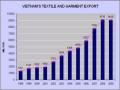
The product with the largest export turnover. A series of foreign corporations are shifting their investment to Vietnam, showing the prosperity of the industry.
According to the Vietnam Textile and Apparel Association, the application of science and technology to create differentiated and high value-added products is one of the most powerful changes that businesses have creatively implemented. Specifically, synthetic fiber products produced for the first time in Vietnam by Formosa Industrial Company (Dong Nai), elastic core yarns by Tainan Spinning Company (Dong Nai), CLC yarn products exported by Thien Nam Joint Stock Company (Binh Duong)..., 4-way stretch, multi-functional fabrics by Hanoi Textile Corporation, Lan Tran Company, Thanh Cong Textile Joint Stock Company, City. Ho Chi Minh City... High-end product groups of Viet Tien Garment Company, Garment 10 Company, Saigon 2 Garment Joint Stock Company, Corel products exported to Europe by Scavi Company,... Moreover, in recent times, the Vietnamese textile and garment industry has also had many advantages thanks to Europe and the United States applying self-defense regimes on imported goods from China - the biggest competitor of Vietnamese textile and garment. The above has affirmed a sustainable development prospect for the Vietnamese textile and garment export industry. Currently, Vietnam has been honored to be in the top 10 countries and territories with the largest textile and garment exports in the world. That great honor has demonstrated the potential of our country's textile and garment industry, the Vietnamese textile and garment industry can be on par with powerful countries in textile and garment exports such as China, India, Bangladesh...
II. DEVELOPMENT PLAN OF VIETNAM'S TEXTILE AND GARMENT INDUSTRY TO 2015, WITH A VISION TO 2020.
1. Development perspective.
a) Develop the textile and garment industry in the direction of specialization and modernization, ensuring rapid, stable, sustainable and effective growth.
b) Maximize the development of the domestic market while expanding exports, taking exports as the development goal of the industry.
c) Develop the Vietnamese market in large urban areas and cities. Move labor-intensive textile and garment establishments to rural areas.
d) Diversify ownership, diversify the scale and type of enterprises, mobilize all domestic and foreign resources to develop the Vietnamese textile and garment industry.
e) Developing textiles and garments in the direction of specialized and modern investment to create a leap in product quality and quantity.
f) Strongly develop supporting industrial products, produce textile and garment raw materials, reduce trade deficit, and increase the added value of the industry.
g) Developing the textile industry in conjunction with environmental protection and the trend of shifting rural agricultural labor.
h) Developing human resources in both quantity and quality for the sustainable development of the Vietnamese textile and garment industry.
2. Development goals.
a) General objectives.
- Developing the textile and garment industry into one of the key and spearhead export industries, increasingly satisfying domestic consumption needs, creating more jobs in society, improving competitiveness, and firmly integrating into the regional and world economy.
- Ensure sustainable and effective development of textile and garment enterprises based on modern technology, quality management system, labor management, environmental management according to international standards.
b) Specific goals
Table 13: Development targets of Vietnam's textile and garment industry to 2020
Target
Unit | Year 2010 | 2015 | 2020 | |
1. Export turnover | Tr. USD | 12,000 | 18,000 | 25,000 |
2. Use of labor | 1000 people | 2,500 | 2,750 | 3,000 |
3. Main products | ||||
- Cotton fiber | 1000 tons | 20 | 40 | 60 |
- Fibers, synthetic fibers | 1000 tons | 120 | 210 | 300 |
- All kinds of fabric | 1000 tons | 350 | 500 | 650 |
- Fabrics of all kinds | Tr. M2 | 1,000 | 1,500 | 2,000 |
- Sewing products | Tr. SP | 1800 | 2,850 | 4.00060 |
4. Localization rate | % | 50 | 60 | 70300 |
Maybe you are interested!
-
 Current Status of Supporting Industry Development for Vietnam's Textile and Garment Industry
 -
 The impact of social capital on business performance - a case study of the Textile and Garment industry in the Southern region of Vietnam - 36
 -
 Spillover effects of foreign direct investment on enterprises in Vietnam's textile and garment industry - 8
 -
 Solutions to develop business opportunities for Vietnam's textile and garment industry in the current financial crisis - 1
 -
 Solutions for developing Vietnam's textile and garment supporting industry - 13

Source: Decision No. 42/2008/QD-BCT
- In the period 2008-2010, average production growth reached 16% to 18%, average export growth reached 20% and export turnover reached 12 billion USD in 2010.
- In the period 2011-2015, average production growth reached 12-14%, average export growth reached 15% and export turnover reached 18 billion USD in 2015.
- In the period of 2016-2020, average production growth will reach 12% to 14%, average export growth will reach 15% and export turnover will reach 25 billion USD by 2020.
3. Product development planning and planning layout.
a) Strategic product planning
- Focus on producing fabrics and accessories for export. In fabric production, dyeing and finishing plays an important role in ensuring fabric quality to meet market and customer requirements. Investment in fabric production must choose high technology to create products with high added value, reduce raw material costs and be environmentally friendly.
- Promote investment in developing cotton, fiber, synthetic fiber and accessory production facilities to improve production and business efficiency, gradually reduce imports and save foreign currency.
- Increase investment in developing the export garment industry to take advantage of market opportunities. Garment enterprises need to diversify and improve the quality of products, actively change the method of producing export goods from receiving raw materials to creating finished products to buying and selling, promoting production and business activities of garment enterprises such as fashion design activities, supplying raw materials and accessories, and trade promotion.
b) Regional planning.
Regional textile planning is distributed in areas with the following main orientations:
- Region I: Red River Delta.
The planning orients Hanoi as a service center, providing raw materials, technology, fashion models, garment production facilities and facilities with high added value. Production facilities will be relocated to industrial parks in the southern provinces such as: Hoa Xa (Nam Dinh), Nguyen Duc Canh (Thai Binh), Pho Noi B (Hung Yen), Dong Van (Ha Nam), Vinh Phuc, Bac Ninh, Ninh Binh. In this area, an export garment industrial cluster and 3 concentrated dyeing and finishing industrial parks will be formed. Investing in a Polyester silk manufacturer with a capacity of 160,000 tons/year in Dinh Vu industrial park (Hai Phong).
- Region II: Southeast Region.
Ho Chi Minh City is a center of trade, fashion design, textile technology services and factories producing high value-added fashion products. Relocate dyeing and finishing facilities in Ho Chi Minh City to Long An Industrial Park and neighboring provinces. This is an area that has developed rapidly in textiles in recent years, and is currently facing many difficulties in labor, so new investment in this area is not encouraged to avoid labor pressure.
- Region III: Central Coast region.
Taking Da Nang city as the center to form an export garment industrial cluster and a number of dyeing and finishing industrial zones in Hoa Khanh (Da Nang), Quang Tri.
- Region IV: Mekong Delta.
Taking Can Tho city as the center to form an export garment industrial cluster and a concentrated textile and dyeing industrial park in Tra Vinh.
- Region V: Northeast and Northwest regions.
Planning to arrange a textile industrial park in Phu Thi, garment factories in the provinces. Developing cotton growing areas for silk in Son La and Dien Bien.
- Region VI: North Central Region.
Planning to arrange textile and garment enterprises along Highway 1 with some industrial clusters and points in Bim Son (Thanh Hoa), Vinh (Nghe An), Hue
(Thua Thien Hue). Forming 3 textile and dyeing industrial zones in Dien Chau (Nghe An), Ha Tinh, Quang Tri in the period of 2012-2015.
- Region VII: Central Highlands.
Orientation to promote specialization of textile raw materials such as mulberry, cotton... associated with processing to create products for export and domestic markets. At the same time, combine to develop garment facilities to serve domestic or as satellites for the garment industry of region II and region III.
III. SOLUTIONS TO PROMOTE VIETNAM'S TEXTILE AND GARMENT EXPORTS IN THE COMING YEARS.
1. Macro solutions
1.1 Capital and financial issues.
In the future, from now until 2010, the textile industry will need a capital source of about 70,000 billion VND. This is a large number that requires the combined use of the following capital mobilization measures:
- It is necessary to mobilize all available resources in companies such as depreciation of basic assets, capital obtained by selling, contracting, leasing unused assets, releasing inventory, mobilizing from officers and employees...
- Joint stock enterprises with good production and business activities need to study the possibility of issuing bonds and stocks to mobilize all capital sources for investment and development.
- Create favorable conditions, encourage and call for foreign investment to mobilize capital from outside and all economic sectors.
- Request permission to use budget capital for planning programs such as planning cotton growing areas, mulberry growing and sericulture areas or planning textile industrial clusters.
- Permission to use budget capital for training schools and specialized research institutes is equal to other types of schools and institutes managed by the Government or Ministries.
- Request permission to use ODA capital or special incentives for infrastructure construction or investment in wastewater treatment or investment support for businesses facing financial difficulties.
- Deferred credit loans from suppliers, financial institutions, banks, financial leasing, commercial loans... For this form, textile and garment enterprises really need government guarantees.
The investment environment is not really open and attractive, which has hindered many foreign companies from investing in Vietnam. Because investors are the ones who understand their country's market best, not being able to attract them to the Vietnamese market will limit the amount of textiles exported to their country, reducing the ability to access modern technology, leading to a decrease in the competitiveness of Vietnamese textiles.
Currently, revenue from export and import taxes accounts for approximately 30% of total revenue from all types of taxes. Export taxes, due to their ease of collection and enforcement, have been mobilized to the maximum. This practice contributes to reducing the motivation for foreign trade development, which is not in line with the trend of trade liberalization worldwide, and puts the budget in an extremely difficult position when tax reduction commitments take effect and revenue from import taxes decreases sharply. To resolve this situation, it is necessary to urgently change the revenue structure, increase the proportion of other types of taxes such as direct taxes, commodity taxes, and remove obstacles to the collection of some taxes such as land use rights transfer tax to gradually reduce the proportion of revenue from import and export activities.
Regarding the issue of exchange rates: Exchange rate policy has a leading position in international trade policies. However, recently, there has been progress in managing exchange rates: the dual exchange rate mechanism has been abolished to be replaced by the main exchange rate on the interbank market, regulations on foreign exchange have also been relaxed...
Strengthen the activities of the Development Support Fund and increase the operational capacity of the Vietnam Textile and Apparel Association.
Vietnam Textile and Garment Corporation said that the biggest problem in implementing investment projects in the industry at present is preferential loans from the Support Fund.
Development is still slow and market demand is limited, only meeting 1/3 - 1/2 of demand. Strengthen the role of the Vietnam Textile and Apparel Association in promotion and information activities and must represent Vietnamese textile and garment enterprises in trade disputes.
The Trade Promotion Agency needs to play a central role in providing comprehensive and updated information. Manage the Ministry of Trade's database well and respond quickly to businesses' information needs.
1.2 Promote administrative reform.
a) Perfecting the import-export system.
- Continue to reform and perfect the tax system to promptly detect and overcome difficulties in textile and garment import and export activities, simplify the tax rate system, each item has only one tax rate, to avoid arbitrary code application.
- Need to review taxable items and incentives for equipment serving export activities.
- Processing methods will continue for many more years. Therefore, the management of importing machinery, equipment, spare parts, tools and raw materials for production as well as resolving cases when liquidating contracts
- The issue of regulating the rate of scrap so that textile and garment enterprises do not have to pay too high taxes for importing accessories with a scrap rate.
b) Perfecting the legal environment.
This is extremely necessary to create a sense of trust for businesses to accept to invest capital in production activities. Some measures to overcome the situation of inconsistent laws and documents guiding the implementation of laws causing difficulties for businesses:
- Strictly handle cases where documents guiding the implementation of laws are issued later than prescribed.
- It is necessary to stipulate the mandatory time for issuing guiding circulars of ministries and branches and close to each other within a certain time period. That is to create synchronization in guiding documents and create more favorable conditions for businesses.
- Minimize the use of "internal circulation" documents after the circular.
- There needs to be a strict process of checking the content and grammar of the guiding circulars before they are issued to avoid vague instructions that can be arbitrarily applied by officials, causing difficulties for businesses.
- Another issue that greatly affects the competitiveness of products as well as the rapid and sustainable growth of enterprises is the improvement of the quality of resources. Three types of products have been and are creating a constraint on growth: electricity, infrastructure and technical labor. Two of them, electricity and infrastructure, still face many difficulties that need to be overcome.
2. Micro solutions.
2.1 Promote the development of commerce via the Internet.
Currently, e-commerce is mainly applied in developed countries with an annual growth rate of e-commerce of 200%. America, EU or Japan
- Our main markets are all countries with highly developed information technology, so e-commerce is vital to these countries, thanks to which transaction costs can be reduced by dozens, even hundreds of times. E-commerce not only helps enterprises reduce costs and expand markets, but can also fundamentally change the mechanism and structure of enterprises. Through the Internet, communication between enterprises is more convenient and faster. It is a new tool for management strategy because it directly connects buyers and sellers, is not limited by space and time, and improves the efficiency of marketing, advertising, and transaction activities. By taking advantage of new technologies to increase business capabilities, foreign enterprises are actively exploiting the Internet effectively, and if they want to cooperate with them, Vietnamese enterprises have no other way but to approach e-commerce step by step.
However, Vietnam's infrastructure is not really able to meet the demand. Building an electronic payment system, protecting intellectual property rights, legal rights, protecting national security, information security... will still take a lot of time in the future, but the immediate task is to build a website to provide information about Vietnamese export enterprises as well as the Textile and Garment Association, the Textile and Garment Corporation in the role of focal point, to provide information fully,