
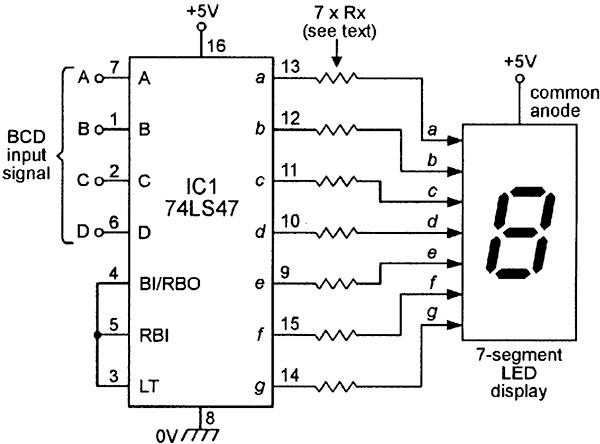
Figure 7.10: BCD to 7-segment LED decoder circuit Common Anode
7.4. Photoresistor
Maybe you are interested!
-
 Basic Electronic Engineering - Ho Chi Minh City College of Construction Part 2 - 7
 -
 Basic Electronic Engineering - Ho Chi Minh City College of Construction Part 1 - 11
 -
 Basic Electronic Engineering - Ho Chi Minh City College of Construction Part 1 - 9
 -
 Basic electronic engineering - City College of Construction. HCM Part 1 - 1
 -
 Bridge and road structure - Ho Chi Minh City College of Construction Part 2 - 9
Photoresistor, also known as photoresistor, is an electronic component whose resistance changes according to the light shining on it (Light-dependent resistor).
Photoresistors are made of high impedance semiconductors coated on an insulating substrate. Commonly used semiconductors are:
- Cadmium sulfide (CdS) and cadmium selenide (CdSe), but cadmium is banned in Europe.
- Lead sulfide (PbS) and indium antimonite (InSb) are used for the infrared spectral region.
- Gecu is the best far infrared detector sensor, used in infrared astronomy and infrared spectroscopy.
When not illuminated, the photoresistor has a large resistance (several MΩ). When illuminated, the resistance drops to a few hundred Ω.
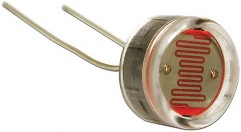
Figure 7.11: Actual shape of photoresistor
The operation of photoresistors is based on the photoelectric effect. When a photon with sufficient energy strikes, it will knock electrons out of the molecule, become free in the mass of the substance and make the semiconductor conductive. The level of conductivity depends on the number of photons absorbed. Depending on the semiconductor, photoresistors react differently to different photon wavelengths. Photoresistors react about 10 ms slower than photodiodes, so they avoid rapid changes in the light source. Photoresistors are used as light-sensitive sensors in detection circuits, such as in street light switching circuits when it is dark.
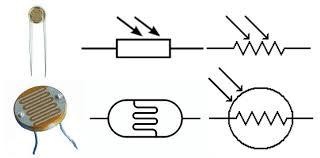
Figure 7.12: RTD photoresistor symbols
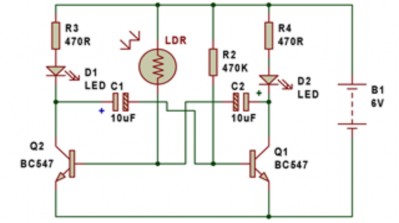
Figure 7.13: Multivibrator circuit using LDR
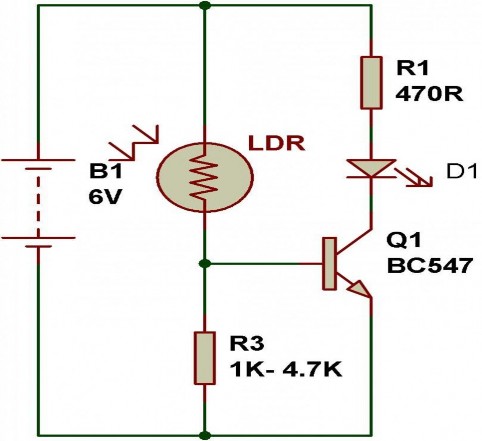
Figure 7.14: LDR light-on circuit
7.5. Photodiode Introduction
A photodiode is a P-N junction or semiconductor device that consumes light energy to generate an electric current. It is also sometimes called a photo detector, photo sensor or light detector.
Photodiodes are specially designed to operate in reverse bias. Reverse bias means that the p-side of the photodiode is connected to the negative terminal of the battery and the n-side is connected to the positive terminal of the battery.
Photodiodes are very sensitive to light, so when light or photons fall on the photodiode, it easily converts light into electric current. Solar cells are also called large-area photodiodes because they convert solar energy or light energy into electrical energy. However, solar cells only work in visible light.
The construction and working of a photodiode is almost similar to a normal P - N junction diode. Photodiodes are mainly used in high speed applications.
In a normal P - N junction diode, voltage is used as the energy source to generate current whereas in photodiodes, both voltage and light are used as the energy source to generate current.
Photodiode Symbol
The symbol for a photodiode is similar to a normal P - N junction diode except it contains arrows marking the diode. The arrows marking the diode represent light or photons.
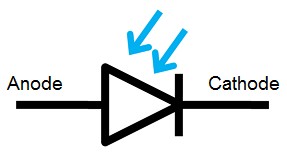
Figure 7.15: Photodiode symbol
A photodiode has two terminals: a cathode and an anode.
Objectives and limitations of photodiode
- Photodiode should always operate when reverse biased.
- Apply low reverse bias voltage.
- Generates low noise
- High increase
- High response speed
- High sensitivity to light
- Low sensitivity to temperature
- Low price
- Small size
- Long life
Types of photodiodes
The working of all types of photodiodes is the same. Different types of photodiodes are developed based on the specific application. For example, PIN photodiodes are developed to increase the response speed. PIN photodiodes are used where high response speed is required.
Different types of photodiodes:
- PN photodiode in series
- PIN photodiode
- Avodanche photodiode
Among all the three photodiodes, PN junction and PIN photodiodes are the most widely used.
Photodiode Applications
The various applications of photodiodes are
- Compact disc player
- Smoke detector
- Space applications
- Photodiodes are used in medical applications such as computed tomography, instruments for sample analysis, and pulse oximetry.
- Photodiodes are used for optical communications.
- Photodiodes are used to measure extremely low light intensities.
7.6. Optical Transistor (PhotoTransitor)
The phototransistor is a device that can sense light levels and change the current flow between the emitter and collector according to the light level.
Both phototransistors and photodiodes can be used to sense light, but phototransistors are more sensitive in terms of the gain provided by the transistor. This makes photodiodes more suitable in some applications.
The idea of the phototransistor has been known for many years. William Shockley first proposed the idea in 1951, not long after the conventional transistor was discovered. That was then just two years before
The phototransistor was demonstrated. Since then phototransistors have been used in a wide variety of applications.
Phototransistor operation
The phototransistor uses the basic transistor concept as the basis for its operation. In fact, a phototransistor can be made by exposing the semiconductor of a regular transistor to light. Very early phototransistors were made by uncoating the plastic casing of the transistor with black paint.
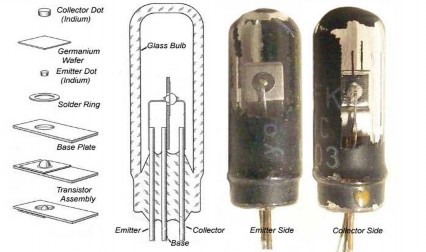
Figure 7.16: Structure and shape of Transistor OC71
Image of an old OC71 Transistor - this type was introduced by Mullard in the UK in 1954, but production continued beyond this date into the 1960s
Old TransistorOC71 - by removing the black paint it shows the characteristics of the phototransistor
Photo transistors work because light striking the semiconductor releases electrons/holes and causes current to flow in the base region.
Light enters the base region where it causes electron-hole pairs to be generated. This generation occurs primarily at the reverse-electron-base junction. The electron-hole pairs move under the influence of the electric field and provide a base current, causing electrons to be injected into the emitter. The resulting photodiode current is multiplied by the current gain of the current transistor.
The performance of a phototransistor can be superior to that of a photodiode for some applications in terms of its performance. As a rough guide, where a photodiode might allow a current of about 1µA under typical room conditions, a phototransistor might allow a current of 100µA to flow. These are very rough approximations, but give an idea of the order of magnitude of the different values and comparisons.
One of the main disadvantages of the phototransistor is that it does not have a particularly good high frequency response. This arises from the large capacitance associated with the base-collector junction. This junction is designed to be relatively large in order to admit sufficient light. For a typical coaxial device, the bandwidth may be limited to around 250 kHz. Series devices have much higher limits, with some operating at frequencies as high as 1 GHz.
Phototransistor Applications
Phototransistor circuits can be used in one of two basic modes of operation. These are called active or linear mode and switch mode.