
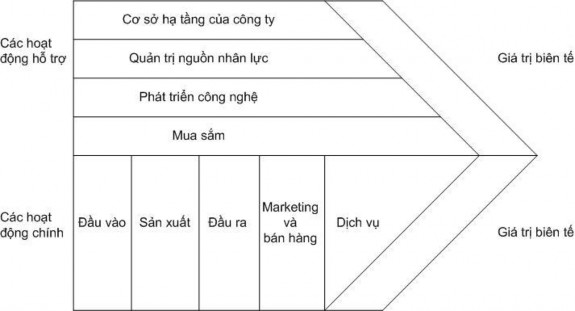
Figure 1.1: Porter's value chain model
(Source: Policy Action Research Unit (2007), Practical Handbook for Better Value Chain Analysis for the Poor, ADB Information Center, Hanoi)
Maybe you are interested!
-
 Bai Dinh Pagoda - Ninh Binh's tourism potential - 8
 -
 Study on the relationship between local people's livelihoods and conservation activities in Van Long wetland nature reserve, Ninh Binh province - 11
 -
 Viewpoints and Goals of Tourism Development in Ninh Binh Province
 -
 Managing teaching activities at the Vocational Education Center - Continuing Education in Kim Son district, Ninh Binh province in the current context - 15
 -
 Strengthening Inspection and Examination of Tourism Activities in Ninh Binh
Porter's value chain model divides activities into two areas: primary activities and supporting activities. Primary activities include inputs, production, outputs, marketing and sales, and customer service.
Input: Activities involved in receiving, storing, and moving product inputs, such as materials management, warehousing, inventory control, vehicle scheduling, and returning products to suppliers, etc.
Production: is the activity of converting input materials into finished products.
Output: includes activities that combine collecting, storing and distributing products from the manufacturer to the buyer.
Marketing and sales: are activities related to advertising, promotion, choosing distribution channels, managing channel relationships and pricing.
Customer service (after-sales service): related to providing services to increase and maintain the value of the product.
Support activities: include activities such as purchasing, technology development, human resource management, and corporate infrastructure.
Purchasing: related to the function of purchasing input materials including raw materials, suppliers, machinery, etc.
Technological development: related to the know-how, processes, procedures, and technology used.
Human resource management: includes activities related to recruitment, hiring, training, development and compensation management for employees in the company.
Corporate infrastructure: includes general management, management planning, legal compliance, finance, accounting, quality management, facilities management, etc.
- According to Kaplinsky R. and Morris M. (2001), the concept of value chain refers to all the activities necessary to transform a product or service from its conception, through the different stages of production, to its distribution to the final consumer and disposal after use.
Figure 1.2: Relationships in a simple value chain
(Source: Kaplinsky R. and Morris M. (2001), Tourism value chain)
- Value Chain Linkage Method (ValueLinks) (2007). The value chain linkage method of GTZ (Deutsche Gesellschaft für Technische Zusammenarbeit – Germany) considers that the value chain is a series of business activities (or functions) that are related to each other, from providing specific input values for a product, to processing, transformation, marketing, and finally selling that product to consumers. Or the value chain is a series of processes in which businesses (operators) perform their main functions to produce, process and distribute a specific product. Businesses are connected to each other through a series of production and business transactions, in which the product is transferred from the hands of the manufacturer, initial processing to the hands of the final consumer.

Figure 1.3: Value chain segmentation (functions)
(Source: GTZ (2007), The Methodology of Value Chain Promotion)
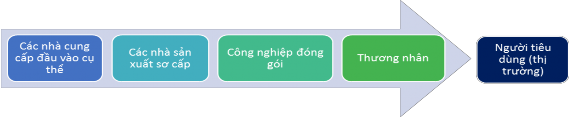
Figure 1.4: Value chain diagram according to GTZ approach
(Source: GTZ (2007), The Methodology of Value Chain Promotion)
1.2.2. Tourism value chain
In the document Value chain analysis practice manual of the MP4 project, GTZ: Value links manual: The methodology of Value chain promotion states that: In the tourism industry, it is necessary to coordinate many services to provide to customers.
goods. Tourism products are usually a chain of services as shown in the figure below. The value chain is in fact a journey in which the traveler moves through a series of interconnected services. The system only functions when all the services are available, at the right times and with the right quality. Here, services are provided by many individual suppliers, requiring a coordinating service provider – the travel agency or tour operator.
The most obvious difference from the value chain of a tangible product is that it is the customer - the tourist - who is "processed" rather than the goods. For each service that a tourist consumes during his or her journey, there must be a secondary service provider. For example, hotel management schools, entertainment services, maintenance services, etc. Thus, mapping the entire chain (for example, ecotourism in a particular mountain area) can become very complicated. However, if all the elements are not ready, there will be no attraction for this service. At the very least, a tourism value chain map can be used as a checklist.

Travel agency
Bus company
Hotel
Operator, cultural group
Bus company
Tour Operator
Tour Operator
Figure 1.5: Value chain diagram in tourism industry according to GTZ approach
(Source: GTZ (2007), Value Links Mannual: The Methodology of Value Chain Promotion)
In the report on the topic: “Developing a sustainable tourism value chain for Dak Lak province (2007)” prepared by Nguyen Duc Hoa Cuong, it is stated that: Tourism is a complex product including the supply of many travel companies as well as government, profit and non-profit organizations. Together they form tourism chains - a series of sequential activities, actors, films and materials necessary to produce a vacation.
1.2.3. Distinguishing tourism value chain from supply chain
They are essentially the same as both involve the same network of actors who are linked to each other to deliver goods and services to the end consumer. If we compare the definition of each supply chain with the value chain we see their similarities and differences. Supply chain as it implies focuses on efficiency and cost of supply. Supply chain is understood as bringing raw materials for manufacturing and finished products to the consumer in a smooth and economical manner. The first objective of a supply chain is to meet customer demand through the most efficient use of resources including: the allocation of capacity, resources and labor. A supply chain tries to match demand with the availability of mineral resources. Other aspects of optimistically assessing a supply chain include keeping in touch with suppliers to eliminate production bottlenecks; resource strategy to create a balance between lowest material and transportation costs; “Just in time” techniques to optimistically assess production flow; maintaining the right coordination between corporate and warehouse locations to serve the consumer market, and using location/location assignment, transportation analysis, dynamic programming and of course, traditional transportation optimism to maximize distribution efficiency.
In contrast, a value chain focuses on the total value to the consumer. Therefore, the goal of a value chain is to maximize value at the lowest possible cost to the consumer. Therefore, the fundamental difference between a supply chain and a value chain is a fundamental shift in focus from consumer-based supply.
Therefore, price reduction and cost cutting strategies are not enough to ensure a sustainable market advantage in the long run; it is necessary for the company to provide value that will justify the product price. Therefore, the supply chain itself has evolved to match supply and value. The clue can be seen in the definition of a supply chain from the Global Supply Chain Forum (1998): “The integration into a unified system of primary economic processes from end user to primary supplier of products, services and information that add value to consumers and other potential customers”. The view that a supply chain must add value to customers is reducing the contrast between a supply chain and a value chain.
1.3. Basic content in tourism value chain analysis
1.3.1. Value chain mapping
Value chain analysis begins with the process of value chain mapping. Mapping a chain means creating a picture of the connections between businesses in the value chain as well as other actors. To understand the value chain we want to analyze, we can use models, tables, figures, charts and similar forms to grasp and visualize its nature. Value chain mapping is a way to make what we see easier to understand. Value chain mapping has three main objectives: -
Helps visualize networks to better understand the connections between actors and processes in a value chain.
- Demonstrates the interdependence between actors and processes in the value chain.
- Provide stakeholders with insights beyond their own involvement in the value chain. However, it is important not to confuse value chain mapping with value chain analysis. Value chain mapping is meant to provide a complete picture of the value chain being studied. Value chain mapping is a way to illustrate (or perhaps simplify) the complexities of real-world value chains. Value chain analysis is about identifying the constraints at each stage of the chain, and then finding solutions to overcome them so that the product meets market requirements and develops sustainably. Building a value chain map is not a quick job. Instead, it is practiced and developed throughout the value chain analysis process. "The implementation of value chain mapping can include many core processes of the value chain. Therefore, based on the available resources, the scope and objectives of the value chain analysis and the mission of the organization, it is important to select the core processes to be mapped. The principle is to distinguish what is the process of transforming the product in many stages to become the final product for the end customer? It is important to limit the value chain analysis to a certain number of core processes. Otherwise, it will be too complicated and consume too much time and resources. To establish a value chain map, the study needs to focus on the following issues:
- Identify core processes in the value chain: The first step is to identify the core processes in the value chain. It is necessary to identify and distinguish the main processes that raw materials pass through before reaching the final stage.
final consumption. These core processes will vary and depend on the nature of the chain being mapped.
- Identify the actors directly involved in the process: it is necessary to identify who the actors are in the value chain and what specific tasks they do. To differentiate between the actors depends on the level of complexity that the mapping wants to achieve. The simplest distinction is to classify the actors according to their main occupation. For example, collectors are those who carry out the collection, while producers are those who participate in production. This is a simple classification but does not provide much information. Other classification criteria can be: form of ownership (state, registered enterprise, cooperative, household, ...), scale (large, medium or small, national or international scale, ...), classification by location (commune, district, province, country, ...).
- Product flow mapping: Once the core processes, actors and specific activities in the value chain have been outlined, product flows are identified. Product flows show the process of becoming a final product: the transformation of products from raw materials to the final product ready for sale to the end customer.
- Product volume mapping: Product volume, when determined, provides an overview of the size of different channels in the value chain.
- According to the value chain analysis model, in addition to the internal actors directly involved in the core processes, there are also external actors providing services. Although the external actors providing services are indirectly involved, they affect the performance of the chain in one way or another. Therefore, they need to be fully analyzed. A potential risk of value chain analysis is that the surrounding environments are not considered.