
Two requirements: There are unified goals and the movement to the goal with common methods and rhythm for the whole class. However, students in the same class do not have the same understanding, ability and desire to solve the work. Therefore, the characteristic of collective work in the lesson is the incompatibility of the actual actions of each student with the basic requirements of organizing activities . That has raised the need to coordinate collective work with group and individual work.
Group teaching is a form of differentiated learning organization . At the same time, each group of students performs different tasks on the same topic; or performs the same task but in small units to facilitate coordination between individuals in work. Group work is an intermediate form of work organization between the collective and the individual . There are two forms of group organization: fixed groups and random groups . Fixed groups create conditions to tighten the connection of actions between students but also easily give rise to dependence and reliance in some students who lack the will to strive. Even the assignment of group leaders should not be stable but should be rotated to create conditions for everyone to express their abilities, train everyone's working ability, and create the ability for each person to improve in work. The largest group should only have 4 people (abbreviated as group 4).
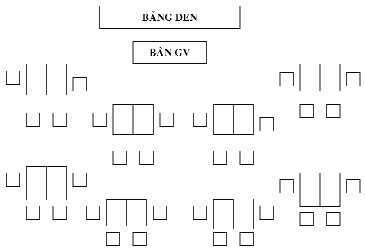
To organize group activities effectively, it is necessary to study how to arrange tables and chairs in the classroom . Currently, many schools have equipped 2-seat tables and chairs for students. Some schools also equip individual desks for students. It is necessary to think about how to arrange tables and chairs that are convenient for group activities. The following is a type of table and chair arrangement suitable for organizing group activities:
The form of individual work in class creates conditions for each student to carry out tasks assigned by the teacher independently, according to personal initiative. It trains the ability to work independently, the sense of striving to improve in work. Teachers have the conditions to help weak students.
Maybe you are interested!
-
 Types of Literary Materials That Can Be Used in Teaching Vietnamese History Grade 10 in High Schools
 -
 Current Situation of Paths and Forms of Vietnamese Language Education for Ethnic Minority Students at Primary Schools in Dinh Hoa District, Thai Nguyen
 -
 Managing Vietnamese language education activities for ethnic minority students at primary schools in Dinh Hoa district, Thai Nguyen province - 1
 -
 Organizing Training to Improve Vietnamese Language Education Capacity for Students at Primary Schools in Dinh Hoa District, Thai Nguyen Province
 -
 Types of lonely characters in contemporary Vietnamese prose through some typical works of Nguyen Huy Thiep, Ta Duy Anh, Chu Lai and Nguyen Danh Lam - 14
3- Types of lessons in Vietnamese primary schools
3.1- New lesson time
The new lesson hour in primary school is a lesson organized with the purpose of conveying a new learning content, equipping students with new scientific information. In primary school, equipping students with scientific knowledge is only at a simple, minimal level and clearly practical in nature. Therefore, the main method to implement in this lesson is through practice, practice to form knowledge. Knowledge is drawn from practice. Then through practice, knowledge is improved . Knowledge equipped for students is closely linked to the skills of use . Therefore, the new lesson hour is also the hour to practice skills, practice knowledge.
3.2- Practice exercises
Practice exercises are lessons organized for students to apply the knowledge and skills they have just been equipped with to situations in life. These types of practice exercises are arranged from easy to difficult, from simple to complex, from applied exercises to creative exercises, etc. Practice exercises like these have helped classroom learning to implement the principle of learning theory in conjunction with reality, learning goes hand in hand with practice , bringing school closer to life, making students become people who know how to work and apply knowledge to life.
3.3- Review
Revision lessons are organized with the purpose of reviewing the knowledge learned in order to deepen knowledge and skills. In these lessons, students understand for the second time what they have learned, remember and apply the knowledge to make it more solid . In addition, students also solve new exercises on the rules they already know, answer orally or write questions. In such lessons, it is useful to study the content learned but according to other new sources of documents, so that in learning there are new elements, making knowledge deepened and expanded.
It is possible to conventionally divide the consolidation of knowledge and skills into the following basic types:
– Consolidation of memory: When students understand the lesson they have learned for the second time and understand it thoroughly enough to be able to retell, present, write and summarize the content of that lesson.
– Practice reinforcement: With this type of reinforcement, the skills that have been initially formed will be perfected and become solid to the necessary level.
– Creative consolidation: When students not only recall and perfect knowledge and skills but also outline new aspects of the problems they have learned.
3.4- Test
Tests are a type of lesson whose basic purpose is to review and evaluate students' learning outcomes , creating feedback information for teachers to adjust their teaching methods and learning organization for students. In terms of organization, there are oral and written tests, 15-minute tests and full-period tests, periodic and irregular tests, early and late tests, chapter tests and tests of lessons just learned. In Vietnamese primary schools today, there are mid- term and final tests . The results of these tests are the main basis for assessing students' level.
3.5- Summary lesson
A synthesis lesson is a type of lesson that performs all the functions of the above lessons at the same time. A synthesis lesson often combines the steps of testing, learning new lessons, practicing, and reviewing.
etc. Lessons in primary schools have been implemented in this comprehensive lesson direction.
Task of activity 2
Task 1: Individual work.
Task 1: Read the information.
Task 2: Take notes on: Characteristics of classroom teaching methods.
Task 2: Work in groups.
Task 1: Watch a videotape recording part of a class lesson. (Videotape implementing the teaching of Math and Vietnamese for grade 3 according to the new primary school program of the Steering Committee for the 2000 Primary School Program Experiment).
Task 2: Discussion: Students' activities during class are recorded on videotape.
Task 3: Work in groups.
Task 1: Look at the lesson plan for one Math lesson and one Vietnamese lesson.
( See the Math teaching guide for grade 3, Vietnamese teaching guide for grade 3 of the Steering Committee for the 2000 primary school program trial , Education Publishing House, 2004). Task 2: Discussion
What type of lesson is in the plan?
– Besides this type of lesson, what other types of lessons are being implemented in Vietnamese primary schools?
Activity Review 2
Present the forms of organizing activities during class hours in primary schools in our country today.
1- Purpose
- Identify the richness of forms of organizing activities in classroom hours.
– Identify the need to organize different forms of activities during class time.
2- Mission
- Explain specifically which cases are appropriate for each form of organization.
class action
- State specific conditions to ensure success in applying each form of organizing classroom activities mentioned above.
Activity 3: Learn about extracurricular activities (1 period)
Information for Activity 3
Extracurricular teaching or extracurricular activities have been very familiar in our country since the beginning of primary schools.
1. Location of extracurricular activities
Extracurricular activities are also known as out-of-class activities.
Extracurricular activities refer to forms of activities that combine learning and playing outside the classroom, with the purpose of linking school learning with social life, creating conditions for students to integrate into the larger reality outside of school.
In essence, extracurricular activities are a form of fun in learning so they are very interesting and attractive.
In terms of form, extracurricular activities expand the working environment, create conditions for bringing students into life, and create conditions for linking knowledge with real life.
In terms of content, extracurricular activities are not limited to the official curriculum. They are not just about teaching words but also about teaching people and how to be human. They contribute significantly to broadening students' political and social horizons about their roles and positions in society. Extracurricular activities teach them how to live happily, healthily, with discipline and order, to love and care for others, to respect the collective, and to be attached to life.
Any subject in school can have extracurricular activities, and the forms of extracurricular activities are rich in content and diverse in form.
It is necessary to distinguish extracurricular activities from tutoring and enrichment activities . Students who need tutoring are students whose learning results are below the level set by the program in terms of knowledge or skills or both knowledge and skills. Students who need tutoring are weak students.
Students who need to be nurtured are students whose academic results exceed the requirements of the program. They are nurtured to have a more solid understanding and skills. Therefore, they will learn some additional issues that, due to time constraints, the program had to cut out. Students who need to be nurtured are excellent students.
Extracurricular activities cannot be confused with nurturing gifted students . Gifted students are students who have cognitive development or practical skills above the average of students of the same age and level. It is the ability to develop
Because these special abilities are beyond the limits of the program, training must provide students with knowledge and skills that are more profound than those required by the program. Training gifted students must be limited to a select group and must be individualized.
2. Tasks of extracurricular activities
Extracurricular activities have 2 tasks:
– Improve the ability to apply knowledge and skills of the subject into life, making the knowledge and skills of the subject received in class become deeper, more positive, and the skills of using knowledge become more proficient. Extracurricular activities also make students gradually familiar with using reference materials, thereby developing the need for self-study and scientific research capacity.
– Bring students into social life, into collective life.
The best way to train new people for society is for schools to integrate into life. Only in that way can the people trained by schools adapt to the great changes of life. Not to mention the effect of broadening students' political horizons about the situation and revolutionary tasks in the new period. From there, it helps them determine their position in society, live ethically and culturally.
3. Principles of organizing extracurricular activities
3.1. Must respect the spirit of voluntary participation and creative independence of students but must be organized and have careful guidance.
The spirit of volunteerism is reflected in the fact that participation is not compulsory. Anyone who wants to, who is interested, can register to participate and choose their own group to participate. But once participating, it is mandatory to comply with the organization's regulations. These regulations ensure the activities of each member as well as the entire organization. These seemingly restrictive regulations are actually a guarantee for the freedom of activity and creativity of each member.
3.2. Activity content must be linked to the curriculum and activity form.
The movement must be diverse and rich.
Extracurricular activities are not limited to the curriculum, but to enhance interest in subjects in the curriculum and improve knowledge and learning skills, the content of extracurricular activities must be linked to the curriculum and expanded.
Extracurricular activities must be diverse and rich in order to create passion and interest in students. We can do that because extracurricular activities are not limited to the classroom or the school grounds. Extracurricular activities are not restricted to the forms of lectures, lectures, exercises, practice, tests, etc. and are not controlled by time.
4. Some forms of extracurricular activities in primary school
4.1. Sightseeing
4.1.1. Characteristics of the tour
Field trips are activities conducted outside the classroom, a form of contact with real life in society. Field trips have many effects on students:
– Regarding cognition: Field trips create conditions for students to recognize and observe objects and phenomena that are closely related to their life experiences and knowledge of life. It enriches students’ knowledge, including their language skills.
– Emotionally: Field trips create conditions for students to immerse themselves in social life, thereby arousing passionate emotions about life. From there, students feel more love and attachment to social life.
4.1.2. Types of tours
There are 3 types of tours:
a) A field trip opens the way to learning a topic.
In this form, the purpose of the visit is defined as creating inspiration for research on the topic, expanding awareness, and collecting practical documents necessary for research on the topic.
To make this introductory tour effective, teachers need to orient students with questions before they arrive at the tour site. Students must arrive at the tour site with a clear intention and purpose. Only then will students focus on the main focus of the work to promptly discover what they need to know and the trip will truly become a conscious activity.
In this job, reading books and newspapers related to the topic is very effective.
b) Visit during the research process
The purpose of this type of tour is to create conditions for students to test part of the knowledge they have learned and collect additional practical documents necessary for completing the research topic.
c) Visit to end the research of a topic
In this form, the purpose of the visit is to consolidate, expand and summarize, generalize the documents obtained in class, in researching the topic.
In elementary school, the easiest forms of field trips are forms 1 and 3.
4.1.3. Tour preparation
To make the field trip successful and truly a learning activity, it is necessary to have careful preparation and to conduct it in the right way. Preparation for the field trip must be done for both sides: teachers and students.
a) On the part of the teacher and organizer
– Determine the topic and location of the tour in the system of lessons. Clearly define the educational and training purposes of the tour. Select the research object of the students at the tour location.
– Develop a tour plan. Plan the work to be done during the tour. Determine how to organize student activities during the tour and the stages of work during the tour.
– Plan to summarize the tour. Time and method of summary immediately after the tour or when returning to class, in the form of writing or collection exercises, drawings, etc.
b) On the game side
The preparation of students is aimed at increasing their active participation during the visit. It is necessary to ensure that students demonstrate maximum initiative and intellectual independence both during the preparation for the visit and during the visit itself.
– Students must have knowledge about the tour: places to visit, purpose of visit, activities to do during the tour, how to conduct practice or observation during the tour, etc.
– Students must clearly understand the organization: tour content, tour team structure, items to bring, etc.
In terms of method, in order to enhance the students' activeness during the tour, teachers need to set out clear and specific tasks for them. It is necessary to determine the general tasks for the whole class, the specific tasks for each group, and even each individual. Practice shows that it is possible to combine students' observation with the tour guide's explanation. The explanation is the source of information about the exhibits, and the objects that students observe will serve to illustrate and concretize the teacher's lecture.
The field trip should end with a debriefing, in which the teacher summarizes what he saw and heard during the trip and reviews the materials the students collected during the trip.
4.2. Reading books and newspapers
4.2.1. Characteristics of reading activities
– Reading books and newspapers is a popular and very important form of extracurricular activity for primary school children. It is an insatiable need of young children, an indispensable activity for everyone in cultural life.
– Reading is the easiest way to self-study, to improve the cultural and educational level of each person. Reading books organized properly will help perfect the views, concepts, form the world view of the reader and thus influence the behavior, the working capacity of the reader, motivate people to actively participate in social life. Reading books will help educate morality, form aesthetic tastes for the reader.
Reading books requires a method to be beneficial and effective.
4.2.2. Types of reading
Children's reading can be divided into two main types:
a) Read books for entertainment
This is the type of reading that most children do today. They read voraciously until the last line and then do not think fully about what they have read. Reading like this is just a way to pass the time. Therefore, they read whatever books or newspapers they come across, without any choice or intention when reading, and when they reach the last line, they consider reading the book as finished.
This way of reading books without guidance will result in pedagogy.
CDUxinsky commented: it dulls the reader's intellectual capacity, often brings false knowledge, incorrect views on things and has a negative effect on human morality.
Reading books, even for entertainment, requires choosing the right books to read. There are truly entertaining books, but there are also many more or less harmful entertaining books, especially comics. These books contain many violent images, "super naughty" games that cause disorder in general, careless sentences, incorrect syntax, misspellings, etc. Students need guidance to avoid these harmful effects.
For useful entertainment books, although there is no requirement to take notes or remember the content, students should still "brainstorm" a little to understand what they have read. What they understand from the reading page will easily remain in their memory as accidental "discoveries" in independent life. That is the way to read with the true meaning of an extracurricular activity. Reading books like this will be a means to cultivate memory and thinking.
b) Read books to learn
This is a very necessary form of learning in human life. No one can study forever in school. And no school can teach a person throughout his life. In addition to studying in school, people also have to learn in life. Every school only equips people with basic, initial knowledge, and the purpose of learning is to apply knowledge to life. Therefore, life itself will mold the knowledge that school provides and turn it into something truly useful for life and for the student himself. We often call it self-study. And one of the very important, very popular and very effective forms of self-study is reading books. Reading books will help us learn from the experiences, discoveries, and thoughts of those who have gone before. What others have to spend decades of effort experimenting, sometimes their whole life, comes to us in just a few hours thanks to knowing how to read books and newspapers, summarizing the work that others have done. Books are the treasure of human knowledge. Reading books to learn is to exploit and take advantage of that treasure.
To achieve the learning requirements through reading, the reader must have a method of taking notes while reading.
Take notes to retain information while reading and to keep the reading from slipping away. Taking notes while reading will train the reader to understand the problem clearly and distinctly. If it is a personal book, you can use a pen to mark the margins and underline important words. Taking notes while reading will improve the level of spoken and written language, and train the reader in a style of presenting the problem.
There are 4 contents of record keeping:
– Statistics of books read