
Hoang. Many members of this system have incarnated to earth to become generals to help the country and bring peace to the people.
The Four Palaces of Chau Ba include: Chau De Nhat, Chau De Nhi, Chau De Tam, Chau De Tu and Chau Nam, worshiped in many places throughout the country; Chau De Ngu is worshiped in Suoi Lan, Lang Son; Chau That Tien La is in Hung Ha, Thai Binh; Chau Bat is Bat Nan in Dong Mo, Lang Son; Chau Cuu Tinh or also known as Ban Thien Cong Chua or Cuu Thien Huyen Nu is worshiped in Bim Son, Thanh Hoa; Chau Be is worshiped in Bac Le, Lang Son...
The Four Palaces of the Royal Family include:
Mr. Hoang De Nhat was a general of Le Loi who fought against the Ming invaders.
Mr. Hoang De Nhi (Mr. Hoang Doi) was a great mandarin of Trieu Tuong who had the merit of reclaiming wasteland and is worshiped in Thanh Hoa.
Maybe you are interested!
-
 Identify Rating Levels and Rating Scales
zt2i3t4l5ee
zt2a3gstourism,quan lan,quang ninh,ecology,ecotourism,minh chau,van don,geography,geographical basis,tourism development,science
zt2a3ge
zc2o3n4t5e6n7ts
of the islanders. Therefore, this indicator will be divided into two sub-indicators:
a1. Natural tourism attractiveness a2. Cultural tourism attractiveness
b. Tourist capacity
The two island communes in Quan Lan have different capacities to receive tourists. Minh Chau Commune is home to many standard hotels and resorts, attracting high-income domestic and international tourists. Meanwhile, Quan Lan Commune has many motels mainly built and operated by local people, so the scale and quality are not high, and will be suitable for ordinary tourists such as students.
c. Time of exploitation of Quan Lan Island Commune:
Quan Lan tourism is seasonal due to weather and climate conditions and festivals only take place on certain days of the year, specifically in spring. In Quan Lan commune, the period from April to June and from September to November is considered the best time to visit Quan Lan because the cultural tourism activities are mainly associated with festivals taking place during this time.
Minh Chau island commune:
Tourism exploitation time is all year round, because this is a place with a number of tourist attractions with diverse ecosystems such as Bai Tu Long National Park Research Center, Tram forest, Turtle Laying Beach, so besides coming to the beach for tourism and vacation in the summer, Minh Chau will attract research groups to come for tourism combined with research at other times of the year.
d. Sustainability
The sustainability of ecotourism sites in Quan Lan and Minh Chau communes depends on the sensitivity of the ecosystems to climate changes.
landscape. In general, these tourist destinations have a fairly high level of sustainability, because they are natural ecosystems, planned and protected. However, if a large number of tourists gather at certain times, it can exceed the carrying capacity and affect the sustainability of the environment (polluted beaches, damaged trees, animals moving away from their habitats, etc.), then the sustainability of the above ecosystems (natural ecosystems, human ecosystems) will also be affected and become less sustainable.
e. Location and accessibility
Both island communes have ports to take tourists to visit from Van Don wharf:
- Quan Lan – Van Don traffic route:
Phuc Thinh – Viet Anh high-speed boat and Quang Minh high-speed boat, depart at 8am and 2pm from Van Don to Quan Lan, and at 7am and 1pm from Quan Lan to Van Don. There are also wooden boats departing at 7am and 1pm.
- Van Don - Minh Chau traffic route:
Chung Huong high-speed train, Minh Chau train, morning 7:30 and afternoon 13:30 from Van Don to Minh Chau, morning 6:30 and afternoon 13:00 from Minh Chau to Van Don.
f. Infrastructure
Despite receiving investment attention, the issue of infrastructure and technical facilities for tourism on Quan Lan Island is still an issue that needs to be resolved because it has a direct impact on the implementation of ecotourism activities. The minimum conditions for serving tourists such as accommodation, electricity, water, communication, especially medical services, and security work need to be given top priority. Ecotourism spots in Minh Chau commune are assessed to have better infrastructure and technical facilities for tourism because there are quite complete and synchronous conditions for serving tourists, meeting many needs of domestic and foreign tourists.
3.2.1.4. Determine assessment levels and assessment scales
Corresponding to the levels of each criterion, the index is the score of those levels in the order of 4, 3, 2, 1 decreasing according to the standard of each level: very attractive (4), attractive (3), average (2), less attractive (1).
3.2.1.5. Determining the coefficients of the criteria
For the assessment of DLST in the two communes of Quan Lan and Minh Chau islands, the students added evaluation coefficients to show the importance of the criteria and indicators as follows:
Coefficient 3 with criteria: Attractiveness, Exploitation time. These are the 2 most important criteria for attracting tourists to tourism in general and eco-tourism in particular, so they have the highest coefficient.
Coefficient 2 with criteria: Capacity, Infrastructure, Location and accessibility . Because the assessment area is an island commune of Van Don district, the above criteria are selected by the author with appropriate coefficients at the average level.
Coefficient 1 with criteria: Sustainability. Quan Lan has natural and human-made ecotourism sites, with high biodiversity and little impact from local human factors. Most of the ecotourism sites are still wild, so they are highly sustainable.
3.2.1.6. Results of DLST assessment on Quan Lan island
a. Assessment of the potential for natural tourism development
For Minh Chau commune:
+ Natural tourism attractiveness is determined to be very attractive (4 points) and the most important coefficient (coefficient 3), so the score of the Attractiveness criterion is 4 x 3 = 12.
+ Capacity is determined as average (2 points) and the coefficient is quite important (coefficient 2), then the score of Capacity criterion is 2 x 2 = 4.
+ Exploitation time is long (4 points), the most important coefficient (coefficient 3) so the score of the Exploitation time criterion is 4 x 3 = 12.
+ Sustainability is determined as sustainable (4 points), the important coefficient is the average coefficient (coefficient 1), so the score of the Sustainability criterion is 4 x 1 = 4 points
+ Location and accessibility are determined to be quite favorable (2 points), the coefficient is quite important (coefficient 2), the criterion score is 2 x 2 = 4 points.
+ Infrastructure is assessed as good (3 points), the coefficient is quite important (coefficient 2), then the score of the Infrastructure criterion is 3 x 2 = 6 points.
The total score for evaluating DLST in Minh Chau commune according to 6 evaluation criteria is determined as: 12 + 4 + 12 + 4 + 4 + 6 = 42 points
Similar assessment for Quan Lan commune, we have the following table:
Table 3.3: Assessment of the potential for natural ecotourism development in Quan Lan and Minh Chau communes
Attractiveness of self-tourismof course
Capacity
Mining time
Sustainability
Location and accessibility
Infrastructure
Result
Point
DarkMulti
Point
DarkMulti
Point
DarkMulti
Point
DarkMulti
Point
DarkMulti
Point
DarkMulti
CommuneMinh Chau
12
12
4
8
12
12
4
4
4
8
6
8
42/52
Quan CommuneLan
6
12
6
8
9
12
4
4
4
8
4
8
33/52
b. Assessment of the potential for humanistic tourism development
For Quan Lan commune:
+ The attractiveness of human tourism is determined to be very attractive (4 points) and the most important coefficient (coefficient 3), so the score of the Attractiveness criterion is 4 x 3 = 12.
+ Capacity is determined to be large (3 points) and the coefficient is quite important (coefficient 2), then the score of the Capacity criterion is 3 x 2 = 6.
+ Mining time is average (3 points), the most important coefficient (coefficient 3) so the score of the Mining time criterion is 3 x 3 = 9.
+ Sustainability is determined as sustainable (4 points), the important coefficient is the average coefficient (coefficient 1), so the score of the Sustainability criterion is 4 x 1 = 4 points.
+ Location and accessibility are determined to be quite favorable (2 points), the coefficient is quite important (coefficient 2), the criterion score is 2 x 2 = 4 points.
+ Infrastructure is rated as average (2 points), the coefficient is quite important (coefficient 2), then the score of the Infrastructure criterion is 2 x 2 = 4 points.
The total score for evaluating DLST in Quan Lan commune according to 6 evaluation criteria is determined as: 12 + 6 + 6 + 4 + 4 + 4 = 36 points.
Similar assessment with Minh Chau commune we have the following table:
Table 3.4: Assessment of the potential for developing humanistic eco-tourism in Quan Lan and Minh Chau communes
Attractiveness of human tourismliterature
Capacity
Mining time
Sustainability
Location and accessibility
Infrastructure
Result
Point
DarkMulti
Point
DarkMulti
Point
DarkMulti
Point
DarkMulti
Point
DarkMulti
Point
DarkMulti
Quan CommuneLan
12
12
6
8
9
12
4
4
4
8
4
8
39/52
Minh CommuneChau
6
12
4
8
12
12
4
4
4
8
6
8
36/52
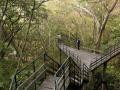
Basically, both Minh Chau and Quan Lan localities have quite favorable conditions for developing ecotourism. However, Quan Lan commune has more advantages to develop ecotourism in a humanistic direction, because this is an area with many famous historical relics such as Quan Lan Communal House, Quan Lan Pagoda, Temple worshiping the hero Tran Khanh Du, ... along with local festivals held annually such as the wind praying ceremony (March 15), Quan Lan festival (June 10-19); due to its location near the port and long exploitation time, the beaches in Quan Lan commune (especially Quan Lan beach) are no longer hygienic and clean to ensure the needs of tourists coming to relax and swim; this is also an area with many beautiful landscapes such as Got Beo wind pass, Ong Phong head, Voi Voi cave, but the ability to access these places is still very limited (dirt hill road, lots of gravel and rocks), especially during rainy and windy times; In addition, other natural resources such as mangrove forests and sea worms have not been really exploited for tourism purposes and ecotourism development. On the contrary, Minh Chau commune has more advantages in developing ecotourism in the direction of natural tourism, this is an area with diverse ecosystems such as at Rua De Beach, Bai Tu Long National Park Conservation Center...; Minh Chau beach is highly appreciated for its natural beauty and cleanliness, ranked in the top ten most beautiful beaches in Vietnam; Minh Chau commune is also home to Tram forest with a large area and a purity of up to 90%, suitable for building bridges through the forest (a very effective type of natural ecotourism currently applied by many countries) for tourists to sightsee, as well as for the purpose of studying and researching.
Figure 3.1: Thenmala Forest Bridge (India) Source: https://www.thenmalaecotourism.com/(August 21, 2019)
3.2.2. Using SWOT matrix to evaluate Quan Lan island tourism
General assessment of current tourism activities of Quan Lan island is shown through the following SWOT matrix:
Table 3.5: SWOT matrix evaluating tourism activities on Quan Lan island
Internal agent
Strengths- There is a lot of potential for tourism development, especially natural ecotourism and humanistic ecotourism.- The unskilled labor force is relatively abundant.- resource environmentunpolluted, still
Weaknesses- Poorly developed infrastructure, especially traffic routes to tourist destinations on the island.- The team of professional staff is still weak.- Tourism products in general
quite wild, originalintact
general and DLST in particularalone is monotonous.
External agents
Opportunity- Tourism is a key industry in the socio-economic development strategy of the province and Van Don economic zone.- Quan Lan was selected as a pilot area for eco-tourism development within the framework of the green growth project between Quang Ninh province and the Japanese organization JICA.- The flow of tourists and especially ecotourism in the world tends toincreasing
Challenge- Weather and climate change abnormally.- Competition in tourism products is increasingly fierce, especially with other localities in the province such as Ha Long, Mong Cai...- Awareness of tourists, especially domestic tourists, about ecotourism and nature conservation is not high.
Through summary analysis using SWOT matrix we see that:
To exploit strengths and take advantage of opportunities, it is necessary to:
- Diversify products and service types (build more tourism routes aimed at specific needs of tourists: experiential tourism immersed in nature, spiritual cultural tourism...)
- Effective exploitation of resources and differentiated products (natural resources and human resources)
div.maincontent .p { color: black; font-family:"Times New Roman", serif; font-style: normal; font-weight: normal; text-decoration: none; font-size: 14pt; margin:0pt; } div.maincontent p { color: black; font-family:"Times New Roman", serif; font-style: normal; font-weight: normal; text-decoration: none; font-size: 14pt; margin:0pt; } div.maincontent .s1 { color: black; font-family:"Times New Roman", serif; font-style: normal; font-weight: normal; text-decoration: none; font-size: 13pt; } div.maincontent .s2 { color: black; font-family:"Times New Roman", serif; font-style: normal; font-weight: normal; text-decoration: none; font-size: 13pt; } div.maincontent .s3 { color: #0D0D0D; font-family:"Times New Roman", serif; font-style: normal; font-weight: bold; text-decoration: none; font-size: 14pt; } div.maincontent .s4 { color: black; font-family:"Times New Roman", serif; font-style: italic; font-weight: normal; text-decoration: none; font-size: 14pt; } div.maincontent .s5 { color: black; font-family:"Times New Roman", serif; font-style: italic; font-weight: bold; text-decoration: none; font-size: 14pt; } div.maincontent .s6 { color: black; font-family:"Times New Roman", serif; font-style: italic; font-weight: normal; text-decoration: none; font-size: 14pt; vertical-align: -3pt; } div.maincontent .s7 { color: black; font-family:"Times New Roman", serif; font-style: italic; font-weight: normal; text-decoration: none; font-size: 14pt; vertical-align: -2pt; } div.maincontent .s8 { color: black; font-family:"Times New Roman", serif; font-style: italic; font-weight: normal; text-decoration: none; font-size: 14pt; vertical-align: -1pt; } div.maincontent .s9 { color: black; font-family:"Times New Roman", serif; font-style: normal; font-weight: normal; text-decoration: none; font-size: 14pt; } div.maincontent .s10 { color: black; font-family:"Times New Roman", serif; font-style: normal; font-weight: bold; text-decoration: none; font-size: 14pt; } div.maincontent .s11 { color: black; font-family:"Times New Roman", serif; font-style: normal; font-weight: normal; text-decoration: none; font-size: 14pt; } div.maincontent .s12 { color: black; font-family:Symbol, serif; font-style: normal; font-weight: normal; text-decoration: none; font-size: 14pt; } div.maincontent .s13 { color: black; font-family:Wingdings; font-style: normal; font-weight: normal; text-decoration: none; font-size: 14pt; } div.maincontent .s14 { color: black; font-family:"Times New Roman", serif; font-style: normal; font-weight: normal; text-decoration: none; font-size: 9pt; vertical-align: 5pt; } div.maincontent .s15 { color: black; font-family:"Times New Roman", serif; font-style: normal; font-weight: normal; text-decoration: none; font-size: 9pt; vertical-align: 5pt; } div.maincontent .s16 { color: black; font-family:Cambria, serif; font-style: italic; font-weight: normal; text-decoration: none; font-size: 14pt; } div.maincontent .s17 { color: #080808; font-family:"Times New Roman", serif; font-style: normal; font-weight: bold; text-decoration: none; font-size: 14pt; } div.maincontent .s18 { color: #080808; font-family:"Times New Roman", serif; font-style: normal; font-weight: normal; text-decoration: none; font-size: 14pt; } div.maincontent .s19 { color: black; font-family:"Times New Roman", serif; font-style: normal; font-weight: normal; text-decoration: none; font-size: 11pt; } div.maincontent .s20 { color: black; font-family:"Times New Roman", serif; font-style: normal; font-weight: normal; text-decoration: none; font-size: 10pt; } div.maincontent .s21 { color: black; font-family:"Times New Roman", serif; font-style: normal; font-weight: bold; text-decoration: none; font-size: 11pt; } div.maincontent .s22 { color: black; font-family:"Times New Roman", serif; font-style: normal; font-weight: normal; text-decoration: none; font-size: 11pt; } div.maincontent .s23 { color: black; font-family:"Times New Roman", serif; font-style: italic; font-weight: normal; text-decoration: none; font-size: 14pt; } div.maincontent .s24 { color: #212121; font-family:"Times New Roman", serif; font-style: normal; font-weight: normal; tex
Identify Rating Levels and Rating Scales
zt2i3t4l5ee
zt2a3gstourism,quan lan,quang ninh,ecology,ecotourism,minh chau,van don,geography,geographical basis,tourism development,science
zt2a3ge
zc2o3n4t5e6n7ts
of the islanders. Therefore, this indicator will be divided into two sub-indicators:
a1. Natural tourism attractiveness a2. Cultural tourism attractiveness
b. Tourist capacity
The two island communes in Quan Lan have different capacities to receive tourists. Minh Chau Commune is home to many standard hotels and resorts, attracting high-income domestic and international tourists. Meanwhile, Quan Lan Commune has many motels mainly built and operated by local people, so the scale and quality are not high, and will be suitable for ordinary tourists such as students.
c. Time of exploitation of Quan Lan Island Commune:
Quan Lan tourism is seasonal due to weather and climate conditions and festivals only take place on certain days of the year, specifically in spring. In Quan Lan commune, the period from April to June and from September to November is considered the best time to visit Quan Lan because the cultural tourism activities are mainly associated with festivals taking place during this time.
Minh Chau island commune:
Tourism exploitation time is all year round, because this is a place with a number of tourist attractions with diverse ecosystems such as Bai Tu Long National Park Research Center, Tram forest, Turtle Laying Beach, so besides coming to the beach for tourism and vacation in the summer, Minh Chau will attract research groups to come for tourism combined with research at other times of the year.
d. Sustainability
The sustainability of ecotourism sites in Quan Lan and Minh Chau communes depends on the sensitivity of the ecosystems to climate changes.
landscape. In general, these tourist destinations have a fairly high level of sustainability, because they are natural ecosystems, planned and protected. However, if a large number of tourists gather at certain times, it can exceed the carrying capacity and affect the sustainability of the environment (polluted beaches, damaged trees, animals moving away from their habitats, etc.), then the sustainability of the above ecosystems (natural ecosystems, human ecosystems) will also be affected and become less sustainable.
e. Location and accessibility
Both island communes have ports to take tourists to visit from Van Don wharf:
- Quan Lan – Van Don traffic route:
Phuc Thinh – Viet Anh high-speed boat and Quang Minh high-speed boat, depart at 8am and 2pm from Van Don to Quan Lan, and at 7am and 1pm from Quan Lan to Van Don. There are also wooden boats departing at 7am and 1pm.
- Van Don - Minh Chau traffic route:
Chung Huong high-speed train, Minh Chau train, morning 7:30 and afternoon 13:30 from Van Don to Minh Chau, morning 6:30 and afternoon 13:00 from Minh Chau to Van Don.
f. Infrastructure
Despite receiving investment attention, the issue of infrastructure and technical facilities for tourism on Quan Lan Island is still an issue that needs to be resolved because it has a direct impact on the implementation of ecotourism activities. The minimum conditions for serving tourists such as accommodation, electricity, water, communication, especially medical services, and security work need to be given top priority. Ecotourism spots in Minh Chau commune are assessed to have better infrastructure and technical facilities for tourism because there are quite complete and synchronous conditions for serving tourists, meeting many needs of domestic and foreign tourists.
3.2.1.4. Determine assessment levels and assessment scales
Corresponding to the levels of each criterion, the index is the score of those levels in the order of 4, 3, 2, 1 decreasing according to the standard of each level: very attractive (4), attractive (3), average (2), less attractive (1).
3.2.1.5. Determining the coefficients of the criteria
For the assessment of DLST in the two communes of Quan Lan and Minh Chau islands, the students added evaluation coefficients to show the importance of the criteria and indicators as follows:
Coefficient 3 with criteria: Attractiveness, Exploitation time. These are the 2 most important criteria for attracting tourists to tourism in general and eco-tourism in particular, so they have the highest coefficient.
Coefficient 2 with criteria: Capacity, Infrastructure, Location and accessibility . Because the assessment area is an island commune of Van Don district, the above criteria are selected by the author with appropriate coefficients at the average level.
Coefficient 1 with criteria: Sustainability. Quan Lan has natural and human-made ecotourism sites, with high biodiversity and little impact from local human factors. Most of the ecotourism sites are still wild, so they are highly sustainable.
3.2.1.6. Results of DLST assessment on Quan Lan island
a. Assessment of the potential for natural tourism development
For Minh Chau commune:
+ Natural tourism attractiveness is determined to be very attractive (4 points) and the most important coefficient (coefficient 3), so the score of the Attractiveness criterion is 4 x 3 = 12.
+ Capacity is determined as average (2 points) and the coefficient is quite important (coefficient 2), then the score of Capacity criterion is 2 x 2 = 4.
+ Exploitation time is long (4 points), the most important coefficient (coefficient 3) so the score of the Exploitation time criterion is 4 x 3 = 12.
+ Sustainability is determined as sustainable (4 points), the important coefficient is the average coefficient (coefficient 1), so the score of the Sustainability criterion is 4 x 1 = 4 points
+ Location and accessibility are determined to be quite favorable (2 points), the coefficient is quite important (coefficient 2), the criterion score is 2 x 2 = 4 points.
+ Infrastructure is assessed as good (3 points), the coefficient is quite important (coefficient 2), then the score of the Infrastructure criterion is 3 x 2 = 6 points.
The total score for evaluating DLST in Minh Chau commune according to 6 evaluation criteria is determined as: 12 + 4 + 12 + 4 + 4 + 6 = 42 points
Similar assessment for Quan Lan commune, we have the following table:
Table 3.3: Assessment of the potential for natural ecotourism development in Quan Lan and Minh Chau communes
Attractiveness of self-tourismof course
Capacity
Mining time
Sustainability
Location and accessibility
Infrastructure
Result
Point
DarkMulti
Point
DarkMulti
Point
DarkMulti
Point
DarkMulti
Point
DarkMulti
Point
DarkMulti
CommuneMinh Chau
12
12
4
8
12
12
4
4
4
8
6
8
42/52
Quan CommuneLan
6
12
6
8
9
12
4
4
4
8
4
8
33/52
b. Assessment of the potential for humanistic tourism development
For Quan Lan commune:
+ The attractiveness of human tourism is determined to be very attractive (4 points) and the most important coefficient (coefficient 3), so the score of the Attractiveness criterion is 4 x 3 = 12.
+ Capacity is determined to be large (3 points) and the coefficient is quite important (coefficient 2), then the score of the Capacity criterion is 3 x 2 = 6.
+ Mining time is average (3 points), the most important coefficient (coefficient 3) so the score of the Mining time criterion is 3 x 3 = 9.
+ Sustainability is determined as sustainable (4 points), the important coefficient is the average coefficient (coefficient 1), so the score of the Sustainability criterion is 4 x 1 = 4 points.
+ Location and accessibility are determined to be quite favorable (2 points), the coefficient is quite important (coefficient 2), the criterion score is 2 x 2 = 4 points.
+ Infrastructure is rated as average (2 points), the coefficient is quite important (coefficient 2), then the score of the Infrastructure criterion is 2 x 2 = 4 points.
The total score for evaluating DLST in Quan Lan commune according to 6 evaluation criteria is determined as: 12 + 6 + 6 + 4 + 4 + 4 = 36 points.
Similar assessment with Minh Chau commune we have the following table:
Table 3.4: Assessment of the potential for developing humanistic eco-tourism in Quan Lan and Minh Chau communes
Attractiveness of human tourismliterature
Capacity
Mining time
Sustainability
Location and accessibility
Infrastructure
Result
Point
DarkMulti
Point
DarkMulti
Point
DarkMulti
Point
DarkMulti
Point
DarkMulti
Point
DarkMulti
Quan CommuneLan
12
12
6
8
9
12
4
4
4
8
4
8
39/52
Minh CommuneChau
6
12
4
8
12
12
4
4
4
8
6
8
36/52
Basically, both Minh Chau and Quan Lan localities have quite favorable conditions for developing ecotourism. However, Quan Lan commune has more advantages to develop ecotourism in a humanistic direction, because this is an area with many famous historical relics such as Quan Lan Communal House, Quan Lan Pagoda, Temple worshiping the hero Tran Khanh Du, ... along with local festivals held annually such as the wind praying ceremony (March 15), Quan Lan festival (June 10-19); due to its location near the port and long exploitation time, the beaches in Quan Lan commune (especially Quan Lan beach) are no longer hygienic and clean to ensure the needs of tourists coming to relax and swim; this is also an area with many beautiful landscapes such as Got Beo wind pass, Ong Phong head, Voi Voi cave, but the ability to access these places is still very limited (dirt hill road, lots of gravel and rocks), especially during rainy and windy times; In addition, other natural resources such as mangrove forests and sea worms have not been really exploited for tourism purposes and ecotourism development. On the contrary, Minh Chau commune has more advantages in developing ecotourism in the direction of natural tourism, this is an area with diverse ecosystems such as at Rua De Beach, Bai Tu Long National Park Conservation Center...; Minh Chau beach is highly appreciated for its natural beauty and cleanliness, ranked in the top ten most beautiful beaches in Vietnam; Minh Chau commune is also home to Tram forest with a large area and a purity of up to 90%, suitable for building bridges through the forest (a very effective type of natural ecotourism currently applied by many countries) for tourists to sightsee, as well as for the purpose of studying and researching.
Figure 3.1: Thenmala Forest Bridge (India) Source: https://www.thenmalaecotourism.com/(August 21, 2019)
3.2.2. Using SWOT matrix to evaluate Quan Lan island tourism
General assessment of current tourism activities of Quan Lan island is shown through the following SWOT matrix:
Table 3.5: SWOT matrix evaluating tourism activities on Quan Lan island
Internal agent
Strengths- There is a lot of potential for tourism development, especially natural ecotourism and humanistic ecotourism.- The unskilled labor force is relatively abundant.- resource environmentunpolluted, still
Weaknesses- Poorly developed infrastructure, especially traffic routes to tourist destinations on the island.- The team of professional staff is still weak.- Tourism products in general
quite wild, originalintact
general and DLST in particularalone is monotonous.
External agents
Opportunity- Tourism is a key industry in the socio-economic development strategy of the province and Van Don economic zone.- Quan Lan was selected as a pilot area for eco-tourism development within the framework of the green growth project between Quang Ninh province and the Japanese organization JICA.- The flow of tourists and especially ecotourism in the world tends toincreasing
Challenge- Weather and climate change abnormally.- Competition in tourism products is increasingly fierce, especially with other localities in the province such as Ha Long, Mong Cai...- Awareness of tourists, especially domestic tourists, about ecotourism and nature conservation is not high.
Through summary analysis using SWOT matrix we see that:
To exploit strengths and take advantage of opportunities, it is necessary to:
- Diversify products and service types (build more tourism routes aimed at specific needs of tourists: experiential tourism immersed in nature, spiritual cultural tourism...)
- Effective exploitation of resources and differentiated products (natural resources and human resources)
div.maincontent .p { color: black; font-family:"Times New Roman", serif; font-style: normal; font-weight: normal; text-decoration: none; font-size: 14pt; margin:0pt; } div.maincontent p { color: black; font-family:"Times New Roman", serif; font-style: normal; font-weight: normal; text-decoration: none; font-size: 14pt; margin:0pt; } div.maincontent .s1 { color: black; font-family:"Times New Roman", serif; font-style: normal; font-weight: normal; text-decoration: none; font-size: 13pt; } div.maincontent .s2 { color: black; font-family:"Times New Roman", serif; font-style: normal; font-weight: normal; text-decoration: none; font-size: 13pt; } div.maincontent .s3 { color: #0D0D0D; font-family:"Times New Roman", serif; font-style: normal; font-weight: bold; text-decoration: none; font-size: 14pt; } div.maincontent .s4 { color: black; font-family:"Times New Roman", serif; font-style: italic; font-weight: normal; text-decoration: none; font-size: 14pt; } div.maincontent .s5 { color: black; font-family:"Times New Roman", serif; font-style: italic; font-weight: bold; text-decoration: none; font-size: 14pt; } div.maincontent .s6 { color: black; font-family:"Times New Roman", serif; font-style: italic; font-weight: normal; text-decoration: none; font-size: 14pt; vertical-align: -3pt; } div.maincontent .s7 { color: black; font-family:"Times New Roman", serif; font-style: italic; font-weight: normal; text-decoration: none; font-size: 14pt; vertical-align: -2pt; } div.maincontent .s8 { color: black; font-family:"Times New Roman", serif; font-style: italic; font-weight: normal; text-decoration: none; font-size: 14pt; vertical-align: -1pt; } div.maincontent .s9 { color: black; font-family:"Times New Roman", serif; font-style: normal; font-weight: normal; text-decoration: none; font-size: 14pt; } div.maincontent .s10 { color: black; font-family:"Times New Roman", serif; font-style: normal; font-weight: bold; text-decoration: none; font-size: 14pt; } div.maincontent .s11 { color: black; font-family:"Times New Roman", serif; font-style: normal; font-weight: normal; text-decoration: none; font-size: 14pt; } div.maincontent .s12 { color: black; font-family:Symbol, serif; font-style: normal; font-weight: normal; text-decoration: none; font-size: 14pt; } div.maincontent .s13 { color: black; font-family:Wingdings; font-style: normal; font-weight: normal; text-decoration: none; font-size: 14pt; } div.maincontent .s14 { color: black; font-family:"Times New Roman", serif; font-style: normal; font-weight: normal; text-decoration: none; font-size: 9pt; vertical-align: 5pt; } div.maincontent .s15 { color: black; font-family:"Times New Roman", serif; font-style: normal; font-weight: normal; text-decoration: none; font-size: 9pt; vertical-align: 5pt; } div.maincontent .s16 { color: black; font-family:Cambria, serif; font-style: italic; font-weight: normal; text-decoration: none; font-size: 14pt; } div.maincontent .s17 { color: #080808; font-family:"Times New Roman", serif; font-style: normal; font-weight: bold; text-decoration: none; font-size: 14pt; } div.maincontent .s18 { color: #080808; font-family:"Times New Roman", serif; font-style: normal; font-weight: normal; text-decoration: none; font-size: 14pt; } div.maincontent .s19 { color: black; font-family:"Times New Roman", serif; font-style: normal; font-weight: normal; text-decoration: none; font-size: 11pt; } div.maincontent .s20 { color: black; font-family:"Times New Roman", serif; font-style: normal; font-weight: normal; text-decoration: none; font-size: 10pt; } div.maincontent .s21 { color: black; font-family:"Times New Roman", serif; font-style: normal; font-weight: bold; text-decoration: none; font-size: 11pt; } div.maincontent .s22 { color: black; font-family:"Times New Roman", serif; font-style: normal; font-weight: normal; text-decoration: none; font-size: 11pt; } div.maincontent .s23 { color: black; font-family:"Times New Roman", serif; font-style: italic; font-weight: normal; text-decoration: none; font-size: 14pt; } div.maincontent .s24 { color: #212121; font-family:"Times New Roman", serif; font-style: normal; font-weight: normal; tex -
 Ha Doi Temple and the Giai Market Festival – Tien Thanh Commune Ha Doi Temple, a Valuable Historical and Artistic Relic.
 -
 Historical relic and festival of Trang Trinh Nguyen Binh Khiem Temple in Vinh Bao district, Hai Phong - 9
 -
 Strengthening Resources for Organizing Tourism Activities of Local Communities and Historical and Cultural Relic Management Units
 -
 Solutions for Restoring Historical and Cultural Relics, Developing Traditional Festivals and Upgrading Resorts and Entertainment Areas to Serve the Needs of Tourism
Mr. Hoang Bo (Ba) is worshiped at Lanh Giang Temple (Lenh Giang), Ha Nam and Hung Yen as a water god who helped fight the enemy. Mr. Hoang Bo, the grandson of Mr. Nguyen Long Canh, is worshiped in Nguyet Ang village, Dai Ang commune, Thanh Tri district, Hanoi, for his contribution in fighting the Ma Na enemy.
Mr. Hoang Bay is often called Mr. Bay Bao Ha. According to legend, he was the son of the King. Following the king's order, he descended to earth to become the seventh son of the Nguyen clan, Le dynasty (Canh Hung era 1740-1786). At that time, the entire Quy Hoa region, especially Thuy Vi and Van Ban districts, were constantly being plundered by bandits. Faced with that situation, the court appointed the seventh famous general of the Nguyen family to guard the border area. He led his army along the Red River to repel the bandits, liberate Van Ban district and consolidate Bao Ha into a strong base.

In an unequal battle with the enemy, he heroically sacrificed himself, his body drifted down the Red River to Bao Ha and then washed ashore. Because of his contributions to the people, the people in the area built a temple to remember his merits.
Mr. Hoang Muoi is worshiped in Ben Cui, on the bank of Lam River, Ha Tinh, a general of the Le Thai To dynasty (some say he was General Nguyen Xi). According to legend in Nghe An region, he was assigned by King Le to guard Nghe An. He just had
He also had the merit of taking care of and comforting the people to do business, opening up trade with all regions. Thanks to that, the people's lives became more and more prosperous. One year, foreign invaders invaded, he rushed into battle, urging the soldiers to defeat the invaders, keeping the border peaceful. When he returned victorious from the invaders, a hurricane came, and countless houses of the people were destroyed and damaged. Pitying the people, he and his soldiers went up the mountain to cut bamboo and cut wood to bring back to help the people. One unfortunate time, when the raft reached the foot of Ngan Hong (Hong Linh), Ngu Ma mountain, a hurricane came and broke the raft. He met with an accident. Before the soldiers and villagers could bury him, termites had piled up to build a tomb. The tomb grew visibly larger each day. Admiring and grateful to him, the people in the area built a temple to worship him on Ngu Ma mountain. After his death, he was still sacred, often appearing as a Saint to help the people. Also in Nghe An, Ong Hoang Muoi is also identified by the people with famous historical figures associated with this countryside such as Uy Minh Vuong Ly Nhat Quang, the 8th son of Ly Thai To...
At the Tu Phu Temple in Nghe Temple, Hai Phong, the representatives of the Four Palaces Quan Hoang are shown: on the left of the worshiping hall is the altar of Hoang Muoi. The upper one sits in a red-lacquered and gilded altar, with two statues of a girl and a boy on either side. Hoang Bay is worshiped on the right side of the worshiping hall. Like Hoang Muoi, Hoang Bay sits in a red-lacquered and gilded altar, with two statues of a girl and a boy on either side. Both of them are trustworthy supporters, supporting the king, helping the country and bringing peace to the people. They are trusted by the people and are the pride of the people.
The Four Palace Holy Ladies and Four Palace Holy Boys are the lowest ranking, the assistant servants – they are the force that deeply respects the Mother, often gathering around the Mother.
…
The Son Trang altar depicts a stone cave. In the center of the cave is a statue of the Son Trang Goddess, who is attended by 12 fairies, arranged throughout the cave.
The Tran Dynasty altar worships Hung Dao Dai Vuong Tran Quoc Tuan. Tran Hung Dao was the National Duke and Commander-in-Chief of the Dai Viet army at that time. Together with
King Tran, he commanded the army and people of Dai Viet to defeat the Yuan-Mongol invaders three times in the 13th century. King Tran called him Thuong Quoc Cong, comparing him to Lu Vuong who helped King Vu of Zhou. King Tran granted him the title Hung Dao Dai Vuong.
In folklore, Tran Hung Dao is a saint who keeps the world pure and has the “magic” to exorcise evil spirits. People respectfully call him “Tran Trieu Hien Thanh” (a saint of the Tran Dynasty). The idol is placed in a shrine, wearing a dragonfly-winged hat, a martial arts uniform, and his hands on his knees.
2.3.6. Value of the historical and cultural relic of Nghe Temple
2.3.6.1. Artistic value
At first, Nghe Temple was just a small thatched temple. In 1919, the temple's back palace was built. In 1925, the back palace was renovated. In 1926, the front palace was built. This is a historical relic complex including stone elephants, stone horses, stone beds, stone stele recording the biography of Mrs. Le Chan and architectural buildings showing the skillful traditional sculpture of many centuries ago. The worshiping hall consists of 5 compartments supported by 16 ironwood columns, placed on 16 meticulously carved stone blocks. In the middle of the roof of the worshiping hall, there is a large Chinese character "An Bien Co Mieu". The back palace consists of 3 compartments, built higher than the worshiping hall with a 2-story roof design, increasing the grandeur and majesty of the building. The unique feature of Nghe Temple architecture is the art of carving on wood and stone. With themes of dragons, unicorns, turtles, phoenixes, pines, chrysanthemums, bamboos, and apricots... showing the techniques of carving shapes, reliefs, and sunken carvings that have reached a sophisticated level. Currently, Nghe Temple still preserves many valuable stone sculptures. A typical example is the large stone stele carved during the Nguyen Dynasty, recording the biography of female general Le Chan. The worshiping hall hangs a stone bell with embossed dragon and cloud dance themes, with sophisticated, soft, and graceful lines. In the incense-burning hall, there is a massive stone bed, made from a single block of stone, with elaborate embossed images of birds, animals, flowers, and leaves. In the rear palace, the statue of the female general sits on a throne, placed in a large red-lacquered, gilded altar with a majestic, kind, and beautiful appearance.
2.3.6.2.Historical value
The historical and cultural relic of Nghe Temple is an important evidence in the construction of the present An Bien area. The relic is also associated with historical stories that are legendary but truthfully reflect the war against the French colonialists (April 1874). The architectural work of Nghe Temple is also the result of the construction and renovation process of An Bien villagers. That shows the spirit of solidarity, mutual support for the common work of the village and together contribute to fight against foreign invaders.
2.3.6.3.Human values
The Mother Goddess worship in our country is an indigenous belief that emerged from primitive times with the role of women in matriarchal society. Initially, this belief worshiped agricultural gods through magic (clouds, rain, thunder, electricity) to help agriculture. Later, due to the introduction of Buddhism, it developed into the Mother Goddess worship. The Mother Goddess worship with the meaning of a mother with the power to reproduce, preserve and protect people has existed in Vietnamese folklore since ancient times. At the Nghe temple relic, the image of the Mother Goddess not only has the power of a mother, but also the female general Le Chan had the merit of killing the enemy, saving the country and establishing the land, establishing An Bien village - the predecessor of Hai Phong city. Those jobs were originally the work of men or of gods, saints, but she, a woman, was a real historical figure who created legendary stories marking heroic feats.
The Three Holy Mothers and the Four Palaces are a creative system that represents the primitive worldview and philosophy of life of the Vietnamese people. When entering the temple, everyone has the same feeling of respect and gratitude, educating people on the morality of drinking water and remembering its source.
2.4. Nghe Temple Festival
To remember the merits of Female General Le Chan, since ancient times, Hai Phong people have organized many festival activities at Nghe Temple to express their admiration and gratitude to a talented and confidant general of the Trung Vuong dynasty. Among them
Among many festival activities, the Thanh Dan festival (Nghe temple festival) is held more solemnly and on a larger scale. Those spiritual values, over time, have crystallized into priceless cultural values of the nation in general and in the consciousness of the people of Hai Phong city in particular, continuing to be passed down from generation to generation.
2.4.1. Name and origin of the festival
Nghe Temple Festival is called Thanh Dan Festival, which means the day the Saint was born.
2.4.2. Festival space and time
The festival takes place from the 7th to the 10th of the second lunar month every year. This is also an occasion to commemorate the birthday of Princess Thanh Chan (the 8th of the second lunar month).
Associated with the An Bien village festival space are the relics: An Bien communal house and Nghe temple. The communal house is the main space where the village festival takes place, the temple is the place to worship the saints and the place where the procession of the gods and spirits to the communal house begins. Although the communal house is the place where the main activities of the festival take place, the saint resides in Nghe temple, so at Nghe temple, the rituals are held solemnly and respectfully.
2.4.3. Purpose and reasons for organizing the festival
This is one of the biggest festivals ever in the locality, an important event of the Party Committee, government and people in the district, demonstrating the responsibility and respect of the current generations, contributing to honoring the merits of Female General Le Chan. The successful organization of the festival not only meets the expectations of the local people, but also contributes to reviewing traditions, educating children and grandchildren about patriotism, the morality of drinking water and remembering its source, national pride and the responsibility of each citizen towards Le Chan district, Hai Phong city and Vietnam.
2.4.4. Content of the festival
2.4.4.1. Traditional festivals
* Ceremony
Before the Holy Birthday Ceremony, the villagers elect a committee to run the festival. According to the traditional ritual, the members of the committee are the village elders and dignitaries of the village (Chief of the village, Deputy Chief of the village) and commune (Village Chief, Village Chief). Those who participate in the festival must abstain from many things: no funerals in the family, having both children, being healthy, abstaining from sexual relations, etc.
On February 7, people perform the Naturalization Ceremony (also known as the Funeral Ceremony). The Funeral Ceremony is a preparation ceremony for the main festival day. The head of the temple informs the gods and asks for permission to prepare for the main festival day. The head of the temple and the temple caretakers direct the cleaning of the temple area, remove damaged items in the temple, purchase and supplement necessary equipment for the festival, clean the temple, and pack the sacrificial objects: halberds, bowls, palanquins, etc. The packing of the sacrificial objects must be done with clean water and towels to purify them.
On the 7th day, the abbot performs the Moc Duc (Statu Bathing Ceremony), an important ritual in the Funeral Ceremony. The abbot lights incense, casts a yin and yang hexagram to see if the gods approve of the Moc Duc (Statu Bathing) Ceremony. If approved (by the yin and yang hexagram), the abbot will bring the statue to the main worship hall or to the yard. The water for bathing the statue is carried by a man who goes to the middle of the Tam Bac River to get a jar of water, then carries it back to cover the statue. After bathing the statue, he uses scented water (five-spice powder) to fumigate and changes the statue into a new outfit. People call it the Moc Duc (Statu Bathing) Ceremony with the hope that the new idol will bring much happiness to the people.
At the same time as the naturalization ceremony, all preparations for the festival in terms of people and facilities were also completed on the 7th.
After the Bathing Ceremony is the Announcing Ceremony. The Announcing Ceremony is a ceremony to report to the gods that all preparations have been completed in preparation for the main ceremony day. The offerings used in the Announcing Ceremony include 2 trays of sticky rice and 2 chickens.
The Sacrifice Ceremony is the most solemn and important ceremony at the Temple. The offerings are handled by the Cai Dam of that year, mainly pigs, each weighing about 70kg. The pigs for worship are assigned by the village to the Cai Dam of that year to raise. The pigs must be carefully selected and raised, must be called Ông heo (holy pig), and must be fed a special diet, different from regular pigs. On the day of the ceremony, they will be bathed and released separately. The pigs must be of the right weight, if they are underweight, the Cai Dam of that year must take responsibility, and must pay the village 5 hao and a foot of wine. The heads and tails of the pigs are slaughtered to make offerings on the incense altar. Outside the communal house, people also perform the Mao Huyet Ceremony (offering the blood and nape of the pig to purify and open the light). In addition to the offerings, the Ceremony Committee appoints someone to write the sacrificial text, usually written by a well-educated and prestigious person in the village (shamans or mandarins). The eulogy praises the saint's merits, expressing the people's wishes to Princess Le Thanh to be blessed with rain for a bountiful harvest, abundant seafood, and to pray for protection so that the people can be warm and prosperous, the country will be peaceful, the people will be healthy and prosperous.
When the offerings were completed, before being brought to Dinh An Bien, the ceremony committee organized the ceremony at Nghe Temple. The ceremony committee consisted of 17 people; one chairman, one Eastern chanter, one Western chanter, and 12 deacons, divided equally on both sides. The ceremony committee was arranged along the sacred axis on both sides of the incense altar, with mats spread out on the ground.
The first ceremony is the Presentation Ceremony. The Presentation Ceremony begins when Dong calls out: "Start the ancient gong", at this time the 2 Deacons beat the drum 3 times, 3 gongs, Dong continues to call out: "Quan tay so" then the Chief Priest proceeds to wash his hands in the available basin of scented water, then Dong calls out: "Phe can", the Chief Priest proceeds to wipe his hands and prepare to perform the ceremony. Next calls out: "Nghe huong tien" then the Chief Priest goes up to the mat first with his hands clasped. Next calls out: "Thuong huong": two attendants light candles and incense and place them on the incense table, the first steps in and out are all facing forward, not turning their backs. In many ceremonies, the ceremonial committee advances and retreats according to the word "a". Next calls out: "Nghenh Hoang"
The Emperor bows down to the majestic and sacred Princess of the South Sea, the Holy Chan Princess bows down. The Chief Priest kneels down and bows five times, and the Assistant Priest also bows. The West chants: “Hung”, the Chief Priest and the Assistant Priest stand up and take their seats. The East chants: “Binh than thu vi”. Each movement is accompanied by music (drums, gongs) to serve as the background for the ceremony. The presentation is complete.
Next is the Offering Ceremony. At the beginning of the ceremony, the Eastern chants: "Offering incense and flowers". The Master of Ceremonies beats the drum three times, and two Priests offer flowers according to the ritual: first beat: Place hands on the offering; second beat: Bring it forward; third beat: Offer it to the head. Following the rhythm, the Priests advance to offer flowers before the incense altar and then return (return to their positions). Following the flower offering ceremony is the tea offering ceremony in the same order as the flower offering ceremony. After all three rounds, the Master of Ceremonies thanks; "The Emperor bows and bows" and then bows five times, then the entire group of Priests bows five times. The ceremony is over.
After the ceremony at the Temple ends, the procession will bring the incense bowl from the Temple onto the palanquin to be carried to An Bien communal house. Before the palanquin departs, from the Temple, drums and gongs will be beaten continuously to let everyone know to prepare to participate. When the palanquin leaves the temple, the palanquin will stop for a while so that everyone can line up. The order of the procession is as follows:
At the head is the signal flag, followed by 5 pennant flags, the colors of which are according to the Five Elements: yellow flag, red flag, blue flag, white flag and black flag. The flag bearers appointed by the village are all strong young men, wearing brown clothes. Following the five element flag is a large drum carried by 2 people, one person beats the drum (called the Head Drum). This person is also the music conductor of the procession and someone holds the umbrella. Next is the gong carried by 2 people and one person beats it. The drums and gongs will keep the rhythm for the procession. Next are the people carrying the bowl and the halberd, behind the bowl bearer are 2 people walking side by side carrying the sign: "Tinh tuc" (keep solemn) and the sign: "Hoi ty" (turn away when seeing). The people carrying the bowl and the halberd are all strong young men wearing brown clothes, similar to the flag bearers. After the group carrying the petition is the group of people who are in charge of the drum, one person holding a cymbal, two people holding a senh tien, and four people playing the five-beat drum. After the group of people who are in charge of the drum is the group of people who are in charge of the drum.