
are stored in warehouses for storage, can be transported to other places according to market demand, the service supply process is closely linked to service consumption. On the contrary, services cannot be stored because the production and consumption processes take place simultaneously, so services cannot be mass produced and stored in warehouses before being consumed.
- Heterogeneity : Services are closely linked to the service provider. Quality depends closely on the service provider (qualifications, skills, etc.). Furthermore, for the same service provider, service quality sometimes changes over time.
2.4.2. Service quality
In today’s competitive economic environment, service quality is essential for the success of any organization. Service quality is a key factor that affects business competitiveness. Banks must always improve service quality continuously because there is no guarantee that the current excellent services will be suitable for the future. Thus, banks need to develop new strategies to satisfy their customers and will provide quality services to gain competitive advantage over their competitors.
Service quality is the result of customers' evaluation of service quality based on criteria through their experiences and expectations and the influence of the company's image. With intangible, heterogeneous, inseparable and non-storeable characteristics, it is difficult to evaluate service quality. Therefore, recognizing the factors affecting service quality is necessary to identify, measure, control and improve customer perceptions of service quality.
Service quality is defined in many different ways depending on the subject and research environment. According to Parasuraman et al. (1985): " Service quality is the gap between customers' expectations and their perceptions after using the service" . Each customer often feels differently about quality, so customer participation in developing and evaluating service quality is very important. In the service sector, service quality
is a function of customer perception. In other words, service quality is determined based on customers' perceptions, or feelings, in relation to their individual needs.
Although there are many studies on service quality, there is still no consensus on this concept, different researchers focus on different aspects of service quality. However, service quality always includes the following characteristics:
- Superiority : For customers, quality service is a service that demonstrates its superiority over other products.
- Product characteristics : Service quality is the sum of the most essential and quintessential aspects crystallized in the product or service, creating the characteristics of the product or service.
- Service delivery : Service quality is closely linked to the process of implementing/transferring services to customers. Therefore, service implementation, service style, and service delivery will determine whether the service quality is good or bad.
- Satisfaction of needs : Services are created to meet customer needs. Therefore, service quality must satisfy customer needs and customer requirements are the basis for improving service quality.
- Value creation : Service quality is closely linked to the values created to serve customers. Services that do not create any value are considered to have no quality. Businesses create value and customers are the recipients of those values.
2.4.3. Theory of customer satisfaction
There are many different definitions of customer satisfaction as well as many debates about this definition. Many researchers believe that satisfaction is the difference between customer expectations and actual perceptions received. According to Fornell (1995): “Satisfaction or disappointment after consumption, is defined as the customer's response to the evaluation by feeling the difference
between pre-consumption expectations and actual perceptions of a product after consuming it”.
According to Zeithaml & Bitner (2000): “Customer satisfaction is the customer's assessment of whether a product or service has met their needs and expectations”.
Kotler (2000) defines: “Satisfaction as a person's feeling of pleasure or disappointment resulting from comparing a product's (or outcome's) perceived performance (or outcome) in relation to his or her expectations”.
Customer satisfaction is the customer's subjective evaluation or judgment based on their understanding of a product or service. It is a form of psychological feeling after the customer's needs are satisfied. Customer satisfaction is formed on the basis of experiences, especially accumulated when purchasing and using products or services. After purchasing and using the product, the customer will compare reality and expectations, from which they can evaluate satisfaction or dissatisfaction.
Thus, it can be understood that the feeling of pleasure or disappointment arises from the buyer's comparison between the actual benefits of the product and their expectations. Whether the customer is satisfied or not after purchasing depends on the comparison between the actual benefits of the product and their expectations before purchasing. The concept of product here is understood not only as a normal physical object but also includes services.
This definition has revealed that satisfaction is a comparison between the actual benefits perceived and the expectations. If the actual benefits are not as expected, the customer will be disappointed. If the actual benefits meet the expectations, the customer will be satisfied. If the actual benefits are higher than the customer's expectations, it will create the phenomenon of higher satisfaction or satisfaction exceeding expectations.
2.4.4. The relationship between service quality and customer satisfaction
Service businesses often assume that service quality is the level of customer satisfaction. However, many researchers
shows that service quality and customer satisfaction are two distinct concepts (Zeithaml & Bitner 2000). Customer satisfaction is a general concept, expressing their satisfaction when consuming a product or service. Meanwhile, service quality only focuses on specific components of the service.
Today, the primary goal of service companies is to satisfy customer needs if they want to make a profit. They will continue to use the service and use it more if their needs are satisfied (Bitner & Hubbert, 1994). Measure customer satisfaction to know where the business's service has satisfied customers. Which services do customers consider satisfactory? From there, develop policies to maintain, edit, change, improve service quality, and increase customer satisfaction. Customer satisfaction can help businesses gain a significant competitive advantage. Businesses understand how customers feel after purchasing a product or service and specifically whether the product or service meets customer expectations or not? Customers form their expectations primarily through past purchasing experiences, word-of-mouth from family, friends, and colleagues, and information conveyed through marketing activities such as advertising or public relations. If customers’ expectations are not met, they will be dissatisfied and will likely tell others about it. Therefore, customer satisfaction has become an important factor in creating competitive advantage. High levels of satisfaction can bring many benefits, including repeat purchases, referrals, retention of choice, reduced costs, and higher prices, which are factors that indicate customer loyalty.
Service quality is the factor that has the greatest impact on customer satisfaction (Cronin and Taylor, 1992; Yavas et al, 1997; Ahmad and Kamal, 2002). If a service provider provides customers with quality products that satisfy their needs, the business has initially made customers satisfied. Therefore, to improve customer satisfaction, product and service providers must improve service quality. In other words, service quality and customer satisfaction are closely related, in which service quality
Service is what comes first and then determines customer satisfaction. The cause-and-effect relationship between these two factors is the key issue in most customer satisfaction studies.
2.4.5. The need to study factors affecting tourists' satisfaction with service quality
Tourism activities are increasingly appreciated by the world because tourism is not only an activity that brings high economic benefits but also an opportunity for people to exchange with different cultures, broaden and acquire new knowledge. The summary report of Vietnam Tourism Development Strategy to 2020, vision to 2030 affirmed that "Tourism has made important contributions to economic growth, hunger eradication, poverty reduction, ensuring social security, preserving and promoting cultural values, protecting the environment and maintaining national security and defense".
Before delving deeper into the socio-cultural impacts of tourism, tourism as a service industry is increasingly contributing significantly to the development of the local economy. Economic benefits from tourism activities include not only revenue from travel services used by tourists but also all services used and all goods exchanged during the tourists' journey in a locality. This is also known as the "on-site export" of goods and services of the locality that welcomes tourists. Therefore, tourism helps increase the gross domestic product and increase foreign exchange reserves.
In 2016, Vietnam's tourism industry welcomed 10,012.7 million international visitors, an increase of over 26% compared to 2015 (7,943.7 million) or nearly 3.7 times compared to 2000 (2,140.1 million). These strong developments have had an important contribution from tourism in localities across the country. In Ca Mau province alone, international visitors increased from 21,050 in 2015 to 23,120 in 2016. These modest numbers are not really commensurate with Ca Mau - a land of pristine nature with vast cajuput and mangrove forests and vast rivers and canals, containing many cultural colors.
unique
From the above results, in order for Ca Mau tourism to truly have an important impact on socio-economic development; bring in large foreign currency revenue, attract investment capital into the tourism sector, positively impact the development of many other economic sectors; create jobs for the social workforce, enhance the province's position among the provinces in the Southwest region as well as in the process of integration with the region and the world, we need a study, an objective study.
2.5. Customer satisfaction assessment model
2.5.1. Parasuraman's service quality model
The Servqual model developed by Parasuraman et al. (1988) has repeatedly tested the service quality model and concluded that service quality includes five basic components (Figure 2.1) with 22 component variables (Appendix 1):
1. Reliability : Demonstrates the ability to perform the service correctly and on time the first time.
2. Responsiveness : Demonstrated through the desire and willingness of service staff to provide timely service to customers.
3. Competence : Demonstrated through professional qualifications and polite, enthusiastic service to customers.
4. Empathy : Showing care and concern for each individual customer.
row.
5. Tangible : Shown through the appearance and uniform of the service staff,
service equipment
Reliability
Response
Satisfaction
Capacity
client
Empathetic
Tangible
Figure 2.1. Five components of the Servqual service quality scale Source: Parasuraman et al.
The five-component service quality model and the Servqual scale cover quite completely all issues that characterize the quality of a service. However, each service industry has its own characteristics. Many researchers have also tested this model in many service sectors as well as in many different markets; the test results show that service quality is not consistent in each service and each industry. Therefore, in each study, in each different research market, the authors need to further study the specific characteristics of each service in combination with the Servqual scale, so that the current research model is complete and highly practical.
2.5.2. Proposed research model and hypotheses
2.5.2.1. Building a research model on factors affecting customer satisfaction with the quality of tourism services in Ca Mau province
To quantify the factors affecting tourist satisfaction when coming to Ca Mau, the author relies on previous related studies by Yang, Ye and Yan (2011), Khadaroo and Seetanah (2007), WEF (2011), Sookram (2011)... to select indicators representing dependent variables and independent variables to include in the model.
quantitative.
2.5.2.2. Dependent variable (Satisfaction)
The dependent variable used in the model is tourist satisfaction when coming to Ca Mau: In general, I am satisfied with the services related to tourists; I will continue to come to Ca Mau when I have time; I will introduce acquaintances to travel to Ca Mau to experience.
Independent variables: As presented in chapter 1, factors affecting tourist attraction activities are divided into factors related to demand, supply and hindering factors. With the purpose of the thesis being to quantify the factors affecting tourist satisfaction when coming to Ca Mau, the author will select some variables representing factors related to supply to include in the model because these are factors that the government as well as the people of Ca Mau can proactively influence to improve the effectiveness of tourist attraction activities and bring comfort and satisfaction to tourists when coming to Ca Mau. The factors included in the model are mainly based on the views of DWChapman (1981), Hossler & Gallagher (1989), Parasuraman (1988). Accordingly, the selected factors are Tourism service capacity , tourism resources , tourism infrastructure , State regulations and policies on entry into Vietnam , reliability, convenience, and sympathy .
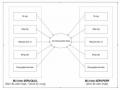
Tourist satisfaction (HL)
Physical facilities and tangible means (VCP) |
Responsiveness of services (DUDV) |
Reliability (DTC) |
Maybe you are interested!
-

 Tourists' Reviews of Local People's Service Quality of Homestay Tourism in Binh Ba Island
 -
 The Relationship Between Quality, Customer Service and Marketing
 -
 Factors affecting tourists' satisfaction with tourism service quality in Ca Mau province - 2
 -
 The Relationship Between Service Quality and Customer Satisfaction:
 -
 Research Model of the Relationship Between Technical Quality and Functional Quality with Ground Service Quality

Based on relevant studies, the research model is built in this thesis as follows:
Service Competency (NLPV)
Convenience (STT) |
Empathy (SCT) |
Figure 2.2: Proposed research model
Source: author's synthesis