
management philosophy. In addition to measures for inspection, control, assurance, and cost-effective management, total quality management also includes many other measures to satisfy the quality needs of both internal and external enterprises. An enterprise that wants to achieve the level of total quality management must be equipped with all the necessary technical conditions to achieve quality in information, quality in training, quality in behavior, attitude, gestures, and conduct within the enterprise as well as towards external customers.
2.2. Customer service quality
2.2.1 - Service quality
According to Associate Professor, Dr. Nguyen Van Thanh [9, p. 87], service quality is the level of customer satisfaction in the process of feeling service consumption, is the overall service of the enterprise that brings a chain of benefits and fully satisfies the expected value of customers in production and supply activities and in service distribution at the output.
Service quality is difficult to evaluate because it depends on customer perception. The measure of service quality is a comparison between customer expectations of service value and actual value received (satisfaction).
Service quality includes technical quality and functional quality.
Technical quality : includes the value customers actually receive from the service the business provides.
Functional quality : is the style of service delivery.
Service quality is not only evaluated at the output compared to the customer's expected value but also includes the operation of the entire supply system and distribution style.
2.2.2 - Customer service quality
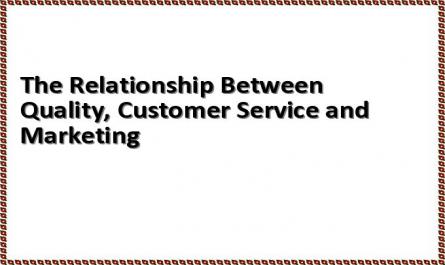
In a business, quality, customer service and marketing are closely related. It is specified as follows:
Marketing
Customer service levels should be determined on the basis of measures derived from research into customer needs and competitor performance, and it is essential to recognize the needs of different market segments.
Quality must be defined, viewed from the customer's perspective, and must be based on research and adjustment.
Customer service
The concept of a total, consistent quality must affect all elements in the entire process : machinery and equipment for production, processing, or staff serving at the counter, welcoming and dealing with customers.
Quality
Figure 1.1. The Relationship Between Quality, Customer Service and Marketing
Customer service activities are necessarily closely related to quality issues. Marketing should be seen as a tool to strengthen the process of tightening all three elements. Because when these three areas are focused as one and overlap, there will be great resonance power and service quality is guaranteed at the optimal level.
Service quality is determined by the customer, not by the provider - the seller . If the service quality does not match what the customer wants, then current customers will leave and new customers will be difficult to attract.
Customer perception of the product
Customer understanding of products from the company | |||
Maybe you are interested!
-
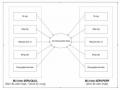
 The Relationship Between Service Quality and Customer Satisfaction:
 -
 The Relationship Between Service Quality and Customer Satisfaction
 -
 The Relationship Between Customer Satisfaction and Service Quality
 -
 The impact of online banking service quality of Vietnam Development Investment Bank on customer satisfaction in Ho Chi Minh City market - 14
 -
 Evaluation Results of Cvno Service Quality Criteria and Individual Customer Satisfaction Level for Bidv
Needs and expectations of
client
CLIENT
1. Gap in understanding
ADMINISTRATION
2. Gap in standards
4. Internal communication gap
3. Transfer gap
Promises in advertising/sales
5. Perception gap
6. Gap in understanding
7. Service Gap
Management definition of these needs
Design/delivery
Customer Experience vs.
to expectation
Design transfer/ handover
(source: Adapted from C.lovelock, production Plus New York: Mc Graw Hill -
1994, 112)
Figure 1.2 Quality gap model
1. Understanding gap : the difference between what the service provider believes the customer expects and what the customer actually needs and expects.
2. Standards gap : the difference between management's perception of customer expectations and the quality standards set for service delivery.
3. Delivery gap : the difference between specific delivery standards and the service provider's actual implementation of these standards.
4. Internal communications gap : the difference between what a company advertises and what its salespeople think about product features, performance, and service quality and what the company is actually capable of delivering.
5. Perceptions gap: the difference between what is actually delivered and what customers think they have received (because customers cannot accurately evaluate service quality)
6. Interpretation gap: the difference between a company's communication efforts and what customers think is promised from those communications.
7. Service gap: the difference between what customers expect to receive and their perception/feeling of the service provided.
Customer service is concerned with building a relationship with customers and different market segments to ensure a long-term relationship so that new market opportunities can be exploited. Therefore, customer service can be seen as an activity that brings time and place benefits to customers.
2.2.3 - Factors determining service quality
American scholars: Zeitham VA, Parasuraman A and Leonard LB have proposed the factors that determine service quality, which are:
The first is reliability: Consistency in operation, performing the right function the first time, and keeping promises make customers feel trustworthy.
Second is the sense of responsibility: It is the enthusiasm or readiness to provide timely and accurate service of the supply staff.
Third is competence: Employees must have the necessary skills and knowledge to
perform service
Fourth is accessibility: Easy to get to, has waiting time, has opening hours.
Fifth is demeanor: It is the politeness, respect, care and friendliness of the company's employees towards customers.
Sixth is communication: Communicate with customers in their own words, listen to their opinions, adjust your communication style for different customer groups, explain how much the service itself will cost and what problems it will solve.
Seventh is credibility: Honesty, reliability, reputation of the business, personal character of the service person.
The eighth is safety: Customers feel no danger, risk or suspicion, physical safety, financial safety, and customer confidentiality is kept.
Ninth is understanding customers: It is the effort to understand customers' needs, remember the specific requirements of each person, create individual attention, and recognize the business's regular and loyal customers.
Tenth is tangibility: Physical evidence of the service, service equipment, appearance of staff, service tools, physical symbols of the service.
Based on the above ten factors, the RATER quality model is proposed:
Word of mouth
believe
Personal needs
Experience
have gone through
Advertising
fox,
Expansion
Service quality factors
Reliability
Responsibility
Capacity
Accessibility
Manners
Communication
Trust
Safety
Understanding customers
Tangibility
Customer satisfaction level
1.
Exceeded expectations
(A<B, excellent quality)
2.
Meet expectations
(A=B, satisfactory quality)
3.
Not meeting the period
B. Perceived service
hope
(A>B, quality is not
obtain)
A. Services
desire
Figure 1.3: Model showing the relationship between 10 quality factors and customer expectations
3. Some service quality assessment models
3.1. Servqual Model
Parasuraman & ctg (1985) proposed a model of five gaps and ten components of service quality, abbreviated as SERVQUAL - this is the most popular model in assessing service quality today. In fact, research on service quality often focuses on this model and models adapted from this model.
The five service quality gaps in the SERVQUAL model include:
- The first gap appears when there is a difference between the customer's expectations of service quality and the manager's perception of customer expectations. This gap is shown in that the Bank does not fully understand what characteristics make up the quality of its service as well as the method of transferring them to customers to satisfy their needs.
- The second gap is that the Bank has difficulty in translating its perception of customer expectations into service quality characteristics. Although it knows customer expectations, due to some subjective reasons such as: professional ability of staff, or objective reasons such as: fluctuations in service demand in the direction of increasing sharply at a time, making the Bank unable to meet them in time.
- The third gap appears when the Bank's employees do not deliver services to customers according to specific criteria determined by the management. Employees are the department that plays an important role in creating the quality of the Bank's services. If some employees do not complete their tasks according to the set criteria, it will affect the quality of the Bank's services.
- Promises from advertising will increase customer expectations, when they are not delivered as promised, it will reduce the quality that customers perceive. This is the fourth gap.
- As mentioned, the difference between the expected quality and the quality they perceive. This is the fifth gap. This gap depends on the previous four gaps. Parasuraman & ctg (1985) said that service quality depends on this fifth gap, to reduce this gap, the four gaps above must be reduced. (Parasuraman & ctg, 1988).
3.1.1 - The gap between customer expectations and business management perceptions:
Business managers do not always have a clear understanding of what customers expect. The gap between customer service expectations and management’s understanding of those expectations is the most damaging gap. This gap limits service delivery because customers’ needs are not understood. This gap requires increased market research, opening up communication channels with frontline employees, and increasing customer contact to close the gap.
3.1.2 - The gap between business managers' perception and service performance
This gap exists when managers have a clear understanding of customer expectations but do not set specific standards for meeting those expectations. This gap is affected by the level of management commitment to service quality, the establishment of service quality objectives, the standardization of tasks, and the feasibility of meeting customer expectations.
The causes of this gap are divided into three groups: resource causes, market causes, and management causes.
- The group of resource causes can include factors such as labor force
labor, labor skills, tools and equipment, other resources;
- The group of causes originating from the market can include factors such as demand scale, fluctuations in seasonal consumer demand or difficulties due to changes in demand characteristics that make the company's service attributes different from the manager's perception of customer expectations;
- The group of causes originating from managers can be mentioned as: managers do not orient service quality according to customer expectations but according to their own subjectivity. They determine service quality indicators based on subjective arbitrariness. The indifference of managers is also a factor creating the above gap.
3.1.3 - Gap between service quality requirements and service performance
Service staff have a great influence on the quality of service that customers perceive. This gap appears because the service delivery and implementation process of the staff is uneven and the service delivery results are below standard. The objectives may be clear, the operating procedures are available but the service staff or the service equipment or the service conditions do not meet the service requirements of the customers.