
brought to the market ”. 17 In Vietnam, the concept of supporting industry was accepted relatively late. Currently, the concept of supporting industry is understood as “ the fundamental manufacturing industries of the main industry ”. 18 In textile production, supporting industry plays an important role and affects product quality and production efficiency. To have a final textile product, it is necessary to go through a certain production process. At each different stage in the textile value chain, there are different supporting products and supporting industries:
In the spinning and weaving stages:
The group of mechanical equipment includes spinning and weaving machines, details such as gears, transmission shafts, iron rods, yarn guides, pots, spindles, ring dies, hedging frames, hedging for weaving machines, and transport vehicles.
Group of non-mechanical parts includes expansion rings, rubber sleeves, paper tube products, and plastic tubes.
The group of chemical products includes adhesives, electrostatic agents, moisturizers, penetrants, dissolving agents, waxes, and chemicals used to sizing fabrics.
In the dyeing, printing and finishing stages:
Dyes: mainly organic chemical products with color and a few of inorganic origin.
Basic chemicals
Biological products.
In the garment and fashion stage:
Sewing accessories are details combined with the main fabric to create garment products, including: thread, cotton panels, buttons, mex, zippers...
The packaging accessories group is the materials and packaging used in the packaging and finishing process of the product, including: PE and PP bags and clothing labels...
Group of additional accessories for sewing equipment and templates used in the sewing process.
17 Source: Dr. Nguyen Ngoc Son (2008), Development of supporting industries for Vietnam's textile and garment industry , Economic Research Journal (359), p. 51.
18 Source: Dr. Nguyen Ngoc Son (2008), Development of supporting industries for Vietnam's textile and garment industry , Economic Research Journal (359), p. 52.
Figure 1: Textile production and finishing process
C
D
F
E
B


Textile and garment industry auxiliary products
1
Cotton production
A
Production of fibers, synthetic fibers
2
Spinning
3
Weaving
4
Dyeing-printing
5
Complete
6
Tailoring
Consumption
2. Metal and non-metal spare parts
3. Metal and non-metal spare parts
4. Dyes and auxiliary chemicals
5 Types of auxiliary chemicals
6. Types of sewing accessories
1. Fertilizers and pesticidesA. Petrochemical industry B. Mechanical industry, manufacturing and automatic control C. Mechanical industry, manufacturing and automatic control D. Mechanical industry, manufacturing and automatic control E. Fashion design industry |
Maybe you are interested!
-
 Cultivation and Production Process of Special Rare Weasel Coffee
 -
 Logistics Activities in the Production Process
 -
 Management Organization, Production Process and Production Operations
 -
 Traditional Fish Sauce Production Process
 -
 Completing the accounting of raw materials for yarn production at Ha Nam Textile Company - 9
4. External factors affecting the competitiveness of textiles
4.1. Political environment, law and economic policy system
A stable political environment is always a premise for the development and expansion of investment activities of domestic and foreign enterprises and organizations. The legal environment is a system of legal documents and regulations that create a corridor for the operations of enterprises in general and textile enterprises in particular, affecting the operations of enterprises such as which products to produce, where to sell to which subjects, input sources for textile products.... Enterprises must comply with the provisions of the law, must fulfill their obligations to the State, to society and to employees as prescribed by law (tax payment obligations, responsibility for ensuring environmental sanitation, ensuring the lives of officers and employees in the enterprise.)
The economic policies of the State, the growth rate of the national economy, the inflation rate, the average income per capita... are factors that directly affect the production and business activities of textile and garment enterprises. If the economic growth rate is high, the Government's policies encourage enterprises to invest in expanding production, currency fluctuations are insignificant, inflation is kept at a reasonable level, the average income per capita increases... will create conditions for enterprises to develop production, improve competitiveness and vice versa.
4.2. Foreign investment in textile and garment production and export
Foreign-invested enterprises play a very important role in the development of production and have a great influence on the competitiveness of textiles in the international market. This role is demonstrated by the spillover effect of modern technology, management experience, and business experience in the international market. Foreign-invested enterprises operating in the production and trading of textiles are increasing, contributing greatly to improving the competitiveness of textiles.
Most of the projects of foreign investors are mainly in the textile and garment sector due to low investment capital, quick capital recovery and the ability to bring high profits. Foreign invested enterprises in the textile and garment industry are formed under
There are two forms: joint venture enterprises and enterprises with 100% foreign investment capital. Due to the advantages of foreign-invested enterprises such as large export markets, new machinery and equipment, and advanced technology, labor productivity is higher, creating many products with diverse designs and higher quality than those of domestic textile enterprises. Moreover, the products produced by these enterprises meet all quality standards, creating favorable conditions for competition in the world market. Therefore, exploiting the full potential of foreign-invested enterprises is an important factor affecting the competitiveness of textiles and garments.
4.3. Competitors in the market
First of all, current competitors in the industry decide the level of competition to gain advantage, the ultimate goal of which is to maintain and develop the existing market share, ensuring the highest level of profit. Competition among competitors tends to increase the intensity of competition and reduce the level of profit in the industry. There are many forms and tools of competition used by competitors when competing in the market, such as price competition or product quality competition. In fact, when competing with each other, competitors often use comprehensive competitive tools based on price competition, product quality, product differentiation, marketing, etc.
Competition often becomes fierce when the industry is in the saturated stage, or in decline, or there are too many competitors with similar potential and diverse business strategies, and economic barriers make it difficult for businesses to move freely to other industries. In order to protect and improve their competitiveness, businesses need to collect enough necessary information about the main competitors with market power and the industry situation to serve as a basis for strategic planning.
4.4. International trade environment
The international trade environment or in other words, the economic relationship between two or more countries in the world. This is an important factor affecting the competitiveness of textile products in the international market. When the relationship
If the relationship between two or more governments is hostile, such conflicts can completely destroy business relations between the two countries. If the bilateral political relationship is improved, it will promote trade development, creating favorable conditions for businesses in business.
Currently, the trend of regionalization and globalization of the economy is taking place more and more strongly. Bilateral and multilateral agreements agreed upon between two or more countries have a profound and direct impact on the production and business activities of textile and garment enterprises. This development and integration trend takes place in many different forms, but especially focuses on the issue of economic cooperation, established to bring about more economic interdependence between countries. Integration helps the circulation of goods in general and textiles in particular between countries, including Vietnam, to develop more and more, because obstacles such as tariffs, import procedures, import quotas or import licenses... are being minimized, scientific and technical achievements are being used optimally and more effectively, creating conditions for improving the competitiveness of textiles and garments in the market.
III. THE NECESSITY OF IMPROVING THE COMPETITIVENESS OF VIETNAMESE TEXTILE AND GARMENT PRODUCTS IN THE US MARKET
It can be said that the textile industry plays an important role in the national economy. This is one of the fastest growing industries in Vietnam in recent years, both in terms of the number of enterprises, the number of workers attracted to this industry and export value.
Firstly , this is an industry that provides essential consumer goods for society. Textile products serve one of the basic, essential needs of people, the need to wear.
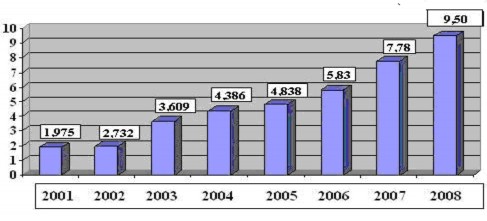
Second , textiles and garments are an industry with high export turnover and contribute to increasing the output value for the entire Vietnamese industry. The textile and garment industry is a traditional industry and has conditions for development in Vietnam. Besides meeting domestic demand, Vietnamese textiles and garments are also exported to more than 60 countries in the world. In 2005, it reached 4.838 billion USD, in 2006 it reached over 5 billion USD and textiles and garments are one of the 10 economic sectors with large export turnover.
Vietnam. It is expected that by 2010, Vietnam's textile and garment export turnover will exceed the 10 billion USD mark. This confirms that textile and garment is one of the key sectors of the country's industry in the process of industrialization and modernization. By exporting products, the textile and garment industry not only contributes to economic development but also brings the country a large source of foreign currency.
Table 1: Vietnam's textile and garment export turnover from 2001 to 2015
2008
Unit: Billion USD
Source: http://www.vinatex.com.vn/Other/KNXKDMVN/KNXKDMVN.htm
Third , the textile industry contributes to solving unemployment and creating jobs for the economy. In Vietnam, in recent times, the textile industry has created jobs for a large number of social workers, especially female workers. As of 2008, with about 2,000 enterprises and other small establishments and private households, the textile industry has attracted more than 1 million workers. 19 In addition
The development of the textile industry not only creates more jobs in the industry but also in other related and supporting industries such as cotton growing, silkworm raising, embroidery and knitting, production of raw materials for the textile industry and a series of other service industries such as packaging, transportation, insurance, banking, quality management consulting... thereby contributing to increasing workers' income, improving per capita income, increasing purchasing power, and expanding the domestic market.
19 Source: Vietnam Textile and Apparel Association.
Fourth, developing the textile and garment export industry is one of the important steps in the industrialization strategy because starting the industrialization process with labor-intensive products is one of our great advantages today. Exporting textile and garment products will help us effectively exploit the absolute and relative advantages of the country, contributing to increasing capital accumulation, expanding production, and increasing income for the economy. To industrialize and modernize in a short time requires a very large source of capital, so without foreign currency earned from export activities, domestic production will face many difficulties. This is reflected in the fact that without foreign currency, there will be no ability to import machinery, equipment, and raw materials for production. Practical experience shows that countries with large foreign currency reserves such as Japan, Taiwan, Singapore, etc. are all countries with large export proportions in the world. Thus, foreign exchange reserves, especially for Vietnam in the current situation, are very necessary when domestic capital is limited, the level of development is not high, and material production is weak. From the initial steps, a foundation for promoting the development of high-tech, advanced, and modern industries will be formed, thereby making the economy grow steadily. Or in other words, developing the textile and garment export industry today plays a role as laying the first brick for the country's construction.
Fifth , contribute to rapidly attracting foreign investment capital.
With efforts to overcome weaknesses to rise up, the textile industry not only always plays an important role in export, increasing foreign currency revenue for the country, contributing significantly to improving the foreign trade balance of our country but also contributes significantly to rapidly attracting foreign investment because foreign investors often look at the export situation to evaluate the payment capacity of a country.
Among export markets, the US market is considered a potential textile export market for Vietnam. Over the past 10 years, the demand for textiles from this superpower has increased continuously. After the US decision to lift the embargo on Vietnam was approved on February 3, 1994, businesses
Vietnamese enterprises began to access the US market. Since then, the export turnover of Vietnamese textiles and garments to the US has continuously increased sharply over the years, bringing a significant source of foreign exchange revenue from this activity. Currently, the export turnover of textiles and garments to the US accounts for a large proportion of the total export turnover of Vietnamese textiles and garments.
Table 2: Structure of Vietnam's textile and garment export market in 2008
16%
9%
18%
57%
US EU
Japan
Other countries
Source: http://traderfax.vn/detailnews.aspx?Ma=76&MaLoai=3
However, when entering the US market, Vietnamese enterprises also encounter many difficulties. In addition to legal issues, US trade practices, quotas, anti-dumping regulations... the issue of competition with rivals in the US textile and garment import market also has a great impact on Vietnam's textile and garment exports to this market.
The US textile market is a large market with many potential importers such as Mexico, Bangladesh, Indonesia, India and especially China. Therefore, competition in this market is extremely fierce. It requires Vietnamese textile enterprises exporting to the US market to make more efforts to be able to export their products to the US with high annual growth rates, competing with strong competitors in the market. Therefore, improving the competitiveness of Vietnamese textile products in the US market is extremely necessary. To do so, Vietnamese textile enterprises exporting to the US market need to focus on researching and analyzing the competitiveness of Vietnamese textile products compared to competitors.