
assimilation of substances in water by microorganisms. DO content depends on the process of oxygen diffusion from air into water, water temperature, biochemical processes in water, and pollution sources. This shows that DO also fluctuates seasonally, especially the source of pollution flowing into Dam Va.
The DO content measured through 3 sampling times is 6.3-3.2-4.9 (mgO 2 /l). The average concentration is 4.8. We can see that at the water receiving point of Muong Dat, DO is low, showing that the pollution level of Dam Va originating from the activities of Quang Minh Industrial Park is inevitable.
2.4. Total N (TN)
N, P are essential elements to create biomass of TSTV. In nature, N, P are often high in polluted surface water areas. TN index represents the amount of N that generates nitrite/nitrate ions and N-containing compounds and is an important pollution index. Normally, the amount of NH 4 + is limited to 0.05 mg/l and NO 3 - is limited to 5 mg/l. At this limit, aquatic organisms can use the nutrient source well to create biomass. However, exceeding it will cause eutrophication in surface water.
The results of TN survey at the respective times were 0.12 - 0.23 and 0.22 mgN/l. If the allowable level is assessed, the concentration of N compounds in Dam Va is high, showing the level of pollution.
2.5. Total P (TP)
Total phosphorus includes all forms of P, of which orthophosphate is always the most abundant. Phosphate can be dissolved in water. Phosphorus is an essential element for life. Living organisms, including humans, possess small amounts and this element is very important in the process of producing energy in cells. Excess phosphorus from fields and lawns on the outskirts of cities into ponds, lakes, rivers and streams is the main cause of algae growth, which then enters water sources and reduces water quality. Phosphorus pollution is dangerous to fish and other aquatic species as well as animals and humans, which depend on clean water. The allowable TP concentration is less than 0.025 mgP/l (According to Khan and Asari, 2005).
The analysis results at different times show that TP has values of 0.14 - 0.18 and 0.08 mgP/l. Thus, it can be seen that P in Dam Va is at a high level, Dam Va water is polluted.
2.6. Chemical oxygen demand (COD)
Is the amount of oxygen needed to oxidize chemical compounds in water including both inorganic and organic. This is also an indicator to assess the level of pollution. COD value can fluctuate within the range of 40-60mgO2 / l (According to QCVN 08:2008/BTNMT on surface water quality) depending on the purpose of use such as domestic water supply but must have appropriate treatment technology; conservation of aquatic organisms; irrigation or water transport and other purposes with low water quality requirements.
The results of water quality analysis of Dam Va through 3 sampling times are 45 - 61 and 65mgO2/l respectively . This result shows that the COD concentration is relatively high, the water is at risk of pollution.
2.7. Metal content
Metal content is shown in the following table:
Table 3.3. Metal content in Dam Va water
Target
Unit | Result | QCVN 08: 2008/BTNMT Column B1 | |
April 22, 2012 | |||
As | mg/l | <0.001 | 0.05 |
Zn | mg/l | 4.09 | 1.5 |
Fe | mg/l | 1.61 | 1.5 |
Cr 3+ | mg/l | 0.3 | 1 |
May 22, 2012 | |||
As | mg/l | 0.0013 | 0.05 |
Zn | mg/l | 1.2 | 1.5 |
Fe | mg/l | 1.68 | 1.5 |
Maybe you are interested!
-

 Research Status of Non-Epithelial Gastrointestinal Cancers in Vietnam
 -
 Analysis of Current Status of Tourism Activities in Phong Dien District
 -
 Results of Satisfaction Level by Marital Status
 -
 Management Status of Tcm Results Evaluation Through NCBH Form Table 2.9: Current Status of Evaluation of Professional Team Performance Results Through Form
 -
 Current Status of Teaching Capacity of Teachers at District-Level Vocational Education Centers in Cao Bang Province
Cr 3+ | mg/l | 0.18 | 1 |
September 15, 2012 | |||
As | mg/l | 0.0015 | 0.05 |
Zn | mg/l | 1.09 | 1.5 |
Fe | mg/l | 1.52 | 1.5 |
Cr 3+ | mg/l | 0.84 | 1 |
Note:
B1: Used for irrigation purposes or other uses if there are similar requirements on quality or uses as type B2.
Comment: The common metal content (Fe, As, Cr, Zn) shows that Fe and Zn are the two metals with concentrations exceeding the permissible level, although not much.
General conclusion: Dam Va is currently polluted mainly by nutrients (NP) and a small part by metals. Therefore, it is necessary to treat these components.
3.1.3. Current status, changes, and composition of plankton
3.1.3.1. Species composition
According to the Wastewater Discharge Survey Report at Quang Minh Industrial Park by the Department of Surface Water Resources, Institute of Geography (Vietnam Academy of Science and Technology), the plankton components in Dam Va include major algae phyla such as Bacillariaphyta ( 1) , Chlorophyta (2) , Cyanophyta (3) , Cryptophyta (4) , Euglenophyta (5) ... The most populous are species (1) and (2) represented by the genera Scennedemus, Closterium, Flagilaria... These species often appear in nutrient-rich waters causing blooms (Red tide).
Floating animals are mainly Rotatoria, Crustaceans, crustacean larvae, mollusks...
3.1.3.2. Quantity, density
It can be seen that cyanobacteria are the dominant species because they live in a temperature- and light-loving environment, in nutrient-rich water areas such as Dam Va. These species live floating, with unstable shapes. The number of cyanobacteria increases sharply in
Summer often causes algae blooms and foul odors due to the strong activity of these species.
On the contrary, in winter when the temperature drops, the number of this species also decreases, we also see less foulness.
The density of plankton species, like that of algae, is high in summer and low in winter.
3.1.3.3. Relationship between plankton communities and water quality
It can be seen that the water quality of Dam Va (shown through biochemical indicators as mentioned above) has a close relationship with the biological community. This is also understandable because surface water is the habitat (habitat) of species. In contrast, species use nutrients in water by assimilating organic substances, metals, and other components in water to create biomass.
This relationship shows the interaction between the water quality of Dam Va and the species. This relationship is symbiotic. However, when there are changes in other factors such as temperature, light, etc., this relationship can be "obstructed" or interrupted. This is shown through seasonal fluctuations in species. As mentioned above, species such as cyanobacteria and plankton have high densities in the summer. These species are adapted to high temperature and light. However, this is only relative because the living environment (surface water quality) is affected by many other factors (such as pH). If the pH is too high (alkaline environment) or too low (acidic environment), it will immediately inhibit the activities and development of plants and plankton.
3.1.3.4. Relationship between TSTV and water quality
Similar to the biological community in Dam Va water, TSTV also has a close relationship with the quality of Dam Va surface water. On the one hand, TSTV is the substrate for floating organisms (plankton), submerged organisms and bottom organisms to live. TSTV is affected by factors such as temperature and the biochemical environment of Dam Va water.
The surface water of Dam Va is the environment for aquatic plants to live. TSTV absorb nutrients in the water to create biomass. When encountering a favorable water environment,
beneficial (pH is between 6.5-7.5), without toxic substances, aquatic plants grow and vice versa.
The process of assimilating nutrients in water contributes to cleaning water sources. When TSTV develops, microorganisms also develop, making the treatment of Dam Va water pollution faster. Therefore, it is necessary to study the growth and development characteristics of TSTV in pollution treatment.
3.1.4. Eutrophication and toxic cyanobacteria
Eutrophication is a common phenomenon in urban lakes, rivers and wastewater channels. The manifestations of eutrophication in urban lakes are high concentrations of nutrients N, P, high P/N ratio due to the relative accumulation of P compared to N. The strong development of algae during the growth and bloom of algae, the lack of diversity of aquatic organisms, especially fish; at the same time, this process is the activity of microorganisms that assimilate organic substances causing foul odors due to the release of H2S gas , etc.
As presented above, cyanobacteria predominate, especially the appearance of bacteria
Microcystis is a genus of poisonous algae. Eutrophication occurs under the following conditions:
Concentration of pollutants, represented by COD, TN, TP, DO, and metals, is higher than the permissible level.
Water environment temperature ranges from 18 0 C - 32.5 0 C equivalent to the months from April to September when air temperature is from 27 0 C - 36 0 C.
Surface water environment has suitable pH from 5.5 - 9.
High density of cyanobacteria and microorganisms in water
Under these conditions, cyanobacteria will grow rapidly, photosynthesize and form blooms. Thus, combining many factors, eutrophication is closely related to toxic cyanobacteria.
In the Dam Va area, according to local residents, this eutrophication situation has occurred, leading to conflicts between residents and Quang Minh Industrial Park. It can be seen that due to sedimentation and waste pollution, Dam Va water is always at risk of eutrophication.
3.1.5. Current status, changes in aquatic species composition and quantity
Through field observations at Dam Va at various times in 2012, it can be seen that there are many species of TSTV appearing here. The dominant species are Ngo Trau, Rau Muong, lotus, water lily, water fern, Cai water fern...
The number of the above species depends on the season and human impact. In the summer, species such as Morning Glory and Lotus are dominant. Some are naturally grown, some are planted by people (Morning Glory and Lotus). In other areas, mainly Water Hyacinth and Water Duck grow wild. In the winter, when Morning Glory and Lotus wither, mainly Water Pennywort (dry areas) and Water Duck are dominant.
Due to sedimentation, most of the area has been reclaimed to grow agricultural crops such as lotus, rice, Vietnamese coriander, and water potatoes. The rest is wild aquatic plants or semi-aquatic plants such as Vietnamese coriander, Chinese water fern, Chinese water fern, Chinese water fern, water hyacinth, water spinach, etc.
3.1.6. Characteristics of water resources in Dam Va
Dam Va is a natural lagoon that is difficult to determine the boundary location on the map as well as its area. The starting point of Dam Va originates from the Ca Lo River water channels on the left bank in Quang Minh Town, leading through the Town's irrigation channels and expanding in Tien Phong Commune (From Ap Tre, Ap Giua, Do Thuong, Quang Minh urban area).
The shape of Dam Va is small in the Northwest, bulging in the middle and ending in the area bordering Dam Van Tri (Dong Anh). The length of Dam Va is about 15km, flowing through 2 districts of Me Linh and Dong Anh of Hanoi.
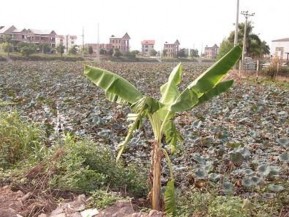
The average depth of Dam Va is about 1.2-1.5m depending on the season. Dam Va is heavily silted and exploited for growing agricultural crops (vegetables) in Quanh Minh Town, Tien Phong Commune and part of Dong Anh District.
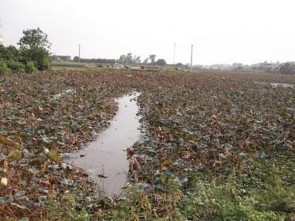
Figure 3.3. Image of sedimentation in residential area Tien Phong commune (Photo taken on September 15, 2012) | Figure 3.4. Image of sedimentation on the way back to market. Quang Minh town (Photo taken on September 15, 2012) |
Older brother.
Bright.
The main tasks of Dam Va are:
- Providing irrigation water for Me Linh district and part of Dong Nai district.
- Drainage for Ca Lo River during flood season, flood prevention for Ca Lo River.
- Aquaculture.
- Maintain the regional ecosystem within Dam Va and neighboring areas.
- Receive domestic and agricultural wastewater and the entire Quang Ninh Industrial Park.
- Regulate hydrological regime for the area.
Dam Va does not have much value in terms of transportation and tourism, but has great value in terms of irrigation in Me Linh district. The development of agriculture in Me Linh district depends greatly on Dam Va.
As a low-lying area of Me Linh district, Dam Va is a place to store wastewater and rainwater for the entire area. The additional water source of Dam Va is supplemented by pumping stations from Ca Lo River in the dry season (from October to April of the following year) to follow the irrigation canals in the fields to irrigate the area and then flow into Dam Va. In the rainy season, the amount of water in Dam Va is supplemented by rainwater with an average rainfall of about 1,900mm/year.
It can be seen that the water volume of Dam Va fluctuates greatly by season. In the rainy season, the water volume is abundant, the area of Dam Va expands significantly; in the dry season, the area decreases, and farmers in Me Linh district use part of the non-flooded land for agricultural purposes to grow crops and flowers.
Dam Va flows through Quang Minh Industrial Park, determined from Quang Minh town, through Ap Trung, Ap Giua, to the center of Tien Phong commune. Dam Va flows mainly through agricultural land, partly through residential areas (Dam Va Bridge section belongs to Tien Phong commune center).
3.1.7. Determining the level and forecasting the risk of pollution
Based on the source of waste, it is possible to identify different sources of pollution such as organic pollution from domestic activities, oil pollution from irrigation water exploitation activities, and agricultural activities. However, as presented, Dam Va is mainly polluted from waste sources of industrial parks, production facilities, and domestic wastewater of people.
Based on the current status of the components in the water of Dam Va, it can be seen that the water of Dam Va has been and is being polluted by organic components, metals (not much) and microorganisms. The pollution tends to increase when Dam Va is silted up, increasingly narrowed and used for other purposes. Eutrophication appears in Dam Va along with industrial wastewater pollution phenomena such as dead plants, dead organisms... In addition, pollution can be recognized by senses such as unpleasant odors, stench, algae blooms, and dead organisms in the summer when the temperature increases. This situation has led to environmental conflicts and requires treatment measures.
Forecast of pollution risk of Dam Va: Currently, Quang Minh Industrial Park is in the process of expanding phase II. It is expected that the area of phase II will be expanded to 850ha, with 10,000 workers. The total amount of wastewater is expected to be 7,000m3 / day-night, 2.4 times higher than the present. Thus, the load of polluting components in Dam Va will increase. The risk of pollution is very high. On the other hand, the process of exploiting groundwater and using water from Dam Va for irrigation purposes also affects