
Unique, natural resorts have the advantage of attracting guests who like the feeling of being close to nature, like to immerse themselves in the simple life in the countryside...
This type has many limitations such as:
+ Few services, simple, low quality.
+ Low specialization, employees take on many tasks
+ Mainly attracts customers with low and middle income, so revenue and profit are often not high.
Maybe you are interested!
-
 General Introduction About Ba Mien Restaurant In Hilton Hanoi Opera Hotel
 -
 Current situation and solutions to improve the quality of room service at Habana Hotel - 2
 -
 Concept of Hotel Room Service Quality
 -
 Evaluation of human resource training quality at ÊMM Hue Hotel - 17
 -
 The relationship between market orientation, learning orientation and business results of hotel and restaurant enterprises: A case study in Ho Chi Minh City - 36
+ Although there are certain limitations, but for a relatively long period, motels have played the most important role in the tourist accommodation system. In the current period, motels continue to develop, and have certain changes, focusing on exploiting specific customer groups, so tourist motels are still an important type of accommodation in the tourist accommodation system.
5.3 Motel
- Concept
Motel is an English term that originally meant Motor - Hotel serving guests traveling by motor vehicles. Along with the diverse development of tourism types, motels are still mainly for the above mentioned guests, but besides that, modern motels also meet the accommodation needs of guests participating in other types of tourism (weekend travel, resort travel, etc.). Therefore, the term modern motel is understood in a broader sense.
In fact, many tourism researchers in Vietnam have tried to find a Vietnamese term equivalent to motel, some people translate it as roadside hotel, self-service hotel, some even translate it as inn, motel... Translating the meaning of motel in the above ways only reflects some characteristics of motel, and it is even only correct for certain types of motels (for example, some motels that are not on the roadside will not be accurate). Coming up with a term equivalent to motel in Vietnamese also faces a huge obstacle, which is the fact that in Vietnam there are very few motels, and it can even be considered that there is no motel in the true sense. Therefore, it is difficult to make a connection, and there is no specific name for this type of tourist accommodation facility.
Although motel accommodation is not yet popular in Vietnam, it also has its own advantages, along with the diversification of tourism types, diversification of tourist accommodation facilities, in the integration trend and when traffic conditions develop... certainly this type of accommodation will gradually develop in Vietnam. Moreover, motel is a popular type of accommodation in many countries around the world, so research on motels has a quite important meaning for tourism development in Vietnam.
The concept of motel can be given as follows: Motel is a type of tourist accommodation facility, often built along national highways, important traffic hubs, city suburbs, or in tourist areas with simple, low-rise architecture, technical facilities are equipped mainly to meet the accommodation needs of guests traveling by motor vehicle, the types of services are few and often have services related to motor vehicles, in addition, guests must serve some of their own needs.
- Genres
+ Roadside motel (transit motel): This is the most popular type of motel, it is often located along traffic routes or at traffic junctions, has many car-related services, mainly serving customers who stop during trips by car, motorbike, the length of stay of customers is short (usually one or two days). This type is popular in the US and Western Europe.
+ Tourist motel: is a type of motel that is often built near places with beautiful landscapes, rich natural resources and favorable weather. This type is mainly for guests who sleep and stay for a relatively long time. This type is most popular in Europe.
+ Suburb motel: is a type of motel that mainly serves weekend guests, usually built in the suburbs of large cities, popular in Western Europe and America.
Nowadays, with the diverse development of tourist needs, motels are diversifying their activities such as building more swimming pools, tennis courts... to attract more guests and prolong their stay at the motel. Motels are increasingly developing and becoming direct competitors of hotels.
- Characteristic
+ Location features
Depending on the type, motels have different locations. For roadside motels: located near main traffic routes (highways), or at important traffic hubs, for resort motels, they are often located in resorts, associated with places with beautiful scenery and mild climate. Suburban motels: located in the suburbs of large cities, usually near suburban forests or near fields, rivers, beaches, etc. In general, motels are often not located in urban centers, however, in reality, there are still motels located right in the urban center, but this case is not common.
+ Architectural and construction features
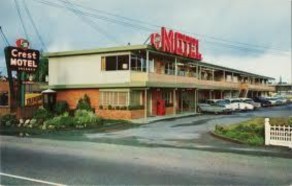
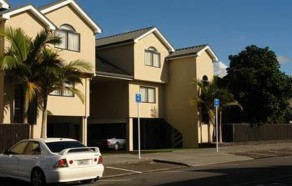
Simple architecture, usually with a roof, low-rise (lower than three stories, but most commonly one to two stories).
Built with simple materials, more than 50% of motels are built in a prefabricated style.
Usually has a wide porch, a walkway right outside the hallway, few motels are built with a hallway in the middle (bedrooms on both sides of the hallway).
Has a relatively large area, often has a large yard, garden, etc.
There is usually a garage for guests, especially for the motel type, there are also service areas for car and motorbike maintenance and repair.
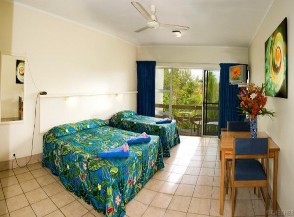
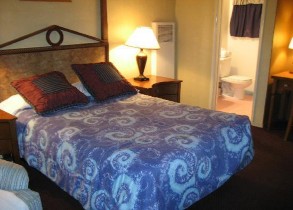
Figure 1.1: Some illustrative images of motels
+ Technical facilities characteristics
The general technical facilities of a motel are mainly housing, gardens, garages (car parking areas), internal roads, electrical systems, water supply and drainage, fire protection systems, etc. In general, the technical facilities of a motel are of lower quality and value compared to other types of accommodation facilities such as hotels, cruise ships, tourist villages, etc.
Technical facilities in motel accommodation business often account for a large proportion of the value of motels. This group focuses on equipment in guest bedrooms.
Motel bedrooms are usually fully equipped with amenities like those in regular hotel bedrooms (Wooden furniture: beds, wardrobes, guest tables, desks, chairs, shelves, etc. Electrical appliances: televisions, VCD players, refrigerators, fans, air conditioners, computers, light bulbs, hair dryers, etc. Fabrics: curtains, sheets, blankets, pillows, carpets, etc. Glassware, porcelain, etc.) In the bedroom, there are usually two to three beds. A special thing is that in the guest bedroom, there are often many rooms, including a kitchen with cooking equipment so that guests can cook for themselves, and laundry equipment for guests to serve themselves (this is a different feature compared to regular hotels). Although according to the previous concept, amenities in motel bedrooms are often of low value, in reality, with the development of social life, many motels have equipped their bedrooms no less than those of high-class hotels.
In motels, the facilities at the reception are often much simpler than in hotels, because the main job of the receptionist is just to give the keys to the guests and provide a few related services. The housekeeping department is also often simple, even having many
Motels do not have a room service department, but only a cleaning and sanitation department (because in these motels, guests have to clean their own rooms and serve themselves).
Only a few motels have their own restaurants (usually in the resort motel category). Although most motels have food services, the types of food products are usually very simple, mostly fast food or easy-to-prepare food, so the technical facilities and equipment of restaurants and kitchens in motels are also often simple. Unlike hotels, motels are often equipped with kitchens and cooking utensils (including laundry) so that guests can serve themselves.
- Product features
Motel products, in addition to the common characteristics of products in the tourist accommodation system, also have their own characteristics such as:
Cheap price (much lower than the service price of luxury hotels, cruise ships, tourist villages...)
Product types are often simple, quantity is small, quality is often not high.
Especially for food and laundry services, guests often have to serve themselves.
There are many car related services such as: car wash, oil change, repair, maintenance...
The length of stay of guests at motels depends on the type of motel. For the type of transportation motel, guests usually stay for a short time (less than four days); For the type of suburban motel, guests also usually stay for a short time (weekend vacation); For the type of resort motel, on the contrary, guests usually stay for a relatively long time (also because of the relatively long stay, they choose motels partly to save costs).
Depending on the type of motel, as well as the specific characteristics of each motel, the technical facilities in the additional service business of motels may be different. Normally, the technical facilities of motels often include equipment, tools, and workshops serving the following services:
Communications: Most motels have telephones, some even have Internet access.
Entertainment: not common in motels.
Sports facilities: Only a few motels have swimming pools and tennis courts.
Car related services: such as repair, maintenance, car wash, gas station... This is a very popular service in motels, especially for traffic motels.
- Characteristics of target customers
Motor vehicle tourists make up the majority (especially for traffic motels)
Guests usually have a low ability to pay. Usually they are tourists with average income.
Service quality requirements are at an average level.
Concentrated among young people, often in pairs, groups of friends, or whole families.
- Characteristics of labor organization
Labor organization in motels is often simpler than in hotels, and the ratio of service staff to guest rooms is also lower (due to fewer types and quantities of services).
Specialization in motels is lower than in hotels, the reception department is often very simple, while some motels do not have a desk department, kitchen department, or even a room cleaning department (like in hotels or tourist villages), but only have general cleaners.
- Advantages and disadvantages
Through analyzing the characteristics of motels, we see that this type of accommodation has the following basic advantages and limitations:
+ Advantages
Cheaper than many other types of tourist accommodation (especially compared to hotels, resorts, tourist villages, cruise ships, etc.)
Convenient for the car travel market.
Simple labor organization, few services thus saving business costs.
+ Limitations
Few services, low quality. Low specialization.
Mainly attracts middle-income customers. Customers have to serve themselves a part of the services.
It can be said that motel is the latest type of tourist accommodation establishment (first established in the US around 1950). However, along with the development of socio-economic life, especially the strong development of road traffic, especially cars, this type has had very strong development steps. Although this type has not developed much in Vietnam at present, however, according to the development trend of the country in the coming time, the motel type will certainly have strong development steps to meet part of the very diverse accommodation needs of guests.
5.4 Bungalow
- Concept
Bungalow is also a term originating from English, meaning separate one-story houses for rent. Similar to motels, finding an equivalent Vietnamese phrase for Bungalow is not simple. In some tourism documents, in Vietnam Bungalow is translated as a recreation house, or a house, however, in our opinion, these phrases cannot fully reflect the characteristics of Bungalow.
In the field of accommodation business in Vietnam, unlike motels, the Bungalow type has gradually become familiar to everyone. Although the author really wants to Vietnamize tourism terms, this issue needs time. When the bungalow type becomes popular and familiar in Vietnam, giving a name is only a convention, even the word "bungalow" can be Vietnamized into the Vietnamese language (read phonetically as Bang - ga - lau). In this textbook, the term Bungalow is still used in considering types of tourist accommodation facilities.
The concept of bungalow can be stated as follows:
Bungalow is a type of tourist accommodation that is often designed in the style of a separate, closed house with high aesthetic entertainment value, and can be arranged separately or gathered in a certain group.
- Bungalow categories
Based on the layout, Bungalows can be divided into the following two categories:
+ Independent bungalow, only one separate bungalow.
+ Bungalow complex, consisting of many bungalows arranged together. Usually there are other accompanying services.
Based on architectural and construction characteristics, bungalows can be divided into the following basic types:
+ Local bungalow: This is a type of bungalow with architecture imbued with local culture, often built with natural materials available in the area, and can be renovated from local residents' houses.
+ Wild bungalow: This type of bungalow is very close to nature, has simple but unique architecture, is often built with simple materials such as wood, bamboo, leaves... often in places with beautiful, wild scenery.
+ Unique Bungalow: This type of Bungalow has a very unique architecture, often in special locations, such as the beach, in the forest... the construction materials are often very diverse.
- Characteristic
+ Location and architectural features
As mentioned above, the division of Bungalow types is mainly based on location and architecture, so when considering the characteristics of location and architecture, we must also consider each type of bungalow. According to the original origin of bungalows, they are small one-story wooden houses, however, with the strong development of this type of accommodation, today it is not only simple in form as the beginning but also has a very diverse architecture and location.
The first group is the bungalows with architecture imbued with local culture, often built with natural materials available in the area. These are local bungalows or natural bungalows.
The second group includes bungalows with extremely unique architecture built according to people's imagination, such as chicken coop-style bungalows, bungalows on cliffs, in the middle of the ocean...)
The third group is the wild bungalows, which often have simple but unique architecture, often built with simple materials such as wood, bamboo, leaves... often in places with beautiful, wild scenery.
Figure 1.2: Some illustrations of bungalows