
The library has been equipped with 2 new computers, so it is possible to build the library's local LAN network. The management software has also been reinstalled using the WINISIS 1.4 program (running on Windows environment) - a software that is quite popular in libraries. Students have begun to be able to look up and search for information on the 2 databases built by the library, although there are still limitations because the old computers used as search tools in the student reading room often have hardware problems.
Although the application of IT in this period was still limited, poor, fragmented and unsystematic. The electronic information and library system was almost non-existent, library resources were not yet online, users could only search for some information and look up the directory in a limited way. However, it was an important stage that opened a new direction for the application of information technology to the information and library activities of the Center.
- Phase 2 : From September 2006 to July 2010
Since September 2006, the Banking Academy Information and Library Center has officially moved to operate in a separate area with a 7-storey building with a total usable area of over 1,600 m2, equipped with synchronous equipment to serve information users and professional activities. This is a favorable condition for the Center to carry out its computerization activities.
Maybe you are interested!
-
 Situation of Information Technology Application in Enterprises
 -
 Information Technology and Information Technology Applications
 -
 Solutions to promote the application of information technology in the tax industry in Vietnam - 30
 -
 Managing information technology projects at the Department of Customs Information and Statistics - 11
 -
 Strengthening the application of information technology to improve the competitiveness of small and medium enterprises in Vietnam - 1
During this time, the Center continued to use CDS/ISIS software until early 2007. The Center started using Excel to enter some basic fields.
By April 2009, we started using Aceess to enter relatively standard fields according to the MARC 21 cataloging format and then export data files for students to look up.
During this time, the Center has not really achieved results in synchronous application of stages, serving readers is still following the
Traditional methods, computer search is still limited. Especially the computer system is still limited, low configuration makes it difficult to process documents and serve readers.
-Phase 3: From July 2010 to present
The rapid development of science and technology revolution has led to the development of electronic documents, digital documents, etc. CDS/ISIS software has many outstanding features but is only an electronic document software, so it quickly became outdated before the appearance of a series of other library software. At the same time, the construction of the database on Microsoft Access data management software lacks many elements that need to be added (assigning cutter indexes, keywords, etc.) and with the construction of this type of database, it does not allow remote access and search for documents, and there is no ability to exchange and connect with databases of other Information Centers - Libraries, so the search and selection of new library management software that suits the requirements and trends at the Information Center - Library of the Banking Academy is inevitable. And by July 2010, the Center had switched to using iLib 4.0 software of CMC Software Solutions Company Limited. iLib 4.0 is an electronic library solution for libraries in Vietnam researched and developed by CMC. This is an integrated library system designed to meet the needs of domestic libraries, from public libraries, university libraries, specialized libraries to information centers nationwide, especially the ability to integrate and process Vietnamese.
During this period, the Center is urgently cataloging and reviewing documents to be suitable and complete the steps in the software to serve users in the most effective way. The Center is adding new electronic document sources. Applying information technology to the service stage, expanding the search on electronic computers. In addition, the Center also opens an Internet access room to create conditions for users to access new technology, find electronic documents, and improve service capacity.
Through the stages of applying IT to information and library activities, the Center is gradually perfecting its activities to keep up with the general trend of the world.
Currently, the Center is constantly developing and applying IT to its activities and the Center is planning to build an electronic library in the near future. This is a library model of the near future, with widespread application of advances in the information automation industry.
2.4. Some achievements in applying information technology at the Information Center - Library of Banking Academy
2.4.1. Building information technology infrastructure at the Banking Academy Information Center - Library
In the late 20th and early 21st centuries, IT and telecommunications in Vietnam developed strongly, opening up new directions for computerization in all fields of activity. Along with the general trend, the Banking Academy Information and Library Center quickly implemented IT application activities in its operations, focusing on building and developing the network system at the Center.
A computer network is a collection of computers connected together by physical transmission lines according to a certain architecture for the purpose of exchanging information between computers. The center is connecting the LAN network in the Banking Academy and the global network system Internet as the basis for operating the entire system operating at the center.
LAN
The Center's LAN is the Academy's LAN system. The main server is located in the Academy's practice building, connecting the transmission line to the Center. The center's LAN is connected through Switch devices (the Center has 4 Switches located on the floors of the Center), thanks to the use of this device, the
Network conflicts are significantly reduced, ensuring the individual operation of each floor and each room while still connecting to create unity in the entire Center as well as the entire network system of the Academy. The use of LAN is mainly to update documents, texts, and information from superiors to departments.
Internet connection
The Internet is considered a network of networks created by connecting computers and computer networks together in a large global network. The physical connection of these computers and computer networks is done through different telecommunications networks such as telephone, satellite or microwave channels, leased lines or fiber optic cables.
The connection to the Internet is done through the Academy's LAN system. The Internet is connected to the server located in the Academy's practice room and then transmitted to the Center via the LAN system. Currently, the Academy is using the Internet provided by Viettel Group.
The Center is equipped with a separate ADSL line to connect the computer system to the Internet. Thanks to the network system, the application of IT to the Center's operations is deployed quickly. All computers of the Center are connected to the Academy's server through 3 HUB sets.
The offices, reading rooms, and computer rooms are all equipped with Wirless signal transmitters for wireless Internet access. The use and exploitation of the Internet has brought about efficiency in the process of exchanging and transferring information quickly and conveniently. The center has
can introduce its document resources to all users, and can exchange data with other library information agencies nationwide.
2.4.2. MARC Machine Readable Cataloging Format
In the 20th century, information technology began to be applied to library activities. The application of information technology has changed the nature of the library profession, in which information storage is closely linked to bibliographic information and cataloging is automated. Automatic cataloging uses a document software or a cataloging subsystem of integrated library management software to create records for a bibliographic database and create appropriate catalogs. However, programs cannot read the cataloging cards that have been entered into the computer. Therefore, an intermediate means is needed for the program to understand the information on the machine-entered cards. Machine-readable cataloging was born and performed this function. In 1996, machine-readable cataloging appeared with the first MARC format of the US Library of Congress.
MARC is an acronym for the English term: “Machine cataloguing”.
This term means “machine-readable cataloging.”
The MARC format was first developed and used by the Library of Congress, and is called USMARC. The structure of the MARC format creates many possibilities for computers to select and organize bibliographic data:
- Allows users to easily access records
- Print out new book announcements, bibliographic publications, tables of contents in various formulas, spine labels.
- Exchange bibliographic data with different libraries in the country and the world.
MARC format is important in automatic cataloging. Therefore, library management software needs to be built according to MARC format standards.
The MARC 21 format is a standard for the representation and exchange of bibliographic and related information in machine-readable form. It is an interchange format, designed to provide technical specifications for the exchange of bibliographic and related information between systems. As an interchange format, MARC 21 does not dictate internal data storage or display formats. The presentation of data is a matter for the individual systems that use the MARC 21 format.
Currently, there are many formats with different advantages, creating many choices for libraries to use. However, the application of many input formats causes many difficulties for libraries in exchanging and sharing resources with each other. Although most software allows the creation of conversion files when exporting and importing data, the exchange of data between databases with different structures between libraries still faces many difficulties and obstacles.
In Vietnam, the MARC 21 format is currently being encouraged to be used. Many university libraries in Vietnam have been using this format. Some other libraries have also had projects to innovate software and switch to applying MARC 21. However, the application of MARC 21 in libraries still faces many difficulties. There are very few documents guiding the use of MARC 21. Currently, in our country, there is no set of keywords and standard subject headings, so each school on the subject chooses its own way to solve the problem. The processing instructions are still not given much attention, and the instructions of many schools are still understood as incorrect processing. Even in a library, the processing of MARC records between staff is different. The number of records is still incorrect. However, we are also encouraging the use of the MARC 21 format because using a common format standard will help share databases faster and easier, creating the ability to exchange information.
between domestic libraries, saving time and effort of library staff.
Since July 2010, right after the Center started to apply iLib 4.0 Software, it has simultaneously used MARC 21 format as the cataloging format for the Center and achieved some effectiveness in automatic cataloging. MARC 21 format is applied at the Center with the following main fields:
+ 0XX: Number and code management information area. Includes 3 fields: 020$c Price
041$a Language code 082$a Classification symbol
$b Cutter index (cutter code by book title)
+ 1XX: Main headings area: 100$a Main description heading
$c Author title
$e Author's role
+ 2XX: Main title area and responsibility information 245$a Book title
$b Subtitles
$c Responsibility Information 250$a Edition
$b Other information about publication 260$a Place of publication
$b Publisher
$c Publication Year
+ 3XX: Physical description area 300$a Number of pages
$b Other physical details
$c Size
$e Attached Documents
+ 4XX: 490$a Series Information Area Series Information
$v Episode number
+ 5XX: Area of notes 500$a General notes
520$a Summary, document annotation
+ 6XX: Additional headers area 653$a Uncontrolled keywords
+ 7XX: Other additional header areas
700$a Personal Name
$e Correct Terminology Related Responsibility 710$a Additional Title for Collective Authorship
+ 8XX: Local use zone 852$b Repository
$j Registration Number
+ 9XX
901 Handler 902 Handle Date
For foreign language books, the field structure is the same as for Vietnamese books, but with the addition of the 020$a ISBN field. In the process of applying the MARC format, the Banking Academy Library and Information Center has made changes, adding and removing fields to suit the conditions of the Center. Applying the MARC format makes it easier to share and use bibliographic records between libraries, not only between domestic libraries but also with foreign libraries.
2.4.3. iLib 4.0 software application of CMC Software Solutions Limited Company
iLib 4.0 is an electronic library solution for libraries in Vietnam researched and developed by CMC. This is an integrated library system designed to meet the needs of domestic libraries, from public libraries, university libraries, specialized libraries to information centers nationwide, especially the ability to integrate and process languages.
Viet. iLib 4.0 is the latest version of CMC's integrated electronic library. iLib 4.0 meets professional standards to ensure the automation of professional work and the connection and exchange of information resources.
iLib 4.0 creates a gateway for users to access all types of information, whether it is publications, electronic documents or audio, images... iLib 4.0 is always regularly updated to grasp modern technologies and meet the innovation needs of information centers. iLib 4.0 is compatible with both the Internet and Intranet. iLib is designed according to the principle throughout the entire program: easy to use, ensuring all requirements and standards of library operations, with a system architecture that supports unlimited expansion and direct logical connections between modules, ready for high-speed data exploitation while still ensuring data safety and security. iLib provides powerful features such as: multilingual support; using ISBD, AACR2 bibliographic description standards and rules... as well as DDC, BBK, LCC classification frameworks,... and types of dictionaries, standard words...; Support cataloging standards according to UNIMARC, MARC21; Search catalogs online via the Internet;…
iLib 4.0 has built many subsystems (Modules) suitable for all activities of information - library agencies and has been selected and put into use by the Banking Academy Information - Library Center.
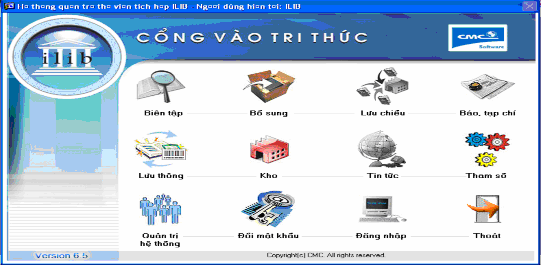
Figure 1: Main interface of iLib 4.0 software
- Online search subsystem – OPAC
- Additional Subsystem
- Serial Publication Subsystem
- Cataloging Subsystem
- Warehouse Management Subsystem
- Circulation subsystem (Borrowing and returning, reader management)
- Interlibrary Loan Subsystem
- News Management Subsystem
- System Administration Subsystem
Each subsystem has the following features:
- Online search subsystem - OPAC : OPAC module allows access to online public catalogs through a public access interface. The module provides quick search capabilities with an interface presented in a predefined format. Allows users to search by many different criteria, supports search operators , and can search in two modes: basic and advanced. Supports inter-library search through the Z39.50 portal. At the same time, it manages users and provides a forum for users to exchange information with each other. In addition, OPAC also provides online services, help, viewing user information, announcing new books, registering to borrow and requesting renewals online.
- Supplemental subsystem : The subsystem provides and fully supports functions and operations serving the supplemental work of a library. Set up orders and receipts of documents. Store all information of orders and receipts, closely monitor the supplemental work of the library. Allow statistics, settlement, creation of reports, complaints related to supplemental work. Manage and monitor supplemental funds; store parameters serving the supplemental work; partially support cataloging work.
- Serial publication subsystem : The subsystem provides powerful features for managing serial publications such as: ordering, tracking the receiving process, binding , cataloging, managing changes , circulation, statistical reports, etc. Build lists of serial publication orders : type, ordering period, period, quantity ordered by publication, supplier, additional fund source. Manage all serial publication activities such as: newspapers, magazines, periodicals, yearbooks, periodicals; non-periodical... Manage additional funds and criteria related to ordering serial publications. Manage each serial publication issue: Track the process of receiving documents and can receive documents.
- Cataloging subsystem : Is a powerful subsystem that supports consistent cataloging rules such as cataloging standards and cataloging descriptions according to international standards such as: classification, keywords , cataloging according to standard formats in MARC21 format and complies with standards and description rules such as AACR2, ISBD, TCVN 4743 - 89 and according to different classification frameworks such as DDC, BBK, UDC, LCC, ... These are cataloging records that help readers look up basic cataloging information about the documents they need. Allows new entry, correction, deletion, browsing, viewing and reuse, setting default values for detailed cataloging of records that are briefly entered into the system by the supplementary department.
- Warehouse management subsystem : Allows creation, organization and management of warehouses according to the requirements of each library such as main warehouse, sub-warehouse, functional warehouse, room, shelf, compartment , ...
- Circulation subsystem : The subsystem allows management of borrowing time, number of documents borrowed and reserved, borrowing fees, fines, etc. For readers , it allows registering new readers, modifying and updating information about readers. Allows setting up different policies at each circulation point in the system, ensuring consistency in the system. Supports summary reports of the entire system and reports of each point.