
The concept of Information Technology in our country is understood and defined in Resolution No. 49/CP of the Government signed on August 4, 1993: " Information technology is a collection of scientific methods, means and modern technical equipment - mainly computer and telecommunications technology - to organize, exploit and effectively use the very rich and potential information resources in all areas of human and social activities. IT directly serves the improvement of State management, improves the efficiency of production, business and other socio-economic activities, thereby contributing to improving the quality of people's lives. IT is developed on the basis of the development of electronic technologies.
- Printing - Telecommunications and Automation".
1.2.3. Application of information technology in teaching
The general trend of countries in the world is: Informatics, IT applications have been interested in being introduced into schools by most countries in the world and have become a global issue. IT brings innovation in teaching and learning methods for all levels of education. IT facilitates the connection of scientific research. IT in education will be a strategic solution to meet the needs of the knowledge economy.
Maybe you are interested!
-
 Enhancing the Application of Information Technology in Teaching for School Teachers
 -
 Managing the application of information technology in teaching at national standard primary schools in Dien Bien Dong district, Dien Bien province - 16
 -
 Strengthening the Management of Facilities, Teaching Facilities and Application of Information Technology in Teaching National Defense and Security Education
 -
 Situation of Information Technology Application in Enterprises
 -
 Testing the Necessity and Feasibility of Measures to Improve Teaching Capacity in the Field of Science and Technology for High School Teachers
According to the Law on Information Technology: “IT application is the use of IT in activities in the fields of socio-economy, foreign affairs, national defense, security and other activities to improve productivity, quality and efficiency of these activities” [68].
In the field of education and training, IT application is the use of IT in the activities of each educational institution to improve the quality and effectiveness of management activities, teaching and education activities.
The application of IT in teaching is a major topic that has been officially put forward as a UNESCO action program and is predicted to fundamentally change education in the early 21st century due to the influence of the digital economy. The application of IT in education will create a fundamental shift in the process of innovation in teaching methods.
teaching and learning methods in schools; this is a modern, advanced approach, oriented towards learners.
Through studying the above concepts, the researcher uses the concept: Application of technology in teaching is the use of technology in teachers' teaching activities and students' learning activities to promote students' cognitive activities, improve the quality and effectiveness of the teaching and learning process to meet the requirements of current educational innovation.
1.2.4. Application of information technology in teaching at secondary schools
Secondary school is a general education level in the National Education System. From the concept of applying IT in teaching and learning applied in secondary schools, it can be considered that: Applying IT in teaching and learning in secondary schools is the use of IT in teaching activities of teachers and learning activities of students in secondary schools to promote students' cognitive activities, improve the quality and effectiveness of the teaching and learning process to meet the teaching and learning requirements in secondary schools.
For secondary school level, subjects have been clearly differentiated, the difficulty of the subjects has increased significantly. Some subjects require transmission and reception at a more abstract level, so the application of IT to support lectures is at a higher and more difficult level. Some experiments in physics and chemistry, especially difficult and dangerous experiments, have been represented by virtual experiments thanks to the application of IT. Some complex illustrations and difficult structural models have been successfully represented through software and drawings thanks to computer drawing tools; some drawings and movements in mathematical representations are conveyed in an easy-to-understand and vivid way; images and documentary videos are included in lectures in social sciences, bringing strong and impressive emotions to students...
In the content of the secondary school program, all subjects are linked to practice and drills to help students remember the knowledge and information they have learned. Integrating IT into practice and drills is very necessary, making the lectures lively and deepening knowledge for students; allowing many
Students participate in practice and drills together; can even establish the speed of knowledge processing...
Along with the subjects in the program, the introduction of some interdisciplinary lectures or scientific research (STEM education) into schools has created a great motivation in applying IT to support teaching. This is also a new orientation that will be implemented a lot in the current period.
For secondary school level, IT contributes to the process of teachers and students building knowledge and learning about the world through experiences and interactions with each other; IT supports collaborative learning, problem solving, meaningful learning, etc. The application of IT in teaching and learning at secondary schools requires each teacher to be able to combine three basic forms of knowledge: subject matter expert knowledge, technology expert knowledge, and method expert knowledge.
For secondary education, Information Technology is still an elective subject for students from grades 6 to 9. The Information Technology program for secondary education provides basic knowledge about computers, computer programs, some software supporting some subjects, ... providing some understanding of the utilities of IT in life. In general, this is basic and simple knowledge so that students can continue to explore and learn to improve their knowledge.
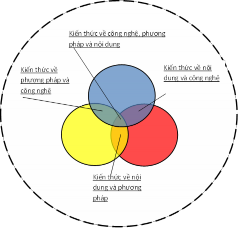
TPACK Model (Content, Method and Technology Knowledge)
Forms and levels of application of information technology in teaching at secondary schools
Currently, the application of IT in teaching has many forms, diverse and rich. Based on the practical situation in secondary schools today, there are two main forms of IT application in teaching as follows:
Lectures with technology applications : Teachers use their lectures, combined with the support of computers, using utility software, teaching aids such as projectors, printers, audio-visual equipment, ... to promote the power of sound and images of documents or experiments, ... to improve the quality of lectures.
Electronic lectures using E-Learning technology: Teachers use applications such as network technology, graphics techniques, simulation techniques, computing technology... to prepare lesson plans including lectures, vivid sounds and images, questions, and exercises prepared in a sequence. Learners use computers to self-study lectures offline or online and have the ability to interact with other learners, helping learners to self-study without needing a direct teacher and without having to go to class.
In fact, secondary schools are currently still using the first form mainly due to the characteristics of the children's age, so their awareness of proactive learning is not high. However, with the needs and conditions of facilities in the coming time, the impact of having to stop studying due to the Covid-19 pandemic, the second model will be applied more commonly. These two basic forms have been applied to secondary schools at different levels depending on the awareness of managers, teachers and students along with the conditions of facilities, teaching equipment, ...
Based on the current IT application activities in secondary schools and the development trend in the near future, we can divide the application of IT in teaching into 5 basic levels from low to high as follows:
Level 1: Using IT to support teachers with some simple operations: such as preparing lesson plans, printing documents, using the Internet to collect documents for teaching activities but not yet using IT to carry out lectures in class.
Level 2: Applying IT to support a part or a stage in teaching. Able to use software to compose and present, know how to use some simple electronic devices. Being a member of some forums to exchange content of lectures or teaching materials. Most teachers in secondary schools today can perform at this level.
Level 3: Know how to use and exploit many specialized teaching software, software for processing movies, sounds, drawings, etc. to organize teaching. Know how to use multimedia classrooms and smart IT devices.
Level 4 : Integrating IT in teaching means teachers use IT in all stages from building lesson plans, preparing lectures, organizing implementation in class and testing and evaluation are all done on computers and computer networks. This form requires teachers to be fully equipped with modern IT equipment and have high-level IT capacity.
Level 5: Smart School is a learning environment equipped with modern equipment. Tablets for each student are connected to teachers, electronic interactive boards, learning management software, and network systems to create a smart classroom environment, helping to connect students and teachers with new teaching methods using electronic lesson plans. This level is currently being applied on a pilot model in a few schools and promises to be widely deployed nationwide.
1.2.5. Teaching management
There are many different understandings of the concept of management, depending on different approaches. Below are some concepts of management.
Author Bui Minh Hien believes that: Management is a process of organized and targeted impact of the management subject on the management object to achieve the set goal". In which it is understood that:
- Management is a goal-oriented activity with defined objectives through which to organize and direct effective implementation.
- Management creates a favorable environment for individuals and groups to cooperate to achieve goals. It is the relationship between people, between the subject and the object of management, between the system and the object of management.
- Management is to utilize all internal and external resources and every opportunity to achieve quality goals [53].
Based on the role of resources in management, author Tran Kiem affirmed: "Management is the impact of the management subject in mobilizing, promoting, combining, using, adjusting, and coordinating resources (human resources, material resources, financial resources) inside and outside the organization (mainly internal resources) in an optimal way to achieve the organization's goals with the highest efficiency" [61, p.8].
From the above general characteristics, NCS can understand: Management is the organized, targeted impact of the management subject on the management object and subject in an organization, by using the most effective potentials and opportunities to make the organization operate and achieve the set goals.
Teaching and learning are the basic and central activities. Therefore, the principal must pay attention to this issue; must influence all members of the school who participate directly or indirectly in teaching and learning activities. Create conditions in all aspects for teaching and learning activities to achieve the highest efficiency and quality.
Thus, teaching management in secondary schools is the organized and targeted impact of the principal on the collective of teachers, students and other management staff to mobilize and effectively use resources, create motivation to promote the teaching and learning process of the school to achieve quality and effective teaching goals.
1.2.6. Managing the application of information technology in teaching at secondary schools to meet the requirements of educational innovation
Based on the concepts of management, teaching management and IT application in teaching, the thesis uses the concept of IT application management in teaching, specifically as follows:
Management of technology application in teaching is the organized and targeted impact of the principal to promote and create conditions for the effective use of technology in teachers' teaching activities and students' learning activities, contributing to improving the quality of teaching and learning.
In the 4.0 industrial revolution, the role of IT appears in almost all sectors. Regarding the education sector, the Ministry of Education and Training affirms: " IT is an effective tool to support innovation in teaching and learning methods and support innovation in educational management, contributing to improving the effectiveness and quality of education ."
The essence of IT application management in teaching at secondary schools is the total impact of the management subject on the team of managers, teachers and students to foster the ability to use the utilities of IT in innovating content, organization methods, teaching and learning to improve the quality of education.
The objective of managing the application of IT in teaching at secondary schools is to effectively carry out the tasks and teaching contents according to the new general education program 2018; contributing to improving the quality and achieving the teaching goals at secondary schools in the context of educational innovation and the development of IT today.
The indirect subject playing the role of directing and managing the application of IT in teaching at secondary schools within the scope of the thesis is: management staff of the Department of Education and Training.
The direct management entity of applying IT in teaching and learning at school level is the management staff of secondary schools, headed by the principal.
Teachers are the direct managers of applying IT to teaching activities.
The subjects of IT application management in teaching at secondary schools are IT usage skills, teachers' activities to exploit the benefits of IT and invest in and manage facilities and technical means to ensure the application of IT in teaching achieves the highest results.
The methods of managing the application of IT in teaching at secondary schools are very diverse and rich; they are implemented through educational management methods; combining management with self-management.
The quality of IT application management in teaching at secondary schools depends on the need for IT application, the school's preparation and local practice; the strategic vision of the manager; the IT environment; support for management, difficulties and obstacles during the implementation process and in the future, etc.
Thus, managing the application of IT in teaching at HCS is a school management activity, according to the existing functions and decentralization of the Department of Education and Training and HCS. Managing the application of information technology in teaching has become an inevitable trend of education in the period of the 4.0 industrial revolution.
1.3. Current context and its impact on teaching, application of information technology in teaching and management of application of information technology in teaching at secondary schools
1.3.1. The information and communication revolution in the fourth industrial revolution and its impact on the application of information technology in education and educational management in general
The 21st century is considered the era of IT, often called the period of the 4.0 industrial revolution. The application of IT has been taking place very quickly all over the world. It has penetrated and affected almost all areas of social life. Especially, for education and training, IT has made a great revolution. In our country, the Ministry of Education and Training has affirmed: IT is a powerful tool to support innovation in teaching and learning methods and support innovation in educational management, contributing to improving the effectiveness and quality of education.