
Evaluate:
Amplitude 9-10mm, very large tremor (corresponding to the initial fever state). Amplitude 6-8mm, large tremor (corresponding to the indifferent state). Amplitude 4-5mm, moderate tremor (corresponding to the state of readiness for competition). Amplitude 2-3mm, average tremor (corresponding to the state of indifference).
Frequency (number of times the hole wall is touched).
8-9 times the amplitude of the oscillation is very large (corresponding to the initial fever state).
6-7 times the amplitude of large oscillations (corresponding to the undifferentiated state).
4-5 times the relatively small amplitude of oscillation (corresponding to the state of readiness for competition).
2-3 times the amplitude of small oscillations (corresponding to a state of indifference) [14], [24], [25], [26], [37], [39].
2.2.5. Pedagogical experimental method
The topic uses experimental methods to test the effectiveness of selected training and psychological adjustment measures.
The experiment was conducted for 1 year from March 2015 to March 2016. The experimental subjects were 18 Kumite athletes of the national Karatedo team with levels ranging from level I athletes to national masters, all athletes were 18 years old or older.
The experiment was conducted using the comparative experimental method.
The experimental group was trained and adjusted according to measures of our choice.
The control group was trained and adjusted using traditional methods (still commonly used as of 2014).
The experimental sites were conducted at the National Sports Training Center in Hanoi and national and international competition venues.
2.2.6. Statistical mathematical methods
The statistical method is used in the topic with the purpose of processing the data obtained from the pedagogical experiment. The results help us analyze and evaluate more accurately and convincingly the effectiveness of the measures that the topic has chosen when applied in practice.
In this topic, algorithms and data analysis methods are used using Excel, R and SPSS 16.0 programs. Specifically as follows:
Cronbach's Alpha reliability coefficient: performed using SPSS software. In which, the reliability of the scale is assessed by the internal consistency method through the Cronbach's Alpha coefficient. Use this reliability coefficient method before factor analysis to eliminate inappropriate variables.
Cronbach's Alpha reliability coefficient only indicates whether the measurements are related to each other or not; but does not indicate which observed variables should be removed and which observed variables should be retained. In that case, calculating the item-total correlation coefficient (Cronbach's Alpha if Item Deleted) will help eliminate observed variables that do not contribute much to the description of the concept being measured. The criteria used when assessing the reliability of a scale:
Eliminate observed variables with a Corrected Item-Total Correlation coefficient of less than 0.4; the scale selection criteria are when the Alpha reliability is greater than 0.6 (the larger the Alpha, the higher the internal consistency reliability).
Alpha value levels: greater than 0.8 is a good measurement scale; from 0.7 to 0.8 is usable; from 0.6 and above is usable.
Exploratory factor analysis EFA : performed using SPSS software, used to reduce a set of k observed variables into a set F (with F <
k) more meaningful factors. In the study of measures to overcome bad mental states for Karatedo athletes, 16 measures were identified to overcome 3 bad mental states. Instead of studying 16 measures divided
In the 3 psychological states, we only study whether the remedies for each psychological state are correlated with each other or not. Criteria:
The KMO (Kaiser-Meyer-Olkin) coefficient is an index used to examine the appropriateness of factor analysis. The value of KMO must reach a value of 0.5 or higher (0.5 ≤ KMO ≤ 1) which is a sufficient condition for factor analysis to be appropriate. If this value is less than 0.5, then factor analysis is likely not appropriate for the research data set.
Bartlett's test of sphericity is used to examine whether the measures in each psychological state that needs to be overcome are correlated with each other. A necessary condition for applying factor analysis is that the measures reflecting different aspects of overcoming a bad psychological state must be correlated with each other. This point is related to convergent validity in EFA analysis. Therefore, if the test shows no statistical significance, factor analysis should not be applied to the variables under consideration. Bartlett's test is statistically significant (sig Bartlett's Test < 0.05), proving that the measures are correlated with each other in overcoming a bad psychological state.
Eigenvalue is a commonly used criterion to determine the number of factors in EFA analysis. With this criterion, only factors with Eigenvalue ≥ 1 are retained in the analysis model.
Total Variance Explained ≥ 50% shows that the EFA model is suitable. Considering the variation as 100%, this value shows how much % of the extracted factors are condensed and how much % of the observed variables are lost.
Distribution chart : The distribution chart of psychological status in the assessment of the current situation was performed using R software with the qplot() command package.
Proportion test : performed using R software with the prop.test() command package. Proportion test is usually based on the assumption of binomial distribution. With a sample number n and a proportion p, and if n is large (ie more than 50
for example), then the binomial distribution can be equivalent to the normal distribution with mean np and variance np(1 – p). Let x be the number of events we are interested in, and testing the hypothesis p = π can use the following statistic:
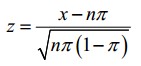
Here, z follows a normal distribution with mean 0 and variance
1. It can also be said that z 2 follows the chi-square distribution with 1 degree of freedom.
Fisher's exact test : Because the number of subjects was too small in the classification of the results of overcoming psychological states (No clarity, Relatively good, Very good) with psychological states (Starting fever, Indifferent, Indistinguishable), the topic used the fisher's exact test (also known as Fisher's exact test). The fisher's exact test was calculated using R software with the fisher.test() command package.
Pearson's Chi-squared test is performed using the chisq.test() command. The X-squared value and statistical significance are based on the p-value (P), which can be compared with the chi-squared tables in sports statistics textbooks through the df value (degrees of freedom). The chi-squared test is used to determine whether the experimental and control groups are similar before the experiment. The results are presented in Table 1.
The Cramer'V coefficient is obtained from the lsr package using the cramersv() command with the binary variables converted like the Binary Logistic regression model presented in the next section. The obtained coefficients are evaluated at the following levels: Weak: 0 – 0.29; Moderate: 0.3 – 0.59; Strong:
0.6 – 1. In the study, we used this coefficient to detect the level of association between the experimental and control groups on measures to overcome bad psychological states before competition, for high-level Vietnamese Karatedo athletes.
Binary Logistic regression model used in epiR package by command epi.2by2() with method="cohort.count". Dependent variable is
Convert into binary form (0 and 1) to estimate the probability of measures to overcome bad psychological state before competition, for Vietnamese senior Karatedo athletes. That is, determine the level of improvement for Vietnamese senior Karatedo athletes through the athlete's psychological state.
Then the psychological states are divided into 2 groups to make 2 binary data columns, called the Outcome variable: Outcome+ is the group with poor recovery (including the states: starting fever, indifference, indiscrimination); and Outcome- is the group with good recovery (state of being ready to compete).
The two experimental groups are two rows (binary form), called the Exposed variable: Exposed+ is the experimental group; and Exposed- is the control group. The calculation results are at the 95% level (95% CIs), in which only the OR (Odds ratio) value is focused on analyzing. OR is the ratio between the Odds (events occurring) of the experimental group (Exposed+) and the control group (Exposed-) to determine the impact rate of measures to overcome bad psychological states before competition, for high-level Vietnamese Karatedo athletes [18], [29], [32], [68], [69].
2.3. Research organization:
2.3.1. Scope of research
The first interview included 38 coaches in 16 provinces and cities with high-level Karatedo teams such as: Hanoi, Ho Chi Minh City, Da Nang, Thanh Hoa, An Giang, etc.
The second interview included 22 people (including 12 scientists, 3 psychologists and 7 experienced coaches).
Interviewed 44 athletes who have been and are participating in Karatedo training in the national team, People's Police, People's Army and teams of Hanoi, Ho Chi Minh City, Da Nang, Thanh Hoa, An Giang, etc.
The 18 Kumite competitors of the national Karatedo team range from level I athletes to national masters. All athletes are 18 years of age or older.
2.3.2. Research time
The research topic was conducted over 4 years, from August 2014 to August 2018 and was divided into 3 phases:
Phase 1: from August 2014 to November 2014, identify research problems, develop research outlines and plans, and defend research outlines.
Phase 2: from December 2014 to December 2017, collect data, determine methods, study the current status of factors affecting the bad psychological state before competition for Vietnamese senior Karatedo athletes. Through the results of analyzing reference documents, interview results, to select measures to overcome the bad psychological state before competition for Vietnamese senior Karatedo athletes. Experimentally apply measures to overcome the bad psychological state before competition for Vietnamese senior Karatedo athletes.
Phase 3: from January 2018 to August 2018, complete data processing, write drafts to seek expert opinions, write official thesis to prepare for thesis defense.
2.3.3. Research location
National Sports Training Center Hanoi. Institute of Sports Science.
Some provincial sports centers.
Some national and international Karatedo competition venues are held domestically and internationally.
Chapter 3. RESEARCH RESULTS AND DISCUSSION
3.1. Research on the current status of training and adjusting the competition mentality for high-level Vietnamese Karatedo athletes
3.1.1. Current awareness of coaches and athletes about training and psychological adjustment before competition
Current status of coaches' awareness of the role of training and psychological adjustment before competition for high-level Vietnamese Karatedo athletes.
Analyzing the theoretical and practical basis, the topic has identified and built a questionnaire with 7 questions on the role of training and psychological adjustment in overcoming bad psychology before competition for high-level Vietnamese Karatedo athletes. Each question is answered by the respondent according to 5 levels of impact (C5: Very large impact; C4: Large impact; C3: Normal; C2: Small impact; C1: Very small impact). The interview results are evaluated on the Likert scale. The interview content is presented in Appendix 1 and focuses on issues such as:
Improve technical skills. Improve physical skills.
Improve psychological adjustment skills. Make good use of psychological energy.
Improve your game strategy.
Overcome bad psychology before competition. Adjust competition psychology.
The interview subjects included 38 coaches who have been and are participating in training high-level Karatedo athletes in Vietnam such as national team coaches, coaches of the People's Public Security Karatedo team, coaches of the Vietnam People's Army team and a number of coaches in 16 provinces and cities with teams of many high-level Karatedo athletes such as Hanoi, Ho Chi Minh City, Da Nang, Thanh Hoa, An Giang, etc.
Regarding the reliability of the interview results, they are presented in Table 3.1 and Appendix 4 (Section 1).
Table 3.1. Reliability of interview results on the role of training and psychological adjustment for Vietnamese senior Karatedo athletes (n = 38)
Reliability coefficient
Number of variables | |
0.754 | 7 |
Maybe you are interested!
-

 Current Status of State Management Activities for Tourism Enterprises in Hanoi
 -
 Research on current status and improvement of cropping system on coastal land of Thanh Hoa province - 19
 -
 Current Status of Human Resource Training at the Institute of Occupational Health and Environment
 -
 Hoang Thanh Phuc (2009), "Research on Current Status and Solutions for Developing Scattered Forestry Planting in Thai Nguyen Province", Master's Thesis,
 -
 Research on the current status and proposed solutions for conservation of Pseudotsuga brevifolia WC Cheng & LKFu, 1975 in Nguyen Binh district, Cao Bang province - 10
From the results in Table 3.1, it can be seen that: The Cronbach's Alpha reliability coefficient of the total of 7 interview questions obtained on the role of training and psychological adjustment is 0.754, when compared with the value of the Correlation Coefficient between the variable - total when removing the variable of each interview role is < 0.754, only from 0.701 to 0.737. At the same time, the value of the Correlation Coefficient between the variable - total obtained in the 7 interview questions has a value obtained from 0.408 to 0.572 > 0.4. Therefore, no interview question has to be removed and the results obtained ensure reliability.
The results of the responses are presented in table 3.2 and chart 3.1.
Table 3.2. Current status of coaches' awareness of the role of training and psychological adjustment for high-level Vietnamese Karatedo athletes (n = 38)
TT
The role of training and psychological adjustment | Impact level (%) |
| δ | |||
Small and very small | Normal | Very big and large | ||||
1 | Improve technical skills | 76 | 11 | 13 | 2.08 | 1.12 |
2 | Improve physical fitness | 61 | 32 | 8 | 2.26 | 1.06 |
3 | Improve your mental adjustment skills | 47 | 39 | 13 | 2.55 | 1.03 |
4 | Make good use of mental energy | 47 | 32 | 21 | 2.63 | 1.10 |
5 | Improve your game strategy | 63 | 21 | 16 | 2.39 | 1.15 |
6 | Overcoming bad psychology before exams fight | 50 | 34 | 16 | 2.50 | 1.11 |
7 | Adjust your competitive mentality | 61 | 26 | 13 | 2.34 | 1.02 |
