
- External sources: People from other units, organizations or teachers in training facilities, or artisans. Using this source, the ability to select good teachers is high, without affecting the operation of the unit or organization. However, it is costly and more difficult to manage.
Before training students, it is also necessary to provide preliminary training to teachers so that they understand the objectives of the training program, know who their training subjects are, and understand some basic information about the organization .
1.2.3. Training evaluation
Training outcome evaluation is the determination of the extent to which training activities meet the initial objectives. From there, lessons are drawn for subsequent training sessions. The effectiveness of training courses is often evaluated through two stages: the cognitive stage and the application stage. ”
1.2.3.1. Assessment of cognitive stage
“ What do trainees learn and acquire through the training course? First of all, the unit or organization needs to evaluate the changes of trainees according to the following criteria: reaction, behavioral learning and achieved goals:
+ Trainee reactions: Evaluate trainees' reactions to the training program they participated in. Through a survey questionnaire to find out whether they enjoyed the program, whether the program content and training methods are suitable for their work reality and suitable for their career development needs.
+ Level of understanding of trainees: Officers, employees of the unit or organization when attending the course need to be tested to determine the level of understanding of the knowledge, skills learned and other related issues according to the requirements of the training course.
+ Change in awareness and behavior: Assign staff to monitor and study how employee behavior changes, in what direction and to what extent when participating in the training course .
1.2.3.2. Evaluation of the application phase
“ How do trainees apply the knowledge and skills they have learned in practice to perform and complete their work? Depending on the specific situation and nature of the work at the unit, managers need to have appropriate measurement tools for the results of the work of employees before and after training. This depends not only on the quality of the training program but also on the ability, level of understanding and application of each trainee.
In addition, units and organizations also need to pay attention to the results obtained after investing in the training program. To do this, it is necessary to analyze the costs and benefits after training.
To evaluate student change, we can use Kirkpatrick's four-level evaluation model to get the best results. ”
Table 1.2. Donald Kirkpatrick's evaluation model
Level
Evaluation aspect | Issues of concern | Tools | |
(1) | React of students | Are students satisfied with the courses they attend? | Questionnaire |
(2) | Awareness | What do students learn from the course? | Test, hypothetical situation |
(3) | Behavior | Can students apply what they learn from the course to their work? Or after the course, can employees improve their performance? the results of your work | Measurement of work performance |
(4) | Result | What does the unit gain from investing in training? | Cost Analysis cost and benefit |
Maybe you are interested!
-

 Evaluation of the Current Status of Human Resource Training at Tu Son Hotel
 -
 Complete Solution for Human Resource Training at the Ethnic Committee
 -
 Evaluation of human resource training quality at ÊMM Hue Hotel - 17
 -
 Current Status of Human Resource Quality in terms of Mental Power
 -
 Some Other Solutions To Improve Human Resource Training At Nui Phao Service Trading Company Limited
(Source: Human resource management, Statistical Publishing House, 2006)
“ Through four levels of assessment, the system can provide valuable information about students' satisfaction with the course, the amount of knowledge and skills they have acquired.
learning, their ability to apply what they learn on the job, and the impact of training programs on organizational success. This information helps managers organize training programs more effectively and take better measures to improve the effectiveness and quality of training.
Level 1 – Reaction: Assessment at this level focuses on how students react to the course they have taken. Through a survey, usually distributed at the end of the course, students express their opinions on various aspects of the course.
Level 2 – Assessment of learning: The second level in the assessment system is concerned with the learning outcomes of the learners. Learning outcomes are determined based on the amount of knowledge, skills, and attitudes that the learners acquire from the course. This level can be conducted throughout the course and uses a variety of assessment methods (Bistriz, 1996) including questionnaires, surveys, observations, theoretical tests on environmental sanitation, practical tests, group assessments, and self-assessments .
“ Level 3 – Behavioral Assessment: The ability and level of application of the knowledge and skills that learners gain from the course to their work is the main assessment object of level 3. Assessment at this level is relatively complex and difficult to conduct.
Level 4 – Outcome Evaluation: This is the evaluation of the effectiveness of training through its impact on business results. This level does not focus on the impact of training on individuals but on the overall impact of training on the entire organization. Level four is the most difficult to implement, takes the most time and requires the most money to collect, organize and analyze the data .
1.3. FACTORS AFFECTING HUMAN RESOURCE TRAINING
1.3.1. External environmental factors
“ There are many external factors affecting human resource training including: socio-economic, scientific and technological progress, labor market, education and training, international integration.
Socio-economic factors: Each political system, laws and policies
Society has its own factors related to human resource training. The more the economy and society develop, the more the state and society invest in human resource training, creating favorable conditions and environments for human resource training and development. At the same time, when the human resources of the country, locality, unit, and organization are trained with high quality, it will contribute to promoting socio-economic development. In a mutual relationship, one factor will support the development of the other.
“ Factors of scientific and technological progress: Today, the world is in the 4.0 industrial revolution, creating many challenges for human resources; requiring increased training, retraining of occupations, rearrangement of the workforce and attracting new high-quality human resources. The progress of science and technology has a great impact on the development and training of human resources because it increases the demand for high-quality human resources, mainly intellectual workers; the number of manual workers is decreasing. New occupations are appearing more and more, requiring training content and training methods to also change.
Labor market factors: Currently, organizations have very strong competition, to develop each organization has a policy to attract high-quality human resources. Therefore, training and developing high-quality human resources but at the same time, there must be a post-training mechanism to ensure that training serves the organization's operations. Avoid brain drain, causing waste that affects the organization's operational efficiency .
1.3.2. Internal environmental factors
“ Due to the organization's development strategy: Each organization has a certain development strategy, this strategy is the basis for making specific action plans, including human resource training plans. That is an important basis for the organization to implement the goal of training human resources with the most appropriate qualifications.
Because human resource policies such as recruitment, human resource allocation, etc. will greatly affect human resource training strategies. Organizations that implement reasonable work arrangements, assignments, and promotion policies, based on actual capacity and professional qualifications, will motivate employees.
Employees who are placed in the right position in line with their professional qualifications will be able to develop their strengths and be encouraged to continue attending further training courses.
“ Due to the attention of the leader, the management team and the employees themselves. The leader is the one who directly directs, the leader's viewpoint will affect the human resource training policy. The leader is truly interested in professional development, interested in the workforce, then the effectiveness of training work will be improved. In addition to incentives and conditions from the organization, the employees themselves are the decisive factor in training work. Employees need to truly realize that training and improving their own capacity and qualifications are the premise for them to develop themselves and improve their position in the organization.
Due to the financial capacity of the organization: Finance is a factor that affects most activities in the organization. When there is adequate financial resources, planned according to a detailed plan, ensuring a balance of income and expenditure will help the training plan to be completed in the best way, ensuring that the training plan is implemented effectively and without interruption.
Due to personal financial resources: In addition to the training support of the organization to conduct training, individuals still have to pay many other costs. For state agencies, the main source of income is from salary, so for young officials, personal financial resources can be a barrier in training work.
Due to employee treatment policy: This is an issue that every employee after training is always concerned about. An organization with good treatment policy during and after training will encourage employees in training and vice versa .
CONCLUSION OF CHAPTER 1
“ Based on the references of the authors as well as some organizations that have researched on human resource training, the thesis presents some concepts of human resources and human resource training, clarifies the role of human resource training to see the importance of this work for each organization and each country. At the same time, researches the theoretical frameworks of human resource training from content to training methods along with experiences drawn from the training work of some countries, thereby providing a basis for the thesis to approach the training work of the Institute of Occupational Health and Environment in the next chapter. ”
CHAPTER 2: CURRENT STATUS OF HUMAN RESOURCE TRAINING AT THE INSTITUTE OF OCCUPATIONAL HEALTH AND ENVIRONMENT
2.1. OVERVIEW OF THE INSTITUTE OF OCCUPATIONAL AND ENVIRONMENTAL HEALTH
2.1.1. Formation and development process
Full name: INSTITUTE OF OCCUPATIONAL HEALTH AND ENVIRONMENT
Address: 57 Le Quy Don, Bach Dang Ward, Hai Ba Trung District, Hanoi Tax code: 0100949810
Legal representative: Doan Ngoc Hai Date of operation: April 24, 1982
“ The Institute of Occupational and Environmental Health is an organization under the management of the Ministry of Health. Currently, the Institute is the leading national institution in occupational health, environmental hygiene and school hygiene.
The Institute has legal status, its own seal and is subject to management according to the provisions of law. Any violations or negligence causing consequences, depending on the level, will be punished according to the administrative regulations and laws of the state.
The Institute is also under the state management of science, health, training and development of staff. All activities and events are organized for the community, solving all problems and concerns of people with health, career and environmental needs.
As an organization under the Ministry of Health, all activities serve the purposes of community, health, profession and environment. The Institute also has its own functions, tasks and powers.
The main functions of the Institute are scientific research, training and development of staff, and professional guidance at lower levels. Directing communication activities on health and vocational education. 2.1.3.
International cooperation and provision of scientific and technical services on health, hygiene, occupation, labor safety, psychology, etc. Issues on accident prevention
injuries, have new proposals and ideas to improve the quality of life of people in the areas covered .
2.1.2. Characteristics of organizational work
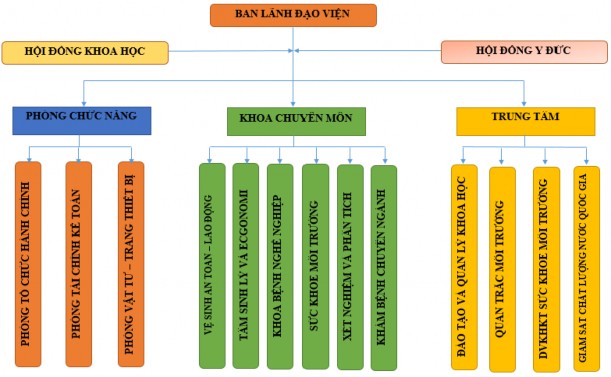
The Institute's organizational structure also includes all departments. Each department undertakes separate functions and supports each other in handling common issues.
Diagram 2.1. Organizational structure at the Institute of Occupational and Environmental Health
Source: Administrative Organization Department
Functional departments :
- Organization and Administration Department (including Internal Political Protection).
- Materials and Equipment Department.
- Finance and Accounting Department.
Specialized departments :
- Department of Hygiene and Labor Safety.
- Faculty of Environmental Health.
- Department of Occupational Diseases.
- Department of Psychophysiology and Ergonomics.