
* For agricultural production:
This is a key industry and has absolute strength in Dong Thap Muoi region, so it is still prioritized for development. To ensure that agriculture remains the economic sector.
owner
Maybe you are interested!
-
 Identify Rating Levels and Rating Scales
zt2i3t4l5ee
zt2a3gstourism,quan lan,quang ninh,ecology,ecotourism,minh chau,van don,geography,geographical basis,tourism development,science
zt2a3ge
zc2o3n4t5e6n7ts
of the islanders. Therefore, this indicator will be divided into two sub-indicators:
a1. Natural tourism attractiveness a2. Cultural tourism attractiveness
b. Tourist capacity
The two island communes in Quan Lan have different capacities to receive tourists. Minh Chau Commune is home to many standard hotels and resorts, attracting high-income domestic and international tourists. Meanwhile, Quan Lan Commune has many motels mainly built and operated by local people, so the scale and quality are not high, and will be suitable for ordinary tourists such as students.
c. Time of exploitation of Quan Lan Island Commune:
Quan Lan tourism is seasonal due to weather and climate conditions and festivals only take place on certain days of the year, specifically in spring. In Quan Lan commune, the period from April to June and from September to November is considered the best time to visit Quan Lan because the cultural tourism activities are mainly associated with festivals taking place during this time.
Minh Chau island commune:
Tourism exploitation time is all year round, because this is a place with a number of tourist attractions with diverse ecosystems such as Bai Tu Long National Park Research Center, Tram forest, Turtle Laying Beach, so besides coming to the beach for tourism and vacation in the summer, Minh Chau will attract research groups to come for tourism combined with research at other times of the year.
d. Sustainability
The sustainability of ecotourism sites in Quan Lan and Minh Chau communes depends on the sensitivity of the ecosystems to climate changes.
landscape. In general, these tourist destinations have a fairly high level of sustainability, because they are natural ecosystems, planned and protected. However, if a large number of tourists gather at certain times, it can exceed the carrying capacity and affect the sustainability of the environment (polluted beaches, damaged trees, animals moving away from their habitats, etc.), then the sustainability of the above ecosystems (natural ecosystems, human ecosystems) will also be affected and become less sustainable.
e. Location and accessibility
Both island communes have ports to take tourists to visit from Van Don wharf:
- Quan Lan – Van Don traffic route:
Phuc Thinh – Viet Anh high-speed boat and Quang Minh high-speed boat, depart at 8am and 2pm from Van Don to Quan Lan, and at 7am and 1pm from Quan Lan to Van Don. There are also wooden boats departing at 7am and 1pm.
- Van Don - Minh Chau traffic route:
Chung Huong high-speed train, Minh Chau train, morning 7:30 and afternoon 13:30 from Van Don to Minh Chau, morning 6:30 and afternoon 13:00 from Minh Chau to Van Don.
f. Infrastructure
Despite receiving investment attention, the issue of infrastructure and technical facilities for tourism on Quan Lan Island is still an issue that needs to be resolved because it has a direct impact on the implementation of ecotourism activities. The minimum conditions for serving tourists such as accommodation, electricity, water, communication, especially medical services, and security work need to be given top priority. Ecotourism spots in Minh Chau commune are assessed to have better infrastructure and technical facilities for tourism because there are quite complete and synchronous conditions for serving tourists, meeting many needs of domestic and foreign tourists.
3.2.1.4. Determine assessment levels and assessment scales
Corresponding to the levels of each criterion, the index is the score of those levels in the order of 4, 3, 2, 1 decreasing according to the standard of each level: very attractive (4), attractive (3), average (2), less attractive (1).
3.2.1.5. Determining the coefficients of the criteria
For the assessment of DLST in the two communes of Quan Lan and Minh Chau islands, the students added evaluation coefficients to show the importance of the criteria and indicators as follows:
Coefficient 3 with criteria: Attractiveness, Exploitation time. These are the 2 most important criteria for attracting tourists to tourism in general and eco-tourism in particular, so they have the highest coefficient.
Coefficient 2 with criteria: Capacity, Infrastructure, Location and accessibility . Because the assessment area is an island commune of Van Don district, the above criteria are selected by the author with appropriate coefficients at the average level.
Coefficient 1 with criteria: Sustainability. Quan Lan has natural and human-made ecotourism sites, with high biodiversity and little impact from local human factors. Most of the ecotourism sites are still wild, so they are highly sustainable.
3.2.1.6. Results of DLST assessment on Quan Lan island
a. Assessment of the potential for natural tourism development
For Minh Chau commune:
+ Natural tourism attractiveness is determined to be very attractive (4 points) and the most important coefficient (coefficient 3), so the score of the Attractiveness criterion is 4 x 3 = 12.
+ Capacity is determined as average (2 points) and the coefficient is quite important (coefficient 2), then the score of Capacity criterion is 2 x 2 = 4.
+ Exploitation time is long (4 points), the most important coefficient (coefficient 3) so the score of the Exploitation time criterion is 4 x 3 = 12.
+ Sustainability is determined as sustainable (4 points), the important coefficient is the average coefficient (coefficient 1), so the score of the Sustainability criterion is 4 x 1 = 4 points
+ Location and accessibility are determined to be quite favorable (2 points), the coefficient is quite important (coefficient 2), the criterion score is 2 x 2 = 4 points.
+ Infrastructure is assessed as good (3 points), the coefficient is quite important (coefficient 2), then the score of the Infrastructure criterion is 3 x 2 = 6 points.
The total score for evaluating DLST in Minh Chau commune according to 6 evaluation criteria is determined as: 12 + 4 + 12 + 4 + 4 + 6 = 42 points
Similar assessment for Quan Lan commune, we have the following table:
Table 3.3: Assessment of the potential for natural ecotourism development in Quan Lan and Minh Chau communes
Attractiveness of self-tourismof course
Capacity
Mining time
Sustainability
Location and accessibility
Infrastructure
Result
Point
DarkMulti
Point
DarkMulti
Point
DarkMulti
Point
DarkMulti
Point
DarkMulti
Point
DarkMulti
CommuneMinh Chau
12
12
4
8
12
12
4
4
4
8
6
8
42/52
Quan CommuneLan
6
12
6
8
9
12
4
4
4
8
4
8
33/52
b. Assessment of the potential for humanistic tourism development
For Quan Lan commune:
+ The attractiveness of human tourism is determined to be very attractive (4 points) and the most important coefficient (coefficient 3), so the score of the Attractiveness criterion is 4 x 3 = 12.
+ Capacity is determined to be large (3 points) and the coefficient is quite important (coefficient 2), then the score of the Capacity criterion is 3 x 2 = 6.
+ Mining time is average (3 points), the most important coefficient (coefficient 3) so the score of the Mining time criterion is 3 x 3 = 9.
+ Sustainability is determined as sustainable (4 points), the important coefficient is the average coefficient (coefficient 1), so the score of the Sustainability criterion is 4 x 1 = 4 points.
+ Location and accessibility are determined to be quite favorable (2 points), the coefficient is quite important (coefficient 2), the criterion score is 2 x 2 = 4 points.
+ Infrastructure is rated as average (2 points), the coefficient is quite important (coefficient 2), then the score of the Infrastructure criterion is 2 x 2 = 4 points.
The total score for evaluating DLST in Quan Lan commune according to 6 evaluation criteria is determined as: 12 + 6 + 6 + 4 + 4 + 4 = 36 points.
Similar assessment with Minh Chau commune we have the following table:
Table 3.4: Assessment of the potential for developing humanistic eco-tourism in Quan Lan and Minh Chau communes
Attractiveness of human tourismliterature
Capacity
Mining time
Sustainability
Location and accessibility
Infrastructure
Result
Point
DarkMulti
Point
DarkMulti
Point
DarkMulti
Point
DarkMulti
Point
DarkMulti
Point
DarkMulti
Quan CommuneLan
12
12
6
8
9
12
4
4
4
8
4
8
39/52
Minh CommuneChau
6
12
4
8
12
12
4
4
4
8
6
8
36/52
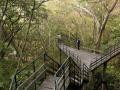
Basically, both Minh Chau and Quan Lan localities have quite favorable conditions for developing ecotourism. However, Quan Lan commune has more advantages to develop ecotourism in a humanistic direction, because this is an area with many famous historical relics such as Quan Lan Communal House, Quan Lan Pagoda, Temple worshiping the hero Tran Khanh Du, ... along with local festivals held annually such as the wind praying ceremony (March 15), Quan Lan festival (June 10-19); due to its location near the port and long exploitation time, the beaches in Quan Lan commune (especially Quan Lan beach) are no longer hygienic and clean to ensure the needs of tourists coming to relax and swim; this is also an area with many beautiful landscapes such as Got Beo wind pass, Ong Phong head, Voi Voi cave, but the ability to access these places is still very limited (dirt hill road, lots of gravel and rocks), especially during rainy and windy times; In addition, other natural resources such as mangrove forests and sea worms have not been really exploited for tourism purposes and ecotourism development. On the contrary, Minh Chau commune has more advantages in developing ecotourism in the direction of natural tourism, this is an area with diverse ecosystems such as at Rua De Beach, Bai Tu Long National Park Conservation Center...; Minh Chau beach is highly appreciated for its natural beauty and cleanliness, ranked in the top ten most beautiful beaches in Vietnam; Minh Chau commune is also home to Tram forest with a large area and a purity of up to 90%, suitable for building bridges through the forest (a very effective type of natural ecotourism currently applied by many countries) for tourists to sightsee, as well as for the purpose of studying and researching.
Figure 3.1: Thenmala Forest Bridge (India) Source: https://www.thenmalaecotourism.com/(August 21, 2019)
3.2.2. Using SWOT matrix to evaluate Quan Lan island tourism
General assessment of current tourism activities of Quan Lan island is shown through the following SWOT matrix:
Table 3.5: SWOT matrix evaluating tourism activities on Quan Lan island
Internal agent
Strengths- There is a lot of potential for tourism development, especially natural ecotourism and humanistic ecotourism.- The unskilled labor force is relatively abundant.- resource environmentunpolluted, still
Weaknesses- Poorly developed infrastructure, especially traffic routes to tourist destinations on the island.- The team of professional staff is still weak.- Tourism products in general
quite wild, originalintact
general and DLST in particularalone is monotonous.
External agents
Opportunity- Tourism is a key industry in the socio-economic development strategy of the province and Van Don economic zone.- Quan Lan was selected as a pilot area for eco-tourism development within the framework of the green growth project between Quang Ninh province and the Japanese organization JICA.- The flow of tourists and especially ecotourism in the world tends toincreasing
Challenge- Weather and climate change abnormally.- Competition in tourism products is increasingly fierce, especially with other localities in the province such as Ha Long, Mong Cai...- Awareness of tourists, especially domestic tourists, about ecotourism and nature conservation is not high.
Through summary analysis using SWOT matrix we see that:
To exploit strengths and take advantage of opportunities, it is necessary to:
- Diversify products and service types (build more tourism routes aimed at specific needs of tourists: experiential tourism immersed in nature, spiritual cultural tourism...)
- Effective exploitation of resources and differentiated products (natural resources and human resources)
div.maincontent .p { color: black; font-family:"Times New Roman", serif; font-style: normal; font-weight: normal; text-decoration: none; font-size: 14pt; margin:0pt; } div.maincontent p { color: black; font-family:"Times New Roman", serif; font-style: normal; font-weight: normal; text-decoration: none; font-size: 14pt; margin:0pt; } div.maincontent .s1 { color: black; font-family:"Times New Roman", serif; font-style: normal; font-weight: normal; text-decoration: none; font-size: 13pt; } div.maincontent .s2 { color: black; font-family:"Times New Roman", serif; font-style: normal; font-weight: normal; text-decoration: none; font-size: 13pt; } div.maincontent .s3 { color: #0D0D0D; font-family:"Times New Roman", serif; font-style: normal; font-weight: bold; text-decoration: none; font-size: 14pt; } div.maincontent .s4 { color: black; font-family:"Times New Roman", serif; font-style: italic; font-weight: normal; text-decoration: none; font-size: 14pt; } div.maincontent .s5 { color: black; font-family:"Times New Roman", serif; font-style: italic; font-weight: bold; text-decoration: none; font-size: 14pt; } div.maincontent .s6 { color: black; font-family:"Times New Roman", serif; font-style: italic; font-weight: normal; text-decoration: none; font-size: 14pt; vertical-align: -3pt; } div.maincontent .s7 { color: black; font-family:"Times New Roman", serif; font-style: italic; font-weight: normal; text-decoration: none; font-size: 14pt; vertical-align: -2pt; } div.maincontent .s8 { color: black; font-family:"Times New Roman", serif; font-style: italic; font-weight: normal; text-decoration: none; font-size: 14pt; vertical-align: -1pt; } div.maincontent .s9 { color: black; font-family:"Times New Roman", serif; font-style: normal; font-weight: normal; text-decoration: none; font-size: 14pt; } div.maincontent .s10 { color: black; font-family:"Times New Roman", serif; font-style: normal; font-weight: bold; text-decoration: none; font-size: 14pt; } div.maincontent .s11 { color: black; font-family:"Times New Roman", serif; font-style: normal; font-weight: normal; text-decoration: none; font-size: 14pt; } div.maincontent .s12 { color: black; font-family:Symbol, serif; font-style: normal; font-weight: normal; text-decoration: none; font-size: 14pt; } div.maincontent .s13 { color: black; font-family:Wingdings; font-style: normal; font-weight: normal; text-decoration: none; font-size: 14pt; } div.maincontent .s14 { color: black; font-family:"Times New Roman", serif; font-style: normal; font-weight: normal; text-decoration: none; font-size: 9pt; vertical-align: 5pt; } div.maincontent .s15 { color: black; font-family:"Times New Roman", serif; font-style: normal; font-weight: normal; text-decoration: none; font-size: 9pt; vertical-align: 5pt; } div.maincontent .s16 { color: black; font-family:Cambria, serif; font-style: italic; font-weight: normal; text-decoration: none; font-size: 14pt; } div.maincontent .s17 { color: #080808; font-family:"Times New Roman", serif; font-style: normal; font-weight: bold; text-decoration: none; font-size: 14pt; } div.maincontent .s18 { color: #080808; font-family:"Times New Roman", serif; font-style: normal; font-weight: normal; text-decoration: none; font-size: 14pt; } div.maincontent .s19 { color: black; font-family:"Times New Roman", serif; font-style: normal; font-weight: normal; text-decoration: none; font-size: 11pt; } div.maincontent .s20 { color: black; font-family:"Times New Roman", serif; font-style: normal; font-weight: normal; text-decoration: none; font-size: 10pt; } div.maincontent .s21 { color: black; font-family:"Times New Roman", serif; font-style: normal; font-weight: bold; text-decoration: none; font-size: 11pt; } div.maincontent .s22 { color: black; font-family:"Times New Roman", serif; font-style: normal; font-weight: normal; text-decoration: none; font-size: 11pt; } div.maincontent .s23 { color: black; font-family:"Times New Roman", serif; font-style: italic; font-weight: normal; text-decoration: none; font-size: 14pt; } div.maincontent .s24 { color: #212121; font-family:"Times New Roman", serif; font-style: normal; font-weight: normal; tex
Identify Rating Levels and Rating Scales
zt2i3t4l5ee
zt2a3gstourism,quan lan,quang ninh,ecology,ecotourism,minh chau,van don,geography,geographical basis,tourism development,science
zt2a3ge
zc2o3n4t5e6n7ts
of the islanders. Therefore, this indicator will be divided into two sub-indicators:
a1. Natural tourism attractiveness a2. Cultural tourism attractiveness
b. Tourist capacity
The two island communes in Quan Lan have different capacities to receive tourists. Minh Chau Commune is home to many standard hotels and resorts, attracting high-income domestic and international tourists. Meanwhile, Quan Lan Commune has many motels mainly built and operated by local people, so the scale and quality are not high, and will be suitable for ordinary tourists such as students.
c. Time of exploitation of Quan Lan Island Commune:
Quan Lan tourism is seasonal due to weather and climate conditions and festivals only take place on certain days of the year, specifically in spring. In Quan Lan commune, the period from April to June and from September to November is considered the best time to visit Quan Lan because the cultural tourism activities are mainly associated with festivals taking place during this time.
Minh Chau island commune:
Tourism exploitation time is all year round, because this is a place with a number of tourist attractions with diverse ecosystems such as Bai Tu Long National Park Research Center, Tram forest, Turtle Laying Beach, so besides coming to the beach for tourism and vacation in the summer, Minh Chau will attract research groups to come for tourism combined with research at other times of the year.
d. Sustainability
The sustainability of ecotourism sites in Quan Lan and Minh Chau communes depends on the sensitivity of the ecosystems to climate changes.
landscape. In general, these tourist destinations have a fairly high level of sustainability, because they are natural ecosystems, planned and protected. However, if a large number of tourists gather at certain times, it can exceed the carrying capacity and affect the sustainability of the environment (polluted beaches, damaged trees, animals moving away from their habitats, etc.), then the sustainability of the above ecosystems (natural ecosystems, human ecosystems) will also be affected and become less sustainable.
e. Location and accessibility
Both island communes have ports to take tourists to visit from Van Don wharf:
- Quan Lan – Van Don traffic route:
Phuc Thinh – Viet Anh high-speed boat and Quang Minh high-speed boat, depart at 8am and 2pm from Van Don to Quan Lan, and at 7am and 1pm from Quan Lan to Van Don. There are also wooden boats departing at 7am and 1pm.
- Van Don - Minh Chau traffic route:
Chung Huong high-speed train, Minh Chau train, morning 7:30 and afternoon 13:30 from Van Don to Minh Chau, morning 6:30 and afternoon 13:00 from Minh Chau to Van Don.
f. Infrastructure
Despite receiving investment attention, the issue of infrastructure and technical facilities for tourism on Quan Lan Island is still an issue that needs to be resolved because it has a direct impact on the implementation of ecotourism activities. The minimum conditions for serving tourists such as accommodation, electricity, water, communication, especially medical services, and security work need to be given top priority. Ecotourism spots in Minh Chau commune are assessed to have better infrastructure and technical facilities for tourism because there are quite complete and synchronous conditions for serving tourists, meeting many needs of domestic and foreign tourists.
3.2.1.4. Determine assessment levels and assessment scales
Corresponding to the levels of each criterion, the index is the score of those levels in the order of 4, 3, 2, 1 decreasing according to the standard of each level: very attractive (4), attractive (3), average (2), less attractive (1).
3.2.1.5. Determining the coefficients of the criteria
For the assessment of DLST in the two communes of Quan Lan and Minh Chau islands, the students added evaluation coefficients to show the importance of the criteria and indicators as follows:
Coefficient 3 with criteria: Attractiveness, Exploitation time. These are the 2 most important criteria for attracting tourists to tourism in general and eco-tourism in particular, so they have the highest coefficient.
Coefficient 2 with criteria: Capacity, Infrastructure, Location and accessibility . Because the assessment area is an island commune of Van Don district, the above criteria are selected by the author with appropriate coefficients at the average level.
Coefficient 1 with criteria: Sustainability. Quan Lan has natural and human-made ecotourism sites, with high biodiversity and little impact from local human factors. Most of the ecotourism sites are still wild, so they are highly sustainable.
3.2.1.6. Results of DLST assessment on Quan Lan island
a. Assessment of the potential for natural tourism development
For Minh Chau commune:
+ Natural tourism attractiveness is determined to be very attractive (4 points) and the most important coefficient (coefficient 3), so the score of the Attractiveness criterion is 4 x 3 = 12.
+ Capacity is determined as average (2 points) and the coefficient is quite important (coefficient 2), then the score of Capacity criterion is 2 x 2 = 4.
+ Exploitation time is long (4 points), the most important coefficient (coefficient 3) so the score of the Exploitation time criterion is 4 x 3 = 12.
+ Sustainability is determined as sustainable (4 points), the important coefficient is the average coefficient (coefficient 1), so the score of the Sustainability criterion is 4 x 1 = 4 points
+ Location and accessibility are determined to be quite favorable (2 points), the coefficient is quite important (coefficient 2), the criterion score is 2 x 2 = 4 points.
+ Infrastructure is assessed as good (3 points), the coefficient is quite important (coefficient 2), then the score of the Infrastructure criterion is 3 x 2 = 6 points.
The total score for evaluating DLST in Minh Chau commune according to 6 evaluation criteria is determined as: 12 + 4 + 12 + 4 + 4 + 6 = 42 points
Similar assessment for Quan Lan commune, we have the following table:
Table 3.3: Assessment of the potential for natural ecotourism development in Quan Lan and Minh Chau communes
Attractiveness of self-tourismof course
Capacity
Mining time
Sustainability
Location and accessibility
Infrastructure
Result
Point
DarkMulti
Point
DarkMulti
Point
DarkMulti
Point
DarkMulti
Point
DarkMulti
Point
DarkMulti
CommuneMinh Chau
12
12
4
8
12
12
4
4
4
8
6
8
42/52
Quan CommuneLan
6
12
6
8
9
12
4
4
4
8
4
8
33/52
b. Assessment of the potential for humanistic tourism development
For Quan Lan commune:
+ The attractiveness of human tourism is determined to be very attractive (4 points) and the most important coefficient (coefficient 3), so the score of the Attractiveness criterion is 4 x 3 = 12.
+ Capacity is determined to be large (3 points) and the coefficient is quite important (coefficient 2), then the score of the Capacity criterion is 3 x 2 = 6.
+ Mining time is average (3 points), the most important coefficient (coefficient 3) so the score of the Mining time criterion is 3 x 3 = 9.
+ Sustainability is determined as sustainable (4 points), the important coefficient is the average coefficient (coefficient 1), so the score of the Sustainability criterion is 4 x 1 = 4 points.
+ Location and accessibility are determined to be quite favorable (2 points), the coefficient is quite important (coefficient 2), the criterion score is 2 x 2 = 4 points.
+ Infrastructure is rated as average (2 points), the coefficient is quite important (coefficient 2), then the score of the Infrastructure criterion is 2 x 2 = 4 points.
The total score for evaluating DLST in Quan Lan commune according to 6 evaluation criteria is determined as: 12 + 6 + 6 + 4 + 4 + 4 = 36 points.
Similar assessment with Minh Chau commune we have the following table:
Table 3.4: Assessment of the potential for developing humanistic eco-tourism in Quan Lan and Minh Chau communes
Attractiveness of human tourismliterature
Capacity
Mining time
Sustainability
Location and accessibility
Infrastructure
Result
Point
DarkMulti
Point
DarkMulti
Point
DarkMulti
Point
DarkMulti
Point
DarkMulti
Point
DarkMulti
Quan CommuneLan
12
12
6
8
9
12
4
4
4
8
4
8
39/52
Minh CommuneChau
6
12
4
8
12
12
4
4
4
8
6
8
36/52
Basically, both Minh Chau and Quan Lan localities have quite favorable conditions for developing ecotourism. However, Quan Lan commune has more advantages to develop ecotourism in a humanistic direction, because this is an area with many famous historical relics such as Quan Lan Communal House, Quan Lan Pagoda, Temple worshiping the hero Tran Khanh Du, ... along with local festivals held annually such as the wind praying ceremony (March 15), Quan Lan festival (June 10-19); due to its location near the port and long exploitation time, the beaches in Quan Lan commune (especially Quan Lan beach) are no longer hygienic and clean to ensure the needs of tourists coming to relax and swim; this is also an area with many beautiful landscapes such as Got Beo wind pass, Ong Phong head, Voi Voi cave, but the ability to access these places is still very limited (dirt hill road, lots of gravel and rocks), especially during rainy and windy times; In addition, other natural resources such as mangrove forests and sea worms have not been really exploited for tourism purposes and ecotourism development. On the contrary, Minh Chau commune has more advantages in developing ecotourism in the direction of natural tourism, this is an area with diverse ecosystems such as at Rua De Beach, Bai Tu Long National Park Conservation Center...; Minh Chau beach is highly appreciated for its natural beauty and cleanliness, ranked in the top ten most beautiful beaches in Vietnam; Minh Chau commune is also home to Tram forest with a large area and a purity of up to 90%, suitable for building bridges through the forest (a very effective type of natural ecotourism currently applied by many countries) for tourists to sightsee, as well as for the purpose of studying and researching.
Figure 3.1: Thenmala Forest Bridge (India) Source: https://www.thenmalaecotourism.com/(August 21, 2019)
3.2.2. Using SWOT matrix to evaluate Quan Lan island tourism
General assessment of current tourism activities of Quan Lan island is shown through the following SWOT matrix:
Table 3.5: SWOT matrix evaluating tourism activities on Quan Lan island
Internal agent
Strengths- There is a lot of potential for tourism development, especially natural ecotourism and humanistic ecotourism.- The unskilled labor force is relatively abundant.- resource environmentunpolluted, still
Weaknesses- Poorly developed infrastructure, especially traffic routes to tourist destinations on the island.- The team of professional staff is still weak.- Tourism products in general
quite wild, originalintact
general and DLST in particularalone is monotonous.
External agents
Opportunity- Tourism is a key industry in the socio-economic development strategy of the province and Van Don economic zone.- Quan Lan was selected as a pilot area for eco-tourism development within the framework of the green growth project between Quang Ninh province and the Japanese organization JICA.- The flow of tourists and especially ecotourism in the world tends toincreasing
Challenge- Weather and climate change abnormally.- Competition in tourism products is increasingly fierce, especially with other localities in the province such as Ha Long, Mong Cai...- Awareness of tourists, especially domestic tourists, about ecotourism and nature conservation is not high.
Through summary analysis using SWOT matrix we see that:
To exploit strengths and take advantage of opportunities, it is necessary to:
- Diversify products and service types (build more tourism routes aimed at specific needs of tourists: experiential tourism immersed in nature, spiritual cultural tourism...)
- Effective exploitation of resources and differentiated products (natural resources and human resources)
div.maincontent .p { color: black; font-family:"Times New Roman", serif; font-style: normal; font-weight: normal; text-decoration: none; font-size: 14pt; margin:0pt; } div.maincontent p { color: black; font-family:"Times New Roman", serif; font-style: normal; font-weight: normal; text-decoration: none; font-size: 14pt; margin:0pt; } div.maincontent .s1 { color: black; font-family:"Times New Roman", serif; font-style: normal; font-weight: normal; text-decoration: none; font-size: 13pt; } div.maincontent .s2 { color: black; font-family:"Times New Roman", serif; font-style: normal; font-weight: normal; text-decoration: none; font-size: 13pt; } div.maincontent .s3 { color: #0D0D0D; font-family:"Times New Roman", serif; font-style: normal; font-weight: bold; text-decoration: none; font-size: 14pt; } div.maincontent .s4 { color: black; font-family:"Times New Roman", serif; font-style: italic; font-weight: normal; text-decoration: none; font-size: 14pt; } div.maincontent .s5 { color: black; font-family:"Times New Roman", serif; font-style: italic; font-weight: bold; text-decoration: none; font-size: 14pt; } div.maincontent .s6 { color: black; font-family:"Times New Roman", serif; font-style: italic; font-weight: normal; text-decoration: none; font-size: 14pt; vertical-align: -3pt; } div.maincontent .s7 { color: black; font-family:"Times New Roman", serif; font-style: italic; font-weight: normal; text-decoration: none; font-size: 14pt; vertical-align: -2pt; } div.maincontent .s8 { color: black; font-family:"Times New Roman", serif; font-style: italic; font-weight: normal; text-decoration: none; font-size: 14pt; vertical-align: -1pt; } div.maincontent .s9 { color: black; font-family:"Times New Roman", serif; font-style: normal; font-weight: normal; text-decoration: none; font-size: 14pt; } div.maincontent .s10 { color: black; font-family:"Times New Roman", serif; font-style: normal; font-weight: bold; text-decoration: none; font-size: 14pt; } div.maincontent .s11 { color: black; font-family:"Times New Roman", serif; font-style: normal; font-weight: normal; text-decoration: none; font-size: 14pt; } div.maincontent .s12 { color: black; font-family:Symbol, serif; font-style: normal; font-weight: normal; text-decoration: none; font-size: 14pt; } div.maincontent .s13 { color: black; font-family:Wingdings; font-style: normal; font-weight: normal; text-decoration: none; font-size: 14pt; } div.maincontent .s14 { color: black; font-family:"Times New Roman", serif; font-style: normal; font-weight: normal; text-decoration: none; font-size: 9pt; vertical-align: 5pt; } div.maincontent .s15 { color: black; font-family:"Times New Roman", serif; font-style: normal; font-weight: normal; text-decoration: none; font-size: 9pt; vertical-align: 5pt; } div.maincontent .s16 { color: black; font-family:Cambria, serif; font-style: italic; font-weight: normal; text-decoration: none; font-size: 14pt; } div.maincontent .s17 { color: #080808; font-family:"Times New Roman", serif; font-style: normal; font-weight: bold; text-decoration: none; font-size: 14pt; } div.maincontent .s18 { color: #080808; font-family:"Times New Roman", serif; font-style: normal; font-weight: normal; text-decoration: none; font-size: 14pt; } div.maincontent .s19 { color: black; font-family:"Times New Roman", serif; font-style: normal; font-weight: normal; text-decoration: none; font-size: 11pt; } div.maincontent .s20 { color: black; font-family:"Times New Roman", serif; font-style: normal; font-weight: normal; text-decoration: none; font-size: 10pt; } div.maincontent .s21 { color: black; font-family:"Times New Roman", serif; font-style: normal; font-weight: bold; text-decoration: none; font-size: 11pt; } div.maincontent .s22 { color: black; font-family:"Times New Roman", serif; font-style: normal; font-weight: normal; text-decoration: none; font-size: 11pt; } div.maincontent .s23 { color: black; font-family:"Times New Roman", serif; font-style: italic; font-weight: normal; text-decoration: none; font-size: 14pt; } div.maincontent .s24 { color: #212121; font-family:"Times New Roman", serif; font-style: normal; font-weight: normal; tex -
 Group of Research Projects on Assessment of Geographical Conditions and Tourism Resources
 -
 General Assessment of Agricultural Tourism Development in Da Lat City
 -
 Assessment of the Quality of Sustainable Tourism Development Factors in Nghe An Province from Provincial Tourism Management Officers
 -
 Initial research on Dong Ky wooden village in tourism development in the Northern Delta - 6
force and hold
firm
position
strength of the province compared to the Mekong Delta region and the whole
water,
Landscapes with favorable terrain, fertile soil, proactive irrigation, low flood depth, priority for rice cultivation (landscapes 3, 5, 6, 7, 11, 15) and crops (landscapes 5, 6, 20) as well as fruit trees (landscapes 4, 10). Landscapes 18, 19, 24, although less favorable for agriculture, have now been renovated and produced on a large scale, so they continue to be developed.
Landscape No. 7 (micro-distribution zone in river banks), No. 12 with characteristics of grassland and shrubs, because the area of these river banks is not stable, it is necessary to have measures to improve the soil, prevent landslides and apply sustainable farming measures to develop agriculture such as growing rice and crops.
Landscapes No. 18, 19, 24 have large flooding depths, flooding durations of over 4 months, and soils contaminated with alum, which are considered less favorable for agriculture, but have now been renovated and produced on a large scale, so they can continue to develop agriculture (rice cultivation) or can be produced in the direction of agroforestry, both ensuring environmental issues and bringing higher economic efficiency. However, production activities must pay attention to the issue of keeping alum to avoid "alum leakage" that negatively affects the surrounding landscape and the environment.
* For forestry industry:
Because it borders Cambodia (48,702km long) and has 2/3 of its area in the Mekong Delta, a typical wetland ecosystem of the Mekong Delta as well as of our country, with high biodiversity and great value, however, they are also very susceptible to being disrupted in terms of sustainability if people do not know how to "behave" properly. Therefore, the issue of forest protection and development in the research territory is always a top priority, especially for the purpose of border protection and conservation of wetland ecosystems.
To ensure environmental protection and protect border lines, landscapes No. 1 (distributed in Tan Hong) and landscape No. 7 (distributed in Hong Ngu) are given priority for forest development because the current vegetation status includes forest (landscape No. 1) and shrubs and grasslands (landscape No. 7).
Landscapes No. 9, 13, 17, 22, where there are still natural forests and planted forests on land
Acid sulfate soils, shallow acid sulfate soils, deep acid sulfate soils and a small number of alluvial soils far from the river are prioritized for forest development to preserve flooded and waterlogged acid sulfate ecosystems of the DTM. However, to ensure economic value, it is necessary to carry out selective exploitation, combined with aquaculture in the form of combined forestry and fishery (landscapes No. 9, 13, 22) or combined with the development of wetland ecotourism (landscapes No. 17 (Gao Giong), 22 (Thap Muoi). Thus, it is necessary to ensure the conservation of wetland ecosystems, protect the environment and gain economic value.
Landscapes No. 1, 17, 13, 22 (distribution zones in Tram Chim National Park) need to be strictly zoned and protected because they belong to Tram Chim National Park, have a very high biodiversity conservation function, and are considered a miniature EIA with a diversity of ecosystems such as: Melaleuca forest ecosystem (Melaleuca spp.), Flooded grassland ecosystem
Seasonal water
baby
(Xyris indica), ghost rice (Cryza rufipogon), wild rice
(Cryza
minuta), sedge
(Eleocharis sp.), reed grass
(Panicum repens), field
grass mouth
(Ischaemum sp.), water lilies (Nymphaea sp.) and almost all animal species
endemic to the wetlands of the Mekong Delta such as: Gia day, Giang sen, Cong coc, Co, ca Loc, ca Sac rang, ca Ro, ... and especially the presence of the species Grusantigone sharpii (also known as Red-crowned Crane or Crane) - a typical migratory bird species and in danger of extinction (listed in the Red Book of Vietnam and the World).
Landscapes No. 2, 14, 23 (distribution zone in Thap Muoi) all 3 zones are distributed close to each other, deep in the DTM and low-lying terrain, flooding time is over 4 months and flooding depth is over 100cm, the area is assessed as less favorable for agricultural and forestry development. Therefore, it is necessary to carry out breeding zones, switch to afforestation for economic exploitation or follow the agroforestry method (planting forest trees interspersed with fruit trees).
* For fishery production:
As an important economic sector and has been strongly developed in recent times. In addition to the province's dense system of rivers, canals, ponds and lakes, most of the research area also has a period of flooding during the flood season (lasting over 3 months), which is a great advantage for the development of the fishing industry.
With a dense system of rivers and canals, the province has strongly developed aquaculture on fish rafts and nets on the river. This form makes good use of the year-round flooded water surface with very good water quality and abundant natural plankton food sources. Therefore, these are areas that need to be prioritized for aquaculture development.
Landscapes No. 8 and 16 are very favorable for freshwater aquaculture, especially those that bring high economic efficiency. However, development must go hand in hand with environmental protection for sustainable development and long-term economic efficiency.
Although landscape types 4, 5, 6 are prioritized for agricultural development, because these landscapes are still flooded for an average of 3 months during the flood season, this is a very favorable condition for aquaculture, the most effective is giant freshwater prawn. Although only one crop can be raised per year, it is necessary to have zoning measures and scientific planning in the form of combined agriculture and forestry to exploit most effectively and protect the environment of the area, avoiding unplanned digging of fish ponds on agricultural land.
The remaining landscapes (landscapes No. 21 and 25) are currently water surface areas but are located deep in the interior of the Dong Thap Muoi area, with poor water quality, water contaminated with alum, and weak infrastructure and infrastructure, making them less favorable for aquaculture than the above landscapes. Therefore, it is necessary to have reasonable investment measures to renovate and combine farming in the form of agriculture - fishery (for landscape No. 25) and forestry - fishery (for landscape No. 21 in Tram Chim National Park) to make reasonable use of this surface water resource and protect the wetland ecosystems of the Dong Thap Muoi region.
The above are only the results of orientation for the development of some production sectors at the macro level for the Dong Thap Muoi region of Dong Thap province. To have more detailed territorial planning results, especially for localities, it is necessary to have more in-depth studies on landscape ecology to arrange crops and livestock reasonably for agriculture - forestry - fishery and tourism as well as conduct landscape assessments for all specific economic sectors in the research area, in order to comprehensively develop the Dong Thap Muoi wetland area.
CONCLUDE
Analyzing landscape diversity, aiming at rational use of resources and environmental protection requires research and comprehensive assessment of natural resources and natural resources of each territorial unit. Applying this approach to the Dong Thap Muoi region will achieve positive results for rational use.
The analysis of each landscape formation factor shows the diverse and complex differentiation of the landscape in Dong Thap Muoi region. The comprehensive assessment of the natural conditions partly outlines the picture of the natural resource potential of the research territory.
The problem of comprehensive natural geography approach can contribute to clarifying the nature of nature, clarifying the laws of origin, development, and natural differentiation characteristics in order to thereby propose appropriate directions for use in the development of each territorial unit.
In particular, landscape assessment is an effective and important method of the comprehensive geographical research direction, with a very important position and role, helping to plan the territory for sustainable socio-economic development based on the principle of optimal use of landscape ecological characteristics and establishing harmonious relationships between humans and the environment. Landscape assessment allows to determine natural potential in close relationship with institutions, policies as well as the level of awareness.
scientific and technological knowledge of the territory.
social art is expressed
present through the process of resource exploitation
The direction of research and landscape assessment for the purpose of rational use of the territory has been applied in the Dong Thap Muoi region of Dong Thap province. Through research and analysis of the Dong Thap Muoi landscape, the project has built a classification system and landscape map of the Dong Thap Muoi wetland (scale 1: 100,000) with specific differentiation as follows: Dong Thap province's landscape is divided into 1 landscape class, 1 landscape sub-class, 1 landscape type and 25 landscape types distributed over 318 zones, with 4 main functions: protection and environmental protection; natural restoration and conservation; economic exploitation and sustainable agricultural development; sustainable fisheries development.
Based on the analysis of the characteristics of landscape types and factors affecting the development of agriculture, forestry, fishery and tourism, the topic has selected and classified assessment criteria for each specific sector. The assessment is
The assessment was carried out using a weighted composite score. Excluding landscapes with limiting factors, 16 landscape types were assessed for agricultural development, of which 9 landscape types were considered highly favorable, 2 landscape types were considered moderately favorable, and 5 landscape types were considered less favorable. For forestry development, 9 landscape types were assessed, of which 4 landscape types were considered highly favorable, 2 landscape types were considered moderately favorable, and 3 landscape types were considered less favorable. For fishery development, 7 landscape types were assessed, of which 1 landscape type was considered highly favorable, 4 landscape types were considered moderately favorable, and 2 landscape types were considered less favorable.
The landscape assessment results have shown us a picture of the suitability of each production and economic sector assessed with the characteristics and differentiation of natural resources across the entire research territory.
From the results of the assessment of landscape types for specific production and economic sectors, the project has made recommendations and distributed the space of production and economic sectors for the purpose of rationally using the territory and protecting the environment of the research territory.
Through the assessment results and recommendations, orientations for the development of agriculture, forestry, fishery and tourism in Dong Thap Muoi in particular and the rational use of the province's resources in general. We see that, compared to the socio-economic development plan of the province, we believe that the results of the project will be important bases for the locality to refer to in adjusting the socio-economic development plan for the purpose of rational use of resources and sustainable development of Dong Thap Muoi wetland area, Dong Thap province in the future.
REFERENCES
1. Armand D.L.(1983), Landscape Science, Science and Technology Publishing House, Hanoi.
2. Report on the socio-economic situation in 2009 and the socio-economic development plan for 2010 of the People's Committee of Dong Thap province 2010.
3. National report (2005) biodiversity section (wetland ecosystems p. 38).
4. Dao Dinh Bac (2004) General Geomorphology (National 2nd edition, Hanoi).
two), University Publishing House
5. Dong Thap Provincial Statistics Office (2009) Statistical Yearbook, Dong Thap Publishing House.
6. Nguyen Thi Kim Chuong (1998) “Systemic approach in comprehensive natural geography research” Proceedings of the Geography Science Conference of Hanoi National University of Education. Hanoi
7. Vu Quoc Dat (2006) “Landscape assessment for rational use of resources,
Environmental protection and sustainable development of Mai Son district, Son La province",
Geography Science Thesis, Geography Faculty Library - Hanoi National University of Education.
8. Nguyen Huu Dien. Report on the results of searching for underground water in Cao Lanh area.
- Dong Thap 1994.
9. State-level independent topic (1996), Organization of key economic territories in Central Vietnam (KX.DL.94.02), Hanoi.
10. Pham Hoang Hai, Nguyen Thuong Hung, Nguyen Ngoc Khanh (1997), "Landscape basis of rational use of natural resources, environmental protection of Vietnam territory", Education Publishing House.
11. Pham Hoang Hai (2000), “Vietnam landscape zoning principles and system of units”. Collection of scientific works of the Conference on Geography - Cadastral Sciences, pp. 40-46, Hanoi National University.
12. Pham Hoang Hai et al. The issue of organizing and designing territory based on landscape research and assessment: methodology, principles and
method. Journal of Earth Sciences, National Center for Natural Sciences and Technology. Hanoi, 1998.
13. Pham Hoang Hai. Vietnam landscape zoning. Ukrainian Geography Journal, Kiev, 1999.
14. Lu Duc Hai, Tran Nghi (2008). Earth science textbook. Education Publishing House
15. Ha Van Hanh (2000) “Research results and classification of A Luoi territorial landscape, Thua Thien Hue province”. Collection of scientific works of the Conference on Geography - Land Administration, pp. 47-51, Hanoi National University.
16. Bao Hanh. Flood discharge mechanism under the influence of tides and coastal irrigation works in the Mekong Delta 2003.
17. Nguyen Hien (2008) Concept of mathematical planning for spatial research in planning geography and territorial organization. Internal circulation lecture series.
18. Nguyen Thuong Hung, Nguyen Ngoc Khanh (1993), Research on tropical monsoon ecological landscape of Vietnam for rational use of territory and environmental protection, Hanoi.
19. Nguyen Cao Huan (2005), Landscape assessment (from ecological approach), Hanoi National University Publishing House.
20. Iaxtsenko AG (1969), Foundations of landscape and natural geographic zoning (Tu Lap and nnk translated) Science Publishing House.
21. Iaxtsenko AG (1982), Geography Today (Translated by Dao Trong Nang), Education Publishing House.
22. Iaxtsenko AG (1983), Applied Landscape, Science and Technology Publishing House.
23. Vu Tu Lap (1976), Geographical landscape of Northern Vietnam. Science and Technology Publishing House. Hanoi.
24. Vu Tu Lap (1978), Natural Geography of Vietnam, (volumes 1 and 2), Education Publishing House.
25. Vu Tu Lap (1999), Natural Geography of Vietnam, Education Publishing House.
26. Vu Tu Lap (1982), Methodology and methods of research and comprehensive assessment of natural conditions for territorial planning, Hanoi.
27. Vu Tu Lap (2001), The development of Geography in the 20th century, Education Publishing House.
28. Hoang Phuong Nga, Nhu Thi Xuan (2005) Cartography. Hanoi National University Publishing House.
29. Phuong Ngoc Thach (2002) Measures to promote industrialization and modernization of agriculture and rural areas in the Mekong Delta. National Political Publishing House.