
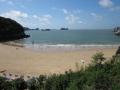
Located isolated from the noisy streets of Cat Ba town (Cat Ba district, Hai Phong), Cat Tien tourist area is likened to a tropical oasis, created by two beaches, Cat Co 1 and Cat Co 2.
Like a turtle’s head, the rocky outcrop jutting out into the sea has divided the two beaches into two separate horizons. A poetic wooden bridge will lead visitors to Cat Co 1 and Cat Co 2. On the right is a steep rocky mountain, on the left is clear blue sea. Here, each moment has its own beauty.
Cat Ba National Park has a unique highland wetland called Ao Ech, about 3.2 hectares wide. This is the only freshwater lake on the highlands, the water in the lake never dries up, even in the summer. Due to favorable natural conditions and abundant fresh water sources, this is home to many small animals such as porcupines, weasels, birds, mountain turtles, snakes, frogs and aquatic animals such as crabs, fish, etc.
Maybe you are interested!
-
 Potential for developing charity tourism in Hai Phong - 2
 -
 Current status, potential and solutions for developing team building tourism in Hai Phong - 13
 -
 Solutions for tourism development in Tien Lang - 10
zt2i3t4l5ee
zt2a3gstourism, tourism development
zt2a3ge
zc2o3n4t5e6n7ts
- District People's Committees and authorities of communes with tourist attractions should support, promote, and provide necessary information to people, helping them improve their knowledge about tourism. Raise tourism awareness for local people.
*
* *
Due to limited knowledge and research time, the thesis inevitably has shortcomings. Therefore, I look forward to receiving guidance from teachers, experts as well as your comments to make the thesis more complete.
Chapter III Conclusion
Through the issues presented in Chapter II, we can come to some conclusions:
Based on the strengths of available tourism resources, the types of tourism in Tien Lang that need to be promoted in the coming time are sightseeing and resort tourism, discovery tourism, weekend tourism. To improve the quality and diversify tourism products, Tien Lang district needs to combine with local cultural tourism resources, at the same time combine with surrounding areas, build rich tourism products. The strengths of Tien Lang tourism are eco-tourism and cultural tourism, so developing Tien Lang tourism must always go hand in hand with restoring and preserving types of cultural tourism resources. Some necessary measures to support and improve the efficiency of exploiting tourism resources in Tien Lang are: strengthening the construction of technical facilities and labor force serving tourism, actively promoting and advertising tourism, and expanding forms of capital mobilization for tourism development.
CONCLUDE
I Conclusion
1. Based on the results achieved within the framework of the thesis's needs, some basic conclusions can be drawn as follows:
Tien Lang is a locality with great potential for tourism development. The relatively abundant cultural tourism resources and ecological tourism resources have great appeal to tourists. Based on this potential, Tien Lang can build a unique tourism industry that is competitive enough with other localities within Hai Phong city and neighboring areas.
In recent years, the exploitation of the advantages of resources to develop tourism and build tourist routes in Tien Lang has not been commensurate with the available potential. In terms of quantity, many resource objects have not been brought into the purpose of tourism development. In terms of time, the regular service time has not been extended to attract more visitors. Infrastructure and technical facilities are still weak. The labor force is still thin and weak in terms of expertise. Tourism programs and routes have not been organized properly, the exploitation content is still monotonous, so it has not attracted many visitors. Although resources have not been mobilized much for tourism development, they are facing the risk of destruction and degradation.
2. Based on the results of investigation, analysis, synthesis, evaluation and selective absorption of research results of related topics, the thesis has proposed a number of necessary solutions to improve the efficiency of exploiting tourism resources in Tien Lang such as: promoting the restoration and conservation of tourism resources, focusing on investment and key exploitation of ecotourism resources, strengthening the construction of infrastructure and tourism workforce. Expanding forms of capital mobilization. In addition, the thesis has built a number of tourist routes of Hai Phong in which Tien Lang tourism resources play an important role.
Exploiting Tien Lang tourism resources for tourism development is currently facing many difficulties. The above measures, if applied synchronously, will likely bring new prospects for the local tourism industry, contributing to making Tien Lang tourism an important economic sector in the district's economic structure.
REFERENCES
1. Nhuan Ha, Trinh Minh Hien, Tran Phuong, Hai Phong - Historical and cultural relics, Hai Phong Publishing House, 1993
2. Hai Phong City History Council, Hai Phong Gazetteer, Hai Phong Publishing House, 1990.
3. Hai Phong City History Council, History of Tien Lang District Party Committee, Hai Phong Publishing House, 1990.
4. Hai Phong City History Council, University of Social Sciences and Humanities, VNU, Hai Phong Place Names Encyclopedia, Hai Phong Publishing House. 2001.
5. Law on Cultural Heritage and documents guiding its implementation, National Political Publishing House, Hanoi, 2003.
6. Tran Duc Thanh, Lecture on Tourism Geography, Faculty of Tourism, University of Social Sciences and Humanities, VNU, 2006
7. Hai Phong Center for Social Sciences and Humanities, Some typical cultural heritages of Hai Phong, Hai Phong Publishing House, 2001
8. Nguyen Ngoc Thao (editor-in-chief, Tourism Geography, Hai Phong Publishing House, two volumes (2001-2002)
9. Nguyen Minh Tue and group of authors, Hai Phong Tourism Geography, Ho Chi Minh City Publishing House, 1997.
10. Nguyen Thanh Son, Hai Phong Tourism Territory Organization, Associate Doctoral Thesis in Geological Geography, Hanoi, 1996.
11. Decision No. 2033/QD – UB on detailed planning of Tien Lang town, Hai Phong city until 2020.
12. Department of Culture, Information, Hai Phong Museum, Hai Phong relics
- National ranked scenic spot, Hai Phong Publishing House, 2005. 13. Tien Lang District People's Committee, Economic Development Planning -
Culture - Society of Tien Lang district to 2010.
14.Website www.HaiPhong.gov.vn
APPENDIX 1
List of national ranked monuments
STT
Name of the monument
Number, year of decisiondetermine
Location
1
Gam Temple
938 VH/QĐ04/08/1992
Cam Khe Village- Toan Thang commune
2
Doc Hau Temple
9381 VH/QĐ04/08/1992
Doc Hau Village –Toan Thang commune
3
Cuu Doi Communal House
3207 VH/QĐDecember 30, 1991
Zone II of townTien Lang
4
Ha Dai Temple
938 VH/QĐ04/08/1992
Ha Dai Village –Tien Thanh commune
APPENDIX II
STT
Name of the monument
Number, year of decision
Location
1
Phu Ke Pagoda Temple
178/QD-UBJanuary 28, 2005
Zone 1 - townTien Lang
2
Trung Lang Temple
178/QD-UBJanuary 28, 2005
Zone 4 – townTien Lang
3
Bao Khanh Pagoda
1900/QD-UBAugust 24, 2006
Nam Tu Village -Kien Thiet commune
4
Bach Da Pagoda
1792/QD-UB11/11/2002
Hung Thang Commune
5
Ngoc Dong Temple
177/QD-UBNovember 27, 2005
Tien Thanh Commune
6
Tomb of Minister TSNhu Van Lan
2848/QD-UBSeptember 19, 2003
Nam Tu Village -Kien Thiet commune
7
Canh Son Stone Temple
2160/QD-UBSeptember 19, 2003
Van Doi Commune –Doan Lap
8
Meiji Temple
2259/QD-UBSeptember 19, 2002
Toan Thang Commune
9
Tien Doi Noi Temple
477/QD-UBSeptember 19, 2005
Doan Lap Commune
10
Tu Doi Temple
177/QD-UBJanuary 28, 2005
Doan Lap Commune
11
Duyen Lao Temple
177/QD-UBJanuary 28, 2005
Tien Minh Commune
12
Dinh Xuan Uc Pagoda
177/QD-UBJanuary 28, 2005
Bac Hung Commune
13
Chu Khe Pagoda
177/QD-UBJanuary 28, 2005
Hung Thang Commune
14
Dong Dinh
2848/QD-UBNovember 21, 2002
Vinh Quang Commune
15
President's Memorial HouseTon Duc Thang
177/QD-UBJanuary 28, 2005
NT Quy Cao
Ha Dai Temple
Ben Vua Temple
Tien Lang hot spring
div.maincontent .p { color: black; font-family:"Times New Roman", serif; font-style: normal; font-weight: normal; text-decoration: none; font-size: 14pt; margin:0pt; } div.maincontent p { color: black; font-family:"Times New Roman", serif; font-style: normal; font-weight: normal; text-decoration: none; font-size: 14pt; margin:0pt; } div.maincontent .s1 { color: black; font-family:"Times New Roman", serif; font-style: normal; font-weight: normal; font-size: 16pt; } div.maincontent .s2 { color: black; font-family:"Times New Roman", serif; font-style: italic; font-weight: bold; text-decoration: none; font-size: 14pt; } div.maincontent .s3 { color: black; font-family:"Times New Roman", serif; font-style: italic; font-weight: normal; text-decoration: none; font-size: 14pt; } div.maincontent .s4 { color: black; font-family:"Times New Roman", serif; font-style: normal; font-weight: normal; font-size: 14pt; } div.maincontent .s5 { color: black; font-family:"Times New Roman", serif; font-style: normal; font-weight: bold; font-size: 14pt; } div.maincontent .s6 { color: black; font-family:"Times New Roman", serif; font-style: normal; font-weight: normal; text-decoration: none; font-size: 14pt; } div.maincontent .s7 { color: black; font-family:"Times New Roman", serif; font-style: normal; font-weight: bold; text-decoration: none; font-size: 14pt; } div.maincontent .s8 { color: black; font-family:"Times New Roman", serif; font-style: normal; font-weight: normal; text-decoration: none; font-size: 9pt; vertical-align: 6pt; } div.maincontent .s9 { color: black; font-family:"Times New Roman", serif; font-style: normal; font-weight: bold; text-decoration: none; font-size: 12pt; } div.maincontent .s11 { color: black; font-family:"Times New Roman", serif; font-style: normal; font-weight: normal; tex
Solutions for tourism development in Tien Lang - 10
zt2i3t4l5ee
zt2a3gstourism, tourism development
zt2a3ge
zc2o3n4t5e6n7ts
- District People's Committees and authorities of communes with tourist attractions should support, promote, and provide necessary information to people, helping them improve their knowledge about tourism. Raise tourism awareness for local people.
*
* *
Due to limited knowledge and research time, the thesis inevitably has shortcomings. Therefore, I look forward to receiving guidance from teachers, experts as well as your comments to make the thesis more complete.
Chapter III Conclusion
Through the issues presented in Chapter II, we can come to some conclusions:
Based on the strengths of available tourism resources, the types of tourism in Tien Lang that need to be promoted in the coming time are sightseeing and resort tourism, discovery tourism, weekend tourism. To improve the quality and diversify tourism products, Tien Lang district needs to combine with local cultural tourism resources, at the same time combine with surrounding areas, build rich tourism products. The strengths of Tien Lang tourism are eco-tourism and cultural tourism, so developing Tien Lang tourism must always go hand in hand with restoring and preserving types of cultural tourism resources. Some necessary measures to support and improve the efficiency of exploiting tourism resources in Tien Lang are: strengthening the construction of technical facilities and labor force serving tourism, actively promoting and advertising tourism, and expanding forms of capital mobilization for tourism development.
CONCLUDE
I Conclusion
1. Based on the results achieved within the framework of the thesis's needs, some basic conclusions can be drawn as follows:
Tien Lang is a locality with great potential for tourism development. The relatively abundant cultural tourism resources and ecological tourism resources have great appeal to tourists. Based on this potential, Tien Lang can build a unique tourism industry that is competitive enough with other localities within Hai Phong city and neighboring areas.
In recent years, the exploitation of the advantages of resources to develop tourism and build tourist routes in Tien Lang has not been commensurate with the available potential. In terms of quantity, many resource objects have not been brought into the purpose of tourism development. In terms of time, the regular service time has not been extended to attract more visitors. Infrastructure and technical facilities are still weak. The labor force is still thin and weak in terms of expertise. Tourism programs and routes have not been organized properly, the exploitation content is still monotonous, so it has not attracted many visitors. Although resources have not been mobilized much for tourism development, they are facing the risk of destruction and degradation.
2. Based on the results of investigation, analysis, synthesis, evaluation and selective absorption of research results of related topics, the thesis has proposed a number of necessary solutions to improve the efficiency of exploiting tourism resources in Tien Lang such as: promoting the restoration and conservation of tourism resources, focusing on investment and key exploitation of ecotourism resources, strengthening the construction of infrastructure and tourism workforce. Expanding forms of capital mobilization. In addition, the thesis has built a number of tourist routes of Hai Phong in which Tien Lang tourism resources play an important role.
Exploiting Tien Lang tourism resources for tourism development is currently facing many difficulties. The above measures, if applied synchronously, will likely bring new prospects for the local tourism industry, contributing to making Tien Lang tourism an important economic sector in the district's economic structure.
REFERENCES
1. Nhuan Ha, Trinh Minh Hien, Tran Phuong, Hai Phong - Historical and cultural relics, Hai Phong Publishing House, 1993
2. Hai Phong City History Council, Hai Phong Gazetteer, Hai Phong Publishing House, 1990.
3. Hai Phong City History Council, History of Tien Lang District Party Committee, Hai Phong Publishing House, 1990.
4. Hai Phong City History Council, University of Social Sciences and Humanities, VNU, Hai Phong Place Names Encyclopedia, Hai Phong Publishing House. 2001.
5. Law on Cultural Heritage and documents guiding its implementation, National Political Publishing House, Hanoi, 2003.
6. Tran Duc Thanh, Lecture on Tourism Geography, Faculty of Tourism, University of Social Sciences and Humanities, VNU, 2006
7. Hai Phong Center for Social Sciences and Humanities, Some typical cultural heritages of Hai Phong, Hai Phong Publishing House, 2001
8. Nguyen Ngoc Thao (editor-in-chief, Tourism Geography, Hai Phong Publishing House, two volumes (2001-2002)
9. Nguyen Minh Tue and group of authors, Hai Phong Tourism Geography, Ho Chi Minh City Publishing House, 1997.
10. Nguyen Thanh Son, Hai Phong Tourism Territory Organization, Associate Doctoral Thesis in Geological Geography, Hanoi, 1996.
11. Decision No. 2033/QD – UB on detailed planning of Tien Lang town, Hai Phong city until 2020.
12. Department of Culture, Information, Hai Phong Museum, Hai Phong relics
- National ranked scenic spot, Hai Phong Publishing House, 2005. 13. Tien Lang District People's Committee, Economic Development Planning -
Culture - Society of Tien Lang district to 2010.
14.Website www.HaiPhong.gov.vn
APPENDIX 1
List of national ranked monuments
STT
Name of the monument
Number, year of decisiondetermine
Location
1
Gam Temple
938 VH/QĐ04/08/1992
Cam Khe Village- Toan Thang commune
2
Doc Hau Temple
9381 VH/QĐ04/08/1992
Doc Hau Village –Toan Thang commune
3
Cuu Doi Communal House
3207 VH/QĐDecember 30, 1991
Zone II of townTien Lang
4
Ha Dai Temple
938 VH/QĐ04/08/1992
Ha Dai Village –Tien Thanh commune
APPENDIX II
STT
Name of the monument
Number, year of decision
Location
1
Phu Ke Pagoda Temple
178/QD-UBJanuary 28, 2005
Zone 1 - townTien Lang
2
Trung Lang Temple
178/QD-UBJanuary 28, 2005
Zone 4 – townTien Lang
3
Bao Khanh Pagoda
1900/QD-UBAugust 24, 2006
Nam Tu Village -Kien Thiet commune
4
Bach Da Pagoda
1792/QD-UB11/11/2002
Hung Thang Commune
5
Ngoc Dong Temple
177/QD-UBNovember 27, 2005
Tien Thanh Commune
6
Tomb of Minister TSNhu Van Lan
2848/QD-UBSeptember 19, 2003
Nam Tu Village -Kien Thiet commune
7
Canh Son Stone Temple
2160/QD-UBSeptember 19, 2003
Van Doi Commune –Doan Lap
8
Meiji Temple
2259/QD-UBSeptember 19, 2002
Toan Thang Commune
9
Tien Doi Noi Temple
477/QD-UBSeptember 19, 2005
Doan Lap Commune
10
Tu Doi Temple
177/QD-UBJanuary 28, 2005
Doan Lap Commune
11
Duyen Lao Temple
177/QD-UBJanuary 28, 2005
Tien Minh Commune
12
Dinh Xuan Uc Pagoda
177/QD-UBJanuary 28, 2005
Bac Hung Commune
13
Chu Khe Pagoda
177/QD-UBJanuary 28, 2005
Hung Thang Commune
14
Dong Dinh
2848/QD-UBNovember 21, 2002
Vinh Quang Commune
15
President's Memorial HouseTon Duc Thang
177/QD-UBJanuary 28, 2005
NT Quy Cao
Ha Dai Temple
Ben Vua Temple
Tien Lang hot spring
div.maincontent .p { color: black; font-family:"Times New Roman", serif; font-style: normal; font-weight: normal; text-decoration: none; font-size: 14pt; margin:0pt; } div.maincontent p { color: black; font-family:"Times New Roman", serif; font-style: normal; font-weight: normal; text-decoration: none; font-size: 14pt; margin:0pt; } div.maincontent .s1 { color: black; font-family:"Times New Roman", serif; font-style: normal; font-weight: normal; font-size: 16pt; } div.maincontent .s2 { color: black; font-family:"Times New Roman", serif; font-style: italic; font-weight: bold; text-decoration: none; font-size: 14pt; } div.maincontent .s3 { color: black; font-family:"Times New Roman", serif; font-style: italic; font-weight: normal; text-decoration: none; font-size: 14pt; } div.maincontent .s4 { color: black; font-family:"Times New Roman", serif; font-style: normal; font-weight: normal; font-size: 14pt; } div.maincontent .s5 { color: black; font-family:"Times New Roman", serif; font-style: normal; font-weight: bold; font-size: 14pt; } div.maincontent .s6 { color: black; font-family:"Times New Roman", serif; font-style: normal; font-weight: normal; text-decoration: none; font-size: 14pt; } div.maincontent .s7 { color: black; font-family:"Times New Roman", serif; font-style: normal; font-weight: bold; text-decoration: none; font-size: 14pt; } div.maincontent .s8 { color: black; font-family:"Times New Roman", serif; font-style: normal; font-weight: normal; text-decoration: none; font-size: 9pt; vertical-align: 6pt; } div.maincontent .s9 { color: black; font-family:"Times New Roman", serif; font-style: normal; font-weight: bold; text-decoration: none; font-size: 12pt; } div.maincontent .s11 { color: black; font-family:"Times New Roman", serif; font-style: normal; font-weight: normal; tex -
 Developing cultural tourism from the potential of ethnic minorities in Ninh Thuan province, the case of the Raglai ethnic group in Bac Ai district - 17
 -
 Hai Duong Tourism - Potential, current situation and development solutions - 9
Tourists can cycle to visit Viet Hai village, a village nestled in the middle of the ocean surrounded by high mountains and old forests of the National Park. This is an attractive tourist destination for foreign tourists.
 Tour 3: Hai Phong - An Lao - Vinh Bao - Tien Lang - Hai Phong. (1 day)
Schedule :
- 6am car picks up the group at the agreed location.
- 6:45 am the group visits Voi mountain in An Lao
- 08:00 visit the Social Protection Center in Thai Son commune - An Lao.
- 10am depart for Vinh Bao and have lunch in Vinh Bao town.
- 12:30 visit the relic site of Trang Trinh Nguyen Binh Khiem.
- 13:30 visit Nhan Muc - Nhan Hoa - Vinh Bao communal house, enjoy the art of Tu Linh dance and water puppetry.
- 14:30 return to Tien Lang hot mineral spring tourist area - Hai Phong.
- 17:30 back to Hai Phong.
Presentation :
From Hai Phong to An Lao, the group visited Elephant Mountain, a mountain that emerged like a dry Ha Long Bay in the shape of an elephant lying in the middle of a plain with tired birds.
Elephant Mountain, a beautiful mountainous area of An Lao district, Hai Phong city, has been chosen by humans as a place to live since the Hung Kings' era. It contributed to the creation of the famous Red River civilization. Elephant Mountain is also one of the major archaeological sites in the Northeast of the country, containing many historical traces of the Stone Age and Bronze Age, a treasure trove of cultural history. Over thousands of years of history, the land and people here have been closely linked in the struggle with nature and wild enemies.
Since the 1960s, the historical and scenic site of Voi Mountain has been granted a certificate by the State and ranked as a national relic. Thereby proving the important position of a relic site. Coming to Voi Mountain, everyone can witness and admire the land rich in potential and inherent heritage. Thousands of years ago, people came here to gather, make a living, and build a life, and archaeologists have found rare and precious relics from the early Bronze Age, the Mac Dynasty...
That is why Elephant Mountain is associated with the historical events of the nation, such as the time when female general Le Chan led troops to fight the enemy and chose Elephant Mountain as an important place to store military provisions and preserve life force. During the Mac Dynasty, Elephant Mountain was like a stronghold where our ancestors steadfastly protected the independence of the country. During the resistance war against the French and the Americans, the army and people of An Lao chose this place as a solid base, the rugged terrain associated with the resounding victories of the army, militia, and guerrillas.
The historical and scenic site of Elephant Mountain also contains a system of majestic, mysterious, and wild caves deep inside the mountain, such as: Elephant Throat Cave, or Gia Vi Cave, Thanh Uy Cave, Tien Chessboard, Tien Well, Nam Tao, Bac Dau, Van Chua Thuong, Van Chua Ha. Each cave is a masterpiece created by nature, associated with historical events, legends, and treasures of folk culture and spiritual culture, such as the long-famous system of temples, communal houses, and pagodas: Hang Temple, the temple of female general Le Chan, the ancient Chi Lai communal house and pagoda... where national heroes who have contributed to the people and the country are worshiped.
The majestic, gray stone color along with the wide range of hills and mountains, the Voi Mountain relic complex in recent years has been invested in, renovated and embellished by the city and An Lao district with many infrastructure works serving the sightseeing, entertainment and religious needs of all classes of people, contributing to preserving and conserving the inherent values of the relic site.
The delegation then visited and gave gifts to the homeless elderly at the Hai Phong City Social Protection Center. The center was initially established in Vinh Bao in 1967, with 6 subjects: lonely elderly, street children, disabled people, deaf and blind people, and rehabilitation. In 1995, the center separated and moved to An Lao with 2 rows of poor houses, which were warehouses of the city's textile factory. This center specializes in caring for lonely elderly people with no one to rely on. The center is currently nurturing and caring for 87 homeless elderly people, who are not cared for and raised by anyone. Among them are those who are paralyzed, unable to take care of themselves, mentally unstable... The center is currently in the process of building and repairing facilities, living conditions are still poor, and the standard of living is still low.
Leaving An Lao, the delegation continued to visit the relic site of Trang Trinh Nguyen Binh Khiem. The relic site was built on the land where he lived during his lifetime in Trung Am village, Ly Hoc commune, Vinh Bao district, Hai Phong. The entire relic site has 9 items including: Kinh Thien pen tower; a temple built after his death (1585) with three front rooms, two back rooms, in front of which are two lakes symbolizing heaven and earth, a horizontal lacquered board in the temple with the four words "An Nam Ly Hoc"; a house displaying the life and career of Nguyen Binh Khiem; the tomb of his father behind the temple; a 5.7m high, 8.5 ton stone statue of Nguyen Binh Khiem; a crescent lake about 1,000m² wide; Song Mai pagoda; the Ancestor House with a statue of Mrs. Minh Nguyet, Nguyen Binh Khiem's wife and Quan Trung Tan, where the new concept of the word "Trung" is kept, directing the heart towards "chi trung chi thien".
Today, the relic site has been built spaciously, becoming a major cultural tourist destination of the region, a place to hold major festivals commemorating the cultural celebrity Nguyen Binh Khiem. The memorial festival is often held on
His birthday (April 10th of the lunar calendar) and his death anniversary (November 28th of the lunar calendar). On his death anniversary, the festival took place on a larger scale and became a cultural event in Hai Phong city, attracting many domestic and foreign tourists to come and offer incense in memory of him.
Temporarily saying goodbye to the Nguyen Binh Khiem relic site, the delegation visited Nhan Muc Communal House in Nhan Hoa Commune, Vinh Bao District, which is the place to worship Qui Minh Dai Vuong - one of the generals under the Hung Due Vuong dynasty.
This is a rather imposing communal house, built in the 17th century. In front of it is a very large communal house yard, with a small lake for water puppet shows during festivals. The roof is not very high, but the curved ends of the roof are carved with images of fierce-looking lions. The communal house faces the Southeast, arranged in the shape of the letter "cong" including five front rooms, three back rooms and one spoon-shaped room. The architecture of the communal house is based on a system of trusses, rafters, beams, and especially rows of large lim columns, giving the communal house a majestic and sturdy appearance. The large columns (main columns) have a diameter of approximately 0.7m; 4.2m high; originally ancient trees in the primeval forest that have long since disappeared. The communal house is covered with moss-covered fish-tail tiles, has a back room 9m long; 4m wide, connected to the front room by a spoon-shaped tube. The roof of Nhan Muc communal house is a continuation of the “gutter” combined with the “roof of the ship”. The artist created a curved roof like the hands of a village girl in a lantern dance. The top of the roof is decorated with a soaring dragon, the dragon’s arms stretched out in the posture of “spitting pearls and spitting jade” before the Phoenix with a graceful and passionate dance.
Nhan Muc communal house has a wooden frame made of four pieces of wood, connected by rafters and beams using mortise and tenon techniques. The rafters are the peak development of the folk architecture of "upper beam, lower beam", "overlapping beams"... On the rafters, rafters, horizontal boards, and first sentences... are carved stylized flowers and leaves. Especially on the large rectangular scroll, there is a relief of a dragon winding in the clouds. Under the blood of the communal house are elaborate and vivid decorative carvings. The interior of the communal house contains a splendid golden scene of worship objects, horizontal boards, parallel sentences, votive doors, large characters, statues of saints and gods... especially many precious antiques such as the 18th century palanquin; pottery, and terracotta dragon knives in the art style of the 20th century.
Nhan Muc Communal House is not only a place to preserve precious art relics but also a center for preserving the nation's fine traditional cultural activities. Coming to the communal house festival, amidst the bustling drum sounds, the bamboo curtain of the water puppet stage (i.e. the water puppet stage) opens, revealing a large wooden puppet, a four or five year old boy, with mischievous eyes, a smiling face, a sleeveless shirt, unbuttoned to reveal his melon belly, and then starts singing. After singing, he approaches the firecrackers hanging on a pole in the middle of the lake and lights them. The firecrackers explode on the water and the choir sings to signal the flag raising. The flags rise from the water and flutter in the wind amid the cheers and bustling drums of Nhan Muc Communal House Festival.
Nhan Muc Communal House still preserves many royal decrees of the dynasties conferring on Qui Minh Dai Vuong the title of tutelary god of Nhan Muc village. The Communal House is not only a place to worship the tutelary god but also a place where local people hold festivals. The festival takes place from the 10th to the 22nd of the third lunar month, coinciding with the Hung King's death anniversary. The Communal House was recognized as a national historical and architectural relic by the Ministry of Culture and Information on December 12, 1994.
After a day of activities, the group will end the trip at Tien Lang hot spring resort to relax and rest. Tien Lang hot spring resort is known by many people in other provinces and cities and abroad. That is understandable because this place is endowed by nature with an endless source of hot spring water, with many benefits to improve human health.
Since ancient times, hot mineral water has been considered a treasure that nature has bestowed upon mankind. There have been many legends about the use of mineral water for medical treatment, and mineral water has always been present in the luxurious life of the nobles and kings. Nowadays, wherever there is a source of hot mineral water, that place has become a resort - health care - medical treatment and that mineral water is exploited, bottled, and distributed to places as a source of drinking water that serves human health.
Vietnam has many mineral water sources, but they are mainly located in remote mountainous areas. However, in Bach Dang commune, Tien Lang district, Hai Phong city, right in the coastal plain, nearly half a century ago, a hot mineral water source was discovered. This is considered one of the five especially valuable mineral water mines in Vietnam, and is of the same type as famous mineral water sources in the world, such as: Mirgorod of Russia, Darkov of Czechoslovakia, Baisov of Bulgaria, E'laruc and Sallivs de Jura of France.
In 1965, during the resistance war against the US to save the country, Vietnam received scientific and technical aid from Russia (former Soviet Union), helping us explore oil and gas in some places in the coastal plains . Among them, a drill point No. 14b in Bach Dang commune, Tien Lang district, Hai Phong city was drilled by Russian experts. At a depth of 850 m underground, the heat of 540C erupted and spewed out of the ground and the Tien Lang hot mineral water source was discovered from here, but due to the country's war situation, the water source was temporarily closed. In 1982, in the process of building and developing the country, former Deputy Prime Minister Doan Duy Thanh, former Secretary of the Hai Phong City Party Committee, reopened the Tien Lang hot mineral water source to serve the people's life and health.
According to document No. 56 dated June 18, 1983, the research team of Hanoi University of Pharmacy determined that Tien Lang hot mineral water has the effect of preventing and treating a number of diseases such as: chronic inflammation and degeneration of the motor system and upper respiratory tract; chronic peripheral neuropathy; chronic gynecological inflammation and endocrine dysfunction in women or pubertal children; tuberculosis of bone and joint lymph nodes not caused by tuberculosis, lymphoid organs in children, some skin diseases and rehabilitation due to sequelae of trauma or surgery, taken internally to treat a number of chronic diseases of the digestive tract.
To promote the use of Tien Lang mineral water to serve the community, from 2004 to now, Phu Vinh Company Limited has invested 100 billion VND to build a hot mineral spring tourist area right here, with an area of nearly
100,000 m2 to serve tourists from all over the world. This place is not
not only produces bottled mineral water but has truly become an ideal destination with attractive tourist services.
The hot spring resort has completed and put into service services: soaking in pure hot water indoors and outdoors with a modern bathtub system mixed with nature, bathing in mineral mud on the fairy hill surrounded by pine forests and ornamental plants, the center of the swimming pool is installed with a hydraulic massage system...
 Tour 4: Hai Phong - Thuy Nguyen - Hai Phong. (1 day)
Schedule :
- 7am pick up at agreed location.
- 7:15 visit Ta Quan - Duong Quan communal house.
- 8am visit Philis Hope Orphanage.
- 11am lunch at restaurant at Cho Tong, Luu Kiem commune.
- 12:30 depart to Minh Tan commune to visit Rang Trung pagoda and Hang Vua.
- 14:30 visit Trang Kenh - Minh Duc scenic spot.
- 16:30 visit An Lu temple - An Lu.
- 17:00 departure to Hai Phong.
Presentation :
Starting the tour, the group will visit Ta Quan - Duong Quan - Thuy Nguyen Communal House, an architectural and artistic relic, a religious work built by the villagers of Ta Quan village to worship Quy Minh Dai Vuong, a close general of Hung Due Vuong (the 18th Hung King). This is also a place for traditional cultural activities of the local people, preserving good customs and practices, along with unique cultural festivals and is one of the valuable humanistic tourism resources of the region.
Then visit, give gifts and play with the children at Philis Hope Orphanage in Thuy Son. Philis Hope Orphanage has 4 large families with 120 children. All the children are orphans, one parent is sick, disabled, poor and unable to raise their children. When entering the orphanage, the children will be raised according to the family model, each family has 2 mothers with 30 children with enough
The children are from 1 to 18 years old. Here, all children go to school. In addition to school hours, they help their mothers clean up the house, create a landscape, grow vegetables to improve meals, and at the same time train their labor awareness to know the value of labor. Depending on their age, children study from kindergarten to high school. After graduating from high school, the children will be encouraged by the village and given the opportunity to take exams to enter universities, colleges, and vocational schools. When they reach adulthood, they can return to their relatives, to society, and earn their own living. As a social protection facility, the Village has built a new family home for the children, with mothers, brothers, and sisters, who are taken care of, educated, and participate in cultural, artistic, and sports activities like other children of the same age. However, the material and spiritual life of the children in the Village is still very difficult.
Saying goodbye to the children at the Village, the next destination of the journey is Rang Trung Pagoda, whose Chinese name is Kien Long Tu. This is one of the five ancient pagodas worshiping Buddha in Minh Tan Commune - Thuy Nguyen District (formerly Duong Dong Village), a famous ancient pagoda in the Hai Phong - Quang Yen area. Associated with the practice of two eminent monks during the Le Trung Hung period (17th century), traces remain in the two towers of the founders in the garden in front of the temple's Buddha hall. People said that in later generations, Rang Trung Pagoda had 4 monks who were ordained as monks by the Buddhist Sangha. In 1960, the monk who presided over the pagoda from 1954 - 1980 was elected to the Central Buddhist Council, and was also in charge of the Summer School of the Hai Phong Buddhist Sangha. Rang Trung Pagoda still preserves many ancient relics of cultural and artistic value such as Buddha statues, although not complete in terms of genre on the Buddha's face, but are works of the 18th century. Around the pagoda are many green trees, so the air in the pagoda is always cool, visitors can relax, enjoy the scenery of the pagoda, and worship. Then walk about 2 minutes, the group will reach Hang Vua in Ve mountain. The cave is from 15 to 18m high, from 5 to 10m wide. In the cave there are many niches, there is a stream of water that is cool all year round. Called