
and similar characteristics of Futsal players. The biggest difference is height, mass and arm length [52]. Modern Futsal requires high development of all physical qualities, because Futsal athletes must constantly move, change running pace and change direction continuously throughout the match. According to Futsal football experts, Futsal athletes move in a Futsal match usually from 4 - 5 km, creating an average blood lactate accumulation of about 5.3 mmol.L [49], including alternating forms of running such as: short-distance speed running, medium-speed running, slow running, walking. In which, short-distance speed running and sudden changes of direction are the majority.
Table 1.3: Distance traveled in a match by Futsal players
TT
Publication documents | National Athlete | Distance (m) | |
1 | Barbero-Alvarez et al (2008) [49] | Spain | 4313 ± 2139 |
2 | Castagna et al (2009) [59] | Spain | 4313 ± 121 |
3 | Dogramaci et al (2011) [79] | Australia | 4277 ± 1030 |
4 | Makaje et al (2012) [115] | Thailand | 5087 ± 1004 |
5 | De Oliveira Bueno et al (2014)[80] | Brazil | 3133.2 ± 2248.5 |
6 | Vieira et al (2016) [181] | Brazil | 3119 ± 1455 |
Maybe you are interested!
-
 Car body electrical practice - 8
zt2i3t4l5ee
zt2a3gs
zt2a3ge
zc2o3n4t5e6n7ts
If the voltage is out of specification, replace the wire or connector.
If the voltage is within specification, install the front fog light relay and follow step 5.
Step 5 Check the front fog light switch
- Remove the D4 connector of the fog light switch
- Use a multimeter to measure the resistance of the front fog light switch.
Measurement location
Condition
Standard
D4-3 (BFG) -D4-4 (LFG)
Light switchFront Fog OFF
>10kΩ
D4-3 (BFG) -D4-4 (LFG)
Front fog light switchON
<1 Ω
- Standard resistor
D4 connector is located on the combination switch assembly.
If the resistance is out of specification, replace the combination switch (the fog light switch is located in the combination switch).
If the resistance is within specification, follow step 6.
Step 6 Check wiring and connectors (front fog light relay-light selector switch)
- Disconnect connector D4 of the combination switch assembly
- Use a voltmeter to measure the voltage value of jack D4 on the wire side.
Measurement location
Control modecontrol
Standard
D4-3 (BFG) - (-) AQ
TAIL
11 to 14 V
D4 connector for the wiring of the combination switch assembly
If the voltage does not meet the standard, replace the wire or connector.
If the voltage is within standard, there may have been an error in the previous measurements.
Step 7 Check the front fog lights
- Remove the front fog light electrical connector.
- Supply battery voltage to the fog lamp terminals
Jack 8, B9 of front fog lamp on the electrical side
blind first.
Power supply location
Terms and Conditions
Battery positive terminal - Terminal 2Battery negative terminal - Terminal 1
Fog lightsbefore morning
- If the light does not come on, replace the bulb.
If the light is on, re-plug the jack and continue to step 8.
Step 8 Check wiring and connectors (relay and front fog lights)
- Disconnect the B8 and B9 connectors of the front fog lights.
- Use a voltmeter to measure voltage at the following locations:
Measurement location
Switch location
Terms and Conditions
B8-2 - (-) AQ
Electric lock ON TAIL size switchFog switch ON
11 to 14 V
B9-2 - (-) AQ
Electric lock ONTAIL size switch Fog switch ON
11 to 14 V
B8 and B9 connectors on the front fog lamp wiring side
Voltage is not up to standard, repair or replace the jack. If up to standard, there may have been an error in the measurement process.
2.2.4. Procedure for removing, installing and adjusting fog lights 1. Procedure for removing
- Remove the front inner ear pads
Use a screwdriver to remove the 3 screws and remove the front part of the front inner ear liner
-Remove the fog light assembly
+ Disconnect the connector.
+ Use a screwdriver to remove 3 screws to remove the fog light cover
2. Installation sequence
-Rotate the fog lamp bulb in the direction indicated by the arrow as shown in the figure and remove the fog lamp from the fog lamp assembly.
-Rotate the fog light bulb in the direction indicated by the arrow as shown in the figure and install the light into the fog light assembly.
- Use a screwdriver to install the fog light cover
-Install the electrical connector
Attention: Be careful not to damage the plastic thread on the lamp assembly.
- Install the front inner ear pads
Use a screwdriver to install the front inner bumper with 3 screws.
3. Prepare the vehicle to adjust the fog light convergence. Prepare the vehicle:
- Make sure there is no damage or deformation to the vehicle body around the fog lights.
- Add fuel to the fuel tank
- Add oil to standard level.
- Add engine coolant to standard level.
- Inflate the tire to standard pressure.
- Place spare tire, tools and jack in original design position
- Do not leave any load in the luggage compartment.
- Let a person weighing about 75 kg sit in the driver's seat.
4. Prepare to check the fog light convergence
a/ Prepare the vehicle status as follows:
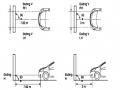
- Place the car in a dark enough place to see the lines. The lines are the dividing line, below which the light from the fog lights can be seen but above which it cannot.
- Place the car perpendicular to the wall.
- Keep a distance of 7.62 m between the center of the fog lamp and the wall.
- Park the car on level ground.
- Press the car down a few times to stabilize the suspension.
Note: A distance of approximately 7.62 m is required between the vehicle (fog lamp center) and the wall to adjust the convergence correctly. If the distance of 7.62 m cannot be achieved, set the correct distance of 3 m to check and adjust the fog lamp convergence. (Since the target area varies with the distance, please follow the instructions as shown in the figure.)
b/ Prepare a piece of thick white paper about 2 m high and 4 m wide to use as a screen.
c/ Draw a vertical line through the center of the screen (line V).
d/ Set the screen as shown in the picture. Note:
- Keep the screen perpendicular to the ground.
- Align the V line on the screen with the center of the vehicle.
e/Draw the reference lines (H, V LH and V RH lines) on the screen as shown in the figure.HINT:
Mark the center of the fog lamp on the screen. If the center mark cannot be seen on the fog lamp, use the center of the fog lamp or the manufacturer's name mark on the fog lamp as the center mark.
H line (fog light height):
Draw a line across the screen so that it passes through the center mark. Line H should be at the same height as the center mark of the fog light bulb.
Line V LH, V RH (center mark position of left fog lamp LH and right fog lamp RH):
Draw two lines so that they intersect line H at the center marks.
5. Check the fog light convergence
a/ Cover the fog lamp or remove the connector of the other side fog lamp to prevent light from the unchecked fog lamp from affecting the fog lamp convergence test.
b/ Start the engine.
c/ Turn on the fog lights and make sure that the dividing line is outside the standard area as shown in the drawing.
6. Adjust the fog light convergence
Use a screwdriver to adjust the fog light to the standard area by turning the toe adjustment screw.
Note: If the screw is adjusted too far, loosen it and then tighten it again, so that the last rotation of the light adjustment screw is clockwise.
3. Self-study questions
1. Describe the operating principle of the lighting system with automatic headlight function
2. Describe the operating principle of the lighting system with the function of rotating headlights when turning
3. Draw diagram and connect lighting system on Hyundai Porter car
4. Draw diagram and connect lighting system on Honda Accord 1992
5. Draw the lighting circuit on a 1993 Toyota Lexus
LESSON 3 MAINTENANCE AND REPAIR OF SIGNAL SYSTEM
I. IMPLEMENTATION GOAL
After completing this lesson, students will be able to:
- Distinguish between types of signals on cars
- Correctly describe common symptoms and suspected areas causing damage.
- Connecting signal circuits ensures technical requirements
- Disassemble, install, check, maintain and repair the signal system to ensure technical requirements.
- Ensure safety in work and industrial hygiene
II. LESSON CONTENT
1. General description
The signal system equipped on cars aims to create signals to notify other vehicles participating in traffic about the vehicle's operating status such as: stopping, parking, braking, reversing, turning...
Signals are used either by light such as headlamps, brake lights, turn signals….. or by sound such as horns, reverse music….
Just like the lighting system. A signal system circuit usually consists of: battery, fuse, wire, relay, electrical load and control switch. Only some switches of the signal system are on the combination switch. The switches of other signals are usually located in different locations such as in the gearbox or brake pedal……
2. Maintenance and repair
2.1. Turn signals and hazard lights
The installation location of the turn signal is shown in Figure 3.1. The turn signal control switch is located in the combination switch under the steering wheel. Turning this switch to the right or left will make the turn signal turn right or left.
The hazard light switch is used when the vehicle has a problem while participating in traffic. When the hazard light switch is turned on, all the turn signals on the vehicle will light up at a certain frequency. The hazard light switch is usually placed separately from the turn signal switch (some old cars integrate the hazard and turn signal switches on the same combination switch cluster).
Figure 3.1 Turn signal switch Figure 3.2 Hazard switch
The part that generates the flashing frequency for the lights is called a turn signal relay. The turn signal relay usually has 3 terminals: B (positive power supply); E (negative power supply); L (providing the turn signal switch to distribute to the
lamp)
2.1.1. Circuit diagram
To generate the frequency for the turn signal, a turn signal relay is used in the turn signal circuit. The current from the turn signal relay will be sent to the turn signal switch assembly to distribute the current to the turn signal lights for the driver's purpose.
Figure 3.3. Schematic diagram of a turn signal circuit without a hazard switch
1. Battery; 2. Electric lock; 3. Turn signal relay; 4. Turn signal switch; 5. Turn signal lamp; 6. Turn signal lamp; 7. Hazard switch
Figure 3.4 Schematic diagram of turn signal circuit with hazard switch
1. Battery; 2. Combination switch cluster; 3. Turn signal;
4. Turn signal light; 5. Turn signal relay
Today's cars no longer use three-pin turn signal relays (B, L, E) but use eight-pin turn signal relays (figure 3.5) (pin number 8 is used for hazard lights).
For this type, the current supplying the turn signal lights is supplied directly from the turn signal relay to the lights.
div.maincontent .p { color: black; font-family:"Times New Roman", serif; font-style: normal; font-weight: normal; text-decoration: none; font-size: 14pt; margin:0pt; } div.maincontent p { color: black; font-family:"Times New Roman", serif; font-style: normal; font-weight: normal; text-decoration: none; font-size: 14pt; margin:0pt; } div.maincontent .s1 { color: black; font-family:"Times New Roman", serif; font-style: normal; font-weight: normal; text-decoration: none; font-size: 13pt; } div.maincontent .s2 { color: black; font-family:"Times New Roman", serif; font-style: italic; font-weight: normal; text-decoration: none; font-size: 14pt; } div.maincontent .s3 { color: black; font-family:"Times New Roman", serif; font-style: normal; font-weight: normal; text-decoration: none; font-size: 14pt; } div.maincontent .s4 { color: black; font-family:"Times New Roman", serif; font-style: normal; font-weight: normal; text-decoration: none; font-size: 13pt; } div.maincontent .s5 { color: black; font-family:"Times New Roman", serif; font-style: normal; font-weight: normal; text-decoration: none; font-size: 13pt; vertical-align: 1pt; } div.maincontent .s6 { color: black; font-family:"Times New Roman", serif; font-style: normal; font-weight: normal; text-decoration: none; font-size: 11pt; } div.maincontent .s7 { color: black; font-family:"Times New Roman", serif; font-style: normal; font-weight: normal; text-decoration: none; font-size: 14pt; vertical-align: -9pt; } div.maincontent .s8 { color: black; font-family:"Times New Roman", serif; font-style: normal; font-weight: normal; text-decoration: none; font-size: 11pt; } div.maincontent .s9 { color: #008000; font-family:"Times New Roman", serif; font-style: normal; font-weight: normal; text-decoration: none; font-size: 14pt; } div.maincontent .s10 { color: black; font-family:"Times New Roman", serif; font-style: italic; font-weight: normal; te
Car body electrical practice - 8
zt2i3t4l5ee
zt2a3gs
zt2a3ge
zc2o3n4t5e6n7ts
If the voltage is out of specification, replace the wire or connector.
If the voltage is within specification, install the front fog light relay and follow step 5.
Step 5 Check the front fog light switch
- Remove the D4 connector of the fog light switch
- Use a multimeter to measure the resistance of the front fog light switch.
Measurement location
Condition
Standard
D4-3 (BFG) -D4-4 (LFG)
Light switchFront Fog OFF
>10kΩ
D4-3 (BFG) -D4-4 (LFG)
Front fog light switchON
<1 Ω
- Standard resistor
D4 connector is located on the combination switch assembly.
If the resistance is out of specification, replace the combination switch (the fog light switch is located in the combination switch).
If the resistance is within specification, follow step 6.
Step 6 Check wiring and connectors (front fog light relay-light selector switch)
- Disconnect connector D4 of the combination switch assembly
- Use a voltmeter to measure the voltage value of jack D4 on the wire side.
Measurement location
Control modecontrol
Standard
D4-3 (BFG) - (-) AQ
TAIL
11 to 14 V
D4 connector for the wiring of the combination switch assembly
If the voltage does not meet the standard, replace the wire or connector.
If the voltage is within standard, there may have been an error in the previous measurements.
Step 7 Check the front fog lights
- Remove the front fog light electrical connector.
- Supply battery voltage to the fog lamp terminals
Jack 8, B9 of front fog lamp on the electrical side
blind first.
Power supply location
Terms and Conditions
Battery positive terminal - Terminal 2Battery negative terminal - Terminal 1
Fog lightsbefore morning
- If the light does not come on, replace the bulb.
If the light is on, re-plug the jack and continue to step 8.
Step 8 Check wiring and connectors (relay and front fog lights)
- Disconnect the B8 and B9 connectors of the front fog lights.
- Use a voltmeter to measure voltage at the following locations:
Measurement location
Switch location
Terms and Conditions
B8-2 - (-) AQ
Electric lock ON TAIL size switchFog switch ON
11 to 14 V
B9-2 - (-) AQ
Electric lock ONTAIL size switch Fog switch ON
11 to 14 V
B8 and B9 connectors on the front fog lamp wiring side
Voltage is not up to standard, repair or replace the jack. If up to standard, there may have been an error in the measurement process.
2.2.4. Procedure for removing, installing and adjusting fog lights 1. Procedure for removing
- Remove the front inner ear pads
Use a screwdriver to remove the 3 screws and remove the front part of the front inner ear liner
-Remove the fog light assembly
+ Disconnect the connector.
+ Use a screwdriver to remove 3 screws to remove the fog light cover
2. Installation sequence
-Rotate the fog lamp bulb in the direction indicated by the arrow as shown in the figure and remove the fog lamp from the fog lamp assembly.
-Rotate the fog light bulb in the direction indicated by the arrow as shown in the figure and install the light into the fog light assembly.
- Use a screwdriver to install the fog light cover
-Install the electrical connector
Attention: Be careful not to damage the plastic thread on the lamp assembly.
- Install the front inner ear pads
Use a screwdriver to install the front inner bumper with 3 screws.
3. Prepare the vehicle to adjust the fog light convergence. Prepare the vehicle:
- Make sure there is no damage or deformation to the vehicle body around the fog lights.
- Add fuel to the fuel tank
- Add oil to standard level.
- Add engine coolant to standard level.
- Inflate the tire to standard pressure.
- Place spare tire, tools and jack in original design position
- Do not leave any load in the luggage compartment.
- Let a person weighing about 75 kg sit in the driver's seat.
4. Prepare to check the fog light convergence
a/ Prepare the vehicle status as follows:
- Place the car in a dark enough place to see the lines. The lines are the dividing line, below which the light from the fog lights can be seen but above which it cannot.
- Place the car perpendicular to the wall.
- Keep a distance of 7.62 m between the center of the fog lamp and the wall.
- Park the car on level ground.
- Press the car down a few times to stabilize the suspension.
Note: A distance of approximately 7.62 m is required between the vehicle (fog lamp center) and the wall to adjust the convergence correctly. If the distance of 7.62 m cannot be achieved, set the correct distance of 3 m to check and adjust the fog lamp convergence. (Since the target area varies with the distance, please follow the instructions as shown in the figure.)
b/ Prepare a piece of thick white paper about 2 m high and 4 m wide to use as a screen.
c/ Draw a vertical line through the center of the screen (line V).
d/ Set the screen as shown in the picture. Note:
- Keep the screen perpendicular to the ground.
- Align the V line on the screen with the center of the vehicle.
e/Draw the reference lines (H, V LH and V RH lines) on the screen as shown in the figure.HINT:
Mark the center of the fog lamp on the screen. If the center mark cannot be seen on the fog lamp, use the center of the fog lamp or the manufacturer's name mark on the fog lamp as the center mark.
H line (fog light height):
Draw a line across the screen so that it passes through the center mark. Line H should be at the same height as the center mark of the fog light bulb.
Line V LH, V RH (center mark position of left fog lamp LH and right fog lamp RH):
Draw two lines so that they intersect line H at the center marks.
5. Check the fog light convergence
a/ Cover the fog lamp or remove the connector of the other side fog lamp to prevent light from the unchecked fog lamp from affecting the fog lamp convergence test.
b/ Start the engine.
c/ Turn on the fog lights and make sure that the dividing line is outside the standard area as shown in the drawing.
6. Adjust the fog light convergence
Use a screwdriver to adjust the fog light to the standard area by turning the toe adjustment screw.
Note: If the screw is adjusted too far, loosen it and then tighten it again, so that the last rotation of the light adjustment screw is clockwise.
3. Self-study questions
1. Describe the operating principle of the lighting system with automatic headlight function
2. Describe the operating principle of the lighting system with the function of rotating headlights when turning
3. Draw diagram and connect lighting system on Hyundai Porter car
4. Draw diagram and connect lighting system on Honda Accord 1992
5. Draw the lighting circuit on a 1993 Toyota Lexus
LESSON 3 MAINTENANCE AND REPAIR OF SIGNAL SYSTEM
I. IMPLEMENTATION GOAL
After completing this lesson, students will be able to:
- Distinguish between types of signals on cars
- Correctly describe common symptoms and suspected areas causing damage.
- Connecting signal circuits ensures technical requirements
- Disassemble, install, check, maintain and repair the signal system to ensure technical requirements.
- Ensure safety in work and industrial hygiene
II. LESSON CONTENT
1. General description
The signal system equipped on cars aims to create signals to notify other vehicles participating in traffic about the vehicle's operating status such as: stopping, parking, braking, reversing, turning...
Signals are used either by light such as headlamps, brake lights, turn signals….. or by sound such as horns, reverse music….
Just like the lighting system. A signal system circuit usually consists of: battery, fuse, wire, relay, electrical load and control switch. Only some switches of the signal system are on the combination switch. The switches of other signals are usually located in different locations such as in the gearbox or brake pedal……
2. Maintenance and repair
2.1. Turn signals and hazard lights
The installation location of the turn signal is shown in Figure 3.1. The turn signal control switch is located in the combination switch under the steering wheel. Turning this switch to the right or left will make the turn signal turn right or left.
The hazard light switch is used when the vehicle has a problem while participating in traffic. When the hazard light switch is turned on, all the turn signals on the vehicle will light up at a certain frequency. The hazard light switch is usually placed separately from the turn signal switch (some old cars integrate the hazard and turn signal switches on the same combination switch cluster).
Figure 3.1 Turn signal switch Figure 3.2 Hazard switch
The part that generates the flashing frequency for the lights is called a turn signal relay. The turn signal relay usually has 3 terminals: B (positive power supply); E (negative power supply); L (providing the turn signal switch to distribute to the
lamp)
2.1.1. Circuit diagram
To generate the frequency for the turn signal, a turn signal relay is used in the turn signal circuit. The current from the turn signal relay will be sent to the turn signal switch assembly to distribute the current to the turn signal lights for the driver's purpose.
Figure 3.3. Schematic diagram of a turn signal circuit without a hazard switch
1. Battery; 2. Electric lock; 3. Turn signal relay; 4. Turn signal switch; 5. Turn signal lamp; 6. Turn signal lamp; 7. Hazard switch
Figure 3.4 Schematic diagram of turn signal circuit with hazard switch
1. Battery; 2. Combination switch cluster; 3. Turn signal;
4. Turn signal light; 5. Turn signal relay
Today's cars no longer use three-pin turn signal relays (B, L, E) but use eight-pin turn signal relays (figure 3.5) (pin number 8 is used for hazard lights).
For this type, the current supplying the turn signal lights is supplied directly from the turn signal relay to the lights.
div.maincontent .p { color: black; font-family:"Times New Roman", serif; font-style: normal; font-weight: normal; text-decoration: none; font-size: 14pt; margin:0pt; } div.maincontent p { color: black; font-family:"Times New Roman", serif; font-style: normal; font-weight: normal; text-decoration: none; font-size: 14pt; margin:0pt; } div.maincontent .s1 { color: black; font-family:"Times New Roman", serif; font-style: normal; font-weight: normal; text-decoration: none; font-size: 13pt; } div.maincontent .s2 { color: black; font-family:"Times New Roman", serif; font-style: italic; font-weight: normal; text-decoration: none; font-size: 14pt; } div.maincontent .s3 { color: black; font-family:"Times New Roman", serif; font-style: normal; font-weight: normal; text-decoration: none; font-size: 14pt; } div.maincontent .s4 { color: black; font-family:"Times New Roman", serif; font-style: normal; font-weight: normal; text-decoration: none; font-size: 13pt; } div.maincontent .s5 { color: black; font-family:"Times New Roman", serif; font-style: normal; font-weight: normal; text-decoration: none; font-size: 13pt; vertical-align: 1pt; } div.maincontent .s6 { color: black; font-family:"Times New Roman", serif; font-style: normal; font-weight: normal; text-decoration: none; font-size: 11pt; } div.maincontent .s7 { color: black; font-family:"Times New Roman", serif; font-style: normal; font-weight: normal; text-decoration: none; font-size: 14pt; vertical-align: -9pt; } div.maincontent .s8 { color: black; font-family:"Times New Roman", serif; font-style: normal; font-weight: normal; text-decoration: none; font-size: 11pt; } div.maincontent .s9 { color: #008000; font-family:"Times New Roman", serif; font-style: normal; font-weight: normal; text-decoration: none; font-size: 14pt; } div.maincontent .s10 { color: black; font-family:"Times New Roman", serif; font-style: italic; font-weight: normal; te -
 Building a Research Model of Factors Affecting Agribank's Brand Value
 -
 Balancing Supply and Demand of a Country's Currency in the Foreign Exchange Market
 -
 Evaluating the effectiveness of agricultural and forestry farming models on limestone terrain in Yen Minh district, Ha Giang province as a basis for planning the district's agricultural and forestry development - 10
 -
 Cao Duy Son's novel "Heavenly Orchestra" from a cultural perspective - 10

Thus, it can be seen that the physical strength of Futsal athletes needs to be comprehensive to improve the overall performance of the body. Good physical strength will create the premise for the implementation of techniques and tactics, at the same time promote the learning and mastery of techniques and tactics, enhance the endurance of athletes in training and competition, prevent injuries, improve performance and prolong the time to maintain the performance of athletes. Therefore, to ensure high performance capacity in 40 minutes of football in the game (about 80 minutes of normal competition), Futsal athletes need good anaerobic endurance.
Futsal is a direct combat sport with reasonable collision movements using force, pushing and pushing according to the rules that often occur, so in competition, athletes need strength to gain an advantage. In addition, athletes must perform technical movements under high-intensity conditions, constantly changing direction and being subject to physical collision, so athletes need good balance and flexibility.
1.4.2 Scientific basis for building annual training plans: [16]
Futsal training is a pedagogical process, aiming to improve the professional level of athletes. To organize training scientifically, so that athletes can develop and maintain a state of athletic fitness, it is necessary to know how to effectively control training by optimizing the training structure. Under certain conditions, building an annual training plan for a team according to the training cycle, has a decisive meaning in improving performance. The law of organizing training and competition according to the cycle, is shown in the relatively complete rotation of training stages, training sessions and technical, tactical and physical exercises of certain cycles. In those cycles, each successive cycle of the same type is not a simple repetition of the previous cycle, but must show a development trend at a higher level in terms of technique, tactics and training LVĐ. The closed cycle is the most important link in the rational organization of the training process, and at the same time is the decisive premise for implementing the system principle. Because it determines the sequence of training sessions, the order of LVĐ changes and all other aspects of the training organization system.
The natural basis for dividing training periods within a large cycle is the three-phase nature of the development of athletic fitness. A large training cycle consists of three periods: preparation, competition and transition. Each period has different goals, tasks and content, as well as different training characteristics. The division of time between each period within a large cycle depends on the professional level of the athletes, technical conditions, facilities, weather characteristics and competition schedule.
From a professional perspective, the competition period cannot be longer than the time during which the athlete can maintain a state of athletic fitness.
In principle, the preparation period cannot be shorter than the time required for the athlete to maintain a state of athletic fitness. Therefore, the preparation period for the championship season cannot be longer than 2 months (the optimal time ensures a smaller distribution of specific training phases of this period). The preparation period consists of 3 phases: pre-competition preparation and each phase cannot be shorter than one month. The transition period is the time required for the athlete's body to fully recover. Duration
Its duration depends on the total amount of exercise exerted on the athlete's body previously and for our players it cannot be more than 1 month in the cycle of the season.
1.4.3 Training physical qualities for Futsal athletes: [26]
1.4.3.1 Strength training
Strength training is the training of the ability to overcome the resistance of the body or of the muscles in the body when working. Strength development is the foundation for the development of other qualities. During the Futsal competition, due to the speed and intensity, athletes not only have to continuously overcome their body weight and complete a series of technical movements under the influence of inertia such as running, jumping, stopping suddenly, starting suddenly, turning, colliding... but also have to complete accurately in a high-speed and confrontational environment the movements of kicking the ball, stopping the ball, heading, dribbling, shooting the ball... This places high demands on athletes not only to equip themselves with a good general strength foundation, but also to be good in both speed strength and endurance. Therefore, strength qualities have become one of the important criteria in assessing the level of physical training for Futsal athletes. Strength qualities Futsal athletes should develop based on the foundation of whole-body strength, focusing on developing strength in the back and lower limbs. The main muscles that athletes need to exert force include: rectus abdominis, external obliques, lumbar-iliac muscles, gluteus maximus, quadriceps, triceps, toe flexors...
1.4.3.2 Speed training
Speed is the ability of the body to move quickly. Speed is divided into reaction speed, movement speed and movement speed. With the high speed in the confrontation between attack and defense in modern Futsal competition today, the increasingly high requirements for the speed of athletes when completing tactical movements, attack and defense techniques in relatively urgent time and space situations are indispensable, thereby enhancing the threat and feasibility in defense of individuals and the whole team, gaining the advantage and winning the competition. Fast movement speed, especially athletes with a good foundation of reaction speed and movement speed, is considered a characteristic speed quality required of Futsal athletes.
1.4.3.3 Endurance training
Endurance is the ability of the body's muscles to maintain work for a long period of time or can be briefly called the ability to resist fatigue. Endurance is divided into two forms: aerobic endurance and anaerobic endurance. Aerobic endurance is a method of activity maintained for a long period of time but with low intensity; anaerobic endurance is a method of activity with high intensity but relatively short time. The characteristics of Futsal competition are long time, large playing field, diverse and rich changes between forms of movement - techniques and tactics, so if you have good endurance, it is the basis to ensure that athletes can maintain and complete attack - defense methods in a high-speed confrontation environment. In Futsal, the total distance an athlete can travel in 40 minutes on the field can be up to about 4000m, and at the same time, he must complete many technical movements and high-intensity runs in a dramatic and intense competitive environment. This requires Futsal athletes to be equipped with a good foundation of aerobic and anaerobic endurance qualities. Aerobic endurance is the most basic endurance quality of Futsal athletes. Along with the increase in rhythm in attack and defense in each modern Futsal match, the time and number of high-intensity runs and jumps are increasing, the energy supply ratio of the anaerobic decomposition system is gradually increasing. Therefore, the role of anaerobic endurance in competition is becoming more and more prominent, so anaerobic endurance is an important endurance quality of Futsal athletes.
1.4.3.4 Flexible training
Flexibility is the ability of a player's body to complete technical movements quickly, accurately and harmoniously under unpredictable changing conditions, and is a synthesis of physical qualities. With the fast, complex and diverse competition conditions of Futsal, in addition, athletes need to accurately judge the situation on the field and complete all kinds of technical movements in coordination with tactics quickly and decisively, so the increasingly high requirements for flexibility for Futsal athletes are indispensable. In the dramatic and high-speed confrontation environment of Futsal competition, it is necessary to base on the opponent's situation to make quick technical and tactical movements to respond to the myriad of changes on the field. Therefore, the flexibility required of Futsal athletes is the ability to act quickly and harmoniously under all situations.
constantly changing in competition. It is mainly expressed through the harmony between the ability to quickly improvise and the movements.
1.4.3.5 Training flexibility
Flexibility is the ability to stretch muscles, ligaments, tendons and the range of motion of the body's joints. Flexibility plays an important role in mastering and improving technical movements, especially for techniques with large amplitudes and high difficulty; as well as developing other qualities in addition to preventing sports injuries. The flexibility of Futsal athletes is usually shown in terms of the range of motion of the main joints in the body, mainly the range of motion of some joints that Futsal requires such as the hip, knee, and ankle joints. It is an indispensable condition for mastering and improving the technical level of Futsal. Therefore, special attention should be paid to and increased exercises to stretch the lower limbs and the ligaments of the hip, knee, and ankle joints.
1.4.4 Recovery
After a stressful exercise, two following processes will take place in the athlete's body:
+ Recovery process: Is the process of re-establishing the ability of all functional systems after stressful activities to return to normal.
+ Adaptation process:
The morphological reorganization of these functional systems.
For any exercise to be effective it is essential that both training and recovery are aligned and that training is aligned with energy mechanics.
As workload increases, adaptation and recovery time also increases.
Rapid recovery: Allows the athlete to participate voluntarily and fully in various important activities after training. Allows the athlete to have the ability to tolerate the exercise, especially the frequency of training, and the athlete can make faster progress in high-volume training. New tasks should not be introduced before the most important functional systems (energy, muscle, nervous, circulatory, respiratory) involved in the task have recovered. The new task should be at least equal in volume to the previous task.
If recovery time is not sufficient: Fatigue increases, work is interrupted and development is hindered. Performance levels may even decrease and the athlete becomes more susceptible to injury. The time required for the body to recover sets limits to how much progress can be made in training.
Purpose of recovery:
+ Promote athlete recovery as quickly as possible.
+ Eliminates the causes of body fatigue.
+ Regenerate temporarily damaged functional abilities.
To accelerate recovery, exertion must target body systems that require more time to recover. This varies with intensity, duration, and intensity of the exercise. Biochemical studies have shown that the rate of recovery of many substances (glycogen, protein, nitrogen) in muscle varies with intensity and other characteristics of the exercise.
The time it takes for different systems to recover varies as does the time it takes for different biochemicals to be replenished. For example, replenishing glycogen stores is faster than replenishing protein deficits. Connective tissues (gland, membranes) and supporting tissues (ligaments, bone) typically take longer to recover than the cardiovascular and gastrointestinal systems.
Furthermore, recovery occurs as a natural consequence of performance improvement, the absorption of the LVAD gained through training. High-level athletes need to focus on recovery of the muscles in general and the muscles in specific regions. Different activities determine which muscle groups are fatigued, which energy systems need to be trained, and to what extent the nervous system is stressed. Based on these differences, different recovery methods should be applied. [16]
1.5 Relevant domestic and foreign research works
1.5.1. Domestic:
In Vietnam, research projects on scientific supervision in football are still very limited. Many researchers have applied scientific supervision methods and tools to study some sports: Dang Ha Viet, Nguyen Hong Son, Nguyen Dang Chieu, Bui Trong Toai. But in the field of professional Futsal, there are still no results of scientific research projects.
The research results of author Bui Trong Toai (2007) [22] have selected a test system to evaluate strength and specialized physical fitness for volleyball athletes with a strong correlation coefficient between the tests. The research has built a system of strength exercises for volleyball athletes including 38 main exercises, classified into groups. After 1 year, it shows that the experimental program is suitable and has a clear development in strength and specialized physical fitness for high-level female volleyball athletes.
The research results of Dang Ha Viet (2008) [29] on national male basketball athletes evaluated the current status of professional endurance and some influencing factors (morphology, function and physical strength) on professional endurance in training and international competition of national male basketball team athletes; Determined some basic functional indicators for developing professional endurance; Determined physiological endurance when applying full-court defensive pressure tactics and quick counterattacks in competition with foreign teams; Determined the system of exercises and training programs for professional endurance for national male basketball team athletes. The results showed that the professional endurance performance of national male basketball team athletes was significantly improved after 6 weeks of training and achieved better values than previous training cycles. All physical qualities were improved, showing that the professional endurance training program did not negatively affect other training programs. The best physical performance shows the athlete's state of fitness before an important tournament.
The results of the study on physical training assessment for football athletes by author Nguyen Hong Son (2016) [16] have resulted in the selection of a number of indicators and tests to conduct assessment of training cycles and training goals. The study has identified groups according to assessment criteria: Physiological assessment function group with LVĐ including: Ejection fraction and sinus rhythm (electrocardiogram), heart function; Blood cell function group including: blood test and urine analysis; Body composition assessment group, psychology - neurology and physical fitness. The assessment results have helped the SLNA football team coaching staff evaluate the training plan, assess the effectiveness of the physical training program as well as assess the physical fitness of athletes through the established standards for each group of indicators.
According to Nguyen Dang Chieu (2004) [6] Research on physiological LVĐ of soccer athletes aged 15-16 and 17-18 during the basic preparation period, determined the current situation
Morphology and body functions of male soccer athletes aged 15-16 and 17-18; Assess changes in function, physiology, hematological and urinary biochemistry under the impact of exercises and training sessions with different LVDs in the basic preparation period and determine some typical indicators such as pulse, Hemoglobin (Hb), Testosterone, Lactic Acid, Urea, Proteinuria, and Creatinine as indicators to evaluate LVDs of exercises and training sessions of male soccer athletes aged 15-16 and 17-18; Assess the effects of LVDs on changes in function, physiology, hematological and urinary biochemistry of male soccer athletes aged 15-16 and 17-18.
1.5.2 Foreign countries .
Noguera et al. (2017) [133] conducted a training monitoring of professional Brazilian Futsal athletes with the aim of comparing the responses of enzymatic, hormonal and psychological markers of two different training cycles during the season. Blood tests were performed to analyze CK and testosterone and cortisol values, and the Total Quality Recovery (TQR) scale and the Recovery and Stress Questionnaire for Athletes (RESTQ) were applied. The findings showed that training weeks promoted the development of TQR, RESTQ and enzymatic markers, improving the anabolic/catabolic balance of Futsal athletes, regardless of the level of training load. The distinction between stress and recovery showed a higher sensitivity for analyzing responses originating from short-term Futsal exercise.
Miloski et al. (2012) [122] studied the training LV distribution of a Brazilian professional Futsal team and determined its effects on physical performance, muscle damage and hormonal status. The study used the s-RPE scale to monitor training LV; physical fitness tests; blood tests, CK, testosterone and cortisol with results showing higher LV in the pre-season than in the season (p < 0.001). The training program demonstrated higher LV in periods with low match rates, emphasizing endurance and strength training in the pre-season, speed and power during the season. This LV organization provided sufficient stimulus for appropriate physical development in professional Futsal athletes, without causing negative disturbances.
Milanez et al. (2011) [121] determined the effect of VO2max on the internal training LV of Brazilian professional Futsal athletes, measured by evaluating the training session using the s-RPE method showing on the maximum oxygen consumption.