
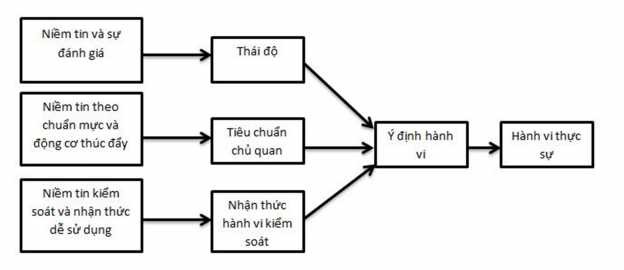
Figure 1.6: TPB model of theory of planned behavior
(Source: Ajzen, 1991)
1.1.3.3 Technology Acceptance Model TAM
The TAM model was developed by Fred Davis (1989) and Richard Bagozzi (1992) based on the development of TRA and TPB theories, going deeper into explaining consumer technology acceptance behavior. There are 5 main variables:
External variables (exogenous variables) or also known as pre-experimental variables: These are variables that influence perceived usefulness (PU) and perceived ease of use (PEU). Examples of external variables are training, opinions or different concepts in using technology.
Perceived usefulness: Users likely perceive that using a particular application technology will increase their effectiveness/productivity for a particular task.
Perceived ease of use: Is the level of ease that users expect when using a technology.
Attitude toward use: An attitude toward using a technology that is shaped by beliefs about its usefulness and ease of use.
Intention to use: Is the user's intention to use the technology. Intention to use is closely related to actual use.
TAM is considered a typical model to apply in studying the acceptance and use of a technology including the Internet.
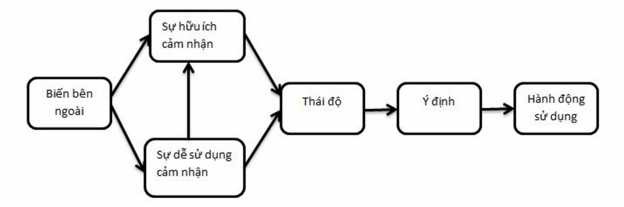
Figure 1.7: TAM model
1.1.3.3 Proposed research model
(Source: Fred Davis, 1989)
The TAM technology acceptance model is modeled from the TRA model, which is widely recognized and considered a typical, useful and highly reliable model in studying user acceptance of information. TAM acknowledges that two factors of perceived usefulness and perceived ease of use are the foundation for determining user acceptance of the system. The importance of the two factors mentioned above is based on analysis from many aspects such as: expectancy theory, behavioral decision theory.
The TAM model has proven its practical significance in scientific research in Vietnam:
In the topic: Research on factors affecting consumers' intention to shop online (ONLINE SHOPPING), by author Tu Thi Hai Yen, Dong A University, it was concluded that online shopping intention in Vietnam is strongly influenced by: Perceived consumer benefits, usability, perceived trust, subjective norms ( perceived consumer benefits and subjective norms are included by the author) . Online shopping intention in Vietnam is strongly influenced by perceived consumer benefits and subjective norms. Meanwhile, usability and perceived trust have no impact on online shopping intention.
Next is the topic: Research on factors affecting the acceptance of using MOBILE BANKING service of customers at Maritime Commercial Joint Stock Bank, Da Nang branch, by author Huynh Thi Ngoc Anh, Da Nang University of Economics, has concluded that there are 4 factors affecting the behavioral intention of users of Mobile Banking service: Expectation, social influence, perceived trust and expected effectiveness .
Topic: The impact of price, perceived quality on consumer satisfaction and loyalty to fish in Nha Trang city , by author Ho Huy Tuu, Nha Trang University of Economics, showed that satisfaction is positively correlated with perceived quality and price , but perceived quality plays the main role in explaining consumer satisfaction while price plays only a secondary role. This result shows that consumers are interested in quality first and then price.
The topic of Research on factors affecting the intention to book hotel rooms online of Vietnamese people - research in Da Nang area , by author Le Thanh Hong, Da Nang University of Economics has concluded a group of 4 influencing factors: perceived usefulness, perceived ease of use, perceived risk of goods/services and perceived risk related to online transactions . In which, perceived usefulness, perceived ease of use have a positive impact on the intention to book rooms, perceived risk of goods/services and perceived risk related to online transactions have a negative impact on the intention to book rooms. There is no difference in factors affecting the intention to book hotel rooms online between people of different genders and ages.
In the topic Factors affecting the trend of changing attitudes towards using e-commerce in Vietnam by author Nguyen Mai Anh, Ho Chi Minh City University of Economics , the groups of factors affecting attitudes towards using e-commerce include: perception of economic usefulness and purchasing process, perceived usefulness related to products, perceived usability, perceived risk to online transactions, perceived product-related awareness and perceived convenience in payment . According to the research results, the two factors of perceived usefulness (purchasing process and products) and convenience in payment have the greatest influence on attitudes towards use.
Overseas research model:
The research model on telecommunications is Behavioral intention towards using 3G technology by Sona Mardikyan, Betul Besiriglu and Gozde uzmaya Bogazici University, Istanbul, Turkey also combined the use of factors in the TAM model with the addition of other factors such as: price , perceived service quality, variety of 3G services, social influence to analyze factors affecting consumers' behavioral intention to use. The results show that perceived ease of use, service quality and price are the main factors affecting behavioral intention towards using 3G technology in Turkey.
In the study Determinants of Mobile Marketing Acceptance by Young People in Malaysia by two authors Mohammad Ismail (Universiti Teknologi MARA, Malaysia) and Razli Razak (Universiti Utara, Malaysia), it was found that two factors, attitude and subjective norms, are the main factors influencing young people's intention to use mobile marketing, in which perceived ease of use and perceived usefulness are among the factors that have a direct impact on attitude, thereby indirectly influencing the intention to use of young consumers in Malaysia. Thus, the TAM model has also explained consumer behavior towards a technology service.
The author will refer to the use of the proposed factors in research models related to e-commerce. During the internship at the unit through the process of contacting customers, interviewing customers, and receiving opinions from hotel staff, the topic found that price factors, perceived risks related to online transactions, and social influence are the factors that customers are most interested in when deciding to book a room at Thanh Xuan Hue Hotel via Booking.com. Thus, in addition to the factors drawn from the technology acceptance model such as perceived ease of use, perceived usefulness, and attitude, the topic also includes other important factors in the research model including price, perceived trust (by author Tu Thi Hai Yen, Dong A University) and perceived quality (Sona Mardikyan, Betul Besiroglu and Gozde Uzmaya, Bogazici University, Istanbul, Turkey).
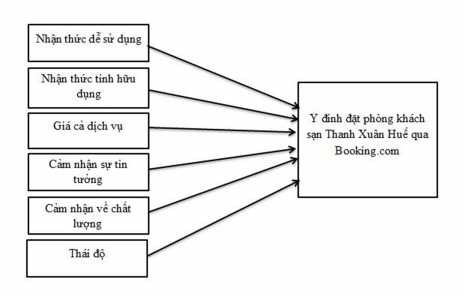
Figure 1.8 Proposed research model.
Perceived ease of use: is the degree to which a person believes that using a particular system will require little effort (according to Daivis, 1989).
Perceived usefulness : is the extent to which a person believes that using a particular system will enhance his or her job performance (according to Davis, 1989).
Attitude: is defined as a positive or negative feeling towards performing a given intended behavior (according to Fishbein and Ajzen 1975).
Price: service price is the cost that a business must pay to satisfy its needs.
Trust perception: is people's belief, feeling of security towards a product or service.
Perception of quality: is the perception of service quality from the customer's perspective.
goods rather than the actual quality of the system (Bienstock 2008)
Intention to use: an indication of an individual's readiness to perform a certain behavior. It is assumed to be a direct antecedent of behavior (Ajzen, 2002).
1.1.3.3.1 Proposed research scale
Variables
Research scale | Code name chemical | References | |
Perception easy to use | Easily search for hotel names on Booking.com | NT1 | Joongho Ehn, Jinsoo Park and Dongwon Lee (2001). |
Easily book guest rooms hotel | NT2 | ||
Easy booking process | NT3 | ||
Perception of usefulness | Can book any time needed | HI1 | Jinsoo Park and Dongwon Lee (2001). |
Bookings can be accessed from multiple different devices with internet connection | HI2 | ||
Save time | HI3 | ||
No booking fees | HI4 | ||
Price | Hotel room prices displayed on Booking.com is reasonable | GC1 | Empirical study in Klang Valley (2010), Jyo Rana (2015) |
Hotel room rates are cheaper than other hotels shown on Booking.com | GC2 | ||
Prices of accompanying services reasonable hotel | GC3 | ||
Feel trust | Trust that your personal information is confidential | CN1 | Salisbury et al. (2001), Chan and Lu (2004) |
Believe that customer transactions with hotels via Booking.com securely | CN2 | ||
The security system between customers, hotels and Booking.com is very ensure | CN3 |
Maybe you are interested!
-

 Overview of Tourism Development Issues in Vietnam's National Parks
 -
 Assessment of the State's Export Development Situation at the Vietnam Development Bank
 -
 Vietnam's supermarket system in the context of integration - current situation and development proposals - 2
 -
 Model system to assess the suitability of Vietnam's population-economic development process - 21
 -
 Credit risk at Bank for Investment and Development of Vietnam: Current situation and preventive solutions - 11
Feel the quality
quantity
Think Booking.com is cool high volume | CNCL1 | MSc. Ho Huy Tuu (2014). | |
Think Booking.com is fast? fast connectivity and access | CNCL2 | ||
Think Booking.com has a service? good customer service | CNCL3 | ||
Attitude | Love your booking hotels on Booking.com | TD1 | Fishbein et al. (1989) |
Feels right to place hotel rooms via Booking.com | TD2 | ||
Feel more comfortable placing hotel rooms via Booking.com | TD3 | ||
Intention to book a room at Thanh Xuan Hue Hotel | Satisfied with the quality of hotel | YD1 | Nguyen Thi Ngoc Giau (2016), Le Thi Quynh Anh (2018). |
Book with complete peace of mind hotels via Booking.com | YD2 | ||
Continue to choose Thanh hotel Spring when I have the opportunity to visit Hue | YD3 | ||
Will recommend to relatives and friends Book hotel rooms through Booking.com | YD4 |
1.2 Practical basis
1.2.1 Overview of the development of Vietnam's tourism industry
Vietnam tourism is considered a key economic sector because Vietnam has diverse and rich tourism potential, confirmed by positive growth figures.
In 2019, Vietnam's tourism industry set a record by welcoming 18 million international visitors for the first time, an increase of 16.2% compared to 2018. From 2015 to 2019, the number of international visitors to Vietnam increased 2.3 times from 7.9 million to 18 million, a growth rate of
Average growth rate of 22.7% per year. Vietnam is continuously among the countries with the fastest tourist growth rate in the world.
General Statistics Office, estimated number of international visitors to Vietnam in December 2019 reached
1,710,170 arrivals, down 5.5% compared to November 2019 but up 24.4% compared to December 2018. In the 12 months of 2019, the estimated number of international visitors to Vietnam reached 18,008,590 arrivals, up 16.2% over the same period in 2018. Of which, the number of arrivals by air reached 14,377,500 arrivals, arrivals by sea reached 264,110 arrivals, and arrivals by road reached 3,366,970 arrivals.
Of which, the 10 markets that bring the most tourists to Vietnam are: China reached
5,806,400 people, South Korea reached 4,290,800 people, Japan reached 951,960 people, Taiwan (China) reached 926,750 people, the US reached 746,170 people, Russia reached
646,520 people, Malaysia reached 606,200 people, Thailand reached 509,800 people, Australia reached 383,510 people, UK reached 315,080 people.
Compared to the same period in 2018, most tourist markets in 2019 increased, of which: Thailand increased the highest by 45.9%; Taiwan (China) increased by 29.8%; South Korea increased by 23.1%; Indonesia increased by 21.3%; Philippines increased by 18.2%; China increased by 16.9%; Japan increased by 15.2%; Cambodia increased by 12.3%; Malaysia increased by 12.2% and Belgium increased by 8.9%... However, some tourist markets decreased such as: Hong Kong (China) decreased by 40.8%; Laos decreased by 17.9%; Finland decreased by 5.7%; New Zealand decreased by 5.5% and Australia decreased by 0.9%.
Estimated domestic tourist arrivals in 2019 reached 85 million, including 43.5 million overnight visitors. Total revenue from tourists reached VND726,000 billion, up 17.1% over the same period in 2018.
Information from localities shows that the number of tourists and total revenue from tourists in 2019 both grew strongly compared to the same period in 2018. Some localities have typical results as follows: Ninh Binh is estimated to welcome 7.6 million visitors (up 3% over the same period in 2018), total revenue from tourism is 3,600 billion VND; Hai Phong welcomes 9 million visitors (up 16.4%) of which international visitors are 930 thousand (up 8.25%); Khanh Hoa is estimated to welcome 7.2 million visitors, including 3.6 million international visitors (up 27.5%); total tourism revenue is estimated at 27,100 billion VND (up 24.2%); Thua Thien Hue is estimated to welcome 7.2 million visitors, including 3.6 million international visitors (up 27.5%); total tourism revenue is estimated at 27,100 billion VND (up 24.2%);