
INTRODUCTION
1. Urgency of the topic:
Our country is in the process of Industrialization - Modernization, transition to socialism. Along with becoming an official member of the World Trade Organization WTO, we are also gradually integrating with the regional and world economy; step by step achieving proud achievements in economic and social development; people's lives are constantly improving and enhancing. Like other national economic sectors, the commercial sector is trying its best to absorb advanced knowledge in the world to catch up with developed countries. The emergence of supermarket business in the early 90s of the 20th century is an inevitable trend, which has changed the face of the country's retail industry. Now, Vietnamese consumers have access to a civilized, modern and very convenient retail business sector.
In the near future, the Vietnamese retail market will have to open completely to foreign retailers (exactly January 1, 2009 according to WTO commitments). Thus, Vietnam will give foreign distributors equal treatment as domestic distribution service providers. However, Vietnam still lacks distribution companies large enough and strong enough to compete with foreign supermarket groups. Understanding the market and inherent advantages in business premises are not enough. In the unequal competition in terms of capital and management experience with foreign competitors, Vietnamese supermarkets need to have effective strategies and measures. In the context of integration, the Vietnamese retail supermarket industry will have many opportunities for development but also face many difficulties.
Maybe you are interested!
-
 Orientation To Improve Competitiveness Of Vietnam's Commercial Banking System In The Context Of International Economic Integration
 -
 Model system to assess the suitability of Vietnam's population-economic development process - 21
 -
 Solution Group on Bad Debt Monitoring and Handling Violations of Vietnam's Commercial Banking System
 -
 Vietnam's Internet Regulatory Document System in 1997 When Internet Services First Appeared in Vietnam:
 -
 Vietnam's strategy to attract tourists in the context of global economic recession - 13
There are many risks and challenges. An objective requirement is that businesses operating in the super
What directions and solutions will the Vietnamese market have to take action to seize opportunities and limit the risk of losing market share right at home? Therefore, I decided to choose the graduation thesis topic: "Vietnam's supermarket system in the context of integration - Current situation and development proposals" with the desire to contribute some of my understanding of supermarkets and propose some solutions for Vietnamese supermarkets.
2. Research objects, scope and purposes
Within the scope of this thesis, I only want to delve into the operations and competitiveness of Vietnamese supermarkets, in comparison with foreign supermarkets that have, are and will penetrate the Vietnamese market. The purpose of my thesis is to provide an overview of the current state of development of the Vietnamese supermarket system; SWOT analysis for the Vietnamese supermarket system in the context of integration; from there, to make recommendations for the development of the Vietnamese supermarket system based on the experience of supermarket development and business in some Asian countries.
3. Research methods
In my thesis, I used methods of synthesis, statistics, and comparison of data from relevant State agencies, ministries, economic experts, and market research. In addition, I also used analytical and synthesis skills to propose practical operational solutions for supermarkets in the current context.
4. Thesis layout
My thesis is divided into 3 chapters:
Chapter I: Theory of supermarkets in the context of integration
Chapter II: Current status of Vietnam's supermarket system in the context of integration
Chapter III: Experience and some proposals for developing Vietnam's supermarket system
To complete this thesis, I received enthusiastic help from my supervisor, Master Tran Thu Trang. Through this, I would like to express my most sincere thanks to her. I would also like to thank all the teachers of Foreign Trade University, who have wholeheartedly imparted to me a basic knowledge system to serve the process of writing my graduation thesis, as well as preparing a solid foundation for me after graduation.
CHAPTER I
THEORY OF SUPERMARKETS IN THE CONTEXT OF INTEGRATION
I. GENERAL THEORY OF SUPERMARKETS IN THE WORLD
1. History of supermarket development in the world
According to Philip Kotler's book "Fundamental Marketing", he believes that supermarkets can originate from two points in time:
First origin: In 1912, John Hartford opened food stores, under the management of the A&G group. Here, people only sold goods in cash and there was no home delivery service.
Second origin: Clarence Sunders's “Piggly – Wiggly” stores were first opened in 1916. These stores were organized as self-service, with barriers separating the buyer's aisles and payment points.
It wasn’t until the 1930s that supermarkets became popular. Michael Cullen’s “King Kullen” store, which opened on August 4, 1930 in Jamaika, Queens, New York, is considered the first true supermarket. It was a self-service, cash-only grocery store that didn’t deliver to homes, and was 6,000 square feet, compared to the typical 75 square feet of stores at the time. Cullen turned over his inventory fairly quickly to ensure
The total profit margin was 9-10% of sales, which was only half of the total profit margin of grocery stores at that time. 1
1 http://www.kingkullen.com/aboutus.asp
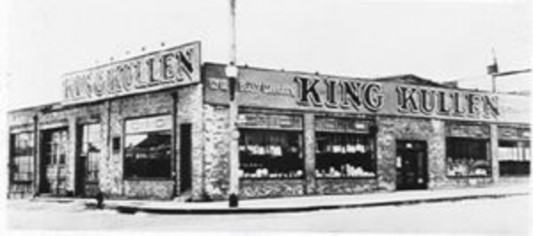
Source: http://www.kingkullen.com/aboutus.asp
Then many other supermarkets appeared and began to grow rapidly. By early 1939, there were about 5,000 supermarkets in the United States, accounting for about 20% of the total food trade. And by the 1990s, the number of supermarkets in the United States had reached 37,000, accounting for about 76% of the food trade.
The reason why supermarkets are successful is due to the following reasons:
The economic downturn forces consumers to consider price first when shopping. Meanwhile, businesses that can buy goods at low prices from suppliers are also facing difficulties in selling goods and renting premises at low prices. Therefore, they have favorable conditions to expand and develop low-cost stores and supermarkets.
The widespread use of private cars has pushed distance issues to second place and contributed to the creation of a once-a-week shopping habit, thus reducing the need for shopping at small local stores. As a result, consumers prefer to go to low-cost self-service supermarkets rather than small stores with higher prices, and they are willing to travel further to buy large quantities of food products for a long time.
Advances in refrigeration have allowed supermarkets and consumers to preserve food for longer periods of time. In addition, new packaging techniques have made it possible to provide consumers with longer-lasting and easier-to-preserve foods.
All of these factors, together with the impact of advertising, stimulated the consumption of goods, reducing the number of sales staff in each store.
Finally, the consolidation of food, meat, and produce departments into one place, facilitating one-stop shopping and attracting buyers from afar.
Supermarkets first appeared in the United States and in the late 1940s and early 1950s the phenomenon quickly spread to Canada and North America. In the 1950s, supermarkets developed rapidly in many European countries. By the 1960s, supermarkets had begun to appear in developing countries in the Middle East, Asia and Latin America.
2. Some concepts about supermarkets
The term “supermarket” in English is called “supermarket”, in French it is called “supermarché”, in which “super” is “super” and “market” or “marché” is “market, market”. Currently, in the world, each country has a different understanding of the word supermarket.
2.1. The concept of supermarkets in the United States
Supermarkets are relatively large self-service stores with low costs, low profit margins and large volumes of goods sold, ensuring full satisfaction of consumer needs for food, laundry detergent, cleaning products and home care items. 2
2 Philip Kotler (1961), “Fundamental marketing”, 2nd Edition
In addition, they also give a more concise concept: "A supermarket is a self-service store that sells many items to meet the common consumer needs of people such as food, drinks, household appliances and other necessary items.
2.2. The concept of supermarkets in the UK
A supermarket is a department store that sells food, beverages, and other goods. It is usually located in cities or along highways or in shopping areas and has an area of about 4,000 to 25,000 square feet 3 (that is, from 371.6m 2 to 2322.5 m 2 ) .
2.3 The concept of supermarkets in France
Supermarket is a self-service retail store with an area of 400 to 2,500 m2 , mainly selling food and household items". 5
Besides the concept of supermarket, we also know the concept of "supermarket chain" and "supermarket system".
“Supermarket chain” refers to a group of supermarkets of a distributor located in different locations but applying a unified business method. In a supermarket chain, the products, prices, methods of managing stalls, booths, ways of displaying goods, signs and external appearance are similar.
“Supermarket system” refers to a unified retail store network that applies self-service sales methods for popular consumer goods.
3. General characteristics of supermarkets
3 Melvin Morgenstein & Harriet Strongin (1987), “Mordern Retailing – Management Principles and Practices”
4 “Converting units of measurement”: 1 square foot = 0.0929m 2
http://xaydungbk.net
5 According to Marc Benoun (1997), “Marketing spécialisé”
Supermarkets perform the function of retailing directly to consumers and thus in the distribution network, supermarkets are a form of retail organization. The nature of supermarket operations is similar to traditional retail stores: purchasing goods in large quantities and directly selling to consumers in small quantities to meet essential needs and daily consumption needs.
Although there are many different concepts of supermarkets, in general, supermarkets have the following basic characteristics:
Firstly , a supermarket is a retail store. Although defined as a “market”, a supermarket is considered a highly developed type of “market”, planned and organized in the form of large stores, with modern equipment and facilities, invested and managed by traders, and licensed by the State. Supermarkets perform the retail function – selling goods directly to end consumers for their own use, not for resale.
Second , supermarkets are creative and apply self-service methods. It can be said that this is the most prominent feature to distinguish supermarkets from other forms of distribution. It is necessary to distinguish between the "self-selection" and "self-service" methods:
- “Self-selection”: after purchasing the goods, the customer will go to the seller to return the goods, however, during the purchase process, there will still be help and guidance from the seller.
- “Self-service”: customers examine and select items to buy, put them in a basket or cart and pay at the checkout counter located near the entrance. The seller is not present during the purchase process.
In developed countries, self-service has become a common formula for the industry. Self-service is synonymous with modern commercial civilization. Self-service helps businesses save on sales costs, especially salary costs for sales staff (usually accounting for up to 30% of total business costs). Self-service helps buyers feel comfortable when