
Step 3: Identify community problems and needs by understanding and analyzing the community situation, problems, causes and needs of the people through appropriate information collection methods;
Step 4: Develop an action plan and mobilize resources. The action plan must involve the people in determining the goals and content of activities in order to maximize people's participation and the community's internal resources. In addition, community workers and people identify direct and indirect beneficiaries, identify resources of relevant parties to mobilize participation;
Step 5: Implement the plan, need to agree on specific tasks to carry out the activities. In particular, need to clearly and specifically identify the content, inspection index, evaluation method and assign the person to perform;
Step 6: Evaluation and transfer, evaluation not only takes place after completing community development activities but also needs to be evaluated in detail and specifically before and after each activity. After evaluation, community workers need to transfer the achievements so that the community can continue to maintain and develop. In case the goal is not achieved or there are unexpected incidents, it can be transferred to another organization or unit for continued implementation.
4.4. Method application process
4.4.1. Overview of the community selected to conduct the experiment
The boarding house located at the end of Binh Hoa 20 Street was built in 2007 with 40 rooms owned by Uncle T. Initially, there were two rows. Talking about the reason for the construction, he shared: “ At that time (2007), Hung Thinh Company finished building Dong An Industrial Park, so there were many factories and they needed workers, and when workers came, they needed a place to live. So I saw that people could build boarding houses to make a living, so I built one too (laughs). At first, the people who lived there were mainly people from the North, not Khmer people. I don't know why, but gradually, those people all moved away and then many Khmer people came to live there. Now (2018), almost 100% are Khmer people. The remaining one or two rooms are Vietnamese people, but they are also from the West, as if they were from the same hometown as the people here... by 2010, my sister also built 40 more rooms next door.
When the construction was finished, there were no more rooms because some people had booked the place in advance, like their family or relatives wanted to live nearby so they registered before there was a room available and they moved there or came from the countryside… In general, this place is close to work, convenient for commuting, and they can walk to work, so it is very convenient for them to stay here” (PVS, Nam, landlord).
Up to now (April 2019), the boarding house has four rows of 83 rooms, each room is 12m2 , totaling 996m2 including the empty yard in front of the boarding house, the total area of the boarding house is more than 1000m2 owned by Mr. T. and his sister. In the boarding house, since 2013, Mr. D.'s family has rented it to open a grocery store and is a place to provide necessities and drinks for people in this area. Because the boarding house owners, Mr. T. and Ms. M. do not live nearby, they only come to the boarding house at the beginning of the month to collect room rent. However, the boarding house owner is also very interested and closely follows the situation of the boarding house through two contacts: Mr. D. and his wife, the owners of the grocery store, and Mr. S., who is trusted to manage the facilities. He is a Khmer worker who has lived in the boarding house for many years and is capable of repairing electricity and water, so he is trusted to do the repairs and is paid monthly.
The boarding house underwent a renovation in 2017 and currently has about 300 people, of which over 90% are Khmer and more notably, they are all from Long Phu and Tran De districts of Soc Trang province (before 2009, it was Long Phu district). This is a very notable feature when almost all the people living in this boarding house have acquaintances in their hometown. This feature has created a close bond and mutual support. Mr. Thach N. was born in 1988, came to Binh Duong in 2012 and a year later his wife also came to live with him. He is a prestigious person in the community as a core group of the association of young workers far from home. He shared:
“Most of the brothers here are from the same hometown in Soc Trang and know each other so it is easy to talk to each other. If we have difficulties, we can share them and inform the neighbors in the area to help each other. It is like we are far from home and hometown, but here we have relatives and brothers, it is much easier. When I first came here, it was very difficult, I couldn't find a job, I was unemployed for two months, but thanks to living with my second sister, I saved money on food and rent, and thanks to my uncle who worked before in Dai Tay Duong company, he sponsored me, so I got that job” (PVS, Male, worker, 29 years old).
Looking at the community organization chart in Figure 4.1, we can also see that the compatriot system is ranked as having the most positive influence and has the highest level of attachment and closeness to the people in the community. In addition, the level of attachment and closeness is also the core groups, grocery stores and the presence of the Youth Union through the youth association of workers far from home at the boarding house. On the negative side, those are the drinking groups and gaming groups that are receiving bad reviews as said by Mr. Vi L., who participated in implementing this tool:
"There are some guys who, after finishing their shift, drink and sing loudly, not allowing anyone to rest. When the landlord and the guys come out to remind them, they are not happy, and then they get tired of it."
(PVS13, Male, worker, 35 years old, Thuan An)
Figure 4.1: Community organization diagram in the boarding house
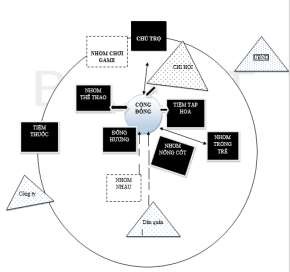
Convention:
: informal organization
: official organization
: close
: Normal
-------: distant Black: positive
White with dots: normal White: negative
Regarding the characteristics of Khmer labor in the community, survey results from 200 people staying in the boarding house show:
Table 4.1: Characteristics of Khmer labor in the community
Personal characteristics Frequency Frequency (%)
(People) | |||
Illiterate | 9 | 4.5 | |
Level 1 | 63 | 31.5 | |
Education | Level 2 | 97 | 48.5 |
Level 3 | 31 | 15.5 | |
30 years old or younger | 72 | 36.0 | |
31 – 40 years old | 89 | 44.5 | |
Year old | 41 years and older | 39 | 19.5 |
Average age | Mean = 33.54 | ||
Current job | Worker | 184 | 92.0 |
Freelance | 16 | 18.0 | |
Average salary Mean = 6.32 million | |||
under 5 million | 25 | 12.5 | |
5 million to under 7 million | 132 | 66.0 | |
7 million or more | 43 | 21.5 | |
Unmarried | 54 | 27.0 | |
Married | 139 | 69.5 | |
Separation/divorce | 7 | 3.5 | |
Maybe you are interested!
-

 Overview of Tourism and Community Based Tourism
 -
 General Overview of the Experimental Process
 -
 Absolute growth rate of experimental chickens over weeks of age
 -
 The impact of financial market development on the capital structure of listed enterprises in the ASEAN Economic Community - 28
 -
 Overview of the Economic, Social and Educational Situation of Dak Glong District, Dak Nong Province
Salary
Marital status
Source: survey data June 2018
Looking at the table describing the 200 people surveyed, it shows that Khmer workers have relatively low education levels and are mainly at primary and secondary levels (31.5% and 48.5%). They are quite young with an average age of 33.54 but most of them are married (139 people with a rate of 69.5%).
Regarding employment, most of them work as workers in industrial parks near their accommodation such as Dong An Industrial Park and Linh Trung 1 Export Processing Zone. The average salary of Khmer workers in the community is 6.32 million VND, higher than our survey on the salary of Khmer workers in Binh Duong and the average salary of ethnic minority workers in the report of the Provincial People's Committee on the migration situation of ethnic minorities in the Southwest region in Binh Duong in 2018 (5.8 million).
Regarding community organization in the boarding house, the results from the community organization diagram tool in Figure 4.1 show the very important influence of informal organizations such as relatives and fellow countrymen. However, in this boarding house, the positive role of the Youth Union through the boarding house workers' youth association also appears. On the negative side, drinking groups and gaming groups are receiving bad reviews as Mr. L. said when participating in implementing this tool:
“There are some guys who, after finishing their shift, drink and sing loudly, not allowing anyone to rest. When the landlord and the guys come out to remind them, they are sometimes unhappy and then tire themselves out.
very much" (PVS13, Male, worker, 35 years old, Thuan An)
4.4.2. Establishing relationships and building a core team
The area where the support activities were carried out was a place where the researcher had 5 years of observation, participation and field research, so he had a close relationship and was trusted by the community. During holidays or community activities, I was always present and participated as a member of the community. In addition, to carry out the support activities, the implementation team had time to identify the needs and establish relationships to create trust from the workers in the boarding house.
The criteria for selecting the core group are those who are truly prestigious in the community and want their community to change and be suitable for the nature of the activities planned to be implemented. The following is the profile of the core group:
- Group leader: Thach X., born in 1976, from Ta Ma area, Soc Moi hamlet, Long Phu commune, Soc Trang province. Mr. X. has a wife and 3 children. His family moved to Binh Duong in October 2010. His current occupation is a bricklayer and is in charge of repairing facilities in the boarding house. He is a prestigious and influential person in the community. In addition, he is very enthusiastic, proactive and has a sense of progress for the community, so he was unanimously elected by the members of the core group as the group leader. He is in charge of the overall implementation of activities and plays a key role in preparing facilities when organizing activities.
- Team member: Tran D., born in 1984, from Ngan Ro 2 Hamlet, Dai An 2 Commune, Tran De District, Soc Trang Province. He and his wife have a 5-year-old daughter, who is currently living with them and attending kindergarten at the temporary shelter. Currently, both of them are workers of
An Loc shoe company. He is a core member of the Solidarity volunteer group of Khmer youth living far from home, so he is trusted by the people. He is in charge of propaganda and mobilizing Khmer workers to participate in activities in the boarding house and on social networks.
- Team member: Trieu Vi L., born in 1989, is a relatively well-educated person in the community (grade 9). He came to Binh Duong in 2010 and is currently working as a worker in the purchasing department of Long Duc leather shoe company because he has gained the trust of the business owner. He and his wife have a daughter who is currently living with her grandmother in her hometown. In the boarding house, he has many relatives living and working. Trieu Vi L. is very active in participating in movements organized by the Youth Union or the Youth Union of the ward. He is the deputy head of the Youth Union of the boarding house and is the bridge between the Youth Union and the Khmer youth workers. He is in charge of organizing support activities and is the bridge in conveying and explaining issues from Mandarin to Khmer so that people can understand them better.
- Team member: Le Thi H., born in 1978, from Cai Be, Tien Giang province, she and her husband moved to Binh Duong and have lived in the boarding house since 2007. They have been selling groceries at the boarding house since 2013 and are loved by the Khmer people in the boarding house because of their cheerful and honest nature. She always supports activities and actively participates because she wants the Khmer community in the boarding house to become more and more stable and progressive. Being close to the people, she easily disseminates information and explains to people the benefits of participating in the activities implemented by the group.
- Team member: Nguyen Quang V., born in 1990, is a native of the locality, currently Deputy Secretary of the Ward Youth Union and Vice President of the Youth Union of Binh Hoa Ward. As a proactive, enthusiastic person and having graduated from University with a major in Social Work, he has very good skills and ways of gathering Khmer workers. He always wants to organize programs and activities that are practical and in-depth, so he participates in the group very enthusiastically. He plays a role in connecting resources and advising on action plans for local authorities.
- Group member: Thach N. was born in 1988 in Soc Leo hamlet, Lich Hoi Thuong commune, Tran De district, Soc Trang province. In the boarding house, Mr. N. has a very good relationship.
Well, most of them are related to him as relatives or friends. On the other hand, he is the head of the Khmer Youth Workers Association, so he has a lot of prestige. He always wants to do something for his community. He plays a key role in implementing specific activities and mobilizing resources in the Khmer workers' community.
- Team member: Duong Le Hoang O., born in 1997, is a 4th year female student majoring in Social Work at Thu Dau Mot University. O.'s house is about 2km from the boarding house, so she has the opportunity to visit the boarding house regularly. As a student majoring in Social Work, she really wants to participate in community development activities and as an intern at the boarding house, O. is loved and trusted by the Khmer people in the boarding house. In addition, O. plays a connecting role and is the leader of the volunteer student group participating in support activities.
4.4.3. Identify community problems and needs
To identify the problems and needs of the people in the community, participatory rapid appraisal (PRA) tools and rapid surveys were used.
In identifying the problems facing livelihoods, the results from the priority ranking tool show that the results are quite similar between men and women. For example, in the issue of “Not knowing about the labor regime and salary”, both genders showed the biggest impact on their lives. As Mr. Thach M. said when participating in the tool:
“This month or that month, I keep getting something deducted or my salary is not as I calculated. Sometimes I want to ask but I am too shy to ask anyone, so sometimes I get frustrated! In general, I don’t know about the policies, so sometimes I feel disadvantaged without knowing, so now if someone tells me or answers me, I will participate immediately” (quoted from the Priority Ranking Tool). On the same issue, in other criteria, all have the highest scores, so it is ranked in the first position.
Next is “ lack of job information ” ranked second for men and third for women. Meanwhile, “ lack of education information ” is ranked second for women. The only difference is the criterion of “not knowing how to spend money wisely” when female workers are ranked fourth while men are ranked fourth.
It seems that this issue is not yet concerned, so it is ranked last. The results of the priority ranking tool also partly reflect the division of labor by gender when it comes to matters related to children's education or spending, women are more concerned than men.
Level | Level | Level | Ranking Level | |||
affect | care about | join | don't understand | Class | ||
Lack of information | 5 | 5 | 5 | 5 | 20 | III |
news about Female Education | 6 | 6 | 5 | 5 | 22 | II |
No leakage to the South | 6 | 6 | 6 | 5 | 23 | I |
dynamic, female money | 6 | 6 | 6 | 6 | 24 | I |
Lack of information | 6 | 6 | 5 | 4 | 21 | II |
Female job news | 6 | 5 | 5 | 5 | 21 | III |
Don't know how Nam spends reasonable female | 5 6 | 3 6 | 3 5 | 5 3 | 16 20 | VI IV |
Lack of information | 5 | 4 | 3 | 6 | 18 | IV |
Women's health news | 4 | 4 | 3 | 4 | 15 | V |
Lack of information | 4 | 4 | 3 | 6 | 17 | V |
Female loan news | 5 | 3 | 3 | 6 | 17 | VI |
Table 4.2: Priority ranking of issues of concern by gender
salary regime
Source: Survey data June 2018
From the qualitative results, we designed a quick survey, the results showed that the needs of 200 workers in the dormitory are shown in the following table 4.3:
Table 4.3: Livelihood-related needs
Demand Response %
N % of cases