
table, contributing to the socio-economic development in the area, economic transformation, increased provincial budget revenue, economic growth, and people's lives are increasingly improved and enhanced.
In addition to the achieved results, Thai Binh province as well as other localities in the country have encountered many difficulties in land acquisition and clearance such as: some provisions of the Land Law as well as Decrees are still inconsistent and inconsistent with the Constitution and Law on State land ownership, land use rights of organizations, households and individuals. This creates unfairness in the rights, obligations and responsibilities of land users, of State management agencies in the field of land management and use, the role and responsibility of investors; A few households whose land was recovered for personal interests have not actively supported land recovery for project implementation; Land management in some localities is still not strict; Management and monitoring of land changes on cadastral records still have many shortcomings, so when recovering land to implement projects, there are many difficulties in the recovery and approval of land origin; The experience of land acquisition and compensation of officials in some places is not much, the publicity of compensation and support plans is sometimes not given due attention, causing frustration among the masses...
However, in addition, compensation, support and resettlement policies still have many shortcomings, the reason is that the determination of compensation conditions is not good because the land price list issued by the Provincial People's Committee is still low compared to the market price, job support for people whose agricultural land is recovered is mainly in cash without really paying attention to the issue of jobs and income of the people, the issuance of land use certificates is still slow, the project owner lacks funds to implement compensation... This slows down the progress of the project, affecting the lives of the people.
1.3.2.2. Overview of compensation, support and resettlement work in Vietnam and in Hanoi city
a, General situation of compensation, support and resettlement in Vietnam
Maybe you are interested!
-
 State management of compensation, support and resettlement when the State acquires land in Buon Ho town, Dak Lak province - 12
 -
 Assessment of the current status of compensation, support and resettlement when the state acquires land in some projects in Hong Bang district, Hai Phong city - 1
 -
 Regulations on Land Compensation, Support and Resettlement Chapter Vi Section 2 and Chapter II Decree 47/ND-CP dated May 15, 2014 on Compensation, Support,
 -
 Compensation, Support and Resettlement Policies in Some Countries
 -
 Implementing compensation and resettlement support policies when the state acquires land in Go Vap district, Ho Chi Minh City - 11
In our country, the provisions of the law on compensation, support and resettlement are increasingly more suitable to the requirements of reality as well as the requirements of economic laws. Paying more attention to the interests of those whose land is recovered, Decree 197/2004/ND-CP after a period of implementation and Decree No. 47/2014/ND-CP dated May 15, 2014 were issued to replace Decree 197/2004/ND-CP, especially
After the promulgation of Decree 84/2007/ND-CP and now Decree 43/2014/ND-CP dated May 15, 2014 detailing the implementation of a number of articles of the Land Law, the feasibility and positive role of legal documents have been demonstrated. Therefore, the work of compensation, support and resettlement in the past time has achieved quite positive results, reflected in the following main aspects:
Firstly, the subjects of compensation, support and resettlement are increasingly identified fully and accurately, in accordance with the actual situation of the country, helping to improve the State's land management work, and the compensation recipients also feel satisfied.
Second, the increasingly high level of compensation and support creates conditions for people whose land is recovered to restore their lost assets. Some support measures, although supplemented and clearly regulated, demonstrate the innovative spirit of the Party and State to help people stabilize their lives and production.
Third, the addition of regulations on the right of investors needing land to negotiate with land users has contributed to reducing pressure on administrative agencies in land recovery.
Fourthly, the procedures for compensation and resettlement support have resolved many problems in the past, helping competent state agencies to effectively carry out compensation and resettlement work.
Fifth, in addition to implementing the provisions of the 2013 Land Law and the Decrees guiding its implementation, localities have based on the policy orientation of the Party and the State and the actual situation in the locality to issue legal documents applicable to their locality, making compensation, support and resettlement work more reasonable and effective. Therefore, applying compensation, support and resettlement policies satisfactorily, land recovery has proceeded normally. Although there are still complaints, the number is small and does not cause significant obstacles in the implementation process.
Sixth, awareness of the importance, human significance and complexity of land acquisition and resettlement issues among local government managers and policy makers has been raised. The Government has made many efforts to create material and technical conditions for compensation, support and resettlement.
The number of competent and experienced staff working in compensation, support and resettlement is increasing; the sharing of practical experience in compensation, support and resettlement among ministries, departments and sectors with investment projects is increasingly expanded and effective.
As improvements in legal regulations on organizational methods, capacity of officials implementing land acquisition and clearance, the progress of land acquisition and clearance in recent investment projects has been shortened compared to previous projects. Contributing to reducing negative impacts on people as well as on projects. The implementation of compensation, support and resettlement policies has helped our country build facilities, develop infrastructure, build export processing zones, industrial parks, high-tech zones, key projects of the State, as well as contribute to restructuring the economy.
b, Assessment of compensation, support and resettlement work in Hanoi city
Compensation and site clearance work in Hanoi in recent years has been carried out in accordance with Decision No. 108/2009/QD-UB dated September 29, 2009 on promulgating regulations on compensation, support and resettlement when the State acquires land in Hanoi; Decision No. 02/2013/QD-UB dated January 7, 2013 on amending and supplementing a number of Articles of the Regulations issued together with Decision No. 108/2009/QD-UB dated September 29, 2009 on promulgating regulations on compensation, support and resettlement when the State acquires land in Hanoi.
In recent years, the City has resolved many complicated and long-standing projects: the clearance of Thanh Nhan "slum" area, Thuoc Tho pond, Voi Phuc - Cau Giay intersection, Nga Tu Vong intersection, Yen So regulating lake, Nam Son landfill, Kim No golf course... The results of the city's compensation, support, resettlement and site clearance work have significantly contributed to creating an attractive environment for investors, promoting the development of economic sectors; helping to implement many large projects of the country and the City in the area, contributing significantly to the comprehensive development achievements of the city. Thanks to that, the City has attracted a lot of foreign direct investment (FDI), official development assistance (ODA), and investment capital from non-governmental organizations (NGOs) of over 3 billion USD. Hanoi has become an attractive and safe destination for international investors and tourists. The urban infrastructure system is developing in a synchronous and modern direction, and many routes have been completed.
important roads and intersections. Solving labor and employment for an average of 70,000 workers each year.
The main problems in the City's site clearance work in recent times are:
- The compensation policy mechanism for land acquisition and clearance still has many shortcomings, lack of synchronization, and even conflicts and unreasonableness in the compensation price policy for subjects in the same project with adjacent land, causing complicated and prolonged complaints, causing many obstacles in compensation and land acquisition work.
- In implementing specific projects, the consultation and proposal of mechanisms and policies by district and functional agencies to the City People's Committee lacked timeliness and flexibility, which significantly affected the efficiency and progress of work.
- In some projects, the coordination and combination between the city and central ministries and branches; between departments and branches of the city and districts; between agencies in the political system in some districts is still not tight and synchronous, so the mobilization of combined strength in implementing site clearance work is still limited.
- There is still a fear of conflict, fear of responsibility, shirking and avoidance among the staff performing public duties. In some places, the specialized apparatus is not fully capable, has not seriously and fully implemented the requirements of the land acquisition and clearance process, especially the principles of publicity and democracy; and has not promptly resolved people's questions and complaints.
- The lack of self-awareness, lack of understanding, and even intentional wrongdoing by some cadres and people are significant obstacles to site clearance work; they are the main causes of delays in land recovery and complicated and prolonged complaints.
- Due to many factors: Land is scarce, market land prices are high, requirements for ensuring jobs and livelihoods for people after land acquisition are difficult, so compared to other localities, site clearance work in Hanoi is much more difficult and complicated.
- The lack of democracy and transparency in compensation work causes frustration among people whose land is recovered; many projects after land acquisition and compensation are implemented slowly, leaving them fallow for a long time, causing waste and frustration among the people; the quality of resettlement houses is not guaranteed, also causing difficulties for land acquisition and compensation work. In addition, the policy
Training and career transition are still lacking in uniformity, failing to meet the urgent demand for job creation for people who have lost their land and means of production... and that is also the reason affecting the progress of site clearance.
Land prices used as the basis for compensation, support and resettlement are mostly implemented according to the land price list announced by the city, so they are lower than the market price. Meanwhile, the authorities of some wards and communes have not paid due attention to the work of site clearance and resettlement; the support and job creation for people after land recovery, and the organization and implementation of policies are not resolute. In addition, some people deliberately cause difficulties, make unreasonable demands, and hinder project progress. Therefore, it is necessary to focus on publicity and transparency in land recovery and site clearance, especially in determining land prices as the basis for compensation, support and resettlement. The compensation level must ensure that people whose land is recovered have the conditions to rebuild their assets in the new place of residence equal to or better than the old place. In addition, the city needs to conduct compensation, support and resettlement in cash close to the market price so that people can proactively choose the appropriate form of resettlement.
The city has focused on directing, proposing many solutions, reviewing, and unifying the issuance of many compensation, support and resettlement mechanisms and policies, especially after the expansion of the city's administrative boundaries; directly reviewing, surveying, inspecting and handling difficulties and problems regarding compensation and support policies for people who have to relocate in a number of key projects. All levels, sectors, especially the functional sectors of the city have made great efforts, participated resolutely, synchronously, and seriously and effectively implemented the city's policies. Organizing professional training for cadres of communes, wards and towns on land acquisition and resettlement work. Propaganda work for the people has been carried out regularly, especially through columns on compensation and support policies and resettlement implementation on newspapers and radio stations of Hanoi city.
The city's timely and synchronous solutions on the issues of planning, land acquisition, procedures and policies mentioned above, with the method of solving and answering on-site, reviewing and shortening the procedures for land acquisition for matters under the authority of the city, have created strong and effective changes in the implementation of land acquisition tasks for matters under the authority of the city, have created strong and effective changes in the implementation of land acquisition tasks in the area.
Regarding the settlement of complaints and denunciations related to site clearance work, although the number of complaints and denunciations is still very large, especially after the city's administrative boundaries were expanded, thanks to active settlement, the scale, nature and complexity of the cases in the past one or two years have decreased significantly.
CHAPTER 2. CURRENT STATUS OF COMPENSATION, SUPPORT, AND RESETTLEMENT WORK WHEN RECOVERING LAND AT THE LIEU GIAI - NUI TRUC ROAD CONSTRUCTION PROJECT (SECTION FROM LA THANH HOTEL TO NUI TRUC INTERSECTION, PHASE 2)
2.1. Overview of natural, economic and social conditions of Ba Dinh district
2.1.1. Natural conditions
2.1.1.1. Geographical location
Ba Dinh District is identified by the Government as the National Administrative - Political Center, where the highest leadership agencies of the Party, State, National Assembly and Government are concentrated. The District is also a center of diplomacy and foreign affairs with headquarters of many international organizations, embassies of countries, where important conferences of the State, international and regional often take place.
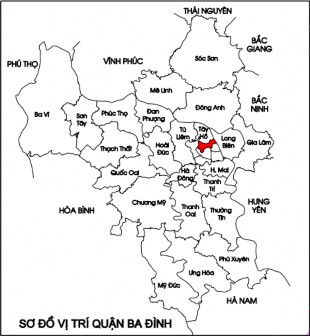
Figure 2.1. Location map of Ba Dinh district
Ba Dinh District has geographical location:
+ North: bordering Tay Ho District and Long Bien District;
+ South: bordering Dong Da District;
+ East: bordering Hoan Kiem District;
+ West: bordering Cau Giay District.
Ba Dinh District belongs to the ancient land of Thang Long - Hanoi, which used to be the royal palace of the feudal dynasties of Vietnam. Up to now, Ba Dinh District has been identified by the government as the center of national administration and politics. The district is also a center of diplomacy and foreign affairs with headquarters of many international organizations, embassies of countries, and is where important conferences of the State, international and regional events often take place.
With its position as an inner-city district of the Capital, with special advantages compared to other localities, Ba Dinh district has played, is playing and will play a particularly important role in the economic - political - cultural - social development of the Capital and the whole country.
2.1.1.2. Topography and geomorphology
Ba Dinh District in the Red River Delta has a relatively flat terrain favorable for production, infrastructure construction and urban residential areas and can be divided into the following 3 main areas:
- The area from Ngoc Ha Street to the East is the Ho Chi Minh Mausoleum, the Ba Dinh political center and the Ancient Citadel with a fairly high terrain with an altitude of 7.6 to 8 m. This is an area that has been built and stabilized for a very long time, with a history of thousands of years.
- Areas built and expanded after 1954 such as Giang Vo, Ngoc Khanh, Thanh Cong have relatively high terrain, average elevation from 6 to 6.5 m, and have been raised from 0.5 to 0.8 m. These areas are surrounded by higher surrounding roads such as Giang Vo street 7.2 to 8 m, De La Thanh street from 8 to 11.5 m, creating low-lying areas.
- Old village areas such as Ngoc Ha, Lieu Giai, Van Phuc have flat and low terrain, with an average ground elevation of 6 to 6.6 m.
2.1.1.3. Climate
The climate of Ba Dinh district shares the same climate regime as Hanoi City in the Northern Delta region, with the characteristics of a tropical monsoon climate, hot, humid, and rainy. There are two distinct seasons in a year: Summer, hot weather, from May to October, humid climate, rainy; Winter, cold weather, from November to April of the following year, with cold Northeast monsoon and drizzle.