genes and benefit sharing. However, it is only on a small scale and has not been applied in practice.
“Proposal for genetic resources policy in Vietnam” Vietnam Association for Conservation of Nature and Environment 2004-2007. This document mentioned the value of Vietnam’s genetic resources and the need for solutions to access and conserve those values. However, it did not mention the need for benefit sharing among the parties.
Research “Access to genetic resources and benefit sharing - Lessons from Vietnam practice” by Tran Cong Khanh, Nguyen Ngoc Sinh in 2005. This document for the first time gave a more general view of ABS practice in Vietnam, however, the research did not have specific solutions suitable for Vietnam.
The document “Long-term access to genetic resources and benefit sharing in Vietnam” by Nguyen Ngoc Sinh in 2006. The document has drawn out the limitations of ABS management in Vietnam and also made policy recommendations to promote good management of genetic resources and biodiversity conservation.
The documents “Current status of access to genetic resources and benefit sharing for Vietnam” and “Investigation and research on access to genetic resources and benefit sharing from biodiversity resources and biosafety to support the development of the Law on Biodiversity” by the Department of Environment, Ministry of Natural Resources and Environment in 2007 also provide an overview of the reality of ABS activities and recommendations on the need for ABS issues to be regulated in the Law on Biodiversity.
Maybe you are interested!
-
 Overview of Bidoup – Nui Ba National Park, Lam Dong Province
 -
 Developing a plan to lease special-use forest environment to develop ecotourism at Ba Vi National Park - Hanoi - 12
 -
 Characteristics of Ecotourism Activities of Ba Vi National Park
 -
 Research on assessing tourism potential with forest products in Ba Vi National Park, Ba Vi district, Hanoi city - 1
 -
 Assessing the current status of activities and proposing solutions for developing ecotourism associated with sustainable management of Cat Ba National Park - 6
The document “Research on theoretical and practical basis and proposed management mechanism for access to genetic resources and benefit sharing from genetic resources in Vietnam” by author Huynh Thi Mai conducted in 2010 has synthesized the most specific theoretical basis based on experiences and international treaties; the current situation and limitations of Vietnam; proposed mechanisms for ABS activities in Vietnam. However, there is still a lack of analysis of feasibility when implemented in localities.
Project "Strengthening capacity on management of access to genetic resources and fair and reasonable sharing of benefits arising from the use of genetic resources", General Department of Environment, Ministry of
Environmental Resources 2014 also contributes to the dissemination and replication of knowledge as well as laws and ABS to officials from central to local levels. From there, the officials themselves, through their practical work, have proposed appropriate ABS mechanisms to optimize the benefits and sustainable development of genetic resources.
Basically, studies on access to genetic resources and benefit sharing have provided a theoretical basis including an overview of the issue in the world, international law; related definitions and concepts; the current status of the issue in Vietnam; Vietnam's efforts in ABS management. However, new studies focus on the overview and analysis of the theoretical basis but have not yet provided specific solutions in ABS management to suit the conditions, circumstances and laws of Vietnam in general and localities in particular. In particular, in the new context, Vietnam participates in deep integration in economic and social forums around the world, including the signing of the Nagoya Protocol, which has posed new requirements for Vietnam: perfecting the ABS management apparatus and laws; improving the capacity of management staff; developing strategies and plans to implement ABS in accordance with international treaties, domestic laws, national and local conditions.
1.4. Overview of ABS management at the study site
Ba Vi National Park, located in the territory of two administrative units, Hanoi City (Ba Vi District, formerly Ha Tay Province) and Hoa Binh Province (Luong Son and Ky Son Districts), has long been famous for its beautiful natural landscapes and picturesque landscapes. This is a transitional mountainous area with a tropical forest ecosystem that still contains many precious species of plants and animals, typical of the Northern midlands, valuable for scientific research, gene conservation and environmental education. Moreover, Ba Vi National Park is considered a "green lung" located in the West of Hanoi Capital, playing a great role in regulating the climate, absorbing carbon and industrial emissions. This is also a source protection area, providing water for production and daily life for people living around the foot of Ba Vi Mountain.
In Ba Vi, there are also studies related to the issue of conservation of genetic resources, besides, evaluating and studying models for fair sharing of benefits from genetic resources is also an issue of concern to the Park. In addition, the National Park also has many activities in the conservation of local traditional knowledge, typically the activities of preserving the traditional medicine profession of the Dao people have initially had good results. However, the situation of loss of genetic resources as well as traditional knowledge in Ba Vi National Park is still happening rapidly from many angles. Many species and valuable genetic resources are being degraded and depleted due to unsustainable exploitation and use, lack of guidance and supervision to ensure that stakeholders understand and properly implement the procedures and regulations of the law. Therefore, there needs to be a specific management plan for access to genetic resources and benefit sharing to improve the effectiveness of conservation and development of genetic resources to serve the sustainable socio-economic development of the locality, and indigenous knowledge associated with the exploitation and use of those genetic resources.
1.5. General assessment of ABS access and application
ABS is no longer a new issue in the world, specifically ABS has been mentioned and widely recognized in most countries. Specifically, a series of international treaties and national laws have recognized ABS principles and provided implementation guidelines, demonstrating the acceptance and necessity of ABS in the management of genetic resources and sharing of benefits from accessing those genetic resources. Accordingly, many countries with high biodiversity have focused on building their own legal frameworks as well as action programs to effectively manage the exploitation of biodiversity values, genetic resources and conserve genetic resources. In Vietnam, the ABS issue has been mentioned quite early, but it has only stopped at studying the theoretical basis and synthesizing international experience. After the ABS issue was included in the 2008 Law on Biodiversity and was specifically guided in Decree 65/ND-CP, the management work has been more clearly oriented.
However, ABS is still a new issue in the context of weak professional capacity and management capacity. Moreover, there are different concepts, needs and levels between regions and localities. The conservatism of many local customs and practices, low awareness related to access to genetic resources and community benefit sharing are all obstacles that are not easy to overcome and will remain long-term challenges for the effective application and implementation of ABS.
Most countries have not yet developed specific management plans or strategies for the field to apply ABS, or have incorporated them into biodiversity planning. Therefore, genetic resources are still lost, and benefits from access to genetic resources have not been shared fairly and reasonably among parties. Therefore, the sustainable development of biodiversity resources has not achieved optimal efficiency.
In Vietnam, ABS has been recognized and institutionalized but its application has not been implemented in practice. Lack of guidelines and investment mechanisms for piloting and supporting implementation is one of the main difficulties. In addition, the lack of full understanding of ABS among stakeholders is also one of the reasons for slow application. ABS management and application in the system of protected areas and national parks has not yet been implemented. However, there have been some initiatives to apply it but they are still on a small scale, voluntary and lack consistency in application methods, payment methods, sharing and monitoring and evaluation processes.
Therefore, it is necessary to research and pilot ABS management plans in practice to guide their wide-scale application as well as provide necessary guidelines or draw experiences for amending, supplementing and perfecting policies to help ABS truly become an effective tool for resource management, benefit sharing and responsibility of the parties. This is also the biggest gap in implementing environmental and biodiversity policies in general in Vietnam. Therefore, if ABS management models can really be built,
appropriate to the conditions and circumstances of protected areas and Vietnamese law will make great contributions to the goal of sustainable management and use of biodiversity resources for development and social security purposes, especially for communities that depend on biodiversity resources.
CHAPTER 2. LOCATION, TIME, METHODOLOGY AND RESEARCH METHODS
2.1. Research location
Ba Vi National Park was the site chosen for the study.
This is a National Park with rich biodiversity, especially medicinal plant genetic resources and the Dao community with a rich treasure of traditional knowledge about medicinal remedies accumulated over a long time. The values of biodiversity and knowledge have great potential for ABS activities in the present and future. However, the issue of ABS management in the Park up to now still does not have a specific management plan or solution.
Ba Vi National Park, Hanoi City was established on January 16, 1991. The park's boundaries were adjusted and expanded through Decision No. 510/QD-TTg, dated May 12, 2003.
2.1.1. Natural conditions of Ba Vi National Park, Hanoi City
Natural boundaries
-Geographic coordinates: 20 0 56' – 21 0 00' North latitude; 105 0 23' – 105 0 28' East longitude.
- Location: Located in Ba Vi, Thach That, Quoc Oai districts of Hanoi city and Luong Son, Ky Son districts of Hoa Binh province.
- Area: 10,782.7 ha, including:
+ Strictly protected area: 2,023.1 ha
+ Ecological restoration zone: 8,713.6 ha
+ Administrative service area: 46 ha
-Buffer zone: Area of over 35,000 hectares in 16 mountainous communes including:
+ Ba Vi district: Ba Vi, Ba Trai, Tan Linh, Khanh Thuong, Minh Quang, Van Hoa, Yen Bai communes;
+ Thach That district: Tien Xuan, Yen Binh, Yen Trung communes;
+ Quoc Oai district: Dong Xuan commune;
+ Luong Son district: has 2 communes: Yen Quang and Lam Son;
+ Ky Son 3 district has communes: Phu Minh, Phuc Tien and Dan Hoa
Terrain: Ba Vi is a medium and low mountainous area, hills and mountains bordering the semi-mountainous area, this area looks like a mountain range emerging in the middle of the plain, only 20km south of the confluence of the Da River and the Red River.
In Ba Vi National Park, there are some mountain peaks with heights over 1000m such as King Peak (1296m), Tan Vien Peak (1227m), Ngoc Hoa Peak (1131m), Vien Nam Peak (1081m) and some lower peaks such as Hang Hum Peak 776, Gia De Peak 714m...
Ba Vi is a mountainous area with a fairly large slope, the western slope falls down to the Da River, steeper than the northwestern and southeastern slopes, the average slope of the area is 25o, the higher the altitude, the steeper the slope, from an altitude of 400m and above, the average slope is 35o and there are exposed cliffs, so traveling in the Park is not convenient.
Climate, hydrology: Ba Vi National Park is located in the center of Ba Vi Mountain, 50 km west of Hanoi. Ba Vi Mountain rises and is isolated from the surrounding plains with an altitude of less than 300m. In general, the western slope of Ba Vi Mountain has an average slope of 250, steeper than the eastern slope. Above 400m in the west, the slope can reach 350 with the presence of cliffs. Ba Vi Mountain has 3 main peaks: Vua Peak with an altitude of 1,296m, followed by Tan Vien Peak with an altitude of 1,226m and Ngoc Hoa Peak with an altitude of 1,120m. Because this is a mountainous terrain, Ba Vi's climate changes according to altitude. Above 500m, there is always fog covering the mountain top.
Excluding the Da River to the west of the National Park, Ba Vi does not have many regularly active streams. Streams in the National Park are small, steep and fast flowing. During the rainy season, the volume of water flowing through these small streams and across the surface sometimes creates landslides. However, during the dry season many streams dry up.
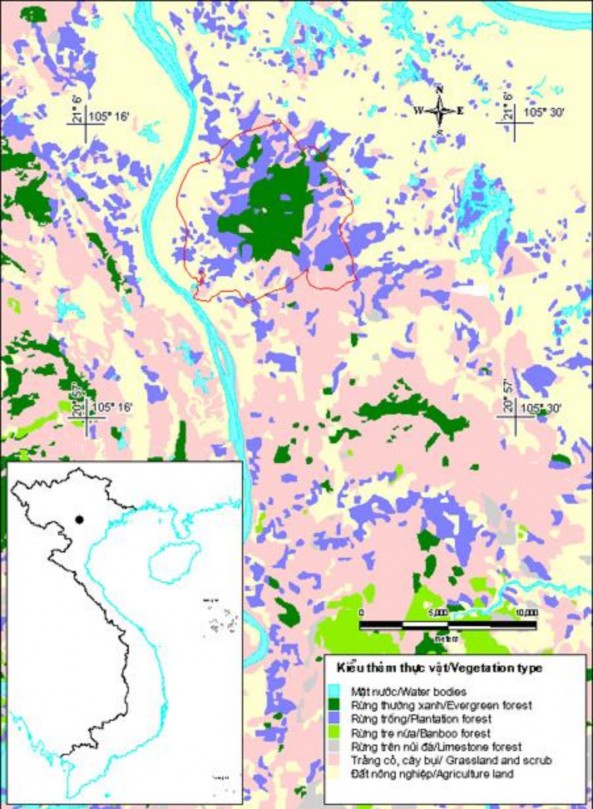
Figure 2.1: Vegetation map and boundary of Ba Vi National Park