
In addition, the arrangement of the instruments of the Nha Nhac orchestra in particular and the royal orchestras in general according to the families: Go , Hoi , Day , is only a relative arrangement based on the pronunciation of the Vietnamese musical instrument group, not based on the principle of organizing the musical instruments according to sound quality (Wood, Bronze, Go, String) like the Western symphony orchestra. This is also the main feature to create the identity of the traditional Vietnamese orchestra in particular and the Eastern orchestra in general in the flow of integration and development between the two cultures - Eastern and Western music .
In fact, each family of musical instruments according to the pronunciation of the Hue royal orchestra has many different sound elements, for example, the Go family (according to the pronunciation of the percussion) includes the sound elements of Moc (wood); Kim (bronze) and Thach (stone)... the Hoi family includes the sound elements of Truc (bamboo, reed); Tho (earth) and Phay (dried gourd shell)... On this basis, the orchestral playing methods of the East and the West are fundamentally different.
Ty Chung and Ty Khanh
It is an orchestra consisting of musical instruments of the Go family (made of bronze and stone), divided into 2 parts (Ty), each part (Chung, Khanh) has a group of musicians in charge, in which, Ty Chung is the group of musicians controlling the Bell instruments, and Ty Khanh is the group of musicians controlling the Stone instruments. This orchestra appeared in 1831, along with the Dai Nhac orchestra under the reign of King Minh Mang, the 12th year.
According to the document Brief History of Vietnamese Music by Nguyen Thuy Loan and the document Imperial Regulations of Dai Nam , the Ty Chung and Ty Khanh orchestras have 26 instruments (divided into 2 groups), using the Chung and Khanh instruments as follows:
GENERAL PARTS
DEPARTMENT OF HANDLING | |||||
General | SL | Instrumentalist | Bell | SL | Instrumentalist |
Uncle General | 1 piece | 1 person | Special | 1 piece | 1 person |
Common border | 12 pcs | 2 people | Border | 12 pcs | 2 people |
Maybe you are interested!
-
 Number of Accommodation Establishments in the Country and the Central Region Through the Years 2011 - 2012
 -
 Number of Years Single Mothers Worked in Binh Duong
 -
 Forecast of Number of Rooms for the Period 2020 – 2030 (Unit: Room)
 -
 Percentage of Investigation Articles Using Role-Playing Skills (%)
 -
 Comparison of Distribution by Number of Cesarean Sections Between Studies
(Note: Bac chung = Big bell, Bien chung = small bell, Dac khanh = Big bell, Bien khanh = small bell).
We know that the Nguyen Dynasty's royal court music mainly served the rituals, so it attached great importance to the percussion instruments. The birth of the Ty Chung and Ty Khanh percussion orchestras had the meaning of completing the royal court music. Bac Chung (Ty Chung) and Dac Khanh (Ty Khanh) combined with the Dai Nhac orchestra to perform in the Giao ceremony. They played the role of opening and ending each ritual song with 3 Chung sounds and 3 Khanh sounds played in unison.
Joint Stock Company
Ty Co belongs to the group of percussion instruments (Ty = part, group; Co = drum) often used to perform in the Giao ceremony. According to the document Traditional Vietnamese Music by Tran Van Khe, Brief History of Vietnamese Music by Nguyen Thuy Loan, Ty Co consists of 7 musicians playing in the ceremony to worship heaven and earth (Nam Giao ceremony), and in the book Kham dinh Dai Nam hoi dien su le , it is described more meticulously: "...Below the row of bells and drums, there are drums, trumpets and large musicians in one set, using 7 people in Ty Co for each set of musicians..." [43], [56], [79]. In addition, there is no document that specifically cite the types of drums used in Ty Co and its role in the royal court music ensemble.
The Eight-tone Orchestra
In the documents of Do Bang Doan and Do Trong Hue, in addition to the name Bat
sound, sometimes also referred to as the Bat Am group, the Bat Am group is the name used to refer to the name of the folk ceremonial orchestra, specializing in serving worship, funerals, weddings, joys and sorrows... It is difficult to find any documents related to the folk worship orchestra participating in the Nguyen Dynasty's royal court music during its prosperous period. In the document of Professor Tran Van Khe, the folk worship orchestra is called the Bat Am group, including the following instruments: 1 drum, 1 thieu canh (or sanh or sinh tien), 1 flute, 1 two-stringed fiddle, 1 three-stringed fiddle, 1 pipa, 1 moon-shaped lute, 1 sixteen-stringed fiddle. The name Bat Am here refers to the 8 sound colors of 8 types of musical instruments, and does not mean the Chinese Bat Am as in the royal court music system, or the eight materials available in nature that Eastern countries use to make musical instruments ( according to the lecture on the history of Eastern music by Professor Pham Minh Khang) .
In reality, folk worship orchestras, due to conditions, often have much fewer instruments than the above mentioned structure. The book " Kham dinh Dai Nam hoi dien su le" does not mention anything about Bat am troupes or teaching orchestras, because in fact, since the beginning of the 19th century, most recently since the Minh Mang period, the teaching orchestra-like organizations have been replaced by the official royal court music system with Nha nhac - Dai nhac orchestras.
However, according to Professor Tran Van Khe, most of the instruments of the guild were used in the royal orchestra in the early 20th century, which were: flute, sanh, sinh tien, dan dien co (single-sided drum), zither (16 strings, commonly called Thap Luc). According to the document The story of the Nam Giao lute and the Giao sacrifices in Hue by Le Van Phuoc, in the Giao sacrifices, in addition to other orchestras, the Bat am troupe still appeared with the following instruments: big drum, drum
child, 3 small drums , 4 ancient drums , Nguyet lute, Tam lute, Ty lute, Ho lute,
3Small drum: round, one side covered
4Ancient drum: bulging at both ends, constricted in the middle like a pestle, when playing, use your hands to tap on both sides of the drum.
The iron lute, flute, Sanh Tien 5 , Tam Am 6. And the Great Music includes many large drums, trumpets, large Thanh La, small Thanh La, large conch shells, small buffalo horn horns, but the total number of musical instruments participating in this orchestra is not stated. According to the document The Great Ceremonies and Dances of Vietnamese Kings by Do Bang Doan and Do Trong Hue, in the Giao sacrificial ceremonies, the Thong Tan officials all chanted... The eight tones are prominent in the songs and the Great Music is composed in the sacrificial ceremonies, showing that: there is a close relationship between the royal and folk musical instruments in the fields of performance techniques, the role of musical instruments, supplementing the system of songs... contributing to the popularization of the royal orchestra, making the royal orchestra have a fresher vitality in the contemporary musical life.
2.4. Number of pieces and performance methods
Through the historical documents we have, combined with field research through the reality of artisans Lu Huu Thi (102 years old), artisan Tran Kich (deceased), artisan Tran Thao, Dai Dung... The number of remaining pieces of orchestras today is not much, there are many pieces that only have names, while the content of lyrics and melodies in musical words have been completely lost... Below we would like to present some commonly used pieces today and the traditional performance methods of Hue royal orchestras.
2.4.1. Sheet music used in grand music
1- Three Wheels Nine Turns 13- The Equal Palace 2- The Ascension Palace 14- The Thoot Trumpet
3- Single 15- Man
4- Double Platform 16- Ma Vu
5Sanh tien: right hand holds a wooden stick about 20cm long, shaped like a playing card, with 5 nails, each nail has 5 coins strung; left hand holds a piece of wood as long as above, taps on the piece of wood in the right hand to make the coins vibrate in rhythm with the music
6Tam am: a copper ring bent into 3 circles with a wooden handle for the instrument, in each circle is a small copper Thanh la. When playing together, hold a wooden stick with a beak to hit the 3 Thanh la to produce 3 different sounds in harmony with the music.
5- Run on the Platform 17- Run on the Horse
6- Xang Xe 18- Chemistry
7- Trumpet War 19- Thai Binh
8- Nam Bang 20- Squeeze Trumpet
9- Nam Tri 21- Phu Luc
10- Nam Ai 22- Phat
11- Card Game 23- Match
12- Ai Palace 24- Opening School
In particular, some songs are often used for the following typical ceremonies:
- Tam Luan Cuu Chuyen (usually combined with Phat and Hiep to end); Often used in important ceremonies such as Giao and Xa Tac ceremonies... Praying for national prosperity, national peace and people's peace.
- Thoét : Used in the Saint's longevity ceremony, when offering wine.
- Dang Dan Don, Xang Xe, Phu Luc, Ken Chien, Tau Ma : Played when the king bows during court ceremonies.
- Double Altar : The King bows in thanks in the Temple
- Bong, Ma, Vu, Man : the ceremony when the music pieces are played
- Nam Bang: In the Giao ceremony when chanting the Phan Hien ceremony
- Dang Dan Cung: Played when the king returned to the palace
- Hoa Part : Played when burning offerings, in Giao ceremony is Sai and Vong ceremony.
whether
- Spring Tour : Drum and trumpet duet (combining 3 songs: Ma Vu, Horn, and Tau)
code), often used in royal Tuong.
- Nam Ai: Used in plays in separation scenes, ceremonies when there is
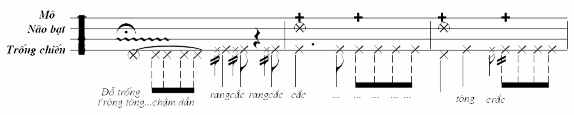
The royal family members passed away… Here we quote the example of the single-stringed instrument in (Dai Nhac) which was only used to play when the king bowed during the Giao ceremony:
Example 27:
Excerpt from "Dan dan don " (Great music)
(Ensemble includes: war drums, sona trumpet, cymbals, buffalo horn)
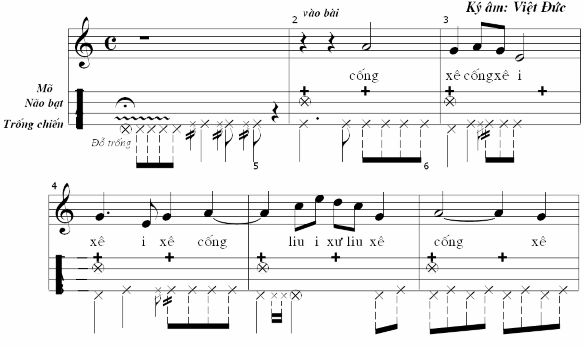
Percussion notation (large band - single instrument)
2.4.2. Sheet music used in small music
1- Carpet Song 9- Five Opposites
2- The Pure Precepts Section 10- The Five Pairs Lower
3- Lake sightseeing 11- Dragon bath
4- Back to school 12- Long Dang
5- Chapter 3 13- The Tower
6- Dance of the Three Lamps 14- Short Song
7- Spring Love Bird Five 15- Northern Song
8- The South Sea 16- The Horse Ride
17- Tam Thien Khuc 18- Phu Luc Dich
19- Phung Vu 20- Ten royal songs including the following melodies: ( Pham tiet, Nguyen tieu, lien hoan, Binh ban, Tay mai, Ho quang, Kim tien, Xuan phong, Long ho, Tau ma ). In which, some commonly used songs are:
- Five pairs of upper and lower songs, Dragon chant : played when the king offers incense
- Ten-handed continuous cards: 10 royal cards, often used in banquets, to entertain state guests.
- Phu Luc Dich : Played when the royal court celebrated longevity
- Phoenix Dance : Flute solo for Phoenix Dance
Example 28: Excerpt from “Long Ngam” (Small Music)
(The ensemble includes: Erhu, Flute, Moon, Sanh tien, Phach mot, Tam am, Drum )
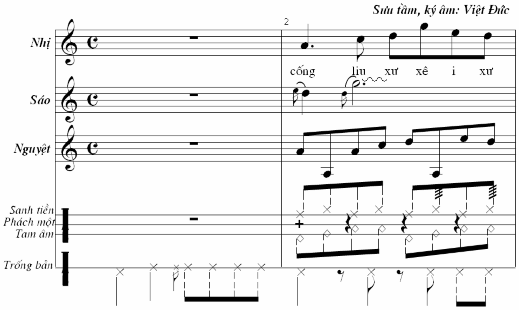
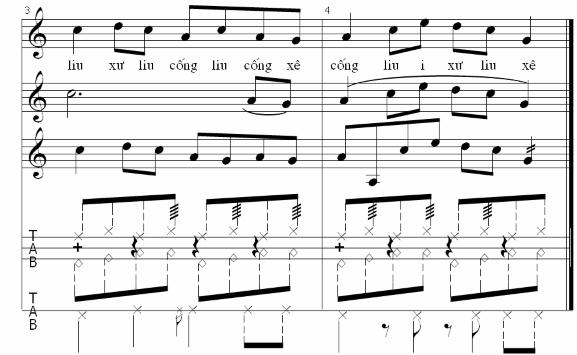
Percussion Minor Music (notation)
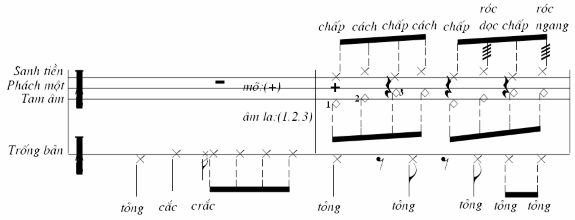
2.4.3. The score of the Octave orchestra
According to the document "The Great Ceremonies and Dances of Vietnamese Kings" by Do Bang Doan (DBĐ) and Do Trong Hue (DTH) and the document " The Imperial Decree of Dai Nam Hoi Dien Su Le - Nguyen Dynasty Cabinet" (part of music and instruments), after each ceremony (associated with the singing) of the Nam Giao ceremony, the Thong Tan official often chanted the Eight-tone music... [22], [79]. Thus, the Eight-tone orchestra has the task of accompanying the singing and the Eight-tone music in the Giao ceremony.