
The method calls it a "job-hopping" situation. Due to many reasons, such as finding a job with higher remuneration, or being fired by the company for not meeting the job requirements.
Table 9: Number of years single mother workers worked in Binh Duong
No. 5
Below 1 year | From 1 – 2 year | From 3-5 year | Over 5 year | Total | |
Case | 13 | 15 | 66 | 56 | 150 |
Ratio % | 8.7 | 10.0 | 44.0 | 37.3 | 100% |
Maybe you are interested!
-
 Evaluation of the effectiveness of safe motherhood interventions among mothers with children under 2 years old in 5 provinces of Vietnam during the period 2006 - 2012 - 24
 -
 Nutritional status before and during pregnancy of mothers and length and weight of newborns in Binh Duong province in 2010 - 2012 - 1
 -
 Assessing the impact of the model of enhancing early detection of disabilities for mothers with children under 6 years old in Hoai Duc district - Hanoi city in the period 2014 - 2016 - 2
 -
 Nutritional status before and during pregnancy of mothers and length and weight of newborns in Binh Duong province in 2010 - 2012 - 18
 -
 Number of Accommodation Establishments in the Country and the Central Region Through the Years 2011 - 2012
Source: Survey results of the project in Di An in 2018 Number of working hours
The number of working hours of workers is always an issue of public concern, because working time is closely linked to the worker's income. Through a questionnaire survey of worker mothers, we found that workers have to work for a long time but the salary is quite meager, on average they have to work 10 hours a day, compared to The prescribed time is 8 hours/day, so the average overtime is 2 hours/day.
Working time of 8 hours/day is the ideal time frame according to State regulations to ensure that workers have time to recover their health, reproduce their labor force as well as have time to take care of their children. female. If you have to regularly work overtime, the time spent recovering is difficult to guarantee. In the long run, this will greatly affect the worker's health.
Equipment for daily living;
Living equipment is also parameters that reflect the quality of human life. In the context of a developed society, no matter where people are, they have basic equipment to meet daily material and spiritual life.
Table 10: Family living equipment
Equipment
Case | Ratio (%) | |
Television | 111 | 74.5 |
Fridge | 81 | 54 |
Washing machine | 40 | 26.7 |
Fan | 130 | 86.7 |
Air conditioner | 13 | 8.7 |
Water heater | 11 | 7.3 |
Microwave oven | 7 | 4.7 |
Bed | 81 | 54 |
Cabinet | 76 | 50.7 |
Furniture | 56 | 37.3 |
Bicycle | 61 | 40.7 |
Motorbike | 103 | 68.7 |
Source: Survey results of the project in Di An in 2018
Table 10 shows that most female workers who are single mothers have basic equipment such as: TV; Fridge; Fan; Bed; Cabinets, bicycles: motorbikes..., in addition there are some other equipment such as washing machines 26.7%, air conditioners 8.7%, water heaters 7.3%, microwave ovens 4.7%.. .
Through the analyzed data, it seems paradoxical that the income and expenses are not enough for monthly living but the items owned are many, in fact the equipment used by single working mothers' families. Not all items are of high value and they buy them themselves, but they use those items by "asking - giving - donating" from organizations, individuals, charity associations... or buying them at high prices. Very cheap or a gift from the company union at the end of the year.
Box 3: Single mothers' opinions about household equipment
"Household appliances are mostly given to each person by everyone, or they are bought secondhand. Only the refrigerator I bought in installments from the company's union has been used for a long time, more than a year. (And I haven't finished paying in installments yet) because I have a small child and need to store milk and food for the child, so I have to try hard to buy it" (Ms. TTTN, 35 years old).
"It's not enough to live as a mother and one child. I don't dare to play around like other people. People leave me shoes and clothes and take them to use. I'll tell the truth, why say that" (DTL, 41 years old).
"I don't have a TV yet. I use this cheap phone for 200,000, mainly to call home when necessary." (PTH, 26 years old).
Regarding transportation, this is an important means for single mothers to use to get to work every day. The survey results showed 61 cases, accounting for 40.7%, using bicycles; 103 cases account for 68.7% of motorbike use. This problem is quite simple because the most popular vehicle now is the motorbike, so most single mothers buy this vehicle. However, there are also some single mothers who do not use it because they do not know how to ride a motorbike or the distance from where they live to work is not too far, so this group chooses a bicycle as a means of transportation. Some other reasons that may make them choose bicycles are that the initial purchase cost is lower than that of a motorbike, there is no need to spend money on fuel every month, and it can also be an effective means of exercise in addition to motorbikes. working time. The survey results also show that there are some single mothers who, due to low income, cannot afford to buy bicycles or motorbikes to get around like Ms. The company is more than 2km away, and also more than 2km from my child's school. She doesn't have a car, so both mother and child have to walk. In the morning, she works until 12 noon before stopping, and her child has to go to school at 12 o'clock, so before 10 a.m., he has to carry his school bag and go from home to the nearby school.
1 hour" or do they have to rely on the support of people around them like Ms. TTTN, 35 years old: " Before I could barely walk, now I have a motorbike thanks to the support of the women in the company and the gender union." Introduce and guarantee me an additional loan from a microfinance institution that allows me to buy in installments, but I cannot afford it on my own."
4.2 Cough all over the body
As analyzed above, the survey results showed that the majority of single mothers originate from provinces outside of Binh Duong, with only a small number of single mothers being local people. They are immigrants from different localities across the country to make a living in Binh Duong province.
Table 11: Family situation and housing type (Unit %)
Source gc
The type of house the mother lives in
Local people | It's different | Shared | |
Home | 22.2 | 12.3 | 14.7 |
Mom's house | 22.2 | 16.7 | 18.0 |
Motel | 52.8 | 66.7 | 63.3 |
Business house for rent | 2.8 | 4.4 | 4.0 |
Model S | 36 | 114 | 150 |
Source: Survey results of the project in Di An in 2018
The results of processing the correlation between the grouping of single mothers who are local and immigrants show that there are significant differences in home ownership as well as their housing type. For example, while 22.2% of local single mothers own their own house, this rate among single mothers from outside the locality is only 12.3%. There is a similar difference in the form of parents staying at home. However, in the form of boarding houses, the results are in the opposite direction, specifically: 66.7% of single mothers from outside the country
Locals said they were renting in a boarding house, while this rate among local single mothers was not low at 52.8%.
Thus, there is a clear difference between the group of local single mothers and the group of immigrants. Local people have the advantage of either having their own house or being able to stay at home with their parents. Up to two-thirds of single mothers have to rent a house and live independently. This reflects not only the difficulties in their physical facilities, but also the limitation in receiving social resources from relatives.
Age group and type of housing
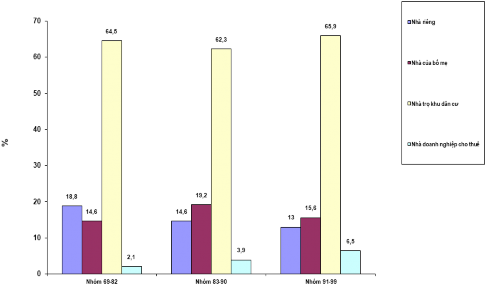
Table 12: Age group and housing type of single mothers (Unit %)
Source: Survey results of the project in Di An in 2018
The results of correlation processing show that there is not much difference between the 3 age groups in terms of housing ownership and use. What is interesting is that the highest rate of owning a home is among single mothers born in 1968 - 1982 (18.8%), followed by the group born in 1983 - 1990 (14.6%), and the lowest is group born in 1991-1999 (13%). Regarding the form of living with parents, the group of single mothers born in 1983 - 1990 has the highest rate (19.25), followed by the group of single mothers born in 1983 - 1990.
born in 1991-1999 (15.6%) and the lowest is born in 1983-1990 (14.6%). In the form of rented accommodation, all three groups of single mothers have similar rates. However, there are very few single mothers living in rental properties, of which the youngest group born in 1991-1999 has the highest rate (6.5%), followed by the group born in 1983-1990. (3.9%) and the lowest is the group of single mothers born in 1968 - 1982 (2.1%).
Workplace and type of housing
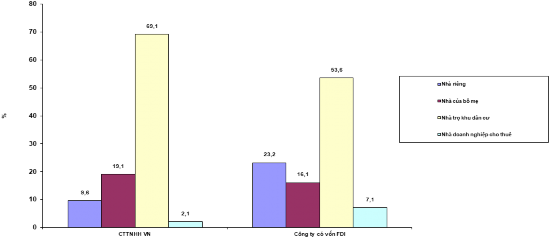
Table 13. Workplace and housing status of single mothers (Unit %)
Source: Survey results of the project in Di An in 2018
The chart shows that the group of single mothers working for companies with FDI capital has a rate of owning a home that is more than 2 times higher than the group of single mothers working for limited liability companies (23.2% compared to with 9.6%); In the form of using the parents' house, there is not much difference between the two groups. 19.1% of single mothers working for LLCs live in their parents' house while this rate in the group of working mothers making the company's FDI capital 16.1%. Survey data continues to show a clear difference in the use of boarding houses between single mothers working for LLCs and those working for FDI companies (69.1% versus 53.6%). and the proportion of single mothers renting housing from businesses
Rental businesses are very low, only 7.1% in FDI enterprises and 2.1% in enterprises with domestic capital. The reason is also very easy to understand because businesses do not have a priority regime for this subject.
Labor contract and type of housing
A question that continues to arise is whether the labor contract is related to the housing status of single mothers? Results and analysis below.
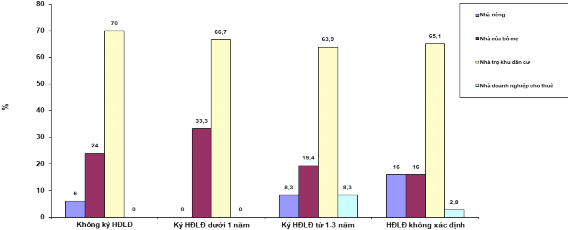
Table 14: Labor contract status and housing status of single mothers (Unit %)
Source: Survey results of the project in Di An in 2018
Labor contracts also greatly affect the accommodation of mothers who are single workers. The results showed that single mothers who are workers, whether under indefinite, short-term or long-term labor contracts, have a low rate of owning their own home (16%), followed by the group of mothers with a contract. Labor contracts are signed for 1-3 years (8.3%) and the lowest is the group without labor contracts (6%). What is interesting is that Table 11 shows that the highest proportion of single mothers living in boarding houses belongs to the group without a labor contract, followed by the group with a labor contract of less than 1 year, and even lower are the two groups with a labor contract. Labor contracts from 1 - 3 years and long-term contracts. In-depth interview information also confirms this reality: " I'm living in a boarding house, I joined this company thanks to a sister.
I'm working here and brought in. I've been working for more than a year and haven't seen any signs yet. " TL, 20 years old, LN Company; " This company is very methodical. I tried for a week and then HR called me to sign the contract. My contract was signed for each year. I signed it twice." T, 24 years old, company worker. YZK.
Income and housing type
Table 15: Income and housing status of single mothers (Unit %)

Source: Survey results of the project in Di An in 2018
Survey data also showed that the average monthly income of single mothers is very low, they have a higher income thanks to working overtime. The monthly income is not high and there is no surplus to accumulate, but only ensures minimum expenses for daily life for themselves and their children. Because their income is low, besides their salary, they have no other source of income, so when they receive their salary, their expenses have an address such as rent, money to buy fuel, daily food, and money for living expenses. Children's education, medical examination and treatment costs when their children are sick, and many other unexpected expenses that can happen to them any day. low income,