
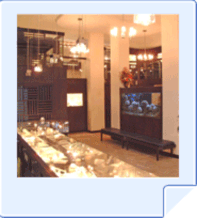
Customers can easily recognize PNJ stores among crowded streets and many stores because of this very unique image.
However, the quality inside the stores is not really comprehensive and uniform. For example, the results of the inspection of some stores in Hanoi in April 2007 are as follows:
Table 2: Inspection results of some PNJ stores in Hanoi - April 2007
STT
Shop | Tran Nhan Tone | Trang Tien | Bach Mai | Kham Thien | Ton Duc Win | Ngoc Lam | HIGH | |
Existing problem | ||||||||
1 | Shop | |||||||
Parking | | | | | ||||
Electrical system | ||||||||
Lighting system | | |||||||
Fan | | |||||||
Platform shelf | | | | | | |||
Display | | | | | | | | |
Ultrasound machine | | |||||||
2 | Rules and regulations | |||||||
Store cleaning | | | ||||||
Cleaning goods | | | | | | | ||
Skin | | |||||||
3 | Books + goods | |||||||
Save document | | | | | | | ||
Books and documents | | |||||||
Management, warehouse | | | | | | | |
Maybe you are interested!
-

 Survey Results on Inspection Time Criteria
 -
 Results of Applying Compulsory Measures to Enforce Payment Obligations in Hanoi City in 2009 and 2010
 -
 Completing the organization of revenue and cost accounting and determining business results at VIETTEC Inspection and Logistics Joint Stock Company - 9
 -
 Results of Lending Activities for Employment at the Vietnam Bank for Social Policies, Hanoi Branch in the Period 2018-2021
 -
 Innovation in Monitoring, Inspection and Evaluation Activities of Investment Results of Programs/Projects
Source: PNJ – Store inspection report
When supervisors discover defects in the store, they always propose immediate solutions. For example: immediately call a repairman, suggest the company provide more decorations, urge the staff to clean the store...[4]
This shows that the Company always tries to maintain the high quality of the stores, ensuring the best services, helping the distribution of PNJ jewelry to be effective.
4.3. Revenue, profit and market share
Along with the expansion of the distribution system, PNJ's revenue and profit have increased significantly over the years.
Table 3: PNJ's revenue and profit (billion VND)
Year
2004 | 2005 | 2006 | T.6/2007 | |
Revenue - billion VND -% growth | 1650 | 1725 104.55% | 2329 135.01% | 1446 |
Profit - billion VND -% growth | 18,105 | 23,949 132.28% | 37,941 158.42% | 86.3 |
Profit/Delivery Ratio | 1.1% | 1.39% | 1.63% | 5.97% |
Source: PNJ – A development journey [8]
Profits in the first 6 months of this year skyrocketed because the Company had just received two contracts from two large American jewelry companies: Zalemark (a contract allowing PNJ to produce and sell jewelry products under the Demeter brand of Zalemark at CAO stores) and DC&D (a contract to process jewelry for DC&D with a total value of about 20 million USD, with delivery deadline until the end of 2008).
In the domestic market, PNJ Company has also continuously increased its market share and gained the trust of a large number of Vietnamese consumers. In the 2007 High Quality Vietnamese Goods program, PNJ jewelry was recognized as the leading brand in the jewelry industry, ranked 16th in the top 100 high quality Vietnamese consumer goods brands, while PNJ's biggest competitor, Saigon Jewelry Company SJC, ranked only 2nd in the jewelry industry, 83rd in the top 100 [14]. This title is established based on the criteria of consumer trust index, brand stability and continuity, economic efficiency, and long-term investment in the brand, so it is the best proof of PNJ's market share development in the Vietnamese jewelry market.
The above results are very admirable, but in the Company's product distribution system there are still some shortcomings and limitations that need to be noted.
4.4. Existing problems and limitations in the domestic product distribution and consumption system of PNJ company
4.4.1. Geographical arrangement: market gaps
Looking at the map of the PNJ store system (Appendix 4), it is clear that the Company is leaving many market areas open. While building a dense store system in Ho Chi Minh City (48 out of the Company's total 86 stores), and Hanoi (15/86 stores), in other cities, PNJ only has one or two stores. Furthermore, in the entire North, the Company only has stores in two cities, Hanoi and Hai Phong, while this area brings in more than 15% of the Company's total annual revenue.
Thanks to wholesale and retail intermediaries in the distribution system, PNJ jewelry products still reach the final consumers in provinces and cities where the Company does not have branches or stores. However, because they do not promote the PNJ brand, the Company still needs to build its stores more widely so that the distribution is most effective, satisfying the goals and requirements that the Company has set out in its plan to build a distribution system.
4.4.2. Conflict in distribution channels
In addition to leaving some market areas open, PNJ Company also caused some conflicts in the distribution system.
First, the Company has an uneven salary policy among stores. For example, the sales salary of employees at Tran Nhan Tong and Vincom stores (Hanoi) is 4% of retail gold revenue, 0.5% of stone revenue, 2% of retail merchandise revenue, 1.5% of Italian necklace revenue, and 4% of silver revenue; while the sales salary of employees at Trang Tien and Big C stores (also in Hanoi) is 5% of retail gold revenue, 0.5% of stone revenue, 2% of retail merchandise revenue, 1.5% of Italian necklace revenue, and 5% of silver revenue. This difference makes employees feel uncomfortable at work and often react when they are transferred to another job position.
In the wholesale channel, PNJ employees also offer products to stores that are purchasing from wholesale intermediaries in their system. This helps shorten the distribution channel and improve the Company's ability to control the distribution process.
but has caused many reactions from wholesale intermediaries, typically the mentality of keeping business information secret, affecting the flow of information serving the construction of the Company's marketing strategies.
There were also conflicts that arose because the Company did not maintain good communication with intermediaries. In 2004, many retailers reacted strongly when the Company opened the PNJ Gold store system: “Why did you switch from wholesale to retail? How can we survive with this type of sales?” Only later did they understand that the retail product line was completely different from the wholesale product line. However, poor management of this information flow has somewhat reduced PNJ’s reputation with intermediaries.[19]
The above limitations and shortcomings, along with the constant fluctuations in the jewelry market, have posed the need for the Company to constantly change. Chapter three of the thesis is a number of solutions and recommendations of the author, hoping to be able to help improve the distribution system of PNJ.
CHAPTER 3
SOLUTIONS AND RECOMMENDATIONS TO IMPROVE THE DOMESTIC DISTRIBUTION AND CONSUMPTION SYSTEM OF PNJ COMPANY
1. FORECAST OF VIETNAM JEWELRY MARKET
1.1. Market size
According to the assessment of the World Gold Council, the Vietnamese jewelry market is a small market compared to other countries in the region but has a very strong and vibrant development. Compared to neighboring countries such as India, China, Thailand, Vietnam's gold consumption is only about 8%. However, the jewelry market has grown steadily at 10-> 14%/year for over 10 years [17], promising great opportunities for businesses in the industry.
Chart 3: Gold and jewelry consumption in Vietnam (tons)
34
36
34
36
25
28
34
48
100
80
gold pieces
makeup
60
40
20
0
2003 2004 2005 2006
Source: www.binhthuan.gov.vn In addition to the scale of consumption, the scale of production and competition in the market also
very large. The number of enterprises operating in the gold, silver, and gemstone industry is also constantly increasing rapidly, about 15% per year, and to date it is estimated that there are about 10,000 enterprises operating in the industry. However, only about 2% of these units invest in modern machinery, the rest mostly use outdated production equipment [13]. As
Therefore, Vietnam's high-end jewelry market still has a lot of potential waiting for businesses to invest and exploit.
On the other hand, our country has joined the WTO and is on the path to AFTA integration, so in the near future, tariff barriers will be abolished and at that time, Vietnamese enterprises will have to compete with foreign enterprises that have a long production process and possess modern, large-scale technological lines and experienced design teams. Currently, some large companies in the world have also begun to exploit the Vietnamese jewelry market such as Design International of France, Estelle of Japan, Pranda Group of Thailand, Lucidau of Korea, Thang Binh of Taiwan, Everest of Australia, KP of the US, etc. [13].
The Vietnamese jewelry market in the near future will certainly have many more fluctuations, requiring domestic enterprises to closely follow each development and react promptly in order to maintain, consolidate and improve their position.
Regarding production inputs, the total domestic gold output currently reaches 2 to 3 tons/year. Thus, almost all raw gold for jewelry production and trading must be imported from abroad. This is a limitation for the development scale of the Vietnamese jewelry market in the context of the current sharp increase in gold prices.
1.2. Price
The value of jewelry in our country's market is currently calculated separately by the gold price (the value of the amount of raw gold and gemstones used to make the jewelry) and the labor price (usually calculated based on the sophistication of the item). Labor prices rarely change, so jewelry prices fluctuate mainly according to the price of raw gold on the market.
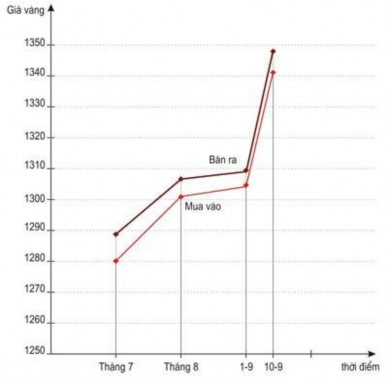
Gold prices in recent months have fluctuated erratically depending on the day, but the general trend is a strong increase. This was clearly shown in the sudden increase in prices in early September 2007. By the end of October 2007, the gold price on the world market was around 765 USD/ounce, reaching a record level in the past 28 years. Domestic gold prices have also been continuously adjusted, closely following world prices. At 9:00 a.m. on October 20, 2007, the selling price of SJC gold was 1,479,000 VND/tael and the buying price was 1,479,000 VND/tael.
1,471,000 VND/tael. The price is so high that most gold speculators are having to pause and wait for new developments.[18]
Chart 4: Gold price in Vietnam in the third quarter of 2007
Source: www.doanhnghiep24g.com.vn/cms/detail.php?id=18247 In early 2007, the Gold and Gemstone Trading Company of the Vietnam Bank for Agriculture and Rural Development put into operation a joint venture gold bonded warehouse with Singapore's Standard Merchant Bank Asia. Therefore, if previously domestic enterprises wanted to import gold, it would take 48 to 72 hours, now it only takes 12 hours, and the gold import fee has also decreased by about 3 times, to only 0.4 to 0.5 USD/ounce [18]. Therefore, the current Vietnamese gold price reacts very
sensitive and in the same direction as world gold prices.
Currently, in the international exchange market, the US Dollar is weakening as the financial world predicts that the US Federal Reserve will cut its key interest rate. In addition, the price of crude oil is continuously breaking records, currently rising to 90 USD/barrel[18]. And the price of gold, as a rule, always fluctuates at the same time as the price of the Dollar and crude oil.