
3.2.2.2 Implementing policies to attract investment in Border Gate Economic Zones
In order to enhance economic development and contribute to poverty reduction, in addition to implementing investment attraction policies issued by the Government, Lao Cai province has concretized the Decrees and Decisions of the Government and the Prime Minister in Lao Cai through Resolutions of the Provincial Party Committee and Decisions of the Provincial People's Committee on preferential policies, support and investment encouragement in Lao Cai province. Since the establishment of Lao Cai Economic Zone, the Provincial People's Committee has issued 5 Decisions (Decision No. 182/2001/QD-UB dated May 21, 2001; Decision No. 521/2005/QD-UB dated September 16, 2005; Decision No. 57/2008/QD-UB dated November 5, 2008; Decision No. 20/2010/QD-UB dated August 10, 2010 and Decision No. 72/2012/QD-UB dated December 28, 2012) regulating investment incentive policies in Lao Cai Economic Zone. These policies are mainly land incentives such as exemption from land rent, water surface rent, support for site clearance costs; the right to transfer land use rights and assets attached to land, transfer of investment projects; Incentives on corporate income tax, import-export tax, personal income tax; support for labor training; investment incentives for major business types in the economic zone (processing and recycling, trade in goods, trade in services, restaurant and hotel business, etc.); special incentives on production of new materials, farming and processing of agriculture, forestry, aquaculture, production of artificial seeds, plant and animal breeds, etc.
20%
16%
64%
Joint venture business cooperation contract
100% foreign capital
Chart 3.1: Structure of FDI investment types in Lao Cai Economic Zone
Source: [83, p.77].
There are administrative reform regulations that have reduced cumbersome administrative procedures for domestic and foreign investors. Specifically, if the Provincial People's Committee grants an investment license, the time from receiving the application to returning the application is no more than 7 days. Thanks to that, investors are assured and invest more in Lao Cai, which is shown through the assessment of the PCI index of Lao Cai from 2006-2011. Since its establishment, there have been 1,761 enterprises, branches, and representative offices registered to operate in the Economic Zone. Attracting foreign direct investment (FDI) in recent years (2006-2013) has licensed 170 projects with a total registered capital of 285 million USD [83, p.77].
Table 3.2 : Comparison table of PCI Lao Cai and component indicators
TT
Component index for scoring PCI rating | Year 2006 | Year 2007 | Year 2008 | Year 2009 | Year 2010 | Year 2011 | |
01 | Cost of market entry | 7.78 | 8.23 | 8.51 | 8.35 | 7.71 | 9.41 |
02 | Land Access and Stability in land use | 5.93 | 6.27 | 7.14 | 7.18 | 7.46 |
7.54 |
03 | Transparency and Accessibility information | 7.8 | 8.56 | 7.04 | 8.68 | 7.39 |
7.34 |
04 | Time cost to implement State regulations | 4.33 | 4.80 | 3.80 | 6.58 | 7.27 |
8.28 |
05 | Informal costs | 6.78 | 6.36 | 6.59 | 6.80 | 7.16 | 8.05 |
06 | Dynamic and pioneering of provincial leaders | 6.59 | 6.90 | 7.81 | 8.78 | 6.94 |
9.38 |
07 | Business support services | 7.01 | 7.85 | 5.21 | 5.64 | 6.32 | 4.43 |
08 | Quality of labor training | 6.46 | 6.24 | 4.63 | 4.97 | 5.71 | 5.22 |
09 | Legal institutions | 3.52 | 5.84 | 5.12 | 4.03 | 4.29 | 6.19 |
General index: | 64.11 | 66.95 | 61.22 | 70.47 | 67.95 | 75.53 | |
Ranking results compared to other provinces and cities nationwide | 6/64 | 5/64 | 8/64 | 3/63 | 2/63 | 1/63 |


Maybe you are interested!
-
 General Assessment of Adjusting Vietnam's Investment Attraction Policy in the Face of the Trend of Forming Free Trade Agreements in Asia
 -
 Salary Policy and Human Resources in Investment Attraction
 -
 Vietnam's Investment Attraction Policy Facing the Trend of Forming Free Trade Agreements in Asia - Pacific
 -
 Implementing credit policy for students at Vietnam Bank for Social Policies - 2
 -
 Current Status of Development of Lao Cai Border Gate Economic Zone
Source: [41].
3.2.2.3 Policies on investment in construction of technical infrastructure
In 2001, the Government issued Decision No. 53/2001/QD-TTg dated April 19, 2001 on policies for border economic zones, however, in recent years
At present, Lao Cai Economic Zone has just been established, so the revenue from the state budget is not much, so the budget left from the state budget revenue does not meet the requirements for building infrastructure of Lao Cai Economic Zone.
On November 26, 2013, the Prime Minister issued Decision No. 72/QD-TTG on financial mechanisms and policies for economic zones. This decision stipulates that investment projects in the construction of technical infrastructure and social infrastructure of economic zones are allocated capital from the development investment capital of the local budget. The central budget supports investment projects in the infrastructure of economic zones according to the provisions of Decision No. 60/2010/QD-TTg dated September 30, 2010 of the Prime Minister. Particularly in the period of 2013-2015, support at least 70% of the total capital from the central budget in the annual plan for investment in the development of the infrastructure system of economic zones selected for focused investment and development according to the Project approved by the Prime Minister. In addition, capital sources are mobilized from government bonds, corporate bonds, local bonds, economic zone land fund capital, and state credit capital.
Based on the planning of the economic zone and the implementation of central policies, Lao Cai province pays special attention to building infrastructure such as electricity, water supply and drainage, information, communication, banking, construction of road systems, warehouses, industrial parks, commercial centers, and market systems. Up to now, the investment in building infrastructure and essential and key works serving the development of the economic zone has been basically completed... The total investment capital for infrastructure in Lao Cai economic zone since its establishment (1998) to date is 2,600 billion VND, of which: Phase 1 (from establishment to 2005) is 1,100 billion VND; Phase 2 (from 2006 to present) is 1,604.5 billion VND [78].
3.2.2.4 Trade development policy, import and export
The State's promulgation of many policies on border trade management such as Decision 254/2006/QD-TTg dated November 7, 2006 on the management of border trade activities with countries sharing a common border and other trade policies stipulated in documents on the operation of the Economic Zone have contributed to the development of trade activities and the environment.
Business is increasingly open and convenient; goods circulate smoothly with relatively stable prices and guaranteed quality. In 2013, the total value of goods and consumer service revenue is estimated at 11,059 billion VND, nearly 2 times higher than in 2010; average growth in the period 2011-2013 reached 27.6%.
Commercial activities of border residents are taking place actively, the management of the exchange, purchase and sale of goods of border residents has gradually become orderly, ensuring the correct subjects, list of goods, tax exemption limits, arranging convenient locations for declaration and customs inspection of goods of border residents at international border gates. The value of goods bought and sold by border residents in 2011 reached 58 million USD; in 2012 it reached over 88 million USD; in 2013 it decreased sharply, reaching only 45 million USD because from March 1, 2013, the list of imported goods in the form of buying and selling and exchanging by border residents was limited according to Circular No. 42/2012/TT-BCT of the Ministry of Industry and Trade. Export goods of border residents produced in the province include bananas, pineapples, cassava, and corn, which have contributed to promoting production development and also contributing to poverty reduction for border residents [ 83, pp.44-47].
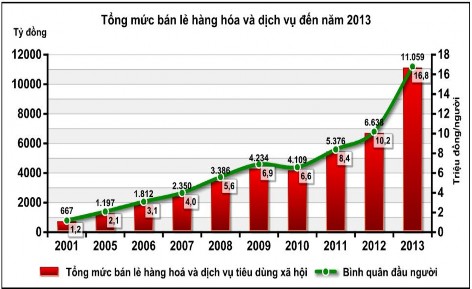
Chart 3.2 : Fluctuations in total retail sales of goods and services
Source: [83].
Import and export activities: Along with investing in KTCK infrastructure, Lao Cai Province has implemented a series of measures to attract and facilitate
for import-export activities such as: Officially opening the international road border gate No. 2 (Kim Thanh) since 2012; putting into use border trucks to replace rudimentary vehicles at the international border gate (Ho Kieu II bridge); issuing C/O for export goods right at the border gate; implementing electronic customs procedures; gradually investing and expanding functional areas in the Ban Vuoc sub-border gate area... contributing to accelerating import-export turnover.
Import and export turnover of enterprises through Lao Cai Border Gate has increased sharply over the years, the structure of main export items includes: ores of all kinds, agricultural products, plastic tables and chairs, cassava tubers, fresh lychees...; main import items are: chemicals, fertilizers of all kinds, gypsum stone, ceramic tiles, machinery and equipment, vegetables, tubers and fruits.
2500
2115
2000
1500
1338
1000
820.4
777
500
449
579.8
357.8
119.9 28.8 91.1
240.6
91.2
0
2000
2005
2010
2013
Import and export
Export Import
Chart 3.3: Import and export turnover in Lao Cai province
Source: [83].
The implementation of incentives for domestic and foreign tourists when entering the commercial area, duty-free area, exempted from taxes when purchasing goods is adjusted to suit the reality. That contributes to promoting trade development, at the same time attracting tourists to visit and shop in the Economic Zone.
3.2.2.5 Immigration, entry, services and tourism policies
With the advantage of a convenient traffic system (road, railway, waterway), Lao Cai Economic Zone not only promotes import and export of goods but also creates favorable conditions to promote import and export activities through border gates. The number of people and vehicles passing through the Economic Zones is increasing.
increased. In 2012, Lao Cai international border gate welcomed over 1.7 million arrivals, mainly tourists and residents from China and Vietnam, to trade at markets in the economic zone and border communes. The number of travel companies also increased rapidly, by 2012 there were 36 units (20 international travel companies, 16 domestic travel companies), the number of tourists to Lao Cai reached nearly 1 million people/year, contributing to increasing the province's budget revenue and promoting the development of the economic zone. Due to the open and favorable exit and entry policies of Vietnam and Lao Cai, not only in the economic zone but also in the whole province, tourism services are quite developed and are one of the economic spearheads of the province. The total number of tourists to Lao Cai in 2013 reached 1,260.9 thousand arrivals, an increase of 54% compared to 2010.
Table 3.3 : Summary table of the number of people, vehicles entering and exiting the country, and the number of tourists passing through Lao Cai Economic Zone, period 2005-2012
Target/Year
2005 | 2010 | 2011 | 2012 | |
1. Number of people entering and exiting the country (people) | 994,548 | 1,416,369 | 1,765,909 | 1,793,350 |
- Departure | 497,284 | 707,561 | 882,352 | 901,129 |
- Entry | 497,264 | 708,808 | 883,557 | 892,221 |
2. Number of vehicles exported entry (vehicle) | 31,336 | 57,140, | 150,308 | 111,568 |
- Chinese cars | 21,733 | 34,527 | 76,642 | 75,377 |
- Vietnamese Car | 9,603 | 22,613 | 73,666 | 36,191 |
3. Number of tourists (People) | 510,000 | 888,395 | 968,970 | 948,610 |
International | 180,000 | 389,007 | 439,620 | 375,530 |
Inland | 330,000 | 499,388 | 529,350 | 573,080 |
Source: [84] and author's synthesis.
Other services such as transportation, finance, post and telecommunications are increasingly developing, opening up many opportunities for Lao Cai's development, increasing local budget revenue and creating many jobs for workers, meeting the development requirements in the area. In 2013, the whole province had 12 bank branches operating with a total outstanding loan capital of over 20 trillion VND; average credit growth of 25%/year; ensuring production and business needs, social security.
3.3 CURRENT STATE OF HUNGER ELIMINATION AND POVERTY REDUCTION IN LAO CAI
3.3.1 Overview of poverty reduction in the country
Thanks to the achievements in socio-economic development and the synchronous implementation of policies and solutions to reduce poverty and encourage people to strive to get rich, poverty reduction in Vietnam has achieved many remarkable results. Specifically:
Firstly, according to the WB's assessment, Vietnam's achievements in the field of poverty reduction are among the most successful in the process of economic development. The poverty rate has decreased rapidly regardless of the poverty standard. The good news is that the poverty reduction rate is evident in all regions, decreasing very rapidly in the Northwest and Central Highlands, with an average annual decrease of 4.5%. According to the criteria for determining poor households of the Ministry of Labor, War Invalids and Social Affairs, the poverty rate has decreased from 16% in 2006 to 14.2% in 2010 (Poverty standard for the period 2005-2010).
2010), down from 9.6% in 2012 to 7.6% in 2013.
Second, Vietnam has exceeded the Millennium Development Goal (MDG1) and is considered by the international community to be one of the countries with a rapid poverty reduction rate and a pro-poor economic model, meaning the poor benefit from the results of socio-economic development.
Table 3.4 : Poverty rate in regions nationwide in the period 2005-2012
(According to 2006-2010 standards, 2011-2015 standards)
Unit: %
STT
Area | 2005 | 2010 | 2012 | |
A | B | 1 | 2 | 3 |
1 | Northeast | 33 | 24.62 | 17.39 |
2 | Northwest | 42 | 39.16 | 28.55 |
3 | Red River Delta | 14 | 8.3 | 4.89 |
4 | North Central Coast | 35 | 16.04 | 15.01 |
5 | South Central Coast | 23 | 17.27 | 12.2 |
6 | Central Highlands | 38 | 22.48 | 15 |
7 | Southeast | 9 | 2.11 | 1.27 |
8 | Mekong Delta | 18 | 13.48 | 9.24 |
Nationwide | 22 | 14.2 | 9.6 |
Source: Author's synthesis.
Third, after 10 years of implementing Program 135, the appearance of poor communes and extremely disadvantaged communes has changed significantly, especially in terms of infrastructure serving the development of commodity production: over 25,000 infrastructure works and 498 commune cluster centers have been built; about 95% of extremely disadvantaged communes have motorized roads to commune cluster centers; nearly 50% of communes and commune cluster centers have markets, over 95% of communes have semi-permanent schools; 84.5% of communes have junior high schools, attracting 90-95% of school-age children; 88% of communes have electricity; 75% of communes have post offices; over 60% of communes have radio and television stations.
Fourth, the synchronous and effective implementation of the Party and State's policies on poverty reduction has created opportunities for the poor to access basic social services in health care, education, and housing. In the period 2006-2010, 52 million people were granted health insurance cards, 8 million poor and ethnic minority students were exempted from tuition fees and school construction contributions, and 2.8 million poor and ethnic minority students were provided with textbooks and notebooks with an average annual budget of over 100 billion VND.
At the same time, poverty reduction policies have also created opportunities for the poor to access production services, contributing to increasing income and reducing poverty. In the 4 years from 2001 to 2004, about 75% of poor households received loans, accounting for 15.8% of the total number of households in the country. Thanks to loans, many households have escaped poverty and have the conditions to purchase additional means and tools of production.
Fifth, mobilize many resources in diverse forms. The total resources to implement the poverty reduction target in the past 5 years reached about
41,000 billion VND, including Program 143, Program 135, international cooperation projects... Investment resources for the poverty reduction target program alone reached about
21,000 billion VND.
However, in addition to the achieved results, poverty reduction work in Vietnam in recent years still has some limitations as follows: The rate of poverty reduction is uneven among regions, the rate of poor households in border areas and mountainous areas is still 1.7 to 2 times higher than the general rate of poor households in the country. The gap between rich and poor, the difference in income between rural population groups, between rural and urban areas tends to increase. A large number of poor people, poor communes