
13.5%/year; services increased by 12.1%/year. In 2013 alone, because the province implemented many measures to promote growth and economic restructuring, it overcame difficulties, GDP growth reached 14%, much higher than the national average. In the period 2006-2013, Lao Cai GDP grew by an average of 12.8%/year, of which: agriculture, forestry and fishery increased by 6.2%/year; industry and construction increased by 17.6%/year; services increased by 12.3%/year. GDP per capita also increased quite rapidly, in 2005 the province's GDP/person (actual price) only reached 9.6 million VND but by 2010 it had reached 16.1 million VND (1.7 times higher than in 2005). In 2013, GDP/person reached 29.7 million VND/person (the whole country estimated at 41.1 million VND/person) [83, p.21].
The economic structure in recent years has shifted in the right direction, the proportion of agriculture, forestry and fishery in GDP has decreased significantly, from 35.3% in 2005 to 18.8% in 2013. The contribution of industry and construction in GDP has increased continuously from 26.5% in 2005 to 37.8% in 2010 and 44.4% in 2013. The contribution of the service sector in GDP remains at 37-38% [83, p.22].
Lao Cai's economic structure is quite unique compared to other provinces in the region and the whole country. Industry and construction, from having the lowest proportion after 7 years, increased 1.68 times (from 26.5% in 2005 to 44.4% in 2013), becoming the sector with the largest contribution to the GDP structure.
The average population in 2013 was 659.6 thousand people, equal to 5.7% of the Region's population and 0.7% of the country's population. Of which, the male population was about 333.4 thousand people (accounting for 50.5%), the female population was about 326.2 thousand people (accounting for 49.5%). The average population density in 2013 was 103.7 people/km2 , equal to 84% of the Region's average density and 37% of the country's average. Low population density is a favorable condition for the province in planning the development of economic zones; industrial parks; large-scale agricultural and forestry production areas.
Table 3.1 : Population of Lao Cai province in the period 2005-2013
TT
Target | Unit | 2005 | 2010 | 2011 | 2012 | 2013 | |
1. | Average population | 10 3 people | 576.97 | 626.22 | 637.52 | 648.27 | 659.6 |
1.1 | Male | " | 287.25 | 315.32 | 320.76 | 326.34 | 333.4 |
1.2 | Female | " | 289.72 | 310.9 | 316.76 | 321.93 | 326.2 |
2. | Natural growth rate (%) | % | 18.90 | 16.91 | 15.48 | 14.58 | 13.88 |
3. | Workforce from 15 years and older | 10 3 people | 307.3 | 426.81 | 434.57 | 442.39 | 450.44 |
% of total population | % | 53.3 | 68.15 | 68.17 | 68.24 | 68.29 |
Maybe you are interested!
-
 Socio-Economic Development Goals, Border Gate Economic Zone Development With Poverty Reduction In Lao Cai Province By 2020
 -
 Current status of tourism development in Lao Cai province - 1
 -
 Current Status of Economic and Tourism Development in Lao Cai Province
 -
 Current Status of Development and Evaluation of Tourism in Lao Cai Province
 -
 Current status of tourism development in Lao Cai province - 2
Source: [18].
Currently, Lao Cai province has 6/9 poor districts 30a and enjoys policies like poor districts, the rate of poor households is high compared to the region and the whole country, by the end of 2013 it was 22.21%, poor households, mainly ethnic minority households, highland and border areas.
Lao Cai province has a large area of forest land with extremely rich vegetation. Hilly forest land has advantages in raising livestock, growing industrial crops and medicinal plants. Hoang Lien Son mountain range with Fansipan peak (the roof of Indochina) is 3,143m high with a rich natural ecosystem, accounting for 50% of rare plants in Vietnam. Hilly land and forests of Lao Cai are very suitable for growing fruit trees, tea trees of all kinds, medicinal plants such as cardamom, artichoke... these are products with high export value. Lao Cai has 35 different types of minerals with 150 mining points, many of which are of high quality and large reserves such as: Apatite (2.5 billion tons), iron (150 million tons), copper (50 million tons). Many types of minerals are being exploited and deeply processed in Lao Cai such as Apatite ore selection; copper smelting plant with a capacity of 10 thousand tons/year; iron and steel plant with a capacity of 1 million tons/year; DAP factory No. 2 has a capacity of 330 thousand tons/year. If the mining industry is strongly promoted, it will create jobs and income for workers, contributing to solving poverty. Lao Cai hydropower has a huge potential, about 1000Mw, there are 68 projects with a total capacity of 882Mw, ensuring enough electricity supply for production and business.
Lao Cai has many famous landscapes and landscapes such as caves, temples, pagodas, especially Sa Pa and Bac Ha resorts. Good tourism development will create jobs for the people, contributing to the implementation of poverty reduction. Many types of tourism and investment in Lao Cai have been strongly developed in recent years; such as eco-tourism, village cultural tourism, adventure tourism... In 2013, the number of tourists to Lao Cai was 1,269.9 thousand, bringing income to the people. The work of maintaining universal primary education, primary education at the right age, and secondary school is maintained. Infrastructure continues to be invested in construction, the whole province has 4,738/7,780 classrooms solidly built, reaching 61% (lower than the national average of 71%), basic teaching equipment meets the requirements of teaching and learning. The total number of schools meeting national standards is 228, accounting for 34.5% [83, p.55].
The health care network from the province to the commune and ward levels has been invested in basic infrastructure and medical equipment. The total number of medical examination and treatment facilities in 2013 was 264, including 13 hospitals (05 provincial hospitals and 08 district general hospitals), 36 regional general clinics, 51 private general clinics, and 164 commune/ward health stations. The hospitals have basically served the medical examination and treatment needs of the people in the province [83, p.54].
Employment is always a focus, the number of workers who are employed each year is always higher than the previous year. In the period 2006-2010, new jobs were created for about 47,500 workers, an average of nearly 9,500 people per year, in the period 2011-2013, new jobs were created for 32,790 people and an average of 10,930 people/year [83, p.56].
3.2 CURRENT STATUS OF DEVELOPMENT OF LAO CAI BORDER GATE ECONOMIC ZONE
3.2.1 Overview of the current situation of border economic zones in Vietnam
Since 1986, along with the process of promoting economic exchange and integration, the strengthening and expansion of economic relations with neighboring countries has been promoted.
To encourage the development of border areas as well as border economic exchanges with neighboring countries, on September 18, 1996, the Prime Minister issued Decision 675/TTg on piloting the application of a number of policy mechanisms in the Mong Cai border gate area, setting a milestone for the formation and development of the theory and practice of the establishment of the economic zone. From 1996 to 2000, following the Mong Cai economic zone, 8 other economic zones in 8 provinces were piloted to apply a number of policy mechanisms in the border gate area. The 8 economic zones are: Lang Son Economic Zone (Lang Son), Lao Cai (Lao Cai), Ha Tien (Kien Giang), Cao Bang (Cao Bang), Cau Treo (Ha Tinh), Moc Bai (Tay Ninh), Lao Bao Commercial Zone (Quang Tri) with Decision No. 219/1998/QD-TTg dated November 12, 1998: "Issuing the Regulations on the Economic and Trade Development Encouragement Zone of Lao Bao, Quang Tri Province" and Bo Y Economic Zone (Kon Tum). In 2001, the Prime Minister issued Decision No. 53/2001/QD-TTg dated April 19, 2001 on the Policy for Economic Zones (followed by Decision No. 273/2005/QD-TTg dated October 31, 2005 of the Prime Minister on amending and supplementing a number of articles of Decision No. 53/2001/QD-TTg dated April 19, 2001 of the Prime Minister on the policy for border economic zones). With preferential policies of economic zones according to Decision No. 53/2001/QD-TTg of the Prime Minister, from 2001 to 2007, 14 border gate areas and economic zones were established according to the Prime Minister's Decisions, increasing the number of economic zones nationwide to 23 zones. After the Prime Minister issued Decision No. 52/QD-TTg dated April 18, 2008, the number of economic zones nationwide to date is 28 as follows: bordering China, there are 11 economic zones; bordering Laos, there are 9 economic zones; bordering Cambodia, there are 9 economic zones (Bo Y international economic zone, Kon Tum province, borders both Laos and Cambodia).
3.2.2 Current status of development of Lao Cai Border Gate Economic Zone
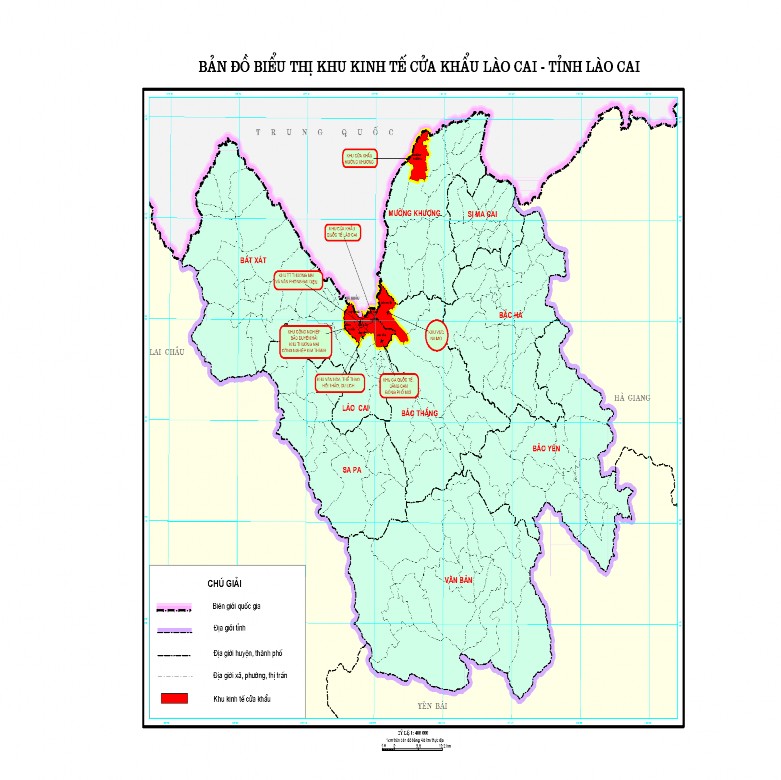
3.2.2.1 Development of economic and residential territorial space in the Border Gate Economic Zone
Source: Author's synthesis.
Lao Cai Border Gate Economic Zone is located on the Kunming - Lao Cai - Hanoi - Hai Phong economic corridor, part of the "Two corridors, one belt" project signed and implemented by the Prime Ministers of Vietnam and China. This economic zone was established and applied pilot preferential policies according to Decision No. 100/1998/QD-TTg dated May 26, 1998 of the Prime Minister and officially applied the economic zone policy according to Decision No. 53/2001/QD-TTg dated April 19, 2001. Since March 30, 2008, Lao Cai Economic Zone has operated according to the provisions of Decree No. 29/2008/ND-CP dated March 14, 2008 of the Government regulating industrial parks, export processing zones and economic zones.
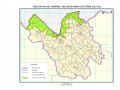
On May 26, 1998, according to Decision 100/1998/QD-TTg of the Prime Minister, Lao Cai Economic Zone includes Lao Cai, Coc Leu, Duyen Hai, Pho Moi wards; Van Hoa commune, Luc Cau village, Dong Tuyen commune, Lao Cai city; Muong Khuong commune, Muong Khuong district; Na Mo village, Ban Phien commune, Bao Thang district. On January 10, 2003, the Prime Minister issued Decision No. 09/2003/QD-TTg approving the expansion of Lao Cai Economic Zone to include Kim Tan and the entire Dong Tuyen commune, increasing the area of Lao Cai Economic Zone from 6,513.8 ha to 7,989 ha; achieving the goal of adjusting the planning and functional zoning to ensure suitability and close connection between zones. Lao Cai Economic Zone is located entirely within the urban area of Lao Cai province (basically the area of the old Lao Cai town), with many great advantages, a pair of international border gates with Yunnan province (China), with all types of transportation, located on the Lao Cai economic corridor.
- Hanoi - Hai Phong - Quang Ninh, is the transit point for goods and services between Vietnam and Yunnan province and the Southwest, China and ASEAN countries via the Kunming - Lao Cai - Hanoi expressway, an area where important foreign economic and cooperation activities regularly take place.
To build Lao Cai Economic Zone commensurate with its position and importance in terms of politics - foreign affairs, economy - society as well as security - defense in the northern border of the country, in order to create a reasonable economic restructuring towards industrialization, modernization, maximizing the exploitation of existing potentials, especially
especially for the trade, service and export processing industries. Create a developed urban and economic center, contributing to promoting the strength of the key economic zone of the Northern midland and mountainous region. Lao Cai province has determined that it is necessary to do a good job of planning the Economic Zone to be worthy of an international border gate. After 15 years since its establishment under Decision 100/1998/QD-TTg dated May 26, 1998 of the Prime Minister, the planning work has been basically completed with an area of 7,989 hectares, accounting for 1.25% of the province's total area, an estimated population of 101,290 (people), accounting for 15.9% of the province's population, with 1,761 enterprises, branches, and representative offices registered to operate in the fields of industrial production, handicrafts, trade, services - tourism... Currently, the following functional areas have been formed in the Economic Zone: (i) Lao Cai International Border Gate Area (50 hectares) with the function of serving import-export, trade, tourism, and service activities with 2 international border gates (road and railway); (ii) New Urban Area, Van Hoa with the function of serving the development of the International Railway Station and cargo yard, bus station, market, Dong Pho Moi Industrial Park (100 ha), Lao Cai ICD dry port; Lao Cai province is cooperating with Vietnam Railways, Hai Phong Port to expand Lao Cai International Railway Station and ICD dry port; (iii) Coc Leu Area with the function of being a commercial center and representative offices; (iv) Duyen Hai Area, Dong Tuyen including Kim Thanh Commercial - Industrial Park (156 ha phase I), Bac Duyen Hai Industrial Park (80 ha) with the function of developing industry, trade, services and goods transit; (v) Kim Tan Area with the function of being a cultural, sports, conference and tourism center of the Economic Zone; (vi) Muong Khuong border gate area : Implement the planning to adjust the district center in the direction of moving the infrastructure serving the border gate activities closer to the center of Muong Khuong town, linking the planning of the district center with the planning of the border gate area; ( vii) Na Mo area (Ban Phiet commune, Bao Thang district): is a temporary crossing (border opening) parallel to this area on the Chinese side is Son Yeu area, where the Chinese side has invested in a border market. In addition, connecting with Lao Cai Economic Zone is Ban Vuoc sub-border gate (Bat Xat district), with a planned area
over 40 hectares: although it is only a secondary border gate, the infrastructure has not been invested much, but the volume of imported and exported goods through here accounts for the largest proportion among the border gates of the Province (in 2011, it accounted for 71%; in 2012, it accounted for 56% of the total import and export turnover through the border gates of the Province); on the opposite side, China has planned to prepare for investment in expanding the Bac Son Development Zone (Ha Khau) [78].
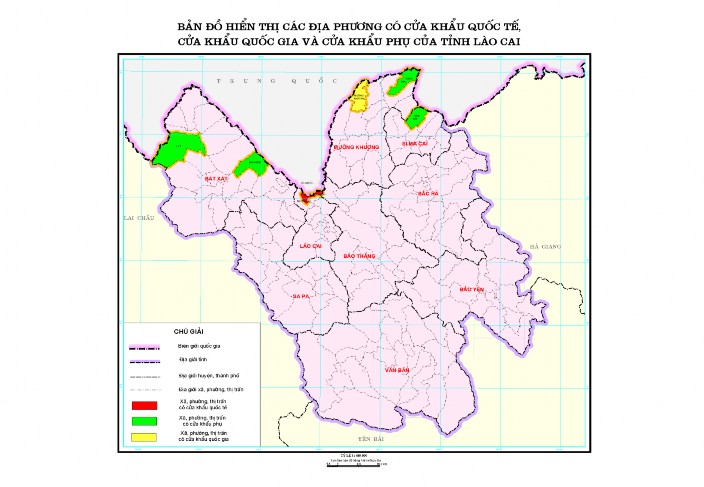
In addition to the KKTCK, there are 4 secondary border gates approved by the Lao Cai Provincial People's Committee in Decision No. 209/QD-UBND, dated January 23, 2009, including Hoa Chu Phung secondary border gate (in Nan San commune, Simacai district); Lo Co Chin secondary border gate (in Pha Long commune, Muong Khuong district); Ban Vuoc secondary border gate (in Ban Vuoc commune, Bat Xat district); Y Ty secondary border gate (in Y Ty commune, Bat Xat district). At the secondary border gates, border trade activities and border residents' exchanges are quite bustling, especially at Ban Vuoc secondary border gate.
Source: Author's synthesis.