
Appendix 19. Foreign currency swap of the State Bank for commercial banks
Term Value Calculated by
7 days
0.30% | Spot selling rate | |
15 days | 0.40% | Spot selling rate |
30 days | 0.50% | Spot selling rate |
60 days | 1.00% | Spot selling rate |
90 days | 1.50% | Spot selling rate |
Note : | The above ratio is according to | Decision No. 1033/QD-NHNN dated August 15, 2001 of |
Maybe you are interested!
-

 Orientations for Perfecting Housing Finance Policy in Hanoi Urban Area
 -
 Perfecting Housing Finance Policy to Integrate With Regional and World Economy
 -
 Policy on mobilizing financial resources for technological innovation for small and medium enterprises (case study of Hai Duong province) - 11
 -
 Current Status of Development of Loan Activities for Employment at the Social Policy Bank, Hanoi Branch
 -
 Domestic and International Context Affecting the Completion of Housing and Land Tax Policy
Governor of the State Bank applied from August 16, 2001 .
Source : Website: http://www.sbv.gov.vn/CdeCSTT-TD/hoandoingte.asp. (access date: February 28, 2007).
Appendix 20. Interbank market interest rates
VNIBOR term
Over night/Over night
4.37 | |
1 week | 5.19 |
2 weeks | 5.85 |
1 month | 6.24 |
2 months | 7.60 |
3 months | 8.30 |
6 months | 8.18 |
Source: http://www.sbv.gov.vn/CdeCSTT-TD/thitruongliennh.asp. (access date: April 28, 2007).
Appendix 21. Interest rates of the State Bank applied to commercial banks
Interest Rate Value Decision Document Effective Date
Basic interest rate 8.25%/year 632/QD-NHNN dated March 29, 2007 April 1, 2007
Refinancing interest rate 6.5%/year 1746/QD-NHNN dated December 1, 2005 December 1, 2005 Discount interest rate 4.5%/year 1746/QD-NHNN dated December 1, 2005 December 1, 2005
Source : Website: http://www.sbv.gov.vn/CdeCSTT-TD/laisuat.asp. (access date: April 28, 2007).
Appendix 22. Total social investment capital structure 2001-2005
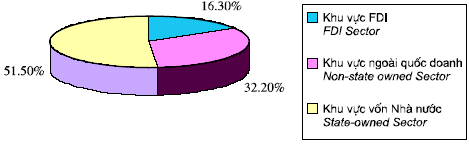
Source : Annual Report 2005 State Bank of Vietnam; p. 25.
Appendix 23. Interest rates on deposits and loans in 2005
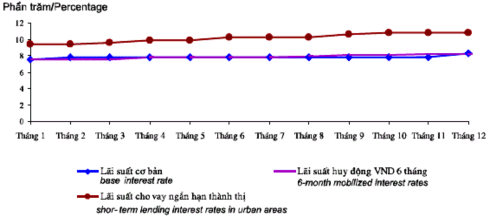
Source : Annual Report 2005 State Bank of Vietnam; p. 40.
Appendix 24. The US Housing Finance System
The current US housing finance system reflects fundamental shifts toward increasing capital through multi-level intermediaries (cutting the link between lenders and public savings).
The main characteristics of the US market are:
The rate of home ownership in general was stable at 64%-65% from 1960 to 1990, now up to 68%.
62% of all home owners purchased their homes through mortgages (average loan-to-equity ratio of 76%) and 38% owned them outright (2001).
82% of all original mortgages in 2001 were fixed rate (for the entire loan term) and the principal was amortized.
A small proportion of mortgages are made in other forms such as: variable rate, variable term, guaranteed payment and balloon (a mortgage with a shorter term with principal and interest paid in installments and the option to re-lend or repay at the end of the term).
63% of first mortgages made in 2001 had 30-year terms and 16% had 15-year terms, with only a small number having variable terms.
The Federal Housing Administration's monthly interest rate survey found that about 16.7% of borrowers requested interest rates of 5% or less. For special loans offered by Fannie Mae, they can be requested at rates as low as 3%.
Lenders typically require proof of repayment or additional credit if the loan is greater than 80% of the home's value and require personal home loan insurance when the loan-to-equity ratio is greater than 80%.
The mortgage loan insurance market is well developed in the United States. For mortgages made since 1999, the insurance on individual mortgages is automatically canceled if the loan-to-value ratio falls below 78%. Unemployed borrowers are not eligible for government incentives for mortgage payments.
In addition to deposits, U.S. lenders have a variety of other sources of funding through issuing bonds themselves with or without mortgage insurance or securitizing the loans themselves or using secondary institutions, which include:
good liquidity conditions - these institutions use loans as collateral for on-lending through both lien rights and transfer rights of collateral, and
Centralized mortgage lending and easy securitization terms- these institutions purchase long-term loans from lenders. The Federal Home Loan Bank (FHLB) was established in 1932,
The Bank's primary role is to foster favorable liquidity conditions in the United States. It is composed of 12 member organizations that provide convenient and timely ways for mortgage lenders to obtain relatively short-term liquidity by pledging valuable assets. Lenders must meet certain basic organizational standards.
Lending institutions pool qualified mortgage loans (housing loans with a loan-to-asset ratio below 80%) and transfer the pooled amount as collateral to the FHLB, and when it exceeds the mortgage base (principal balance greater than 80%) the lending institution assumes all credit risk.
FHLB loans to lenders are typically on a cash basis (fixed or floating rate) through the issuance of cash bonds through the FHLB's extensive network (loan terms range from one night to seven months).
The FHLB's goal is to create a low-cost vehicle for mortgage lenders to manage their assets/liabilities. In 2003, the FLHB lent $600 billion, or 10% of its total residential mortgage loan stock, mostly with medium-term maturities (3 months to 3 years) and variable interest rates.
Although FHLB bonds are not backed by the government (based on the mortgages of the members), they are still treated as fully backed by the government and are sold at only a 20-30 basis point premium over the government's debt balance. FHLB bonds do not receive special tax treatment, but they do receive other benefits of being federal debt (exempt from SEC insurance requirements and reserve requirements).
Most lending institutions can issue bonds directly, but the FHLB system offers bonds to investors with the incentive of third-party assessment and monitoring of the quality of collateral and the creation of tiering and parity of loan security coverage to significantly reduce the required risk and liquidity differences among bonds.
U.S.-based mortgage banks operate within a framework similar to traditional mortgage banks, holding their loans on balance sheets and lending them out mostly through the issuance of bonds. They typically do not hold deposits. These institutions frequently purchase loans and assume responsibility for the entire life of the mortgage loan through its term by securitizing the loans or issuing bonds with maturities sufficient to service the loans or with the expectation of issuing bonds on a rolling basis to service the loans. Securitization requires finding investors willing to accept uncertainty in a systematic fashion.
in repayment, with little expectation of repayment (when the reinvestment rate falls). Issuing bonds requires a mechanism to ensure that the spread between the interest rate on loans and the interest rate on future bonds is maintained.
Fannie Mae is the most famous American secondary organization in the world, its origin is a mortgage bank that focuses on buying fixed-rate loans from lending institutions and issuing fixed-rate bonds to make them. The risk when making them is that those loans can be paid at any time while the bonds have a fixed payment term, cannot be paid early.
In the late 70s and early 80s, interest rates rose dramatically, and the interest rates on Fannie Mae’s early-payment loans fell sharply. Meanwhile, the bonds matured and the loans they made became much more expensive. This bankrupted most of the companies, and Fannie Mae then adjusted its use of securitization to avoid the risk to investors. This move made their business boom because lenders themselves were having similar problems and were looking to transfer the risk elsewhere.
In the 1990s, Fannie Mae began to return to lending through bond issuance. Fannie Mae is a 100% privately owned but government-sponsored company. It has tried very hard to structure its insurance to protect itself against unexpected changes in interest rates. The loans that Fannie Mae (including Fannie Mae and Freddie Mac) makes to the American people have fixed interest rates for the duration of the typical 30-year loan term. This makes it difficult to actually make loans, so most of the risk is borne by Fannie Mae or Freddie.
Mae takes the hit. This is why the majority of Fannie Mae's variable-rate loans are purchased by the FHLB for temporary lending.
In 2002, Fannie and Freddie lent about $3.3 trillion in residential mortgages, and over 50% of all these loans were outstanding:
90% of these loans have fixed interest rates
55% of these loans are packaged and sold through securitization of mortgage loans and 45% are replaced by these entities (e.g., acting as a mortgage lender) as well as re-lent through bonds and limits under various conditions.
Appendix 25. Housing finance systems in Europe
In Europe, mortgage lending has grown steadily over the past few decades. However, mortgage markets have retained their distinctive national characteristics and their importance to the economy varies from country to country. The largest markets (in terms of outstanding loans) are Germany, the United Kingdom, France and the Netherlands. The fastest growing markets during this period were Portugal, Spain, Ireland and the Netherlands.
The impressive development of European mortgage markets since the late 1980s was the result of the deregulation of the financial sector and the very long period of low interest rates in individual markets (a result of the preparation for the introduction of the single currency). This environment created fierce competition in mortgage markets across Europe as well as greatly increased access to housing, thereby creating favorable conditions for meeting the high demand for housing loans.
Increased competition coupled with technological advances has prompted mortgage lenders to develop financial products
as well as new approaches to delivering these products to customers. Product innovation continues as customer needs become more complex. With the unification of the common currency, Euro mortgage products have crossed national borders and integrated into different markets.
The rapid growth of mortgage markets has outpaced GDP growth over the same period, thus increasing their share of the economy. There is considerable variation in the importance of major mortgage markets across Europe, with residential mortgages accounting for 50% or more of GDP in Denmark, the Netherlands, the UK and Germany, for example, compared to less than 10% in some other countries such as Italy, Greece and Austria.
The mortgage market is booming in most European countries, sustained by low interest rates, innovative lending products and fierce competition among mortgage lenders.
The fastest growing mortgage markets in the “old Euro 15” are Ireland, Greece and Spain. However, within the EU 25, the fastest growing mortgage markets are concentrated in the Central and Eastern European countries (CEECs). Moreover, growth rates in CEEC countries are often higher than 50% per year. The fastest growing mortgage market in the EU 25 is Lithuania, with an increase of 88%.
The main reason for the steady growth in CEEC countries is that the mortgage markets are still very young and just starting to develop. In addition, the solid growth of the macro economy as well as positive economic perceptions are factors that contribute to the development of these mortgage markets.