
adopt foreigners and about 3,000 children adopted domestically. In fact, the need to find foreign adoptive families for Vietnamese children is a real need, especially for children in list 2 (children with special needs). However, the implementation of the Law on Adoption has not reflected this situation correctly (the list of children needing to find alternative families nationwide as of February 2012, established according to the Law on Adoption, is only 170 children), so the entire international adoption system of Vietnam must continue to make efforts for the benefit of children with special needs. However, this not only requires patience over time but also requires active propaganda, mobilization, and training to create a change in awareness and action for the benefit of children in special circumstances.
The Hague Convention has only been in effect since February 1, 2012. With such a short implementation period, it is not possible to have any specific assessment. Initially, it will take 1-2 years to propagate and train to bring this Convention into real life. The connection between the Law on Adoption and the Hague Convention will gradually and firmly transition to a new period of multilateral cooperation on international adoption under the framework of the Hague Convention.
Currently, Vietnam is cooperating on international adoption with 7 countries under the Hague Convention, including: France, Italy, Switzerland, Spain, Denmark, Canada and Ireland. Of which, Ireland is the first country to sign a Memorandum of Understanding on administrative procedures applicable in handling adoption records with Vietnam since the Hague Convention came into effect in Vietnam from February 1, 2012.
As of 2012, there are 87 countries and territories (see Appendix 2.3) participating in the 1993 Hague Convention. Of which, the United States is the country with the most adoptions in the world. Providing data on Vietnamese children adopted by the United States will give us a more comprehensive view of the situation of foreign adoption in Vietnam and other countries. Refer to the data in the following table:
Chart 2.2: Number of Vietnamese children adopted by US citizens from 1999 to 2012 [4,8]
Maybe you are interested!
-
 Regulations on foreign adoption in Vietnam at present - 6
 -
 Registration of Adoption with Foreign Elements
 -
 International Convention on Adoption Involving Foreign Elements That Vietnam Has Signed and Participated In.
 -
 Comparison of personal income tax management laws in Vietnam and some countries in the world - 15
 -
 Overview of Voluntary Health Insurance Laws of Some Countries in the World and Suggestions for Vietnam

See also Appendix 2.4 and 2.5 on the living conditions of children adopted by foreigners and their growth and development.
CHAPTER 2: FOREIGN ELEMENTS ON ADOPTION OF CHILDREN IN SOME COUNTRIES IN THE WORLD, COMPARISON WITH VIETNAMESE LAW
Comparing the laws on foreign adoption in Vietnam and some countries in the world helps us to understand and approach how countries with the same foreign adoption relationship will have different regulations on this relationship. As well as the method of harmonizing domestic laws with international treaties on adoption of countries. This will help us to approach and understand international treaties in general and in the integration and development of countries in the region as well as in the world on foreign adoption.
2.1. Laws of some countries on adoption with foreign elements
The laws on adoption with foreign elements of some countries in the world are divided into two main groups:
- Group 1: Includes developing or underdeveloped countries or countries with special historical characteristics such as war, natural disasters, floods, civil wars... are usually countries that give children to foreigners for adoption (such as China, India, Vietnam, Guatemala...)
- Group 2: Includes developed countries with high economic and educational levels. These countries often have citizens who adopt foreign children (such as France, the US, Sweden, Canada, Australia, the UK, Japan, etc.)
For each of the above groups, the law on foreign adoption will regulate according to specific characteristics suitable for the relationships arising from foreign adoption. For countries that mainly let children be adopted by foreigners, the provisions of the law will specifically mention the regulations on children as well as foreign adoption. For countries whose citizens adopt children from other countries, the law will regulate more specifically for their citizens in adopting children from foreigners.
The content of adoption regulations in general and foreign adoption in particular in different countries is also very different. Some countries stipulate it in the Civil Code, some countries establish a separate law, and some countries only stipulate it as principles. However, the noble goal of adoption regulations is to protect children, create a truly meaningful alternative home for them, and help them develop both mentally and physically.
In this thesis, the author only mentions the laws on international adoption of countries that allow their children to be adopted by other countries such as China, India, Guatemala, and Nepal to compare with the laws of Vietnam in the field of international adoption. These countries share some historical factors and are all countries that mainly allow children to be adopted by foreigners.
2.1.1. Chinese law on adoption involving foreign elements
a. Social situation and foreign adoption in China
China is a multi-ethnic country with 56 officially recognized ethnic groups. China is the world's most populous country with a population of about 1.3 billion people, the majority of whom are Han Chinese, who make up 93% of the country's population and are the main ethnic group in half of China's land area. The Han Chinese are also a relatively heterogeneous ethnic group, and can be considered a combination of many different ethnic groups sharing common cultural and linguistic characteristics. The Kinh (Vietnamese) form a small group concentrated in the coastal region of Guangxi.
As a populous country, the government has a policy of limiting population growth, which requires families in urban areas (except for ethnic "minorities" such as Tibetans) to have only one child, while households in rural areas can have two children if the first child is a girl. Because in rural areas, having a son is considered more economically advantageous.
Coupled with the cultural and psychological factors of the traditional preference for sons in China, it seems that the rate of sex-selective abortion and infant abandonment is quite high in rural areas. This policy is especially applicable to the Han people. As a result, in 2000, the sex ratio of newborns in China was 177 boys for every 100 girls, much higher than the natural ratio (106 out of 100). The imbalance in the sex ratio makes it impossible for about 30-40 million Chinese men to marry Chinese women.
And there are more and more orphanages for abandoned children, and about 98% of these children are not adopted and live in these orphanages until they grow up. Faced with this situation,China has opened a program for international adoption.
but currently only meets a small proportion of these children.
As of 2012, China was the world's second largest economy in terms of nominal GDP. Its GDP per capita reached US$5,417, about one-ninth of the US's GDP per capita ($48,328) and four times higher than Vietnam's GDP per capita ($1,374). However, the gap in living standards between Chinese people is huge. Many rural, remote areas living in poverty have voluntarily left their children in the care of government childcare organizations" [9]
For the above reasons, the rate of Chinese children in need of international adoption is increasing.
b. Hague Convention 1993
China ratified the 1993 Hague Convention on the Protection of Children and Co-operation in Respect of Intercountry Adoption on September 16, 2005, which came into effect on January 1, 2006. This shows that China has completed its international adoption legal system quite early.
China's accession to the 1993 Hague Convention demonstrates its strong commitment to protecting children in the field of intercountry adoption. Its accession to the Convention has helped China to strengthen its adoption relations not only with countries that have signed the Adoption Cooperation Agreement with China, but also to open up relations with countries that have signed the 1993 Hague Convention.
China has made strong steps in international adoption relations with other countries, as shown by the adoption figures. Up to now, China has
China is the largest adoptive country in the world. And the United States is the largest recipient of Chinese children among all adoptive countries. Refer to the following table for data on children adopted by foreigners to see more clearly the situation of international adoption in China:
Figure 3.1: Number of Chinese children distributed by adoptive country from 2005-2009 [10,11]
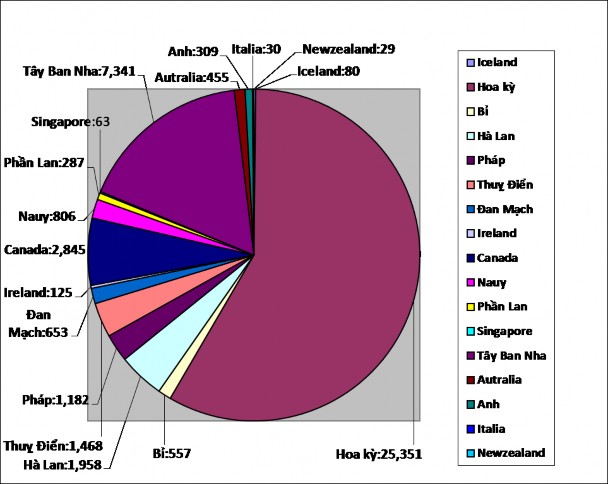
The above data clearly shows that the United States is the country that adopts the most Chinese children among the countries that have adoption relations with China. For more information, please refer to the following data on Chinese children adopted by the United States over the years:
Figure 3.2: Number of Chinese children adopted in the United States from 1991 to 2011 [11]

c. Domestic laws on adoption involving foreign elements
The Adoption Law of China was passed by the Standing Committee of the National People's Congress of China on December 29, 1991, effective from April 1, 1992, and amended on November 4, 1998, effective from April 1, 1999.
China's Adoption Law consists of two parts:
Part A: The Law on Domestic Adoption includes 6 chapters and 34 articles.
The content covers the following issues: Principles and purposes of adoption; Conditions for giving and receiving adoption; Procedures for adoption and adoption management agencies in China; Legal consequences of adoption; Prohibited acts related to children and in adoption relationships; Legal responsibilities for prohibited acts; Cases of implementation of this law by autonomous regions and the promulgation of measures to implement this law by the National Assembly.
In Part A, Article 21 of Chapter 2, it is stipulated that adoption involving foreign elements: “A foreigner may adopt a child (boy or girl) in the People's Republic of China in accordance with the provisions of this Law…”
This is the general law that forms the basis for China's foreign adoption. Based on this law, China has issued a detailed and specific legal document on foreign adoption in Part B.
Part B: Measures for registration of foreign adoption in the People's Republic of China includes 16 articles.
Decree No. 15 of the Ministry of the Interior of the People's Republic of China amending the measures for registration of foreign adoptions in the People's Republic of China, approved by the State Council on May 12, 1999, is hereby issued and implemented.
This Decree consists of 16 articles, regulating issues related to adoption involving foreign elements such as conditions for foreigners to adopt children, agencies handling and managing adoptions, procedures for registering adoptions as well as fees to be paid to adoption registration agencies.
Any conflicts arising between the laws of the countries where the adoptive parents live and those of China shall be resolved through negotiations by relevant departments and agencies of the two governments.
In order to implement its measures for international adoption, on October 9, 2005, the Central Adoption Authority of China (CCAA) issued the Regulations for Foreign Adoption Agencies Operating in the Field of Adoption in China. When carrying out adoption support activities in China, foreign adoption agencies must comply with the regulations and
the requirements in this document.
This document consists of 7 parts regulating the following issues:
- Procedures for adoption;
- Adoption documents;
- Procedure for submitting, processing and terminating applications;
- Adoption service fee;
- Admission of children with special needs
- Report on adoption;
It stipulates 8 points to note in the adoption relationship between foreigners, such as: no profit, no fraud, having a channel to exchange information with the Central Adoption Agency of China, no selection or designation of children for adoption.
Next, on December 2, 2008, the China Adoption Center sent a letter to organizations and adoptive parents with a message regarding adoption and the amount of support for adoption organizations and children in China. The general amount of support is 35,000 yuan equivalent to
$5,100 as of January 1, 2009. This support is committed to be used for the care of children in foster care facilities.
See also data on Chinese children adopted by foreigners from 2005-2009.
Chart 3.3: Number of Chinese children adopted by foreigners from 2005-2009 [10, 11]