
Unsold rooms will be lost forever. Because of this characteristic, hotels often tend to accept more advance reservations than the number of available hotel rooms, to prevent the case of guests canceling their reservations. But sometimes this causes inconvenience for both guests and owners.
- Non-transferability: Every other product, when purchased, will belong to the person who pays for it. But the service products in the hotel business do not have that nature. When the buyer pays, they only have the right to use it and cannot take it away.
1.2 Overview of Tourism Marketing
Maybe you are interested!
-
 Some solutions to develop international travel business of Vietnam tourism industry - 11
 -
 Travel and Tourism Businesses Need to Aim for Green Marketing Strategy
 -
 Marketing solutions to develop tourism in Ben Tre province by 2020 - 2
 -
 Marketing solutions for tourism development in Ninh Thuan province until 2020 - 17
 -
 Some marketing solutions to increase revenue of Level Hotel, a member of LV Hai Phong Investment and Tourism Joint Stock Company - 2
1.2.1 Definition of Marketing
The term Marketing has been internationalized, and has not been translated into local languages (previously in Vietnam it was often translated as “marketing”). Marketing is considered a developing and constantly improving science. Some previous scientists have given some definitions, generalizing this definition as follows.
According to Philip Kotler, considered the founder of modern Marketing, there is a definition: "Marketing is a social and managerial process by which individuals and groups obtain what they need (needs) and want (desires) through creating, offering and exchanging products of value with each other."
Peter Drucker said that “Marketing is a fundamental function and cannot be considered separately. All business activities are evaluated based on the final results, which means evaluating from the customer's perspective. The success of a business is not determined by the business but by the customer.”
Ray Corey stated, “Marketing includes all those activities by which a company adjusts to its environment creatively and profitably.”
The American Marketing Association (AMA) affirms that Marketing is "A social and managerial process by which individuals and organizations obtain what they need and want through creating and exchanging products of value with other people and organizations."
In general, Marketing can be understood as the process of working with the market to carry out exchanges, aiming to satisfy the needs and desires of the parties.
1.2.2 Definition of Tourism Marketing
The World Tourism Organization (UNWTO) defines: “Tourism marketing is a management philosophy that, through research, forecasting, and selection based on tourist needs, can bring tourism products to the market in a way that is suitable for the purpose of generating the most profit for the tourism organization.”
Robert Lanquar and Robert Holler argue that “Tourism marketing is a set of methods and techniques supported by a specific and methodical spirit aimed at satisfying the unspoken and stated needs of customers, which may be for leisure purposes or other purposes including family, business and meetings.”
Service Marketing can be summarized as a process of research and analysis (customer needs - tourism products - supply methods and support of the organization) to bring customers to the product to satisfy customer needs and satisfy profit goals.
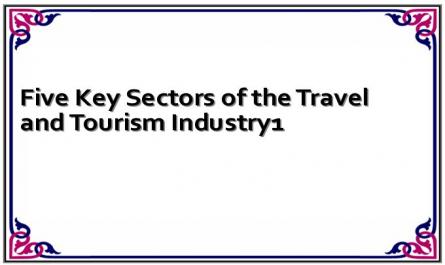
Areas of visit:
Big park
National Park Museum/Gallery
Wildlife Park Garden
Ancient ruins
Sports center
Shopping Center/Entertainment/Recreation
Festivals and events
Accommodation sector:
Hotel/Motel
Guest House/Bed and Breakfast Farm
Apartment/Villa/Village
Resort Village/Resort Center Conference and Exhibition Center
Mobile home, tent, camp
/Marina
Field of destination organizations:
National Tourism Office (NTO)
Destination Marketing Organization (DMO)
Regional/Departmental Tourism Office
Local tourism office
Tourism Industry Association
Transportation Sector: Air Ship/Ferry Train
Bus
Car/Motorbike for rent
Tourism organization field
Tour Operator Wholesaler/Broker
Retail Travel Agents Conference Organizers
Booking agent
Creative travel organizer
Figure 1.1: Five main sectors of the tourism and travel industry 1
In the hotel industry, marketing and sales are often seen as the same thing. The sales department is the most visible part of the hotel, selling tours, pleasing guests with delicious food and drinks, while most of the work related to marketing takes place behind closed doors. In the hotel industry, many people confuse marketing with advertising and promotion. In fact, advertising and promotion are parts of a larger marketing complex, which includes product, price, distribution, and many marketing tools that work together to satisfy customer needs.
1 (Source: Tourism Marketing - Dr. Ha Nam Khanh Giao, 2011)
1.2.3 The importance of tourism marketing
In the US, tourism marketing is divided into two types corresponding to the two main components of the tourism industry: hospitality and travel. In which, the hospitality industry is one of the main global industries. In the US, this industry is the second largest in terms of employees, providing jobs for about 12 million people in all 50 states, with total sales reaching more than 500 billion USD annually. Marketing is considered to play an increasingly important role in the restaurant sector of the hospitality industry. This sector is witnessing a shift from individual restaurants to restaurant chains, which operate in a fiercely competitive environment, requiring marketing skills to gain customers.
Hotels are following a similar trend. In response to increasing competitive pressures, hotel chains need to rely on the expertise of their marketing managers. The positions of food and beverage manager and room manager are no longer exclusive paths to the General Manager position. Some hotel chains have created a structure in which the marketing manager reports directly to the group CEO, thus making the marketing manager equal to the General Manager. Marketing has become a necessary business philosophy for all managers, while one marketing manager is a full-time marketer and the others are part-time marketers.
The success of hospitality marketing depends largely on the entire travel industry. For example, resort and hotel guests purchase travel-service packages offered by wholesalers through travel agencies. By agreeing to participate in packages arranged by wholesalers, hotels avoid competition. Similarly, hotels and car rental companies develop cooperative relationships with airlines to offer frequent flyer promotions. The success of the subway is the result of coordinated marketing among many members of the travel industry. Airlines, car rentals, and trains also cooperate with cruise lines in developing product/service packages, which requires cooperation in pricing, promotion, and implementation of the packages. The interdependence of hospitality and travel increases the complexity of the task. Therefore, the
The travel industry requires marketing professionals who have a holistic understanding and the ability to respond to changing customer needs by creating innovative strategies based on a solid marketing foundation.
1.3 Factors affecting the tourism marketing environment
1.3.1 Microenvironmental factors
For marketing activities to be successful, the marketing department must coordinate activities with other departments and consider the influence of factors in the micro-marketing environment.
The micro environment consists of factors that are closely related to the business and that affect the business's ability to serve its customers. All these forces form the micro marketing environment as shown in the diagram below:
Company
Supplier
Marketing Intermediaries
Client
Competitors
Figure 1.2: Key elements in the micro-environment 2
Public
Thus, the micro-environment of marketing activities is the sum of factors that directly affect marketing activities including: Suppliers, Companies, competitors, marketing intermediaries and customers.
1.3.1.1 Supplier
Suppliers are businesses and individuals that provide the resources needed by a company and its competitors to produce certain goods and services.
Any change from the supplier will affect the marketing activities of the business. To ensure stability in providing goods for business in terms of quality, quantity and time,
2 (Source: Tourism Marketing - Dr. Ha Nam Khanh Giao, 2011)
Most businesses establish partnerships with many of their suppliers.
For this reason, marketers must always have accurate information about the current and future status, quantity, quality, and prices of the resources for production and services. They must also pay attention to the attitude of suppliers toward their business and competitors. Scarce resources and rising prices can worsen the market opportunities for certain goods and services, or may force a business to stop production.
1.3.1.2 Company
The basic task of the Marketing system is to create products and services to provide to the target market. Whether that work is successful or not is influenced by many factors. First of all, Marketing decisions must comply with strategic tasks, specific goals, policies and development directions outlined by the business leadership. Therefore, the business leadership has a great influence on the operations and decisions of the Marketing department. In addition, the Marketing department must work synchronously and closely with other functional departments in the company such as: finance - accounting, materials, production, planning, research and development, design department, human resources department. Each department has specific operational goals, if the Marketing department's goals are not agreed by other departments, it cannot be successful.
1.3.1.3 Competitors
In the tourism industry, the Marketing perspective also considers competition on four levels:
- Desired competition: With the same amount of income, people can use it for different purposes, when used for one purpose, it will stop being used for another purpose. That spending structure will reflect consumer trends, thus creating opportunities to threaten the marketing activities of the business. Currently, in cities on weekends, people want to relax by going to the suburbs, places with beautiful and quiet spaces, so tourism businesses in the inner city need to have appropriate changes.
- Competition between different types of tourism products: To satisfy a desire that can be in the case of people traveling on weekends in the suburbs
by going on a tour or traveling alone with family... from there, tourism businesses will offer suitable products.
- Competition in the same product category: In the same promotional program for family weekend travel between businesses, there is also a thorough exploitation of customer psychology according to the age and position of each family member.
- Brand competition: This is a form of competition in which businesses must create a certain reputation for themselves in the market.
- In the four types of competition above, the level of intensity will gradually increase from 1 to four. When considering competition, businesses must consider all four levels to decide on marketing plans.
1.3.1.4 Marketing Intermediaries
These are service organizations, other businesses and individuals who help businesses organize the consumption of their products, goods and services to the final buyer.
Intermediaries and professional distribution businesses play a very important role in helping businesses find customers or doing sales for them. They are wholesalers, retailers, and representatives of customers.
Marketing service firms such as consulting firms, marketing research organizations, advertising agencies, radio stations, television stations, newspapers, magazines, etc. help companies focus on promoting their products to the right audience, in the right market, at the right time. Choosing and deciding which specific firm to cooperate with to purchase their services is something that businesses need to consider very carefully. Businesses need to regularly evaluate the performance of these intermediaries and eliminate ineffective intermediaries.
Intermediary financial credit organizations such as banks, finance companies, insurance companies, auditing companies perform financial transaction functions, financial support or guarantees to help businesses prevent risks in their business processes. Changes occurring in these organizations can affect the effectiveness of the business's marketing activities.
1.3.1.5 Customers
Customers are the objects of service of the business, the deciding factor for the success or failure of the business. Because customers create the market, the scale
Customer size creates market size. Customers will include needs. Needs themselves are not the same between customer groups and are constantly changing. Needs and changes in demand are influenced by many factors, in turn, needs and their changes affect all marketing decisions of the business.
To capture and track information about tourists, tourism businesses often focus on the following main types of customer markets (according to the spatial scope of tourism activities).
- Domestic tourist market: Includes individuals, households and customer groups that purchase tourism programs or conduct tourism activities within the territory of a country.
- International tourist market: Includes individuals, households and customer groups that purchase tourism programs or conduct tourism activities beyond the territorial scope of a country.
- Domestic tourist market: Includes individuals, households and customer groups that purchase tourism programs or conduct tourism activities within the territories of many countries in a certain geographical area.
The needs and factors affecting the needs of customers in the above markets are not the same. Therefore, the nature of the influence on the marketing activities of enterprises is also different, so they need to be studied separately depending on the level of participation in the markets of an enterprise.
1.3.1.6 Public
Any group or organization that has an actual or potential interest in or influence on the ability of an organization to achieve its objectives. Every company operates in a marketing environment surrounded or influenced by a series of public organizations. The direct public of an enterprise is formed from 5 types: financial companies, media agencies, government agencies, direct social mass organizations, the general public and officials and employees within the enterprise.
The publics that support or oppose a company's marketing decisions can either facilitate or hinder the company. They are divided into three categories:
- Positive public: Interested in the business with a good attitude
- Searching public: Businesses are looking for their attention