
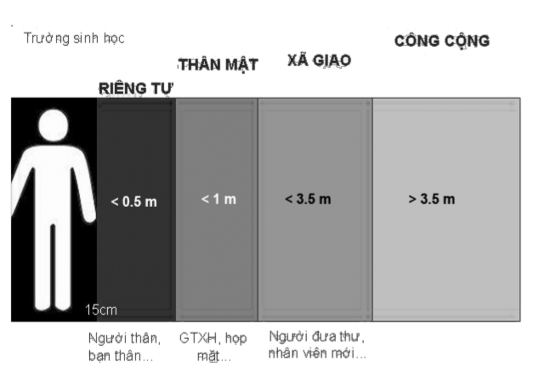
Position and style of tables and chairs in communication:
In the office environment - workplace or in the public environment, the seating position also shows certain meanings in communication. Therefore, the arrangement of the meeting table and the finding of seats also shows the knowledge and skills of the communicator. You can pay attention to the following basic requirements when determining the seating position:
+ Corner position is suitable for delicate, polite conversation between two people
Maybe you are interested!
-

 Accounting determines business performance at Thanh Son Company Limited and factors affecting the effectiveness of this accounting work - 21
 -
 Factors affecting the effectiveness of internal control system in social insurance collection at Binh Duong Provincial Social Insurance - 19
 -
 Epidemiological, molecular biological, clinical, paraclinical characteristics and factors affecting the effectiveness of treatment of chronic hepatitis B virus with antiviral drugs - 21
 -
 Internal control factors affecting the effectiveness of business operations at commercial banks in Vinh Long province - 4
 -
 Factors Affecting the Organization of School Counseling Skills Training for High School Teachers in Particularly Difficult Areas
+ The collaborative position shows two people sitting next to each other looking in the same direction or sitting opposite each other but the table acts as a place to put papers.

+ Competitive position with two people sitting opposite each other and the table acting as a
as the front line.
+ The independent position is an arrangement not for dialogue but represents the position of a person who does not want to be disturbed or does not want to talk. This position is often in the library or in a restaurant with strangers in a "common" environment.

Chapter 3: Basic communication skills
1. Self-assessment skills
1.1. Self-assessment
To understand self-evaluation, we need to understand evaluation. In the common understanding: evaluation is clearly recognizing the value of a person or thing.
There are many different concepts of self-assessment from different researchers. We propose the concept: self-assessment is an individual's assessment of the external aspects and abilities, and personality qualities of oneself.
1.2 Student self-assessment skills
a. Definition
Self-assessment skills are the ability to objectively assess one's own form and abilities, and personal qualities by correctly and relatively proficiently carrying out the operations of the self-assessment process.
Self-assessment skills include two aspects:
Firstly, the knowledge aspect: for students to be able to evaluate themselves, they need to have an understanding of self-assessment. The deeper and clearer the understanding, the faster and more accurate the self-assessment will be.
Second is the implementation aspect: students must know how to perform self-assessment steps completely, accurately and proficiently.
b. Self-assessment process
Defining a self-assessment process is a complex and relative task.
First, receiving information about oneself: this is the process of people listening and collecting information related to themselves. Information reception is done through two ways:
The path of self-observation and self-analysis to draw out information about oneself, individuals can self-observe to have information about their appearance such as: height, body shape, face, etc. Besides, individuals can also self-analyze psychological phenomena inside the body such as: sense of discipline, work spirit, learning ability, communication ability, etc. Through this path, sedx individuals have very complete and whole personal information, but it is subjective and emotional.
The way to receive information from the outside: is information from other people's comments and assessments about yourself. External information is often objective but sometimes not accurate and appropriate.
Second, information processing, after receiving information, the individual proceeds to process the information, this is the stage of encoding the message in the communication model, this activity
takes place in the brain and as a result the individual understands the meaning of other people's comments and assessments of him or her.
In the process of information processing, individuals must apply their own knowledge and experience, and the processing results depend on the subjectivity of each individual.
Third, determining self-worth, this is the process of an individual pointing out, naming and affirming their own value, based on other people's comments and assessments of themselves, the individual sees whether that information is objective or not, and whether they are consistent with other people's comments.
Fourth, compare your abilities, capacities, personality qualities and external aspects with the established value system.
Each person has a different system of values in life. The system of values is the foundation and the deciding factor.
2. Effective listening skills
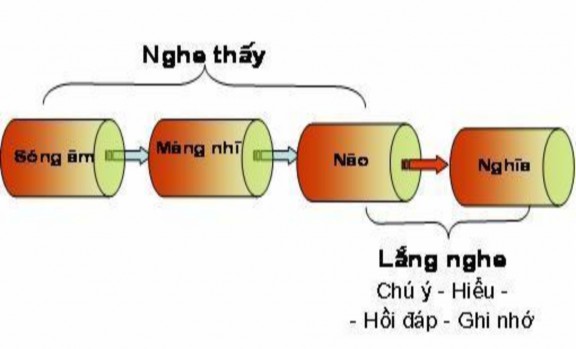
2.1. Concept of hearing and listening
Listening is the process of receiving information through the sense of hearing.
Listening is the process of receiving information through hearing accompanied by a state of attention. Listening helps people understand the content of the information as well as the emotional and sentimental states of the speaker.
Listening skills are the ability to understand the content of speech, recognize the mood, emotions and needs of the speaker.
a. Requirements for the speaker
Satisfy the needs of the speaker. When speaking, everyone has the need to be cared for and listened to by others, so when you listen, you have satisfied the needs of the speaker. This will also create good impressions in the speaker's mind.
Encourage the speaker to express his or her views and ideas. When listened to, the speaker will feel respected and can comfortably share his or her thoughts, views and ideas.
b. Requirements for listeners
Collect more information. When listening, we will receive more information from the speaker to have more basis and foundation when deciding on a problem. Moreover, according to common psychology, people only want to talk to those who know how to listen, so when being listened to, people will share more.
Create an atmosphere of listening in communication and create good relationships. When others are speaking, we listen, then it is our turn to speak, and they also listen.
will listen attentively. By doing this, both sides will understand each other more and create satisfaction for each other.
2.2 Benefits of listening
There is a saying that "Speaking is silver, silence is gold, listening is diamond" or "Three years old is enough to learn to speak but a lifetime is not enough to learn to listen" showing that listening plays a very important role.
According to Paul Tory Rankin (1930), in verbal communication, people spend 42.1% of their total time listening, 31.9% speaking, 15% reading and 11% writing. Thus, in verbal communication, listening takes up nearly half of the time. This shows that listening skills are extremely important and listening will bring many benefits to both the speaker and the listener.
2.3 Listening levels
Ignoring means not paying attention, not paying attention, ignoring everything the speaker says. This level of listening is characterized by talking about oneself or doing other things while the speaker is speaking.
Pretend listening is pretending to listen attentively but actually thinking about something else or not paying attention and not understanding the speaker's information. Nodding, listening attentively but not understanding the content and sometimes having behaviors and gestures that are contrary to the content the speaker wants to convey are manifestations of pretend listening.
Selective listening, partial listening is when the listener only listens to part of the information and listens to what he is interested in and likes. This level of listening is manifested by occasional talking or doing personal work.
Listening attentively is focusing on what the speaker is saying and trying to understand them. In this type of listening, the listener focuses on the person talking to them, not on their own work.
but there are no gestures to show that they understand the information the speaker is giving and encourage them to speak.
Empathic listening is a type of listening in which the listener not only listens attentively but also puts himself in the position of the speaker to be able to understand them thoroughly. When listening empathically, we not only understand the messages that the speaker wants to convey but also understand their thoughts, feelings, and needs. At this time, listening is not only with the heart but with both the heart and the mind. Attention, open-ended questions, responsive behaviors and encouragement to the speaker... are manifestations of this form of listening.
2.4 Factors affecting listening effectiveness
According to D. Torrington, 75% of oral communications are ignored, misunderstood or quickly forgotten, and the ability to grasp the deep thoughts in the words of others is even rarer. This proves that to listen effectively is not simply: if you want to listen, stop talking, but there are many other factors that affect the effectiveness of listening.
a. Speed of thinking
Normally, the speaking speed of an adult is 125 words/minute while the human thinking speed is 4 times faster, so we spend more time thinking than listening, which means we are often distracted. Therefore, when talking about something, we should speak briefly and should not speak too slowly, which will easily distract the listener.
b. Interests
People often only listen to what they like. When they encounter problems that are not suitable for them, they often do not want to hear and do not listen.
c. Complexity of the problem
When hearing a complex problem, beyond understanding or little related, then
People tend to ignore it and stop listening.
d. Impatience
Listening requires patience because the speaker does not always say what we want to hear. Therefore, in reality, it often happens that both people compete to speak or speak together. When listening to others, we often have opinions in response and want to express those thoughts immediately. If we do not know how to restrain ourselves and patiently listen to others, listening cannot be effective.
e. Lack of listening skills
Like any other skill, listening well requires practice, and effective practice requires specific exercises. However, teaching students how to listen has not received much attention.
g. Lack of observation while listening
To listen effectively, not only hearing but also other senses, especially vision, are needed to fully grasp the message that the speaker wants to convey through language and non-verbal elements.
“Why are you so stupid? Don't look me in the eye.”
are two very good verses that talk about the importance of eye contact when listening. However, we often rarely use or do not know how to use our eyes during communication.
h. Negative stereotypes and prejudices
When we have prejudices or biases towards the person we are talking to or the issue they are talking about, it will negatively affect our attitude and listening effectiveness.
i. Bad listening habits
While listening, we often fall into bad habits such as: cutting