
Efforts with the Governor General's Office were also ineffective. Meanwhile, Nguyen Hao Vinh returned to Saigon from Japan.
Nguyen Hao Vinh was brought by his father to appear before Governor Klobukowski.
Below is the passage where the governor interrogated Nguyen Hao Vinh: "Why did you go to Japan and whose money did it use?"
Nguyen Hao Vinh was very calm:
Maybe you are interested!
-
 Movement "Learning from the Coast, Emulating the Coast" in Industry.
 -
 Rubber Workers' Struggle Movement to Protect and Promote the Achievements of the Dong Khoi Uprising
 -
 Theory of Movement Games of 5-6 Year Old Preschool Children in Physical Education Activities
 -
 3D Movement of Split Stone Technique
 -
 Research on solutions to develop mass sports movement in Vientiane capital of Lao People's Democratic Republic - 9
- I went to Japan with money from Minh Tan company to learn how to make lighters so that I can later come back and take care of the company's lighter factory.
Mr. Nguyen Hao Vinh also carefully handed over to the Governor General the blueprint of the lighter factory that he had asked an artist in Japan to draw. The Governor General immediately asked Nguyen Hao Vinh's father: did you buy shares of Minh Tan Technology?
- That's right.
- How much?
- A lot, so I have the conditions to send my child to school to control a branch in the company. The governor tried to put Nguyen Hao Vinh's father into a revolutionary organization. Meanwhile, he quickly asked the governor to take back his shares.
The Governor General immediately invited Mr. Gilbert Chieu to convene a meeting of the Minh Tan Company's board of directors and hand over control of the lighter factory in My Tho to Nguyen Hao Vinh. Gilbert Chieu immediately carried it out.
The colonial governor took advantage of that to win over Nguyen Hao Vinh by allowing him to speak directly to him. Nguyen Hao Vinh pretended to be happy, but after a while, he announced that the factory was losing money and asked the court to auction it off to get the money to give back to Minh Tan.
In the South, the French were pursuing those who were active in the Duy Tan movement. In 1908, Mr. Nguyen Than Hien had to leave Can Tho and cross the sea by boat to Cambodia, then to Hong Kong, Shanghai, and Hangzhou. Following the French request, the Japanese government expelled Mr. Cuong De on November 30, 1909. In 1913, Mr.
Nguyen met with Cuong De. He explained to him that most of the southern people were eager to contribute to the cause of national salvation and had a warm affection for him. Therefore, Mr. Nguyen asked him to return to the country and he agreed. He returned to Saigon in February 1913. After only a few days, the rumor that Cuong De had secretly returned to Saigon quickly spread to the French authorities, who immediately offered a reward to try to capture him. Despite being in a very dangerous situation, he calmly traveled throughout the six provinces to visit the bases of the movement. Due to a letter calling for emigration from Mr. Nguyen Than Hien and after meeting with Mr. Cuong De, a group of 10 adults and 2 teenagers led by Mr. Nguyen Quang Dieu went to Hong Kong. The group met at Huynh Hung's house. During the meeting, Cuong De was invited by some young people there to see the bombs they had made, but he accidentally detonated a bomb, fortunately no one was injured. The explosion exposed the meeting, and the British police arrived. Seeing that something was wrong, Mr. Truong Duy Toan quickly took Cuong De to escape through the front door. After that, Mr. Nguyen Than Hien's group was arrested one by one and brought to court. When appearing in court in Hong Kong, Huynh Hung confessed that he had bought the bombs and the others did not know. Huynh Hung was fined 200 silver and sentenced to nine months in prison, the others were released, waiting for the day to be deported back to the country. At that time, Cuong De had just returned to Hong Kong and saw the news of the court's acquittal. Thinking it was real, he hurriedly went to meet his comrades and was also arrested. Mr. Nguyen Hao Vinh and Lam Can hired lawyers to ask for his release. Released after 8 days in prison, his comrades took him out of Hong Kong. He decided to go to Europe, bringing along Truong Duy Toan, who was good at French, and Do Van Y, who was good at German. In 1916, Nguyen Hao Vinh was arrested in Hong Kong and handed over to the colonial government in Cochinchina. He was sentenced to death by the French colonial court in Saigon, but was later pardoned by the French President. In 1928 he was arrested and brought to court for spreading printed matter and talking nonsense.
He was the founder of two newspapers, Hoan Cau Tan Van and Nam Ky Kinh Te Bao, using the pen name Hot Tat Liet. With this pen name, he opened a war of words with Le Hoang Muu, editor of Luc Tinh Tan Van, when he wrote the novel Ha Huong Phong Nguyet under the pen name Mong Hue Lau. Readers responded and supported Hot Tat Liet, causing a strong public opinion demanding the burning of Ha Huong Phong Nguyet. The colonialists were forced to follow public opinion.
Nguyen Hao Vinh established the Xua Nay printing house at 62-64 boulevard Bonard, later renamed Le Loi boulevard until now. During this time, he contributed to the revival of the publishing industry in the South. After a period of activity, he returned to a peaceful life at the house of worship named Truoc Tiet Tang Tho in Thu Thiem, Thu Duc, Ho Chi Minh City. He passed away on June 19, 1941, and was remembered and buried according to the rituals of the Cao Dai Chieu Minh Tam Thanh religion.
Mr. Truong Duy Toan (in ao dai) and Mr. Nguyen Hao Vinh in 1915 [Source:
Xua & Nay magazine, issue 246, month
October 2006,
p.19]
CHINESE AND INDIANS IN SOUTH VIETNAM IN THE EARLY 20TH CENTURY.
Nong Co Min Dam Newspaper
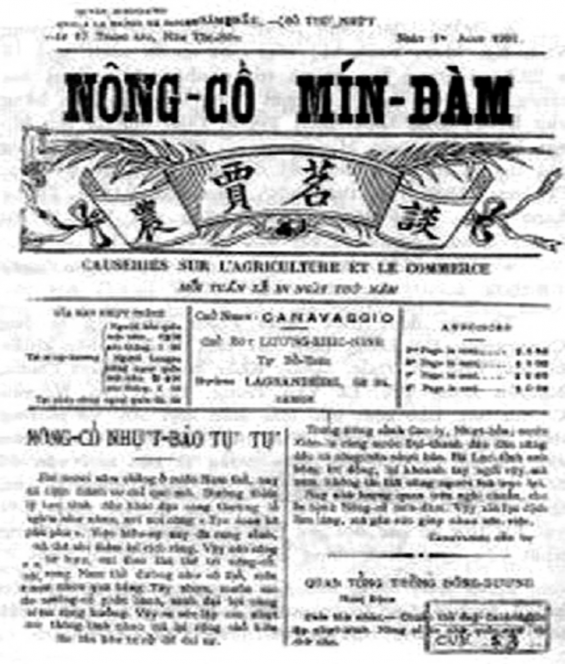
(Source: tbn1.google.com)
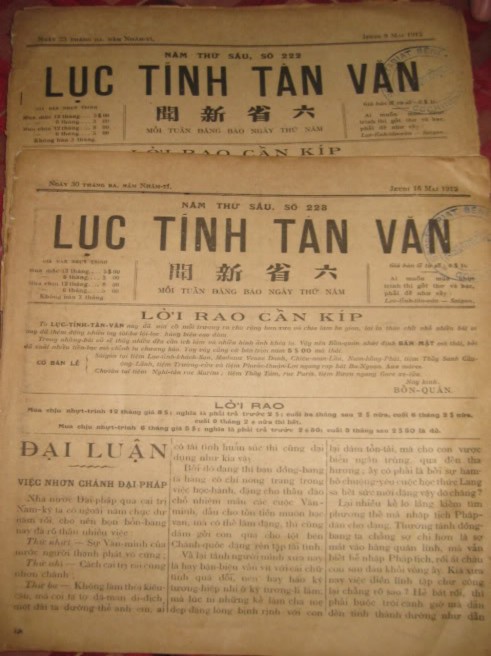
(Source: photobucket.com)
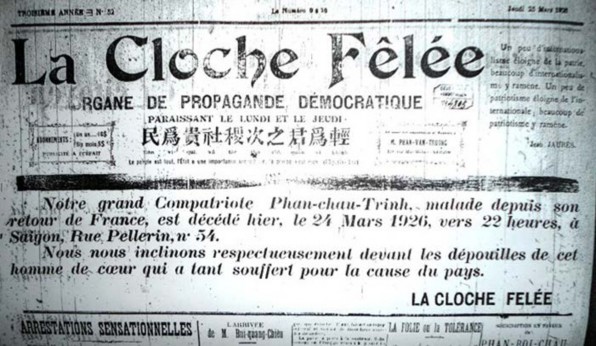
(Source: www.viet.rfi.fr )
Indian money changer
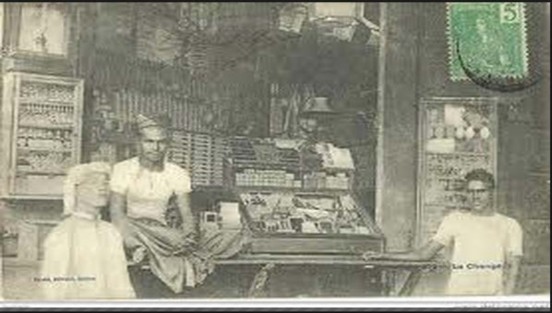
(Source: diendan.org.vn
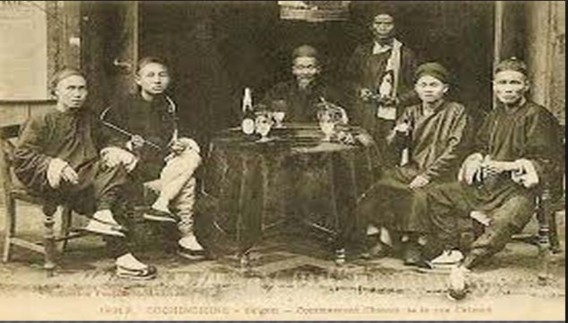
(source: diendan.org.vn)
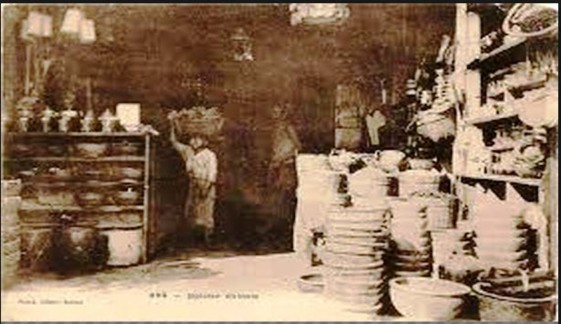
Chinese grocery store
( Source: diendan.org.vn )
Minh Tan novel by Tran Chanh Chieu [58, pp.79-82].
“The saint taught about changing the people when he was still alive: The path of great learning lies in enlightening virtue and renewing the people…”
However, since the day King Si Vuong came to convert the people into the Nam Viet people, the Confucian scholars often hid and spoke of corrupt things, without any intention of reforming the people.
When I had some free time, I went to China to learn about the situation of the Duy Tan period. I traveled all over the roads of Hong Kong, Yangcheng, Hunan, Hubei, Foshan, and Sanshui, and saw people everywhere racing to find ways to develop their trade.
Some people sat in the big streets weaving silk, making glasses, combs, ties, earrings, while others made shoes, boots, hats, glasses, lamps, chests, barrels, and all kinds of utensils to send to South Vietnam to sell to the people they bought.
Some people were concerned with the work of creating new newspapers, opening stone houses, and drawing all kinds of pictures for the people to understand easily. Some literary people were concerned with translating foreign books into Chinese characters, so that the Qing people could understand them.
In contemporary China there are three precious things:
Primary school, old age education
Many open up technology, the country has no immigrants, the people take advantage of their own interests, many open up naval and land military schools...
On every road there was a school, with two words: Poetry Institute. The helpless took the journals and books and distributed them at the docks, trains, and hotels to sell to passersby.
The old men received pills, powders, liquids, and oils, stood at the crossroads of the roads and proclaimed them, and were busy with their work.