
2.2.3. Respiratory system
Earthworms do not have lungs, they breathe through their skin. Oxygen in the environment is dissolved into the mucus on the surface of the worm's body, then penetrates the tiny branching blood vessel system inside and is transported to the organs, CO2 is also released through a similar process. Earthworms have the ability to absorb oxygen and release CO2 in the water environment, this helps them to be able to live in water from 10 to 30 days, even for many months.
2.2.4. Excretory system
The excretory system of earthworms consists of a pair of kidneys at each segment, these organs ensure the excretion of nitrogenous waste products in the form of ammonia and urea.
Maybe you are interested!
-

 Investor Directly Manages Project Implementation
 -
 Supporting Farmers to Participate More Directly in the Agricultural Product Consumption System
 -
 Mono- and Poly-Infection of Worms in Children 12-23 Months
 -
 Comparison Between Confiscation of Objects and Money Directly Related to Crimes in Vietnam and Confiscation of Property in France
 -
 Assessment of the Current Status of Water Sources Directly Affecting the Thuong River Flowing Through Bac Giang Province.
2.2.5. Nervous system
Consisting of cerebral ganglia, abdominal nerve chain and nerves along with sensory organs and reflex arcs, the nervous system contains a number of cells that secrete hormones that greatly affect reproduction.
Earthworms have no eyes but are very sensitive to light thanks to photoreceptor cells scattered under their skin.
2.2.6. Reproductive system
Earthworms are hermaphrodites, each worm has both male reproductive organs (testicles, seminal vesicles, vas deferens and prostate) and female reproductive organs (ovaries, oviducts and seminal vesicles). These reproductive organs are located at the 18th to 22nd segment of the worm, towards the head, this is called the genital girdle. At the 6th to 8th segment there are two holes, this is where the seminal vesicles are located.
3. Physiological characteristics of earthworms
Earthworms are very sensitive, they react strongly to light, temperature, salinity and drought conditions.
3.1. Temperature
Earthworms can live in temperatures ranging from 20-30 0 C. However, the most suitable temperature for their growth and development is from 25-28 0 C. At temperatures that are too low, they will stop working and may die.
Inappropriate temperature will affect the activity, metabolism, growth, respiration and reproduction of worms. According to Lofs - Holmin (1995).
3.2. Humidity
Humidity is a very important factor for the development of earthworms. The most suitable humidity for earthworms is around 60-70% (Ewards, CA (1983)). Earthworms love to live in humid environments. In nature, earthworms love to live in humid places, near sewers or places with a lot of easily decomposed and rotten organic matter such as in animal manure piles, rotting garbage piles.
3.3. Light
Worms are very afraid of sunlight. The ultraviolet rays of sunlight are very harmful to worms and can kill them (Figure 1.1.14). Worms avoid sunlight, strong light, blue light and ultraviolet rays but are not afraid of infrared light (Edwards, CA (2000)).
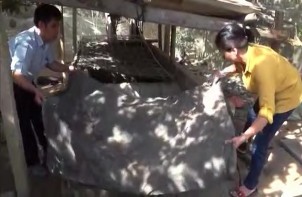
Figure 1.1.14. Do not let sunlight shine directly on the worms.
Figure 1.1.15. Shielding the worms from light
Therefore, it is necessary to cover the cage carefully during the day to avoid direct sunlight on the surface of the worm bed (Figure 1.1.15).
3.4. Air
The air affects the growth and reproduction of earthworms mainly by the content of O 2 and CO 2 . Earthworms can tolerate CO 2 concentrations of about 0.01-11.5%. In addition to O 2 and CO 2 , it is also necessary to pay attention to harmful gases such as: Cl 2 , NH 3 , H 2 S, SO 2 , SO 3 , CH 4 . Willis (1995) and Edwards (1998) said that earthworms cannot live well in organic waste containing a lot of NH 3 .
3.5. pH
pH: is a factor that greatly affects the growth and development of earthworms. Earthworms prefer stable pH conditions, most suitable in the pH range of 6.8-7.5, but they can tolerate a wide pH range from 4-9, if the pH is too low, they will leave.
Therefore, worm food needs to be checked and processed to achieve the appropriate pH. Litmus can be used to measure the pH in worm food.
4. Growth and reproduction
4.1. Growth
Earthworms grow by increasing the number of body segments or increasing the cross-sectional area of body segments. During the growth process, the weight and volume of the earthworms increase.
up. When the genital band appears, the worm is sexually mature, when the genital band degenerates, the worm is old. Worms have the ability to regenerate damaged or severed parts, and can regenerate both the front and back of the body.
4.2. Reproduction
Earthworms reproduce very quickly in relatively stable tropical climates with high humidity like those in the South. According to many documents, from an initial pair in suitable living conditions, 1,000-1,500 individuals can be produced in a year.
When mating, they close all other stimulating organs, so they do not react to light and contact. A large amount of mucus is secreted by both, thanks to which the worms exchange sperm with each other. After about 1 hour of mating, the two individuals separate from each other.
To reproduce, worms must cross-fertilize each other, with the head of one touching the tail of the other (Figure 1.1.16). The sperm of one will enter the spermatocyte sac of the other and the sperm will temporarily stay there to prepare for the next fertilization.
At this time, the genital girdle thickens, receives a few eggs, then moves to the top of the worm's head and receives sperm in the sperm sac, then escapes (falls to the ground) and tightens both ends to form a worm cocoon, each cocoon contains 5-20 eggs.
The number of cocoons produced depends on the species of worm and the age of maturity of the worm. Worm cocoons are elongated, round at one end and slightly pointed at the other, looking like cotton seeds, about 1-2 mm in size, initially opaque white, then turning light brown and then dark brown when the cocoons are about to hatch (Figure 1.1.17).
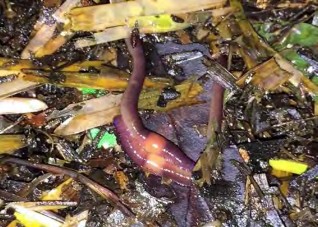
Figure 1.1.16. Worms mating
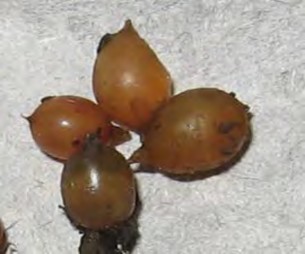
Figure 1.1.17. Worm cocoon
The hatching time of each cocoon is completely different, this time depends on environmental conditions, temperature, humidity, under suitable conditions, after 2-3 weeks the cocoon will hatch and the baby worms will crawl out (Figure 1.1.18).
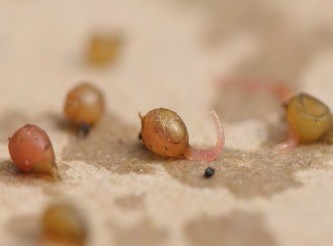
Figure 1.1.18. Baby worms emerge from cocoons.
When newly hatched, the baby worms are as small as a pinhead, white, about 2-3 mm long, after 5-7 days their bodies will gradually turn red and a dark red stripe will begin to appear on their backs. About 15-30 days later, they mature and begin to develop a genital girdle (according to Arellano, 1997); from this point on they begin to be able to mate and reproduce.
Normally, if well cared for in suitable conditions, worms can lay cocoons continuously once a week, so the number of worms increases greatly after a period of raising.
B. Questions and practice exercises
Questions: Circle the correct answer to the following questions:
Question 1: What color are adult earthworms?
a. White
b. Light pink
c. Red or plum color
d. Black
Question 2: What color are newly hatched earthworms?
a. White
b. Light pink
c. Red or plum color
d. Black
Question 3: When is the worm's reproductive belt most evident?
a. 15 days old
b. 30 days old
c. 90 days
d. All are correct
Question 4: What does a worm cocoon look like?
a. Elongated shape, one end is round, one end is slightly pointed
b. Elongated shape, slightly pointed ends
Question 5: How does the color change of the worm cocoon occur?
a. White light brown dark brown
b. White, pink, red Question 6: How do worms respire?
a. Lungs
b. Skin
Question 7: Are earthworms hermaphrodites or unisexual animals?
a. Bisexual
b. Monosex
Question 8: What is the most suitable temperature for the reproduction and growth of earthworms?
a. Below 25 0 C b. 25 – 28 0 C
c. Above 30 0 C
Question 9: What is the most suitable humidity for the reproduction and growth of earthworms?
a. 40 – 50 %
b. 50 – 60 %
c. 60 – 70 %
d. 70 – 80 %
Question 10: What is the most suitable pH for the reproduction and growth of earthworms?
a. 4.5 – 5.5
b. 5.6 – 6.5
c. 6.8 – 7.5
d. 7.8 – 8.0
C. Remember
- Worms grow and develop well in conditions of temperature from 25-28 0 C; humidity from 60-70%, pH from 6.8-7.5 and must be covered to prevent light from entering but must ensure that the worms have enough air to breathe;
- Worms reproduce by cross-fertilization and if well cared for in suitable conditions, worms can lay cocoons continuously once a week.
Lesson 2. Survey of worm farming conditions Lesson code: MD 01-02
Introduction
People preparing to raise earthworms need to grasp information about the situation of raising and consuming earthworms, as well as the necessary conditions for raising earthworms and based on that basis, create a plan to raise earthworms suitable to the current conditions of the family in order to bring the highest profit.
Target
- Understand the need for raising and consuming worms as a basis for making a plan for raising worms;
- Survey food sources, water sources and worm farming locations;
- Complete the plan for raising worms;
- Comply with the correct procedures to ensure environmental hygiene.
A. Content
1. Determine the situation of raising and consuming worms
Good harvest, low price is a common story in agricultural production in Vietnam. Although earthworms and earthworm castings are very valuable in livestock and crop farming, to produce goods, it is necessary to determine the input and output of the product.
Therefore, earthworm farmers need to determine the situation of earthworm farming and consumption in the locality and neighboring areas, to decide which form of earthworm farming to use, on what scale, whether the earthworm products will be used for livestock or crops at home or sold to local households, or sign contracts with earthworm companies... Therefore, before raising earthworms, farmers need to make a plan so that earthworm farming achieves the highest efficiency.
1.1. Importance
- Grasp information about the actual situation of raising and consuming earthworms;
- As a basis for orienting worm farming;
- Avoid the situation of supply exceeding demand and vice versa;
- When you can grow products, selling them is the most profitable.
1.2. Types of information to be identified
1.2.1. Information on worm farming situation
Those who intend to raise earthworms can discuss with agricultural officers of communes, districts, regions, etc. to know the actual worm-raising area in the locality, the specific address of each worm-raising household in the commune, and the address of the worm-buying place. At the same time, farmers also learn about worm-raising techniques and seek help from agricultural officers.
In addition, those who intend to raise worms can meet directly with those who are raising them to exchange information about actual worm raising and learn from their experiences.
1.2.2. Information on earthworm consumption
Worm farmers should negotiate directly with worm product consumers about quantity/month and price, and can sign a contract to purchase the product.
At the same time, it is necessary to regularly monitor market information on mass media to avoid oversupply, which means producing a lot of worm products but not being able to sell them.
1.3. How to collect information
1.3.1. Prepare to collect information
a. Prepare the questionnaire
When collecting information, two sources of information are needed for reference: the first source of information is from: agricultural officers and those who directly raise them, the second source of information is from local consumers of earthworms. The questions asked and arranged in a table must be appropriate to the subjects mentioned above. The questions can be made into two tables or these two types of questions can be arranged into one table. When making a questionnaire, depending on the reality, ask questions that are appropriate to the conditions of the people who need information into one questionnaire.
b. Prepare a notebook and pen for taking notes: The notebook can be a notebook or a student book and a pencil or pen for taking notes.
1.3.2. Determine where and how many points to collect information
- Information is collected from the following 3 subjects: commune agricultural officers, direct farmers and product consumption establishments. The number of information collection points depends on the actual situation, the more information collected the better.
1.3.3. Approach the subject to collect information
When asking to collect information, the questioner needs to be gentle, tactful, and talk about the situation of raising and consuming earthworms so that the other person can answer the questions correctly and completely (Figure 1.2.1).