
Test results show:
Regarding the convenience of the coating process, most of the formulas are easily coated according to the parameters stated in section 2.2.2. The resulting coated pellets are evenly colored and less likely to stick together.
From the graph we can see that with the same film thickness of 20%, the ability to control drug release of the formulations is divided into 2 types:
Type 1 includes film-coated formulations: CT9, CT10: The drug is released quickly and almost completely within the first 2 hours.
Type 2: CT11, this formula has the ability to control drug release better than the formulas in type 1 and shows more suitability in the preparation of colonic release coatings: better delay in release in the first hours (T lag reaches 4 - 5 hours) and signs of rapid release in the following hours. Therefore, Eudragit S100 was chosen as a controlled release excipient combined with zein to conduct further studies.
Research on plasticizers in formulation
For the film coating method, the choice of plasticizer is one of the important factors because the plasticizer is the ingredient that increases flexibility, reduces cracking, improves the adhesion of the film to the core and improves the permeability of the film, thereby affecting the ability to control the drug release of the coating film. Therefore, to choose the appropriate plasticizer, it is necessary to conduct a survey of the effect of the plasticizer on the ability to control the drug release of the coated pellet.
Carry out pellet coating of CT3 core using the following plasticizers:
Table 3.26. Coating solution formula for 50g batch of mesalamine pellets
STT
Ingredient | CT11 | CT12 | CT13 | |
1 | Zein | 8 | 8 | 8 |
2 | Eudragit S100 | 4 | 4 | 4 |
3 | DBP | 2.4 | - | - |
4 | Glycerin | - | 2.4 | - |
Maybe you are interested!
-
 Test Results of Optimal Mode Effect on Mechanical Properties
 -
 Frequency Distribution of Test Results No. 2
 -
 Statistical Table of Test Results of Classes 10A1 and 10A6
 -
 Correlation Coefficient Results and Significance Level of Correlation Coefficient Test for Joint Stock Commercial Bank Group
 -
 Anticancer Cell Activity Test Results
5
TEC | - | - | 2.4 | |
6 | Talc | 2.4 | 2.4 | 2.4 |
7 | Tween 80 | 0.8 | 0.8 | 0.8 |
8 | Ethanol 80 (ml) v.v. | 200 | 200 | 200 |
40
35
30
25
20
15
10
5
0
CT11
CT12
CT13
0
5
TIME (HOURS)
10
% MESALAMIN RELEASED
Conduct the dissolution test under condition 1 (first 2 hours in 0.1 N HCl environment pH 1.2 and the following hours in phosphate buffer environment pH 6.8) in section 2.2.4.4, obtain the results as shown in the graph below
Figure 3.11. Solubility test results of pellet samples using different plasticizers (n = 6)
Test results show:
Regarding the convenience in the coating process: CT11 and CT13 coating films use DBP and TEC plasticizers for evenly colored pellets, less dust in the coating chamber and less sticky pellets. Meanwhile, CT12 coating films use glycerin, which makes the pellets stick together more and stick to the coating chamber. The reason may be because glycerin is a liquid with high viscosity and stickiness, so when used to spray on pellets, it easily makes the particles stick together.
From the dissolution test graph, we can see that with the same film thickness of 20%, CT11 and CT12 films using DBP and glycerin plasticizers have better drug release control than CT13 films using TEC (both reaching T lag of about 5 hours). However, compared to films using glycerin, films using DBP plasticizers show better release delay in the first 5 hours and faster release rate in the following hours. The reason may be because DBP is a primary plasticizer.
water, has the ability to coordinate well with the zein - Eudragit S100 mixture to create a uniform coating film, better control of release than TEC and glycerin. Therefore, the CT11 formula using DBP plasticizer was chosen as the plasticizer in the following studies.
3.3.2.3. Study on the influence of dissolution test conditions on the ability to control release
90
80
70
60
50
40
30
20
10
0
CT11 (dissolve 2)
0 2 4 6
TIME (HOURS)
% MESALAMIN RELEASED
As presented, pH between individuals fluctuates and is not uniform, and there is currently no document regulating dissolution test conditions for colonic release tablets. Therefore, after selecting the controlled release excipients in combination with zein and plasticizers used in the coating formulation, the research team conducted a dissolution test of the coated pellet under condition 2 presented in section 2.2.4.4. Pellet coating with the same coating components as CT11 and dissolution testing under condition 2 (first 2 hours in 0.1 N HCl pH 1.2 environment; next 3 hours in phosphate buffer pH 7.4 environment and the following hours in phosphate buffer pH 6.8 environment) as presented in section 2.2.4.4 obtained the following results:
Figure 3.12. Results of dissolution test of pellets prepared according to CT11 under dissolution test condition 2 (n = 6)
From the graph, we can see that after changing the dissolution test conditions, the T lag of the coating film only reached about 2 hours and the drug was released quickly in the following hours. The reason may be that Eudragit S100 is a polymer that dissolves in pH ≥ 7, causing the coating film to break early and release the drug quickly when switching to pH 7.4. Therefore, the research team improved the coating film formula to prepare coated pellets with better release control in the second dissolution test condition.
3.3.2.4. Study on the effect of film coating temperature
Film coating temperature can affect the ability to form the coating film and the strength of the film. To investigate the film coating temperature, fix the fluidized bed coating parameters: spray gun pressure, gun diameter, liquid spray speed. Carry out CT16 coating in section
3.3.2.5 with inlet air temperature at 30 o C and 60 o C. Pellets obtained after packaging were SEM-imaged to determine the surface morphology. The SEM-imaged results are shown in the following figure:
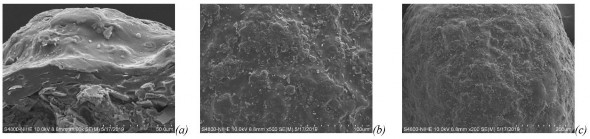
Figure 3.13. SEM images of (a) cross section of pellet bag, (b) surface of pellet bag, (c) surface of pellet bag at 60 o C
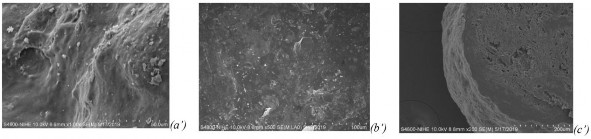
Figure 3.14. SEM images of (a') pellet surface, (b') pellet surface, (c') pellet cross section at 30 o C
SEM images show that the film coating temperature affects the formation of the coating layer. At the inlet air temperature of 60 o C, the coating layer is uneven and rough. The cross-sectional image of the pellet coated at 60 o C shows that the coating layer has gaps in the middle. The reason may be due to the rapid evaporation of the solvent, which makes the coating layer uneven on the surface, creating gaps in the middle of the coating layer. In contrast, the film-coated pellet at 30 o C has a fairly even and smooth surface compared to the pellet coated at 60 o C. The cross-sectional image of the pellet shows that the coating layer at 30 o C is a continuous, uniform layer, without gaps in the middle of the coating layer, helping the pellet to be more stable during storage. Based on the above results, the coating temperature of 30 o C was chosen for further studies.
3.3.2.5. Study on improving the ability to control the release of mesalamine pellets in the colon under condition 2
Research on improving the dissolution rate of mesalamine from human pellets
Through experiments, it was found that the drug release was not fast after T lag time , the pellet shape did not change after the dissolution test. Therefore, to improve the dissolution rate of the drug from the core after T lag time , the study improved the composition of the core pellet by adding lactose monohydrate excipient and super-disintegrating excipient, which swells when in contact with water, DST, to the core pellet. Proceed to prepare the core pellet as shown in the table
3.27 to investigate the effects of lactose monohydrate and sodium starch glycolate.
Table 3.27. Pellet composition with different excipient ratios (Calculated for pellets containing 500mg mesalamine)
STT
INGREDIENT | CT3 | CT5 | CT6 | CT7 | |
1 | Mesalamine (mg) | 500 | 500 | 500 | 500 |
2 | MCC PH 101 (mg) | 500 | 400 | 400 | 400 |
3 | Lactose monohydrate (mg) | - | 200 | 40 | 40 |
4 | Sodium starch glycolate (mg) | - | 0 | 55 | 110 |
5 | PVP K30 (mg) | 90 | 90 | 90 | 90 |
6 | Aerosil 200 (mg) | 15 | 15 | 15 | 15 |
7 | Water (g) (*) | 0.6 | 0.6 | 0.6 | 0.6 |
(*) Evaporates during preparation
120
100
80
60
40
20
0
CT3
CT5
CT6
CT7
0
2
4
6
TIME (HOURS)
% MESALAMIN RELEASED
Prepare CT3, CT5, CT6 and CT7 with the amount of active ingredients and excipients for a batch size of 500 g of core pellets as in Appendix 2.1 and test the dissolution of the core pellets under the dissolution test conditions of the core pellets (phosphate buffer pH 6.8) in section 2.2.4.3, the results are as follows
Figure 3.15. Results of the survey on the influence of excipients on the drug release ability of core pellets (n = 6)
The preparation of all four pellet samples was carried out easily according to the procedure outlined above.
Pellets are uniform spherical particles, meeting the requirements of properties and content.
The dissolution test results showed that: Sample CT3, after 2 hours, had 73% of the drug released; the pellet still kept its spherical shape after the drug was released from the core pellet. Sample pellet CT5 released the drug quickly from the core pellet because the pellet component contained easily soluble lactose, creating a diffusion channel into the core pellet. Formula CT5 still kept its spherical shape after the drug was released from the core pellet. Sample pellet CT6 released the drug quickly from the core pellet because the pellet component contained the super-disintegrating excipient DST which absorbed water, swelled, creating a diffusion channel to help the drug dissolve well into the environment; the pellet swelled in the dissolution environment, however, the shape did not change much due to the low amount of DST. Sample pellet CT7 released the drug completely after 2 hours; the pellet swelled and deformed strongly in the dissolution environment due to the high amount of DST. Based on the above research results, formula CT7 was selected for the next study.
Based on the above research results, the pellet standard used for the research is 100% release after ≤ 2 hours.
Study on the combination of EC with zein and Eudragit S100 in the coating composition
Referring to the literature, it was found that EC is a polymer that is insoluble in water, does not decompose or swell under different pH conditions and is widely used in studies of controlled release systems, so the thesis combined EC with the zein - Eudragit S100 mixture to prolong the latent time for coated pellets.
To study the effect of EC combined with zein and Eudragit S100 in the coating film composition, the ratio of zein-ethyl cellulose mixture (1:1), the ratio of plasticizer, talc, the amount of solvent used in the formula was fixed and the ratio of Eudragit S100 compared to the total amount of polymer was changed to 10% (CT14), 20% (CT15), 30% (CT16).
In addition, to increase the % of drug release from the core after the latent period, use pellets containing DST in the core like the CT7 core pellet formula and coat 240 g of pellets with the coating formulas shown in table 3.28.
Table 3.28. Coating solution formula combining EC with zein and Eudragit S100 for 240g of mesalamine pellets
STT
Ingredient | CT14 | CT15 | CT16 | |
1 | Zein | 38.25 g | 34 g | 29.75 g |
2 | Eudragit S100 | 8.5 g | 17 g | 25.5 g |
5 | Ethyl cellulose | 38.25 g | 34 g | 29.75 g |
6 | Dibutyl phthalate (DBP) | 17 g | 17 g | 17 g |
7 | Talc | 17 g | 17 g | 17 g |
9 | Ethanol 80% v/v (ml) | 1420 ml | 1420 ml | 1420 ml |
100
90
80
70
60
50
40
30
20
10
0
CT14
CT15
CT16
0
5
TIME (HOURS)
10
% MESALAMIN RELEASED
The dissolution test under condition 2 (first 2 hours in 0.1 N HCl pH 1.2 environment; next 3 hours in phosphate buffer pH 7.4 environment and the following hours in phosphate buffer pH 6.8 environment) as presented in section 2.2.4.4 gave the following results
Figure 3.16. Results of the study on the effects of zein, Eudragit S100 and ethyl cellulose in the coating composition on T 10 (n = 6)
Pellet coating uses CT7 pellet core with DST in the core to help the drug release quickly after the latent period T lag because the coating membrane corrodes quickly after this time , causing water to diffuse quickly into the core. DST in the pellet core absorbs water, swells, breaks the pellet coating membrane and releases the active ingredient quickly into the dissolution medium.
The percentage of Eudragit S100 affects the T 10 time , however increasing the percentage of Eudragit S100 in the research formulations did not increase the corresponding T 10 of the colonic release pellets. CT16 with a percentage of Eudragit S100 of 30% gave the value
T 10 value > 4 hours (8.07 ± 0.98 % active substance released after 4 hours), while CT14 with Eudragit S100 % ratio of 10 % also gave T 10 value of about 4 hours (7.26 ± 1.59 % mesalamine released after 4 hours). In contrast, CT15 with Eudragit S100 % ratio of 20 % had T 10 < 4 hours (15.87 ± 2.89 % mesalamine released after 4 hours).
The CT16 coating film has a relatively fast drug release rate after latent period compared to CT14. After 7 hours, CT16 and CT14 released 82.29 ± 2.42% and 60.36 ± 1.99%, respectively. The results showed that CT16 controlled drug release well in the first 4 hours and released mesalamine quickly after latent period, so it was chosen for further studies.
Investigation of the effect of plasticizer ratio on the ability to control drug release.
Pellet coating was carried out with a fixed coating film composition of zein - Eudragit S100 - EC ratio, talc ratio, solvent and coating process parameters according to CT16; changing the plasticizer ratio to 20% (CT16), 30% (CT17) and 40% (CT18). Pellet coating was carried out according to the method described in section 2.2.2. The fixed coating layer mass was 30% compared to the core pellet mass. The preparation results were as follows:
% CHD (w/w) vs.
polymer
Comment | |
20% (CT16) | Pellet surface is evenly colored, packaging chamber has little dust, no phenomenon pellet adhesion to each other and to the chamber |
30% (CT17) | Pellet surface is evenly colored, the packaging chamber has less dust, and begins to appear. Phenomenon of pellet particles sticking to grape bunches and clinging to the bag chamber. |
40% (CT18) | The pellet surface is evenly colored, the pellet sticks a lot to the wurtter tube and stick together in clumps |
The reason may be that when the concentration of plasticizer increases, the coating fluid after contact with the pellet takes longer to dry, so the pellets easily stick together and stick in the coating chamber. From the above results, it can be seen that the ratio of plasticizer in the formula is 20% compared to the amount of polymer is appropriate.