
52. Pham Hoai Chung (2016). Research on investment in developing urban road traffic infrastructure. PhD thesis in economics, University of Transport.
53. Nguyen Thi Tuyet Mai (2016). Research on solutions for sustainable development of inland waterway transport in the Northern region. PhD thesis in Economics, University of Transport.
54. Ngo Duc Du (2017). Proposed solutions for sustainable development of Hai Phong seaport. PhD thesis, Vietnam Maritime University.
55. Than Dinh Vinh (2020). Planning for the development of the urban road network of Hai Phong City towards an ecological urban area. Doctoral thesis in engineering, Hanoi University of Architecture.
56. Le Thi Minh Huyen (2020). Model and solutions for managing the public transport system in Hai Phong city. Doctoral thesis in engineering, Hanoi University of Architecture.
57. Nguyen Thi Bich Hang (2015). The impact of output on subsidies and proposed solutions to reduce subsidies for public transport . GTVT Magazine.
58. Nguyen Thi Bich Hang (2019). Building a set of indicators to evaluate the level of task completion (KPIs) for units providing public transport services by bus in Ho Chi Minh City. GTVT Magazine .
59. Hoang Thai Dai, Manh Quan Phuc (2007). Evaluation of sustainable development of some clean water supply projects in Bac Giang province. Journal of Science and Technology of Water Resources and Environment No. 16, Thuyloi University.
60. General Department of Roads (2015). Decision No. 1895/QD-TCDBVN dated July 9, 2015 on the framework program for professional training and legal regulations in transport business activities for drivers and service staff on vehicles.
61. Vietnam Road Administration (2015). Decision No. 1896/QD-TCĐVN dated July 9, 2015 on professional training and legal regulations for operators of automobile transport business.
62. International standard ISO - 3833:1977 and Vietnamese standard TCVN - 6211:2003. Road vehicles - Types - Terms and definitions.
63. TCVN 7880:2008. Road vehicles. Noise emitted from automobiles. Requirements and test methods in type approval.
64. TCVN 7881:2008. Road vehicles. Noise emitted from motorcycles. Requirements and test methods in type approval.
65. TCVN 7882:2008. Road vehicles. Noise emitted from motorcycles. Requirements and test methods in type approval.
66. QCVN 10:2014/BXD. National technical regulation on construction works ensuring access for people with disabilities.
67. QCVN 31:2014/BGTVT. National technical regulation on vehicle journey monitoring equipment.
68. QCVN 09:2015/BGTVT. National technical regulation on technical safety quality and environmental protection for automobiles.
69. QCVN 10:2015/BGTVT. National technical regulation on technical safety quality and environmental protection for urban passenger cars.
70. QCVN 14 :2015/BGTVT. National technical regulation on technical safety quality and environmental protection for motorbikes and mopeds.
71. QCVN 07:2016/BXD. National technical regulations on technical infrastructure works.
72. QCVN 82:2019/BGTVT. National technical regulation on urban passenger car standards for use by people with disabilities.
73. QCVN 41:2019/BGTVT. National technical regulation on road signs .
74. Website:
chinphu.vn, www.gso.gov.vn, mt.gov.vn, bao Giaothong.vn, tapchi Giaothong.vn, vov Giaothong.vn, vea.gov.vn, haiphong.gov.vn, sogtvt.haiphong.gov.vn, sogtvt.hanoi.gov.vn, tramoc.com.vn, buyttphcm.com.vn, danangbus.vn, vi.wikipedia.org/wiki/Sustainable_development
https://vovgiaothong.vn/covid19-thay-doi-nganh-giao-thong-cong-the-gioi-nhu-the-nhan
ENGLISH
75. Townsend, C., Kenworthy, J., Murray-Leach, R., (2005). Sustainable Urban Transport . In The natural advantage of nations: Business Opportunities, Innovation and governance in the 21st Century, 371-386 United Kingdom: Earthscan.
76. M Deakin, G Mitchell, P Nijkamp, R Vreeker (2007). Sustainable urban development, Europe . Volume 2: The Environmental Assessment Methods, London and New York: Routlegde.
77. Sampaio et a l. (2008). Efficiency Analysis of Public Transportation Systems: Lessons for Institutional Planning . Transportation Research Part A Policy and Practice, Vol. 42, issue 3, 445-454.
78. Chhavi dhingra (2011). Measuring Public Transport Performances: Lessons for Developing Cities. Sustainable Urban Transport Technical Report #9. Deutsche Gesellschaft für Internationale Zusammenarbeit (GIZ), Germany.
79. Miller, P. (2014). Sustainability and Public Transportation: Theory and Analysis . University of Calgary: Calgary, AB, Canada.
80. Miller, P.; de Barros, AG; Kattan, L.;Wirasinghe, S.C. (2016). Analyzing the sustainability performance of publictransit . Transp. Res. Part D, 44, 177– 198.
81. De Gruyter, C., Currie, G., Rose, G. (2017). Sustainability Measures of Urban Public Transport in Cities: A World Review and Focus on the Asia/Middle East Region . Sustainability, Vol. 9, No. 1, 43.
82. Graham Currie, Chris De Gruyter (2018). Exploring links between the sustainability performance of urban public transport and land use in international cities . The Journal of Transport and Land Use, Vol 11, No. 1, pp. 325–342.
83. Nguyen Van Nam (2013). Bus Prioritization in Motorcycle Dependent Cities. Doctoral thesis, Technische Universität Darmstadt.
84. Diem Trinh Thi Le (2014). Tourist use of public transport at destinations – the case of Munich, Germany. Doctoral thesis, Technical University of Munich.
85. Aleksander Purba (2015). A study on evaluating urban bus service performance in developing country: Case studies of medium-sized cities in Indonesia. Doctoral thesis, Yokohama National University.
86. Ehab Diab (2015). Urban Public Transportation Systems: Understanding the Impacts of Service Improvement Strategies on Service Reliability and Passenger's Perception. Doctoral thesis, McGill University.
87. Ly Huy Tuan (2011). Master Plan for Urban Transport Development Seen from Sustainable Aspects in Vietnam. Proceedings of the Eastern Asia Society for Transportation Studies (EASTS), Vol.8.
88. European Union Sustainable Development Forum (2003). Strategy of Sustainable Development.
89. UIC (2002), European Standard EN 13816, Transportation – Logistics and Services-Public Passenger Transport – Service quality definition, targeting and measurement.
90. UIC (2006), European Standard EN 15140, Public passenger transport - Basic requirements and recommendations for systems that measure delivered service quality.
91. Websites: https://sustainabledevelopment.un.org/topics/sustainabletransport http://www.un.org/sustainabledevelopment/sustainable-development-goals/ www.jica.go.jp, cleanairasia.org, www.uitp .org,www.urbs.curitiba.pr.gov.br, nl.linkedin.com/company/stadsregio-amsterdam, seoulsolution.kr/en, www.spad.gov.my, www.bmta.co.th/en/home, www.iges.or.jp/en, www.itdp.org, paddi.vn/vi, data.worldbank.org, www. hino.co.jp
LIST OF PUBLISHED SCIENTIFIC WORKS OF THE AUTHOR
1. Nguyen Quang Thanh, Hoang Trung Thong, Dinh Van Hiep (2015). An Efficient Solution to Promote Public Transportation toward Sustainable Development: A Case Study in Haiphong city. Proceeding of 8 th ATRANS Symposium in Bangkok, Thailand. Organized by Asian Transportation Research Society (ATRANS) and International Association of Traffic and Safety Sciences (IATSS). http://www.atransociety.com
2. Nguyen Quang Thanh, Vu Thi Phuong Hoa (2016). A Marketing Solution to Enhance Service Quality of Public Transportation: A Case Study in Haiphong city. Proceeding of 9 th ATRANS Symposium in Bangkok, Thailand. Organized by Asian Transportation Research Society (ATRANS) and International Association of Traffic and Safety Sciences (IATSS). http://www.atransociety.com
3. Nguyen Quang Thanh (2017). Establishing A Public Transport Authority in Haiphong city. Presented at the CityNET/ SHRDC Transportation Strategy Workshop for Asian Cities, Seoul, Korea. Organized by CityNET and Seoul Human Resource Development Center. http://www.urbansdgplatform.org
4. Nguyen Quang Thanh, Vu Thi Phuong Hoa, Nguyen Huu Ha (2017). Improving Public Transportation Towards Sustainable Development: A Case Study in Haiphong city. Proceeding of the 10th ATRANS Annual Conference, Asian Transportation Research Society, Bangkok, Thailand. Organized by Asian Transportation Research Society (ATRANS) and International Association of Traffic and Safety Sciences (IATSS). http://www.atransociety.com
5. Nguyen Quang Thanh, Nguyen Huu Ha (2020). Analysis of the impact of some socio-economic factors on the demand for public passenger transport by bus in Hai Phong city . Proceedings of the XXII Conference on Science and Technology, University of Transport. ISBN 978-604-76-2272-6
6. Nguyen Quang Thanh, Nguyen Huu Ha (2020). Developing a model of Public Transport Management Agency in Hai Phong city . Proceedings of the 22nd Conference on Science and Technology, University of Transport. ISBN 978-604-76-2272-6
7. Nguyen Quang Thanh, Nguyen Huu Ha (2020). Smart public transport system and its application in Hai Phong city . Proceedings of the 22nd Conference on Science and Technology, University of Transport. ISBN 978-604-76-2272-6
8. Nguyen Quang Thanh, Vu Thi Phuong Hoa, Nguyen Huu Ha (2020). Current Situation and Solutions to Enhance Service Quality of Public Transport in Hai Phong City, Vietnam. Proceeding of 13 th ATRANS Annual Conference in Bangkok, Thailand. Organized by Asian Transportation Research Society (ATRANS) and International Association of Traffic and Safety Sciences (IATSS). http://www.atransociety.com
9. Vu Thi Phuong Hoa, Nguyen Quang Thanh, Nguyen Huu Ha (2020). Efficient Management of Revenue and Subsidy for Urban Public Transport Service in Hai Phong City, Vietnam. Proceeding of 13 th ATRANS Annual Conference in Bangkok, Thailand. Organized by Asian Transportation Research Society (ATRANS) and International Association of Traffic and Safety Sciences (IATSS). http://www.atransociety.com
10. Nguyen Quang Thanh, Nguyen Huu Binh (2021). Theoretical basis for developing public passenger transport by bus in urban areas in a sustainable direction. Journal of Transport, June 2021 issue. ISSN 2354-0818
11. Nguyen Quang Thanh, Nguyen Huu Ha (2021). Research on developing high-quality bus routes in Hai Phong city. Transport Magazine, July 2021 issue. ISSN 2354-0818
APPENDIX I
STATISTICS OF BUS NETWORK AND INFRASTRUCTURE SERVICE ACCORDING TO THE PLAN TO 2025 AND 2030
Table PLI.1 - Bus route network in Hai Phong city, period 2010 - 2020
STT
Route number | Line name | Route | Length (km) | Uptime | Frequency (min/ch) | Number of vehicles/day | Note | |
1 | 01 | The Barrier Bridge – Du Nghia | Cau Rao Bus Station - Lach Tray - To Hieu - Ton Duc Thang - QL5 - Nomura - Du Nghia | 21 | 4:30-20:30 | 10- 20 | 86 | Currently mining |
2 | 02 | Ben Binh - Kenh Market, Vinh Bao | Ben Binh-Cu Chinh Lan-Nguyen Tri Phuong-Hoang Van Thu-Nguyen Duc Canh-Tran Nguyen Han-Truong Chinh-Tran Nhan Tong-Phan Dang Luu-Hoang Quoc Viet-QL10-Kenh Market-Tien Lang-Vinh Bao Town. | 40 | 4:30-20:30 | 10- 20 | 84 | Currently mining |
3 | 03 A | City Post Office Do Son | Post Office - Hoang Van Thu - Cau Dat - Lach Tray - Pham Van Dong - Tilting Wharf (Do Son) | 24 | 5am- 8pm | 15-20 | 60 | Declaring waterfall |
4 | 03 B | Oil and Gas Hotel - Do Son | Petroleum Hotel-Da Nang-Dien Bien Phu-Hoang Van Thu-Cau Dat-Lach Tray-Pham Van Dong-Zone II Do Son | 30 | 5:30- 21:00 | 10-15 | 120 | Currently mining |
5 | 04 | City Post Office – Minh Duc | Post Office-Nguyen Tri Phuong-Bach Dang-Cau Binh-DT 359-Tan Duong commune-Thuy Son commune-Nui Deo-Thuy Duong commune-An Lu commune-Trung Ha commune-Thuy Trieu commune-Ngu commune Tam Hung-Minh Duc Commune, Pha Rung | 20 | 5:20-8:30 | 15-20 | 72 | Currently mining |
Maybe you are interested!
-
 Goffi G's Model for Assessing Tourism Destination Competitiveness and Sustainability
 -
 Identify Rating Levels and Rating Scales
zt2i3t4l5ee
zt2a3gstourism,quan lan,quang ninh,ecology,ecotourism,minh chau,van don,geography,geographical basis,tourism development,science
zt2a3ge
zc2o3n4t5e6n7ts
of the islanders. Therefore, this indicator will be divided into two sub-indicators:
a1. Natural tourism attractiveness a2. Cultural tourism attractiveness
b. Tourist capacity
The two island communes in Quan Lan have different capacities to receive tourists. Minh Chau Commune is home to many standard hotels and resorts, attracting high-income domestic and international tourists. Meanwhile, Quan Lan Commune has many motels mainly built and operated by local people, so the scale and quality are not high, and will be suitable for ordinary tourists such as students.
c. Time of exploitation of Quan Lan Island Commune:
Quan Lan tourism is seasonal due to weather and climate conditions and festivals only take place on certain days of the year, specifically in spring. In Quan Lan commune, the period from April to June and from September to November is considered the best time to visit Quan Lan because the cultural tourism activities are mainly associated with festivals taking place during this time.
Minh Chau island commune:
Tourism exploitation time is all year round, because this is a place with a number of tourist attractions with diverse ecosystems such as Bai Tu Long National Park Research Center, Tram forest, Turtle Laying Beach, so besides coming to the beach for tourism and vacation in the summer, Minh Chau will attract research groups to come for tourism combined with research at other times of the year.
d. Sustainability
The sustainability of ecotourism sites in Quan Lan and Minh Chau communes depends on the sensitivity of the ecosystems to climate changes.
landscape. In general, these tourist destinations have a fairly high level of sustainability, because they are natural ecosystems, planned and protected. However, if a large number of tourists gather at certain times, it can exceed the carrying capacity and affect the sustainability of the environment (polluted beaches, damaged trees, animals moving away from their habitats, etc.), then the sustainability of the above ecosystems (natural ecosystems, human ecosystems) will also be affected and become less sustainable.
e. Location and accessibility
Both island communes have ports to take tourists to visit from Van Don wharf:
- Quan Lan – Van Don traffic route:
Phuc Thinh – Viet Anh high-speed boat and Quang Minh high-speed boat, depart at 8am and 2pm from Van Don to Quan Lan, and at 7am and 1pm from Quan Lan to Van Don. There are also wooden boats departing at 7am and 1pm.
- Van Don - Minh Chau traffic route:
Chung Huong high-speed train, Minh Chau train, morning 7:30 and afternoon 13:30 from Van Don to Minh Chau, morning 6:30 and afternoon 13:00 from Minh Chau to Van Don.
f. Infrastructure
Despite receiving investment attention, the issue of infrastructure and technical facilities for tourism on Quan Lan Island is still an issue that needs to be resolved because it has a direct impact on the implementation of ecotourism activities. The minimum conditions for serving tourists such as accommodation, electricity, water, communication, especially medical services, and security work need to be given top priority. Ecotourism spots in Minh Chau commune are assessed to have better infrastructure and technical facilities for tourism because there are quite complete and synchronous conditions for serving tourists, meeting many needs of domestic and foreign tourists.
3.2.1.4. Determine assessment levels and assessment scales
Corresponding to the levels of each criterion, the index is the score of those levels in the order of 4, 3, 2, 1 decreasing according to the standard of each level: very attractive (4), attractive (3), average (2), less attractive (1).
3.2.1.5. Determining the coefficients of the criteria
For the assessment of DLST in the two communes of Quan Lan and Minh Chau islands, the students added evaluation coefficients to show the importance of the criteria and indicators as follows:
Coefficient 3 with criteria: Attractiveness, Exploitation time. These are the 2 most important criteria for attracting tourists to tourism in general and eco-tourism in particular, so they have the highest coefficient.
Coefficient 2 with criteria: Capacity, Infrastructure, Location and accessibility . Because the assessment area is an island commune of Van Don district, the above criteria are selected by the author with appropriate coefficients at the average level.
Coefficient 1 with criteria: Sustainability. Quan Lan has natural and human-made ecotourism sites, with high biodiversity and little impact from local human factors. Most of the ecotourism sites are still wild, so they are highly sustainable.
3.2.1.6. Results of DLST assessment on Quan Lan island
a. Assessment of the potential for natural tourism development
For Minh Chau commune:
+ Natural tourism attractiveness is determined to be very attractive (4 points) and the most important coefficient (coefficient 3), so the score of the Attractiveness criterion is 4 x 3 = 12.
+ Capacity is determined as average (2 points) and the coefficient is quite important (coefficient 2), then the score of Capacity criterion is 2 x 2 = 4.
+ Exploitation time is long (4 points), the most important coefficient (coefficient 3) so the score of the Exploitation time criterion is 4 x 3 = 12.
+ Sustainability is determined as sustainable (4 points), the important coefficient is the average coefficient (coefficient 1), so the score of the Sustainability criterion is 4 x 1 = 4 points
+ Location and accessibility are determined to be quite favorable (2 points), the coefficient is quite important (coefficient 2), the criterion score is 2 x 2 = 4 points.
+ Infrastructure is assessed as good (3 points), the coefficient is quite important (coefficient 2), then the score of the Infrastructure criterion is 3 x 2 = 6 points.
The total score for evaluating DLST in Minh Chau commune according to 6 evaluation criteria is determined as: 12 + 4 + 12 + 4 + 4 + 6 = 42 points
Similar assessment for Quan Lan commune, we have the following table:
Table 3.3: Assessment of the potential for natural ecotourism development in Quan Lan and Minh Chau communes
Attractiveness of self-tourismof course
Capacity
Mining time
Sustainability
Location and accessibility
Infrastructure
Result
Point
DarkMulti
Point
DarkMulti
Point
DarkMulti
Point
DarkMulti
Point
DarkMulti
Point
DarkMulti
CommuneMinh Chau
12
12
4
8
12
12
4
4
4
8
6
8
42/52
Quan CommuneLan
6
12
6
8
9
12
4
4
4
8
4
8
33/52
b. Assessment of the potential for humanistic tourism development
For Quan Lan commune:
+ The attractiveness of human tourism is determined to be very attractive (4 points) and the most important coefficient (coefficient 3), so the score of the Attractiveness criterion is 4 x 3 = 12.
+ Capacity is determined to be large (3 points) and the coefficient is quite important (coefficient 2), then the score of the Capacity criterion is 3 x 2 = 6.
+ Mining time is average (3 points), the most important coefficient (coefficient 3) so the score of the Mining time criterion is 3 x 3 = 9.
+ Sustainability is determined as sustainable (4 points), the important coefficient is the average coefficient (coefficient 1), so the score of the Sustainability criterion is 4 x 1 = 4 points.
+ Location and accessibility are determined to be quite favorable (2 points), the coefficient is quite important (coefficient 2), the criterion score is 2 x 2 = 4 points.
+ Infrastructure is rated as average (2 points), the coefficient is quite important (coefficient 2), then the score of the Infrastructure criterion is 2 x 2 = 4 points.
The total score for evaluating DLST in Quan Lan commune according to 6 evaluation criteria is determined as: 12 + 6 + 6 + 4 + 4 + 4 = 36 points.
Similar assessment with Minh Chau commune we have the following table:
Table 3.4: Assessment of the potential for developing humanistic eco-tourism in Quan Lan and Minh Chau communes
Attractiveness of human tourismliterature
Capacity
Mining time
Sustainability
Location and accessibility
Infrastructure
Result
Point
DarkMulti
Point
DarkMulti
Point
DarkMulti
Point
DarkMulti
Point
DarkMulti
Point
DarkMulti
Quan CommuneLan
12
12
6
8
9
12
4
4
4
8
4
8
39/52
Minh CommuneChau
6
12
4
8
12
12
4
4
4
8
6
8
36/52
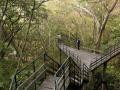
Basically, both Minh Chau and Quan Lan localities have quite favorable conditions for developing ecotourism. However, Quan Lan commune has more advantages to develop ecotourism in a humanistic direction, because this is an area with many famous historical relics such as Quan Lan Communal House, Quan Lan Pagoda, Temple worshiping the hero Tran Khanh Du, ... along with local festivals held annually such as the wind praying ceremony (March 15), Quan Lan festival (June 10-19); due to its location near the port and long exploitation time, the beaches in Quan Lan commune (especially Quan Lan beach) are no longer hygienic and clean to ensure the needs of tourists coming to relax and swim; this is also an area with many beautiful landscapes such as Got Beo wind pass, Ong Phong head, Voi Voi cave, but the ability to access these places is still very limited (dirt hill road, lots of gravel and rocks), especially during rainy and windy times; In addition, other natural resources such as mangrove forests and sea worms have not been really exploited for tourism purposes and ecotourism development. On the contrary, Minh Chau commune has more advantages in developing ecotourism in the direction of natural tourism, this is an area with diverse ecosystems such as at Rua De Beach, Bai Tu Long National Park Conservation Center...; Minh Chau beach is highly appreciated for its natural beauty and cleanliness, ranked in the top ten most beautiful beaches in Vietnam; Minh Chau commune is also home to Tram forest with a large area and a purity of up to 90%, suitable for building bridges through the forest (a very effective type of natural ecotourism currently applied by many countries) for tourists to sightsee, as well as for the purpose of studying and researching.
Figure 3.1: Thenmala Forest Bridge (India) Source: https://www.thenmalaecotourism.com/(August 21, 2019)
3.2.2. Using SWOT matrix to evaluate Quan Lan island tourism
General assessment of current tourism activities of Quan Lan island is shown through the following SWOT matrix:
Table 3.5: SWOT matrix evaluating tourism activities on Quan Lan island
Internal agent
Strengths- There is a lot of potential for tourism development, especially natural ecotourism and humanistic ecotourism.- The unskilled labor force is relatively abundant.- resource environmentunpolluted, still
Weaknesses- Poorly developed infrastructure, especially traffic routes to tourist destinations on the island.- The team of professional staff is still weak.- Tourism products in general
quite wild, originalintact
general and DLST in particularalone is monotonous.
External agents
Opportunity- Tourism is a key industry in the socio-economic development strategy of the province and Van Don economic zone.- Quan Lan was selected as a pilot area for eco-tourism development within the framework of the green growth project between Quang Ninh province and the Japanese organization JICA.- The flow of tourists and especially ecotourism in the world tends toincreasing
Challenge- Weather and climate change abnormally.- Competition in tourism products is increasingly fierce, especially with other localities in the province such as Ha Long, Mong Cai...- Awareness of tourists, especially domestic tourists, about ecotourism and nature conservation is not high.
Through summary analysis using SWOT matrix we see that:
To exploit strengths and take advantage of opportunities, it is necessary to:
- Diversify products and service types (build more tourism routes aimed at specific needs of tourists: experiential tourism immersed in nature, spiritual cultural tourism...)
- Effective exploitation of resources and differentiated products (natural resources and human resources)
div.maincontent .p { color: black; font-family:"Times New Roman", serif; font-style: normal; font-weight: normal; text-decoration: none; font-size: 14pt; margin:0pt; } div.maincontent p { color: black; font-family:"Times New Roman", serif; font-style: normal; font-weight: normal; text-decoration: none; font-size: 14pt; margin:0pt; } div.maincontent .s1 { color: black; font-family:"Times New Roman", serif; font-style: normal; font-weight: normal; text-decoration: none; font-size: 13pt; } div.maincontent .s2 { color: black; font-family:"Times New Roman", serif; font-style: normal; font-weight: normal; text-decoration: none; font-size: 13pt; } div.maincontent .s3 { color: #0D0D0D; font-family:"Times New Roman", serif; font-style: normal; font-weight: bold; text-decoration: none; font-size: 14pt; } div.maincontent .s4 { color: black; font-family:"Times New Roman", serif; font-style: italic; font-weight: normal; text-decoration: none; font-size: 14pt; } div.maincontent .s5 { color: black; font-family:"Times New Roman", serif; font-style: italic; font-weight: bold; text-decoration: none; font-size: 14pt; } div.maincontent .s6 { color: black; font-family:"Times New Roman", serif; font-style: italic; font-weight: normal; text-decoration: none; font-size: 14pt; vertical-align: -3pt; } div.maincontent .s7 { color: black; font-family:"Times New Roman", serif; font-style: italic; font-weight: normal; text-decoration: none; font-size: 14pt; vertical-align: -2pt; } div.maincontent .s8 { color: black; font-family:"Times New Roman", serif; font-style: italic; font-weight: normal; text-decoration: none; font-size: 14pt; vertical-align: -1pt; } div.maincontent .s9 { color: black; font-family:"Times New Roman", serif; font-style: normal; font-weight: normal; text-decoration: none; font-size: 14pt; } div.maincontent .s10 { color: black; font-family:"Times New Roman", serif; font-style: normal; font-weight: bold; text-decoration: none; font-size: 14pt; } div.maincontent .s11 { color: black; font-family:"Times New Roman", serif; font-style: normal; font-weight: normal; text-decoration: none; font-size: 14pt; } div.maincontent .s12 { color: black; font-family:Symbol, serif; font-style: normal; font-weight: normal; text-decoration: none; font-size: 14pt; } div.maincontent .s13 { color: black; font-family:Wingdings; font-style: normal; font-weight: normal; text-decoration: none; font-size: 14pt; } div.maincontent .s14 { color: black; font-family:"Times New Roman", serif; font-style: normal; font-weight: normal; text-decoration: none; font-size: 9pt; vertical-align: 5pt; } div.maincontent .s15 { color: black; font-family:"Times New Roman", serif; font-style: normal; font-weight: normal; text-decoration: none; font-size: 9pt; vertical-align: 5pt; } div.maincontent .s16 { color: black; font-family:Cambria, serif; font-style: italic; font-weight: normal; text-decoration: none; font-size: 14pt; } div.maincontent .s17 { color: #080808; font-family:"Times New Roman", serif; font-style: normal; font-weight: bold; text-decoration: none; font-size: 14pt; } div.maincontent .s18 { color: #080808; font-family:"Times New Roman", serif; font-style: normal; font-weight: normal; text-decoration: none; font-size: 14pt; } div.maincontent .s19 { color: black; font-family:"Times New Roman", serif; font-style: normal; font-weight: normal; text-decoration: none; font-size: 11pt; } div.maincontent .s20 { color: black; font-family:"Times New Roman", serif; font-style: normal; font-weight: normal; text-decoration: none; font-size: 10pt; } div.maincontent .s21 { color: black; font-family:"Times New Roman", serif; font-style: normal; font-weight: bold; text-decoration: none; font-size: 11pt; } div.maincontent .s22 { color: black; font-family:"Times New Roman", serif; font-style: normal; font-weight: normal; text-decoration: none; font-size: 11pt; } div.maincontent .s23 { color: black; font-family:"Times New Roman", serif; font-style: italic; font-weight: normal; text-decoration: none; font-size: 14pt; } div.maincontent .s24 { color: #212121; font-family:"Times New Roman", serif; font-style: normal; font-weight: normal; tex
Identify Rating Levels and Rating Scales
zt2i3t4l5ee
zt2a3gstourism,quan lan,quang ninh,ecology,ecotourism,minh chau,van don,geography,geographical basis,tourism development,science
zt2a3ge
zc2o3n4t5e6n7ts
of the islanders. Therefore, this indicator will be divided into two sub-indicators:
a1. Natural tourism attractiveness a2. Cultural tourism attractiveness
b. Tourist capacity
The two island communes in Quan Lan have different capacities to receive tourists. Minh Chau Commune is home to many standard hotels and resorts, attracting high-income domestic and international tourists. Meanwhile, Quan Lan Commune has many motels mainly built and operated by local people, so the scale and quality are not high, and will be suitable for ordinary tourists such as students.
c. Time of exploitation of Quan Lan Island Commune:
Quan Lan tourism is seasonal due to weather and climate conditions and festivals only take place on certain days of the year, specifically in spring. In Quan Lan commune, the period from April to June and from September to November is considered the best time to visit Quan Lan because the cultural tourism activities are mainly associated with festivals taking place during this time.
Minh Chau island commune:
Tourism exploitation time is all year round, because this is a place with a number of tourist attractions with diverse ecosystems such as Bai Tu Long National Park Research Center, Tram forest, Turtle Laying Beach, so besides coming to the beach for tourism and vacation in the summer, Minh Chau will attract research groups to come for tourism combined with research at other times of the year.
d. Sustainability
The sustainability of ecotourism sites in Quan Lan and Minh Chau communes depends on the sensitivity of the ecosystems to climate changes.
landscape. In general, these tourist destinations have a fairly high level of sustainability, because they are natural ecosystems, planned and protected. However, if a large number of tourists gather at certain times, it can exceed the carrying capacity and affect the sustainability of the environment (polluted beaches, damaged trees, animals moving away from their habitats, etc.), then the sustainability of the above ecosystems (natural ecosystems, human ecosystems) will also be affected and become less sustainable.
e. Location and accessibility
Both island communes have ports to take tourists to visit from Van Don wharf:
- Quan Lan – Van Don traffic route:
Phuc Thinh – Viet Anh high-speed boat and Quang Minh high-speed boat, depart at 8am and 2pm from Van Don to Quan Lan, and at 7am and 1pm from Quan Lan to Van Don. There are also wooden boats departing at 7am and 1pm.
- Van Don - Minh Chau traffic route:
Chung Huong high-speed train, Minh Chau train, morning 7:30 and afternoon 13:30 from Van Don to Minh Chau, morning 6:30 and afternoon 13:00 from Minh Chau to Van Don.
f. Infrastructure
Despite receiving investment attention, the issue of infrastructure and technical facilities for tourism on Quan Lan Island is still an issue that needs to be resolved because it has a direct impact on the implementation of ecotourism activities. The minimum conditions for serving tourists such as accommodation, electricity, water, communication, especially medical services, and security work need to be given top priority. Ecotourism spots in Minh Chau commune are assessed to have better infrastructure and technical facilities for tourism because there are quite complete and synchronous conditions for serving tourists, meeting many needs of domestic and foreign tourists.
3.2.1.4. Determine assessment levels and assessment scales
Corresponding to the levels of each criterion, the index is the score of those levels in the order of 4, 3, 2, 1 decreasing according to the standard of each level: very attractive (4), attractive (3), average (2), less attractive (1).
3.2.1.5. Determining the coefficients of the criteria
For the assessment of DLST in the two communes of Quan Lan and Minh Chau islands, the students added evaluation coefficients to show the importance of the criteria and indicators as follows:
Coefficient 3 with criteria: Attractiveness, Exploitation time. These are the 2 most important criteria for attracting tourists to tourism in general and eco-tourism in particular, so they have the highest coefficient.
Coefficient 2 with criteria: Capacity, Infrastructure, Location and accessibility . Because the assessment area is an island commune of Van Don district, the above criteria are selected by the author with appropriate coefficients at the average level.
Coefficient 1 with criteria: Sustainability. Quan Lan has natural and human-made ecotourism sites, with high biodiversity and little impact from local human factors. Most of the ecotourism sites are still wild, so they are highly sustainable.
3.2.1.6. Results of DLST assessment on Quan Lan island
a. Assessment of the potential for natural tourism development
For Minh Chau commune:
+ Natural tourism attractiveness is determined to be very attractive (4 points) and the most important coefficient (coefficient 3), so the score of the Attractiveness criterion is 4 x 3 = 12.
+ Capacity is determined as average (2 points) and the coefficient is quite important (coefficient 2), then the score of Capacity criterion is 2 x 2 = 4.
+ Exploitation time is long (4 points), the most important coefficient (coefficient 3) so the score of the Exploitation time criterion is 4 x 3 = 12.
+ Sustainability is determined as sustainable (4 points), the important coefficient is the average coefficient (coefficient 1), so the score of the Sustainability criterion is 4 x 1 = 4 points
+ Location and accessibility are determined to be quite favorable (2 points), the coefficient is quite important (coefficient 2), the criterion score is 2 x 2 = 4 points.
+ Infrastructure is assessed as good (3 points), the coefficient is quite important (coefficient 2), then the score of the Infrastructure criterion is 3 x 2 = 6 points.
The total score for evaluating DLST in Minh Chau commune according to 6 evaluation criteria is determined as: 12 + 4 + 12 + 4 + 4 + 6 = 42 points
Similar assessment for Quan Lan commune, we have the following table:
Table 3.3: Assessment of the potential for natural ecotourism development in Quan Lan and Minh Chau communes
Attractiveness of self-tourismof course
Capacity
Mining time
Sustainability
Location and accessibility
Infrastructure
Result
Point
DarkMulti
Point
DarkMulti
Point
DarkMulti
Point
DarkMulti
Point
DarkMulti
Point
DarkMulti
CommuneMinh Chau
12
12
4
8
12
12
4
4
4
8
6
8
42/52
Quan CommuneLan
6
12
6
8
9
12
4
4
4
8
4
8
33/52
b. Assessment of the potential for humanistic tourism development
For Quan Lan commune:
+ The attractiveness of human tourism is determined to be very attractive (4 points) and the most important coefficient (coefficient 3), so the score of the Attractiveness criterion is 4 x 3 = 12.
+ Capacity is determined to be large (3 points) and the coefficient is quite important (coefficient 2), then the score of the Capacity criterion is 3 x 2 = 6.
+ Mining time is average (3 points), the most important coefficient (coefficient 3) so the score of the Mining time criterion is 3 x 3 = 9.
+ Sustainability is determined as sustainable (4 points), the important coefficient is the average coefficient (coefficient 1), so the score of the Sustainability criterion is 4 x 1 = 4 points.
+ Location and accessibility are determined to be quite favorable (2 points), the coefficient is quite important (coefficient 2), the criterion score is 2 x 2 = 4 points.
+ Infrastructure is rated as average (2 points), the coefficient is quite important (coefficient 2), then the score of the Infrastructure criterion is 2 x 2 = 4 points.
The total score for evaluating DLST in Quan Lan commune according to 6 evaluation criteria is determined as: 12 + 6 + 6 + 4 + 4 + 4 = 36 points.
Similar assessment with Minh Chau commune we have the following table:
Table 3.4: Assessment of the potential for developing humanistic eco-tourism in Quan Lan and Minh Chau communes
Attractiveness of human tourismliterature
Capacity
Mining time
Sustainability
Location and accessibility
Infrastructure
Result
Point
DarkMulti
Point
DarkMulti
Point
DarkMulti
Point
DarkMulti
Point
DarkMulti
Point
DarkMulti
Quan CommuneLan
12
12
6
8
9
12
4
4
4
8
4
8
39/52
Minh CommuneChau
6
12
4
8
12
12
4
4
4
8
6
8
36/52
Basically, both Minh Chau and Quan Lan localities have quite favorable conditions for developing ecotourism. However, Quan Lan commune has more advantages to develop ecotourism in a humanistic direction, because this is an area with many famous historical relics such as Quan Lan Communal House, Quan Lan Pagoda, Temple worshiping the hero Tran Khanh Du, ... along with local festivals held annually such as the wind praying ceremony (March 15), Quan Lan festival (June 10-19); due to its location near the port and long exploitation time, the beaches in Quan Lan commune (especially Quan Lan beach) are no longer hygienic and clean to ensure the needs of tourists coming to relax and swim; this is also an area with many beautiful landscapes such as Got Beo wind pass, Ong Phong head, Voi Voi cave, but the ability to access these places is still very limited (dirt hill road, lots of gravel and rocks), especially during rainy and windy times; In addition, other natural resources such as mangrove forests and sea worms have not been really exploited for tourism purposes and ecotourism development. On the contrary, Minh Chau commune has more advantages in developing ecotourism in the direction of natural tourism, this is an area with diverse ecosystems such as at Rua De Beach, Bai Tu Long National Park Conservation Center...; Minh Chau beach is highly appreciated for its natural beauty and cleanliness, ranked in the top ten most beautiful beaches in Vietnam; Minh Chau commune is also home to Tram forest with a large area and a purity of up to 90%, suitable for building bridges through the forest (a very effective type of natural ecotourism currently applied by many countries) for tourists to sightsee, as well as for the purpose of studying and researching.
Figure 3.1: Thenmala Forest Bridge (India) Source: https://www.thenmalaecotourism.com/(August 21, 2019)
3.2.2. Using SWOT matrix to evaluate Quan Lan island tourism
General assessment of current tourism activities of Quan Lan island is shown through the following SWOT matrix:
Table 3.5: SWOT matrix evaluating tourism activities on Quan Lan island
Internal agent
Strengths- There is a lot of potential for tourism development, especially natural ecotourism and humanistic ecotourism.- The unskilled labor force is relatively abundant.- resource environmentunpolluted, still
Weaknesses- Poorly developed infrastructure, especially traffic routes to tourist destinations on the island.- The team of professional staff is still weak.- Tourism products in general
quite wild, originalintact
general and DLST in particularalone is monotonous.
External agents
Opportunity- Tourism is a key industry in the socio-economic development strategy of the province and Van Don economic zone.- Quan Lan was selected as a pilot area for eco-tourism development within the framework of the green growth project between Quang Ninh province and the Japanese organization JICA.- The flow of tourists and especially ecotourism in the world tends toincreasing
Challenge- Weather and climate change abnormally.- Competition in tourism products is increasingly fierce, especially with other localities in the province such as Ha Long, Mong Cai...- Awareness of tourists, especially domestic tourists, about ecotourism and nature conservation is not high.
Through summary analysis using SWOT matrix we see that:
To exploit strengths and take advantage of opportunities, it is necessary to:
- Diversify products and service types (build more tourism routes aimed at specific needs of tourists: experiential tourism immersed in nature, spiritual cultural tourism...)
- Effective exploitation of resources and differentiated products (natural resources and human resources)
div.maincontent .p { color: black; font-family:"Times New Roman", serif; font-style: normal; font-weight: normal; text-decoration: none; font-size: 14pt; margin:0pt; } div.maincontent p { color: black; font-family:"Times New Roman", serif; font-style: normal; font-weight: normal; text-decoration: none; font-size: 14pt; margin:0pt; } div.maincontent .s1 { color: black; font-family:"Times New Roman", serif; font-style: normal; font-weight: normal; text-decoration: none; font-size: 13pt; } div.maincontent .s2 { color: black; font-family:"Times New Roman", serif; font-style: normal; font-weight: normal; text-decoration: none; font-size: 13pt; } div.maincontent .s3 { color: #0D0D0D; font-family:"Times New Roman", serif; font-style: normal; font-weight: bold; text-decoration: none; font-size: 14pt; } div.maincontent .s4 { color: black; font-family:"Times New Roman", serif; font-style: italic; font-weight: normal; text-decoration: none; font-size: 14pt; } div.maincontent .s5 { color: black; font-family:"Times New Roman", serif; font-style: italic; font-weight: bold; text-decoration: none; font-size: 14pt; } div.maincontent .s6 { color: black; font-family:"Times New Roman", serif; font-style: italic; font-weight: normal; text-decoration: none; font-size: 14pt; vertical-align: -3pt; } div.maincontent .s7 { color: black; font-family:"Times New Roman", serif; font-style: italic; font-weight: normal; text-decoration: none; font-size: 14pt; vertical-align: -2pt; } div.maincontent .s8 { color: black; font-family:"Times New Roman", serif; font-style: italic; font-weight: normal; text-decoration: none; font-size: 14pt; vertical-align: -1pt; } div.maincontent .s9 { color: black; font-family:"Times New Roman", serif; font-style: normal; font-weight: normal; text-decoration: none; font-size: 14pt; } div.maincontent .s10 { color: black; font-family:"Times New Roman", serif; font-style: normal; font-weight: bold; text-decoration: none; font-size: 14pt; } div.maincontent .s11 { color: black; font-family:"Times New Roman", serif; font-style: normal; font-weight: normal; text-decoration: none; font-size: 14pt; } div.maincontent .s12 { color: black; font-family:Symbol, serif; font-style: normal; font-weight: normal; text-decoration: none; font-size: 14pt; } div.maincontent .s13 { color: black; font-family:Wingdings; font-style: normal; font-weight: normal; text-decoration: none; font-size: 14pt; } div.maincontent .s14 { color: black; font-family:"Times New Roman", serif; font-style: normal; font-weight: normal; text-decoration: none; font-size: 9pt; vertical-align: 5pt; } div.maincontent .s15 { color: black; font-family:"Times New Roman", serif; font-style: normal; font-weight: normal; text-decoration: none; font-size: 9pt; vertical-align: 5pt; } div.maincontent .s16 { color: black; font-family:Cambria, serif; font-style: italic; font-weight: normal; text-decoration: none; font-size: 14pt; } div.maincontent .s17 { color: #080808; font-family:"Times New Roman", serif; font-style: normal; font-weight: bold; text-decoration: none; font-size: 14pt; } div.maincontent .s18 { color: #080808; font-family:"Times New Roman", serif; font-style: normal; font-weight: normal; text-decoration: none; font-size: 14pt; } div.maincontent .s19 { color: black; font-family:"Times New Roman", serif; font-style: normal; font-weight: normal; text-decoration: none; font-size: 11pt; } div.maincontent .s20 { color: black; font-family:"Times New Roman", serif; font-style: normal; font-weight: normal; text-decoration: none; font-size: 10pt; } div.maincontent .s21 { color: black; font-family:"Times New Roman", serif; font-style: normal; font-weight: bold; text-decoration: none; font-size: 11pt; } div.maincontent .s22 { color: black; font-family:"Times New Roman", serif; font-style: normal; font-weight: normal; text-decoration: none; font-size: 11pt; } div.maincontent .s23 { color: black; font-family:"Times New Roman", serif; font-style: italic; font-weight: normal; text-decoration: none; font-size: 14pt; } div.maincontent .s24 { color: #212121; font-family:"Times New Roman", serif; font-style: normal; font-weight: normal; tex -
 Accounting for production costs and product pricing of P&G Advertising and Trading Company Limited - 1
 -
 M Ph Ng C TC Kh Ng Ng Yen HEL Tinin À Neuraminidase (Www.aht.org.uk)
 -
 Absolute Growth (G/day) and Relative Growth (%) of Cattle Groups
STT
Number line | Line name | Route | Length (km) | Uptime | Frequency (min/ch) | Number of vehicles/day | Note | |
6 | 05 | Dinh Vu - Wharf Khue - Tien Lang | Dinh Vu-Nguyen Binh Khiem-Nguyen Van Linh- Truong Chinh-Le Duan-Hoang Thiet Tam-Tran Thanh Ngo-Tran Tat Van-DT 354-Cau Dam Post Office. | 39 | 5:20 – 20:00 | 15-20 | 100 | Currently mining |
7 | 07 | White Sewer – Uong Bi | Le Hong Phong - Ngo Gia Tu - Lach Tray - Nguyen Van Linh - Tran Nguyen Han - Ton Duc Thang - Metro Supermarket - Binh Bridge - Nui Deo intersection - Dong 3-way intersection Son - National Highway 10 - Uong Bi City | 40 | 6am-6:30pm | 20 | 76 | Currently mining |
8 | 09 | No. 415 Da Nang - Dai Ha Commune, Kien Thuy | Da Nang-Le Thanh Tong-Le Lai-Le Hong Phong-Ngo Gia Tu-Cau Rao-Pham Van Dong-DT 355-Da 3-junction Phuc-TT Doi Mountain-Dai Ha Commune (Kien Thuy) | 28 | 6am– 6:30pm | 20 | 60 | Currently mining |
9 | 12 | Lai Xuan Ferry – City Post Office | Lai Xuan Ferry - DT352 - Trinh Xa intersection - DT351 - Thuy Nguyen Hospital - Nui Deo - Binh Bridge - Hanoi Road - So Dau intersection - Ton Duc Thang - Dai Liet intersection Hong Bang Doctor - Metro Supermarket | 30 | 5:30-19:30 | 15-20 | 60 | Currently mining |
10 | 13 | Cat Ba Town - Gia Luan Ferry | Cat Ba - Ang Soi - Khe Sau - National Park - Gia Luan commune - Gia Luan ferry | 26 | 6am – 5:30pm | 20 | 42 | Currently mining |
11 | 14 | Cat Ba Town – Cai Rim | Cat Ba - Chan Trau - Xuan Dam - Hien Hao Intersection - Phu Long Market - Cai Vieng Ferry | 24 | 6am– 5:30pm | 20 | 42 | Declaring waterfall |
12 | Inner city bus rapid transit | Cat Bi 5-way intersection - So Dau 3-way intersection | Da Nang Street - Intersection 6 - Dien Bien Phu - 5-star Bank - Tran Phu - Nguyen Duc Canh - Swing Bridge - Trai Chuoi - Xi Mang Intersection - Thuong Ly Bus Station - So Dau Intersection. | 6.5 | 5am-8pm | 15 | 88 | Exploited from 10/8/2015 |