
146. Oratai Krutwaysho, Bill Bramwell (2010), 'Tourism policy implementation and society, ScienceDirect'. < https://doi.org/10.1016/j.annals.2009.12.004>.
147. Priya Chetty (2011), 'Advantages of demand forecast for the tourism industry', Retrieved November 8, 2019, < http://www.projectguru.in>.
148. Richard Sharpley (2009), Tourism development and the environment: Beyond sustainability? , Earthscan, USA.
149. S.Medlik (1995), Managing Tourism , Butterworth - Heinemann Ltd.
150. Susan A.Weston (1996), Commercial Recreation & Tourism - An Introduction to Business Oriented Recreation , Brown & Benchmark.
151. Swarbrooke. J (2001), Sustainable tourism management , 2, CABI, London.
152. Tiffany M. Doan (2011), “Sustainable Ecotourism in Amazonia: Evaluation of Six Sites in Southeastern Peru”, International Journal of tourism research, Volume 15, Issue 3, May/June 2013, pp. 261-271, <http://onlinelibrary.wiley.com>.
153. UNEP, UNWTO (2005), Making Tourism More Sustainable - A Guide for Policy Makers, Madrid, Spain.
154. UNWTO (2004), Indicators of Sustainable Development for Tourism Destinations, Madrid, Spain.
155. UNWTO (2007), A Practical Guide to Tourism Destination Management , UNWTO Madrid.
156. UNWTO, DG DEVCO/EuropeAid (2013), 'Sustainable Tourism for Development Guidebook', Retrieved November 8, 2019, <http://icr.unwto.org>.
157. Valeriu, Elena-Manuela (2007), “Cultural tourism and sustainable development”, Romanian Journal of Economic Forecasting, Vol 1, pp. 89-96, < http://www.ipe.ro>.
158. Vuong, KT, & Prof, DPR (2019), Analyzing Factors Affecting Sustainable Tourism , European Journal of Business and Innovation Research, 7(1), 30–42.
159. World Economic Forum (WEF) (2009), The Travel and Tourism Competitiveness Report , Managing in a Time of Turbulence.
160. Xu Xeng (2015), 'State management for business travel activities in China', Retrieved May 12, 2019, <http://en.people.cn>.
LIST OF APPENDIXES
Appendix 1A
Summary table of criteria for evaluating the State management of provincial-level localities for PTDLBV | |
Appendix 1B | Summary table of factors affecting the State management of Thanh Hoa province for PTDLBV |
Appendix 2A | Survey form for expert opinions on criteria for evaluating State management of provincial level for PTDLBV |
Appendix 2B | Survey of expert opinions on factors affecting public administration of Thanh Hoa province for PTDLBV |
Appendix 2C | List and information about surveyed experts |
Appendix 3A | Results of expert opinion survey on criteria for evaluating public administration provincial level for PTDLBV |
Appendix 3B | Results of expert opinion survey on factors affecting Management Thanh Hoa Provincial Government for PTDLBV |
Appendix 4A | Survey form for officials working in tourism management agencies in Thanh Hoa province |
Appendix 4B | Business survey form |
Appendix 4C | Tourist survey form |
Appendix 4D | Sample survey form for local people |
Appendix 4F | Number of valid ballots collected from State management agencies and enterprises with representatives investigated |
Appendix 4G | Results of investigation of state management agencies on tourism and tourism enterprises |
Appendix 5A | Coding table of assessment criteria for local level State management content province for PTDLBV used in survey form for managers and tourism enterprises |
Appendix 5B | Coding table of factors affecting the State management of Thanh Hoa province for PTDLBV used in survey form for managers and enterprises |
Appendix 6A | Survey results of CB and DNDL on the current status of state management content of Thanh Hoa province Chemistry for PTDLBV through criteria groups |
Appendix 6B | Survey results of CB and DNDL on the current status of Factors affecting State management of Thanh Hoa province for PTDLBV |
Appendix 7.1A. | Tourist Information |
Appendix 7.1B. | General information about the community |
Appendix 7.2 | Tourist survey results on accommodation quality |
Appendix 7.3 | Tourist survey results on restaurant/food quality |
Appendix 7.4 | Level of illness and accident encountered after the trip |
Appendix 7.5 | Tourist survey results |
Appendix 7.6 | Local community survey results |
Appendix 8A | Results of Thanh Hoa Tourism Development in the period 2016-2020 |
Appendix 8B | List of some priority projects for tourism development in Thanh Hoa province in the period 2008- 2020 |
Appendix 9 | Administrative map of Thanh Hoa province |
Appendix 10 | Thanh Hoa tourist map |
Maybe you are interested!
-
 Identify Rating Levels and Rating Scales
zt2i3t4l5ee
zt2a3gstourism,quan lan,quang ninh,ecology,ecotourism,minh chau,van don,geography,geographical basis,tourism development,science
zt2a3ge
zc2o3n4t5e6n7ts
of the islanders. Therefore, this indicator will be divided into two sub-indicators:
a1. Natural tourism attractiveness a2. Cultural tourism attractiveness
b. Tourist capacity
The two island communes in Quan Lan have different capacities to receive tourists. Minh Chau Commune is home to many standard hotels and resorts, attracting high-income domestic and international tourists. Meanwhile, Quan Lan Commune has many motels mainly built and operated by local people, so the scale and quality are not high, and will be suitable for ordinary tourists such as students.
c. Time of exploitation of Quan Lan Island Commune:
Quan Lan tourism is seasonal due to weather and climate conditions and festivals only take place on certain days of the year, specifically in spring. In Quan Lan commune, the period from April to June and from September to November is considered the best time to visit Quan Lan because the cultural tourism activities are mainly associated with festivals taking place during this time.
Minh Chau island commune:
Tourism exploitation time is all year round, because this is a place with a number of tourist attractions with diverse ecosystems such as Bai Tu Long National Park Research Center, Tram forest, Turtle Laying Beach, so besides coming to the beach for tourism and vacation in the summer, Minh Chau will attract research groups to come for tourism combined with research at other times of the year.
d. Sustainability
The sustainability of ecotourism sites in Quan Lan and Minh Chau communes depends on the sensitivity of the ecosystems to climate changes.
landscape. In general, these tourist destinations have a fairly high level of sustainability, because they are natural ecosystems, planned and protected. However, if a large number of tourists gather at certain times, it can exceed the carrying capacity and affect the sustainability of the environment (polluted beaches, damaged trees, animals moving away from their habitats, etc.), then the sustainability of the above ecosystems (natural ecosystems, human ecosystems) will also be affected and become less sustainable.
e. Location and accessibility
Both island communes have ports to take tourists to visit from Van Don wharf:
- Quan Lan – Van Don traffic route:
Phuc Thinh – Viet Anh high-speed boat and Quang Minh high-speed boat, depart at 8am and 2pm from Van Don to Quan Lan, and at 7am and 1pm from Quan Lan to Van Don. There are also wooden boats departing at 7am and 1pm.
- Van Don - Minh Chau traffic route:
Chung Huong high-speed train, Minh Chau train, morning 7:30 and afternoon 13:30 from Van Don to Minh Chau, morning 6:30 and afternoon 13:00 from Minh Chau to Van Don.
f. Infrastructure
Despite receiving investment attention, the issue of infrastructure and technical facilities for tourism on Quan Lan Island is still an issue that needs to be resolved because it has a direct impact on the implementation of ecotourism activities. The minimum conditions for serving tourists such as accommodation, electricity, water, communication, especially medical services, and security work need to be given top priority. Ecotourism spots in Minh Chau commune are assessed to have better infrastructure and technical facilities for tourism because there are quite complete and synchronous conditions for serving tourists, meeting many needs of domestic and foreign tourists.
3.2.1.4. Determine assessment levels and assessment scales
Corresponding to the levels of each criterion, the index is the score of those levels in the order of 4, 3, 2, 1 decreasing according to the standard of each level: very attractive (4), attractive (3), average (2), less attractive (1).
3.2.1.5. Determining the coefficients of the criteria
For the assessment of DLST in the two communes of Quan Lan and Minh Chau islands, the students added evaluation coefficients to show the importance of the criteria and indicators as follows:
Coefficient 3 with criteria: Attractiveness, Exploitation time. These are the 2 most important criteria for attracting tourists to tourism in general and eco-tourism in particular, so they have the highest coefficient.
Coefficient 2 with criteria: Capacity, Infrastructure, Location and accessibility . Because the assessment area is an island commune of Van Don district, the above criteria are selected by the author with appropriate coefficients at the average level.
Coefficient 1 with criteria: Sustainability. Quan Lan has natural and human-made ecotourism sites, with high biodiversity and little impact from local human factors. Most of the ecotourism sites are still wild, so they are highly sustainable.
3.2.1.6. Results of DLST assessment on Quan Lan island
a. Assessment of the potential for natural tourism development
For Minh Chau commune:
+ Natural tourism attractiveness is determined to be very attractive (4 points) and the most important coefficient (coefficient 3), so the score of the Attractiveness criterion is 4 x 3 = 12.
+ Capacity is determined as average (2 points) and the coefficient is quite important (coefficient 2), then the score of Capacity criterion is 2 x 2 = 4.
+ Exploitation time is long (4 points), the most important coefficient (coefficient 3) so the score of the Exploitation time criterion is 4 x 3 = 12.
+ Sustainability is determined as sustainable (4 points), the important coefficient is the average coefficient (coefficient 1), so the score of the Sustainability criterion is 4 x 1 = 4 points
+ Location and accessibility are determined to be quite favorable (2 points), the coefficient is quite important (coefficient 2), the criterion score is 2 x 2 = 4 points.
+ Infrastructure is assessed as good (3 points), the coefficient is quite important (coefficient 2), then the score of the Infrastructure criterion is 3 x 2 = 6 points.
The total score for evaluating DLST in Minh Chau commune according to 6 evaluation criteria is determined as: 12 + 4 + 12 + 4 + 4 + 6 = 42 points
Similar assessment for Quan Lan commune, we have the following table:
Table 3.3: Assessment of the potential for natural ecotourism development in Quan Lan and Minh Chau communes
Attractiveness of self-tourismof course
Capacity
Mining time
Sustainability
Location and accessibility
Infrastructure
Result
Point
DarkMulti
Point
DarkMulti
Point
DarkMulti
Point
DarkMulti
Point
DarkMulti
Point
DarkMulti
CommuneMinh Chau
12
12
4
8
12
12
4
4
4
8
6
8
42/52
Quan CommuneLan
6
12
6
8
9
12
4
4
4
8
4
8
33/52
b. Assessment of the potential for humanistic tourism development
For Quan Lan commune:
+ The attractiveness of human tourism is determined to be very attractive (4 points) and the most important coefficient (coefficient 3), so the score of the Attractiveness criterion is 4 x 3 = 12.
+ Capacity is determined to be large (3 points) and the coefficient is quite important (coefficient 2), then the score of the Capacity criterion is 3 x 2 = 6.
+ Mining time is average (3 points), the most important coefficient (coefficient 3) so the score of the Mining time criterion is 3 x 3 = 9.
+ Sustainability is determined as sustainable (4 points), the important coefficient is the average coefficient (coefficient 1), so the score of the Sustainability criterion is 4 x 1 = 4 points.
+ Location and accessibility are determined to be quite favorable (2 points), the coefficient is quite important (coefficient 2), the criterion score is 2 x 2 = 4 points.
+ Infrastructure is rated as average (2 points), the coefficient is quite important (coefficient 2), then the score of the Infrastructure criterion is 2 x 2 = 4 points.
The total score for evaluating DLST in Quan Lan commune according to 6 evaluation criteria is determined as: 12 + 6 + 6 + 4 + 4 + 4 = 36 points.
Similar assessment with Minh Chau commune we have the following table:
Table 3.4: Assessment of the potential for developing humanistic eco-tourism in Quan Lan and Minh Chau communes
Attractiveness of human tourismliterature
Capacity
Mining time
Sustainability
Location and accessibility
Infrastructure
Result
Point
DarkMulti
Point
DarkMulti
Point
DarkMulti
Point
DarkMulti
Point
DarkMulti
Point
DarkMulti
Quan CommuneLan
12
12
6
8
9
12
4
4
4
8
4
8
39/52
Minh CommuneChau
6
12
4
8
12
12
4
4
4
8
6
8
36/52
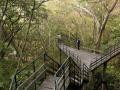
Basically, both Minh Chau and Quan Lan localities have quite favorable conditions for developing ecotourism. However, Quan Lan commune has more advantages to develop ecotourism in a humanistic direction, because this is an area with many famous historical relics such as Quan Lan Communal House, Quan Lan Pagoda, Temple worshiping the hero Tran Khanh Du, ... along with local festivals held annually such as the wind praying ceremony (March 15), Quan Lan festival (June 10-19); due to its location near the port and long exploitation time, the beaches in Quan Lan commune (especially Quan Lan beach) are no longer hygienic and clean to ensure the needs of tourists coming to relax and swim; this is also an area with many beautiful landscapes such as Got Beo wind pass, Ong Phong head, Voi Voi cave, but the ability to access these places is still very limited (dirt hill road, lots of gravel and rocks), especially during rainy and windy times; In addition, other natural resources such as mangrove forests and sea worms have not been really exploited for tourism purposes and ecotourism development. On the contrary, Minh Chau commune has more advantages in developing ecotourism in the direction of natural tourism, this is an area with diverse ecosystems such as at Rua De Beach, Bai Tu Long National Park Conservation Center...; Minh Chau beach is highly appreciated for its natural beauty and cleanliness, ranked in the top ten most beautiful beaches in Vietnam; Minh Chau commune is also home to Tram forest with a large area and a purity of up to 90%, suitable for building bridges through the forest (a very effective type of natural ecotourism currently applied by many countries) for tourists to sightsee, as well as for the purpose of studying and researching.
Figure 3.1: Thenmala Forest Bridge (India) Source: https://www.thenmalaecotourism.com/(August 21, 2019)
3.2.2. Using SWOT matrix to evaluate Quan Lan island tourism
General assessment of current tourism activities of Quan Lan island is shown through the following SWOT matrix:
Table 3.5: SWOT matrix evaluating tourism activities on Quan Lan island
Internal agent
Strengths- There is a lot of potential for tourism development, especially natural ecotourism and humanistic ecotourism.- The unskilled labor force is relatively abundant.- resource environmentunpolluted, still
Weaknesses- Poorly developed infrastructure, especially traffic routes to tourist destinations on the island.- The team of professional staff is still weak.- Tourism products in general
quite wild, originalintact
general and DLST in particularalone is monotonous.
External agents
Opportunity- Tourism is a key industry in the socio-economic development strategy of the province and Van Don economic zone.- Quan Lan was selected as a pilot area for eco-tourism development within the framework of the green growth project between Quang Ninh province and the Japanese organization JICA.- The flow of tourists and especially ecotourism in the world tends toincreasing
Challenge- Weather and climate change abnormally.- Competition in tourism products is increasingly fierce, especially with other localities in the province such as Ha Long, Mong Cai...- Awareness of tourists, especially domestic tourists, about ecotourism and nature conservation is not high.
Through summary analysis using SWOT matrix we see that:
To exploit strengths and take advantage of opportunities, it is necessary to:
- Diversify products and service types (build more tourism routes aimed at specific needs of tourists: experiential tourism immersed in nature, spiritual cultural tourism...)
- Effective exploitation of resources and differentiated products (natural resources and human resources)
div.maincontent .p { color: black; font-family:"Times New Roman", serif; font-style: normal; font-weight: normal; text-decoration: none; font-size: 14pt; margin:0pt; } div.maincontent p { color: black; font-family:"Times New Roman", serif; font-style: normal; font-weight: normal; text-decoration: none; font-size: 14pt; margin:0pt; } div.maincontent .s1 { color: black; font-family:"Times New Roman", serif; font-style: normal; font-weight: normal; text-decoration: none; font-size: 13pt; } div.maincontent .s2 { color: black; font-family:"Times New Roman", serif; font-style: normal; font-weight: normal; text-decoration: none; font-size: 13pt; } div.maincontent .s3 { color: #0D0D0D; font-family:"Times New Roman", serif; font-style: normal; font-weight: bold; text-decoration: none; font-size: 14pt; } div.maincontent .s4 { color: black; font-family:"Times New Roman", serif; font-style: italic; font-weight: normal; text-decoration: none; font-size: 14pt; } div.maincontent .s5 { color: black; font-family:"Times New Roman", serif; font-style: italic; font-weight: bold; text-decoration: none; font-size: 14pt; } div.maincontent .s6 { color: black; font-family:"Times New Roman", serif; font-style: italic; font-weight: normal; text-decoration: none; font-size: 14pt; vertical-align: -3pt; } div.maincontent .s7 { color: black; font-family:"Times New Roman", serif; font-style: italic; font-weight: normal; text-decoration: none; font-size: 14pt; vertical-align: -2pt; } div.maincontent .s8 { color: black; font-family:"Times New Roman", serif; font-style: italic; font-weight: normal; text-decoration: none; font-size: 14pt; vertical-align: -1pt; } div.maincontent .s9 { color: black; font-family:"Times New Roman", serif; font-style: normal; font-weight: normal; text-decoration: none; font-size: 14pt; } div.maincontent .s10 { color: black; font-family:"Times New Roman", serif; font-style: normal; font-weight: bold; text-decoration: none; font-size: 14pt; } div.maincontent .s11 { color: black; font-family:"Times New Roman", serif; font-style: normal; font-weight: normal; text-decoration: none; font-size: 14pt; } div.maincontent .s12 { color: black; font-family:Symbol, serif; font-style: normal; font-weight: normal; text-decoration: none; font-size: 14pt; } div.maincontent .s13 { color: black; font-family:Wingdings; font-style: normal; font-weight: normal; text-decoration: none; font-size: 14pt; } div.maincontent .s14 { color: black; font-family:"Times New Roman", serif; font-style: normal; font-weight: normal; text-decoration: none; font-size: 9pt; vertical-align: 5pt; } div.maincontent .s15 { color: black; font-family:"Times New Roman", serif; font-style: normal; font-weight: normal; text-decoration: none; font-size: 9pt; vertical-align: 5pt; } div.maincontent .s16 { color: black; font-family:Cambria, serif; font-style: italic; font-weight: normal; text-decoration: none; font-size: 14pt; } div.maincontent .s17 { color: #080808; font-family:"Times New Roman", serif; font-style: normal; font-weight: bold; text-decoration: none; font-size: 14pt; } div.maincontent .s18 { color: #080808; font-family:"Times New Roman", serif; font-style: normal; font-weight: normal; text-decoration: none; font-size: 14pt; } div.maincontent .s19 { color: black; font-family:"Times New Roman", serif; font-style: normal; font-weight: normal; text-decoration: none; font-size: 11pt; } div.maincontent .s20 { color: black; font-family:"Times New Roman", serif; font-style: normal; font-weight: normal; text-decoration: none; font-size: 10pt; } div.maincontent .s21 { color: black; font-family:"Times New Roman", serif; font-style: normal; font-weight: bold; text-decoration: none; font-size: 11pt; } div.maincontent .s22 { color: black; font-family:"Times New Roman", serif; font-style: normal; font-weight: normal; text-decoration: none; font-size: 11pt; } div.maincontent .s23 { color: black; font-family:"Times New Roman", serif; font-style: italic; font-weight: normal; text-decoration: none; font-size: 14pt; } div.maincontent .s24 { color: #212121; font-family:"Times New Roman", serif; font-style: normal; font-weight: normal; tex
Identify Rating Levels and Rating Scales
zt2i3t4l5ee
zt2a3gstourism,quan lan,quang ninh,ecology,ecotourism,minh chau,van don,geography,geographical basis,tourism development,science
zt2a3ge
zc2o3n4t5e6n7ts
of the islanders. Therefore, this indicator will be divided into two sub-indicators:
a1. Natural tourism attractiveness a2. Cultural tourism attractiveness
b. Tourist capacity
The two island communes in Quan Lan have different capacities to receive tourists. Minh Chau Commune is home to many standard hotels and resorts, attracting high-income domestic and international tourists. Meanwhile, Quan Lan Commune has many motels mainly built and operated by local people, so the scale and quality are not high, and will be suitable for ordinary tourists such as students.
c. Time of exploitation of Quan Lan Island Commune:
Quan Lan tourism is seasonal due to weather and climate conditions and festivals only take place on certain days of the year, specifically in spring. In Quan Lan commune, the period from April to June and from September to November is considered the best time to visit Quan Lan because the cultural tourism activities are mainly associated with festivals taking place during this time.
Minh Chau island commune:
Tourism exploitation time is all year round, because this is a place with a number of tourist attractions with diverse ecosystems such as Bai Tu Long National Park Research Center, Tram forest, Turtle Laying Beach, so besides coming to the beach for tourism and vacation in the summer, Minh Chau will attract research groups to come for tourism combined with research at other times of the year.
d. Sustainability
The sustainability of ecotourism sites in Quan Lan and Minh Chau communes depends on the sensitivity of the ecosystems to climate changes.
landscape. In general, these tourist destinations have a fairly high level of sustainability, because they are natural ecosystems, planned and protected. However, if a large number of tourists gather at certain times, it can exceed the carrying capacity and affect the sustainability of the environment (polluted beaches, damaged trees, animals moving away from their habitats, etc.), then the sustainability of the above ecosystems (natural ecosystems, human ecosystems) will also be affected and become less sustainable.
e. Location and accessibility
Both island communes have ports to take tourists to visit from Van Don wharf:
- Quan Lan – Van Don traffic route:
Phuc Thinh – Viet Anh high-speed boat and Quang Minh high-speed boat, depart at 8am and 2pm from Van Don to Quan Lan, and at 7am and 1pm from Quan Lan to Van Don. There are also wooden boats departing at 7am and 1pm.
- Van Don - Minh Chau traffic route:
Chung Huong high-speed train, Minh Chau train, morning 7:30 and afternoon 13:30 from Van Don to Minh Chau, morning 6:30 and afternoon 13:00 from Minh Chau to Van Don.
f. Infrastructure
Despite receiving investment attention, the issue of infrastructure and technical facilities for tourism on Quan Lan Island is still an issue that needs to be resolved because it has a direct impact on the implementation of ecotourism activities. The minimum conditions for serving tourists such as accommodation, electricity, water, communication, especially medical services, and security work need to be given top priority. Ecotourism spots in Minh Chau commune are assessed to have better infrastructure and technical facilities for tourism because there are quite complete and synchronous conditions for serving tourists, meeting many needs of domestic and foreign tourists.
3.2.1.4. Determine assessment levels and assessment scales
Corresponding to the levels of each criterion, the index is the score of those levels in the order of 4, 3, 2, 1 decreasing according to the standard of each level: very attractive (4), attractive (3), average (2), less attractive (1).
3.2.1.5. Determining the coefficients of the criteria
For the assessment of DLST in the two communes of Quan Lan and Minh Chau islands, the students added evaluation coefficients to show the importance of the criteria and indicators as follows:
Coefficient 3 with criteria: Attractiveness, Exploitation time. These are the 2 most important criteria for attracting tourists to tourism in general and eco-tourism in particular, so they have the highest coefficient.
Coefficient 2 with criteria: Capacity, Infrastructure, Location and accessibility . Because the assessment area is an island commune of Van Don district, the above criteria are selected by the author with appropriate coefficients at the average level.
Coefficient 1 with criteria: Sustainability. Quan Lan has natural and human-made ecotourism sites, with high biodiversity and little impact from local human factors. Most of the ecotourism sites are still wild, so they are highly sustainable.
3.2.1.6. Results of DLST assessment on Quan Lan island
a. Assessment of the potential for natural tourism development
For Minh Chau commune:
+ Natural tourism attractiveness is determined to be very attractive (4 points) and the most important coefficient (coefficient 3), so the score of the Attractiveness criterion is 4 x 3 = 12.
+ Capacity is determined as average (2 points) and the coefficient is quite important (coefficient 2), then the score of Capacity criterion is 2 x 2 = 4.
+ Exploitation time is long (4 points), the most important coefficient (coefficient 3) so the score of the Exploitation time criterion is 4 x 3 = 12.
+ Sustainability is determined as sustainable (4 points), the important coefficient is the average coefficient (coefficient 1), so the score of the Sustainability criterion is 4 x 1 = 4 points
+ Location and accessibility are determined to be quite favorable (2 points), the coefficient is quite important (coefficient 2), the criterion score is 2 x 2 = 4 points.
+ Infrastructure is assessed as good (3 points), the coefficient is quite important (coefficient 2), then the score of the Infrastructure criterion is 3 x 2 = 6 points.
The total score for evaluating DLST in Minh Chau commune according to 6 evaluation criteria is determined as: 12 + 4 + 12 + 4 + 4 + 6 = 42 points
Similar assessment for Quan Lan commune, we have the following table:
Table 3.3: Assessment of the potential for natural ecotourism development in Quan Lan and Minh Chau communes
Attractiveness of self-tourismof course
Capacity
Mining time
Sustainability
Location and accessibility
Infrastructure
Result
Point
DarkMulti
Point
DarkMulti
Point
DarkMulti
Point
DarkMulti
Point
DarkMulti
Point
DarkMulti
CommuneMinh Chau
12
12
4
8
12
12
4
4
4
8
6
8
42/52
Quan CommuneLan
6
12
6
8
9
12
4
4
4
8
4
8
33/52
b. Assessment of the potential for humanistic tourism development
For Quan Lan commune:
+ The attractiveness of human tourism is determined to be very attractive (4 points) and the most important coefficient (coefficient 3), so the score of the Attractiveness criterion is 4 x 3 = 12.
+ Capacity is determined to be large (3 points) and the coefficient is quite important (coefficient 2), then the score of the Capacity criterion is 3 x 2 = 6.
+ Mining time is average (3 points), the most important coefficient (coefficient 3) so the score of the Mining time criterion is 3 x 3 = 9.
+ Sustainability is determined as sustainable (4 points), the important coefficient is the average coefficient (coefficient 1), so the score of the Sustainability criterion is 4 x 1 = 4 points.
+ Location and accessibility are determined to be quite favorable (2 points), the coefficient is quite important (coefficient 2), the criterion score is 2 x 2 = 4 points.
+ Infrastructure is rated as average (2 points), the coefficient is quite important (coefficient 2), then the score of the Infrastructure criterion is 2 x 2 = 4 points.
The total score for evaluating DLST in Quan Lan commune according to 6 evaluation criteria is determined as: 12 + 6 + 6 + 4 + 4 + 4 = 36 points.
Similar assessment with Minh Chau commune we have the following table:
Table 3.4: Assessment of the potential for developing humanistic eco-tourism in Quan Lan and Minh Chau communes
Attractiveness of human tourismliterature
Capacity
Mining time
Sustainability
Location and accessibility
Infrastructure
Result
Point
DarkMulti
Point
DarkMulti
Point
DarkMulti
Point
DarkMulti
Point
DarkMulti
Point
DarkMulti
Quan CommuneLan
12
12
6
8
9
12
4
4
4
8
4
8
39/52
Minh CommuneChau
6
12
4
8
12
12
4
4
4
8
6
8
36/52
Basically, both Minh Chau and Quan Lan localities have quite favorable conditions for developing ecotourism. However, Quan Lan commune has more advantages to develop ecotourism in a humanistic direction, because this is an area with many famous historical relics such as Quan Lan Communal House, Quan Lan Pagoda, Temple worshiping the hero Tran Khanh Du, ... along with local festivals held annually such as the wind praying ceremony (March 15), Quan Lan festival (June 10-19); due to its location near the port and long exploitation time, the beaches in Quan Lan commune (especially Quan Lan beach) are no longer hygienic and clean to ensure the needs of tourists coming to relax and swim; this is also an area with many beautiful landscapes such as Got Beo wind pass, Ong Phong head, Voi Voi cave, but the ability to access these places is still very limited (dirt hill road, lots of gravel and rocks), especially during rainy and windy times; In addition, other natural resources such as mangrove forests and sea worms have not been really exploited for tourism purposes and ecotourism development. On the contrary, Minh Chau commune has more advantages in developing ecotourism in the direction of natural tourism, this is an area with diverse ecosystems such as at Rua De Beach, Bai Tu Long National Park Conservation Center...; Minh Chau beach is highly appreciated for its natural beauty and cleanliness, ranked in the top ten most beautiful beaches in Vietnam; Minh Chau commune is also home to Tram forest with a large area and a purity of up to 90%, suitable for building bridges through the forest (a very effective type of natural ecotourism currently applied by many countries) for tourists to sightsee, as well as for the purpose of studying and researching.
Figure 3.1: Thenmala Forest Bridge (India) Source: https://www.thenmalaecotourism.com/(August 21, 2019)
3.2.2. Using SWOT matrix to evaluate Quan Lan island tourism
General assessment of current tourism activities of Quan Lan island is shown through the following SWOT matrix:
Table 3.5: SWOT matrix evaluating tourism activities on Quan Lan island
Internal agent
Strengths- There is a lot of potential for tourism development, especially natural ecotourism and humanistic ecotourism.- The unskilled labor force is relatively abundant.- resource environmentunpolluted, still
Weaknesses- Poorly developed infrastructure, especially traffic routes to tourist destinations on the island.- The team of professional staff is still weak.- Tourism products in general
quite wild, originalintact
general and DLST in particularalone is monotonous.
External agents
Opportunity- Tourism is a key industry in the socio-economic development strategy of the province and Van Don economic zone.- Quan Lan was selected as a pilot area for eco-tourism development within the framework of the green growth project between Quang Ninh province and the Japanese organization JICA.- The flow of tourists and especially ecotourism in the world tends toincreasing
Challenge- Weather and climate change abnormally.- Competition in tourism products is increasingly fierce, especially with other localities in the province such as Ha Long, Mong Cai...- Awareness of tourists, especially domestic tourists, about ecotourism and nature conservation is not high.
Through summary analysis using SWOT matrix we see that:
To exploit strengths and take advantage of opportunities, it is necessary to:
- Diversify products and service types (build more tourism routes aimed at specific needs of tourists: experiential tourism immersed in nature, spiritual cultural tourism...)
- Effective exploitation of resources and differentiated products (natural resources and human resources)
div.maincontent .p { color: black; font-family:"Times New Roman", serif; font-style: normal; font-weight: normal; text-decoration: none; font-size: 14pt; margin:0pt; } div.maincontent p { color: black; font-family:"Times New Roman", serif; font-style: normal; font-weight: normal; text-decoration: none; font-size: 14pt; margin:0pt; } div.maincontent .s1 { color: black; font-family:"Times New Roman", serif; font-style: normal; font-weight: normal; text-decoration: none; font-size: 13pt; } div.maincontent .s2 { color: black; font-family:"Times New Roman", serif; font-style: normal; font-weight: normal; text-decoration: none; font-size: 13pt; } div.maincontent .s3 { color: #0D0D0D; font-family:"Times New Roman", serif; font-style: normal; font-weight: bold; text-decoration: none; font-size: 14pt; } div.maincontent .s4 { color: black; font-family:"Times New Roman", serif; font-style: italic; font-weight: normal; text-decoration: none; font-size: 14pt; } div.maincontent .s5 { color: black; font-family:"Times New Roman", serif; font-style: italic; font-weight: bold; text-decoration: none; font-size: 14pt; } div.maincontent .s6 { color: black; font-family:"Times New Roman", serif; font-style: italic; font-weight: normal; text-decoration: none; font-size: 14pt; vertical-align: -3pt; } div.maincontent .s7 { color: black; font-family:"Times New Roman", serif; font-style: italic; font-weight: normal; text-decoration: none; font-size: 14pt; vertical-align: -2pt; } div.maincontent .s8 { color: black; font-family:"Times New Roman", serif; font-style: italic; font-weight: normal; text-decoration: none; font-size: 14pt; vertical-align: -1pt; } div.maincontent .s9 { color: black; font-family:"Times New Roman", serif; font-style: normal; font-weight: normal; text-decoration: none; font-size: 14pt; } div.maincontent .s10 { color: black; font-family:"Times New Roman", serif; font-style: normal; font-weight: bold; text-decoration: none; font-size: 14pt; } div.maincontent .s11 { color: black; font-family:"Times New Roman", serif; font-style: normal; font-weight: normal; text-decoration: none; font-size: 14pt; } div.maincontent .s12 { color: black; font-family:Symbol, serif; font-style: normal; font-weight: normal; text-decoration: none; font-size: 14pt; } div.maincontent .s13 { color: black; font-family:Wingdings; font-style: normal; font-weight: normal; text-decoration: none; font-size: 14pt; } div.maincontent .s14 { color: black; font-family:"Times New Roman", serif; font-style: normal; font-weight: normal; text-decoration: none; font-size: 9pt; vertical-align: 5pt; } div.maincontent .s15 { color: black; font-family:"Times New Roman", serif; font-style: normal; font-weight: normal; text-decoration: none; font-size: 9pt; vertical-align: 5pt; } div.maincontent .s16 { color: black; font-family:Cambria, serif; font-style: italic; font-weight: normal; text-decoration: none; font-size: 14pt; } div.maincontent .s17 { color: #080808; font-family:"Times New Roman", serif; font-style: normal; font-weight: bold; text-decoration: none; font-size: 14pt; } div.maincontent .s18 { color: #080808; font-family:"Times New Roman", serif; font-style: normal; font-weight: normal; text-decoration: none; font-size: 14pt; } div.maincontent .s19 { color: black; font-family:"Times New Roman", serif; font-style: normal; font-weight: normal; text-decoration: none; font-size: 11pt; } div.maincontent .s20 { color: black; font-family:"Times New Roman", serif; font-style: normal; font-weight: normal; text-decoration: none; font-size: 10pt; } div.maincontent .s21 { color: black; font-family:"Times New Roman", serif; font-style: normal; font-weight: bold; text-decoration: none; font-size: 11pt; } div.maincontent .s22 { color: black; font-family:"Times New Roman", serif; font-style: normal; font-weight: normal; text-decoration: none; font-size: 11pt; } div.maincontent .s23 { color: black; font-family:"Times New Roman", serif; font-style: italic; font-weight: normal; text-decoration: none; font-size: 14pt; } div.maincontent .s24 { color: #212121; font-family:"Times New Roman", serif; font-style: normal; font-weight: normal; tex -
 Assessment of the Quality of Sustainable Tourism Development Factors in Nghe An Province from Provincial Tourism Management Officers
 -
 The Process of Formation and Development of Law and State Management by Law for Tourism Activities in the Democratic Republic of Vietnam
 -
 Factors Affecting State Management of Tourism Activities
 -
 Strengthening State Management of Tourism Resources Development
APPENDIX 1
APPENDIX 1A:
Summary table of criteria for evaluating provincial-level local management of PTDLBV
STT
State management content for tourism development of the provincial level | Evaluation criteria | Classify | References | |
Organize the implementation of strategies, planning, plans and policies for tourism development | The organization and implementation of national tourism strategies, planning, plans and policies are consistent with the country's potential and position. tourism strength of Thanh Hoa province. | Suitability | The author developed from the theory proposed by Nguyen Hong Phu (2018) | |
1 | The level of serious implementation of the strategy, planning, plans and policies of relevant organizations and individuals; | Validity | The author developed from the theory proposed by Nguyen Hong Phu (2018); Dao Anh Tuan (2013), Nguyen Anh Tu (2015) | |
The implementation of strategies, planning and tourism development plans in Thanh Hoa province has been timely and effective. fruit. | Efficiency | |||
The level of coherence of national tourism development strategies, plans, policies and schemes compared to other strategies, plans and schemes socio-economic development plan of Thanh Hoa province | Sustainability | The author developed from the theory proposed by Nguyen Hong Phu (2018) | ||
Develop, promulgate and organize the implementation of legal documents on tourism at the provincial level. | The development of legal documents on tourism has met the requirements of the integration process and the general development plan of Thanh Hoa province. | Efficiency | The author developed from the theory proposed by Dao Anh Tuan (2013), Nguyen Hong Phu (2018) | |
2 | The system of tourism legal documents is built and issued under local authority, complete, synchronous and fair. open, transparent | Validity | ||
The issuance of preferential policies and investment attraction to exploit the tourism potential and strengths of Thanh Hoa province has received attention and attracted many investors. invest. | Validity | The author developed from the theory proposed by Nguyen Hong Phu (2018) | ||
The implementation and concretization of legal documents on PTDLBV are suitable to the reality in Thanh Hoa province. | Suitability | The author developed from the theory proposed by Nguyen Hong Phu (2018) | ||
3 | Organization of state management apparatus for DLBV development , coordination of state agencies | The current organization of the province's state management apparatus for tourism is effective. | Efficiency | The author developed from the theory proposed by Nguyen Anh Tu (2015), Nguyen Hong Phu (2018) |
The current number of tourism managers in the province is reasonable, meeting the task. | Suitability |
STT
State management content for local tourism development provincial level | Evaluation criteria | Classify | References | |
in local government management province for PTDLBV | Coordination between sectors in managing labor contracts in the area currently meets the requirements. | Efficiency | ||
4 | Management of tourism market development promotion at provincial level | Attractive and effective local tourism market development promotion policy | Efficiency | The author developed from the theory proposed by Dao Anh Tuan (2013), Nguyen Anh Tu (2015), Nguyen Hong Phu (2018) |
Coordination of promotional activities Market development in recent years has been effective. | Suitability | |||
Tourism promotion work inside and outside the province is carried out reasonably and achieves results. fruit | Suitability | |||
5 | Management of recognition of tourist areas and destinations and licensing of tourism activities at provincial level (including tourist spots, tourist areas, tourism service businesses)? | Legal documents on management, recognition of tourist areas and destinations and licensing of tourism activities are consistent with the socio-economic development resolutions, strategies, plans, programs and tourism development plans of the province, contributing to tourism development. become the key economic sector of the province. | Suitability | The author developed from the theory proposed by Dao Nguyen Hong Phu (2018) |
The management of provincial tourist areas and tourist attractions must ensure close coordination between state management agencies. water on tourism with departments, branches and sectors | Validity | The author developed from the theory proposed by Dao Anh Tuan (2013), Nguyen Hong Phu (2018) | ||
Procedures for recognizing tourist areas and destinations and granting tourism licenses are simple, convenient, and responsive. meet the needs of individuals and people | Efficiency | |||
Provincial-level local environmental protection, climate change response and resource protection work | The local policy on conservation, exploitation of tourism resources and protection of tourism environment is clear, complete and synchronous. | Validity | Nguyen Hong Phu (2018) | |
6 | Resource use plans are linked to the protection of natural resources. | Suitability | Dao Anh Tuan (2013), Nguyen Hong Phu (2018) | |
Activities to control and reduce pollution during production and consumption Tourism products have been implemented and ensured to comply with regulations. | Efficiency | Dao Anh Tuan (2013), Nguyen Anh Tu (2015), Nguyen Hong Phu (2018) | ||
Activities to reduce waste and treat natural waste generated from tourism activities are perform regularly and effectively | Sustainability | Dao Anh Tuan (2013), Nguyen Hong Phu (2018) | ||
7 | Human resource development management (planning, training), application of science and technology in tourism | The work of organizing, training, fostering and developing tourism human resources has been maintained and enhanced over the years. | Validity | Nguyen Hong Phu (2018) |
Policy to encourage and support training and development of tourism human resources locally implemented synchronously and fully | Validity | Nguyen Hong Phu (2018) |
STT | State management content for local tourism development provincial level | Evaluation criteria | Classify | References |
8 | Level of human resource assurance for local provincial-level state management activities for PTDLBV | Sustainability | Dao Anh Tuan (2013), Nguyen Anh Tu (2015), Nguyen Hong Phu (2018) | |
The application of IT in tourism activities in Thanh Hoa has been deployed and implemented. effective | Efficiency | Dao Anh Tuan (2013), Nguyen Hong Phu (2018) | ||
Organize inspection, examination, settlement of complaints, denunciations and handling of violations in PTDL of local provincial level | Inspection, examination, settlement of complaints and denunciations and handling of violations of tourism laws are carried out regularly. regularly | Validity | Nguyen Anh Tu (2015) | |
Inspect, examine, resolve complaints, denunciations and handle violations of tourism laws. The schedule is carried out correctly and on time. | Efficiency | Dao Anh Tuan (2013), Nguyen Anh Tu (2015), Nguyen Hong Phu (2018) | ||
Content of inspection, examination, supervision, handling of violations and complaints is objective and reasonable. | Suitability | Nguyen Anh Tu (2015), Nguyen Hong Phu (2018) |
(Source: author's synthesis)
APPENDIX 1B
Summary table of factors affecting Thanh Hoa province's State management of PTDLBV
Element
REFERENCES | ||
I. Economic, political and social conditions | ||
1 | Local economic growth | Le Thi To Quyen and colleagues (2018); Duong Hoang Huong (2017) |
2 | Reasonable price for travel services | Truong Tri Thong and Nguyen Trong Nhan (2019) |
3 | Level of investment in tourism | Le Thi To Quyen and colleagues (2018) |
4 | Begging, soliciting and selling street vendor | Vu Van Dong (2014) |
5 | Social evils, epidemics | |
6 | Level of safety, order and security at the site tourism, tourist area | |
II. TNDL | ||
7 | Historical relics are restored, protected, and preserved. and put into operation DLBV | Le Duc Vien (2017) |
8 | The richness and beauty of the natural landscape of course, unique indigenous culture | Manuel et al. (2016) |
9 | The attractiveness, uniqueness and diversity of the system flora and fauna | Nguyen Thi Trang Nhung and colleagues (2014) |
10 | Diverse and rich cuisine | Manuel et al. (2016) |
III. Viewpoints and policies of PTDLBV | ||
11 | Provincial tourism development policies and mechanisms | Le Duc Vien (2017); Truong Tri Thong (2019) |
12 | Policies to encourage people Sustainable Development | |
13 | Coordination between local authorities and people in organizing tourism activities of the province | |
14 | Product strategy, quality improvement quantity of tourism services of the province | Le Thi To Quyen and colleagues (2018) |
15 | Policies for preservation, restoration and development Environmental resources associated with sustainable development | Nguyen Quyet Thang (2012) |
IV. Infrastructure and technical facilities serving PTDLBV | ||
16 | Road system, traffic, means of transport convenient to travel within the area | Maythawn (2014) |
17 | Information system, electricity, water, equipment served by HDDL | |
18 | System of accommodation facilities and restaurants | Nguyen Trong Nhan (2015) |
19 | Entertainment and relaxation system, shopping shopping | |
V. State management capacity for PLDLBV | ||
20 | The suitability of decentralization and delegation of authority State management apparatus for PLDLBV | Tran Thi Xuan Mai (2019) |
Qualifications and abilities of staff doing the work State management of tourism | ||
22 | Ethical qualities of staff doing the work State management of tourism | |
VI. Sense of responsibility of tourists and facilities Tourist and local people | ||
23 | Sense of responsibility of tourists | Duong Hoang Huong (2017) |
24 | Sense of responsibility of tourism establishments | |
25 | Environmental protection awareness and tourism development local people | Nguyen Quyet Thang (2012) |
21
(Source: Author's synthesis)
APPENDIX 2 APPENDIX 2A
Survey form for expert opinions on criteria for evaluating provincial-level local management of PTDLBV
Number of votes:……. | |
DEPARTMENT OF POSTGRADUATE ADMINISTRATION |
EXPERT SURVEY FORM
(On the criteria for evaluating provincial-level local management of PTDLBV)
INTRODUCTION
Hello everyone! My name is: Le Thi Binh, currently a PhD student at the University of Commerce, Hanoi. I am conducting a research project on “State management of Thanh Hoa province for PTDLBV”. First of all, I would like to sincerely thank you for creating the conditions to meet and conduct this exchange. The discussed viewpoints will be very useful for the research project and contribute to the completion of State management of Thanh Hoa province for PTDLBV.
Personal information of the respondent:
Full name: ……………………. Age:…………………..Gender:….. Work unit: ……………………..
Position: .. ……………….. Education: …………………. Time working at current position: ……………………….
CONTENT SECTION
1. Criteria for evaluating the content of State management of Thanh Hoa province for PTDLBV.
STT
Contents of State management of local PTDLBV provincial level | Evaluation criteria | Opinion of the expert | ||||
Classify | Agree | Disagree | Other opinions | |||
1 | Organize the implementation of strategies, planning, plans and policies for tourism development | The organization and implementation of national tourism strategies, planning, plans and policies are consistent with the country's tourism potential and strengths. Thanh Hoa province. | ||||
The level of serious implementation of strategies, planning, plans and policies books of related organizations and individuals; | ||||||
The organization and implementation of strategies, planning and tourism development plans in Thanh Hoa province has been timely and effective. effective again. | ||||||
The level of coherence of national tourism development strategies, plans, policies and schemes compared to other strategies, plans, schemes and schemes Socio-economic development policy of the province | ||||||
STT
Contents of State management of PTDLBV of provincial-level localities | Evaluation criteria | Opinion of the expert | ||||
Classify | Agree | Disagree | Other opinions | |||
Thanh Hoa | ||||||
Develop, promulgate and organize the implementation of legal documents on tourism at the provincial level. | The development of legal documents on tourism has met the requirements of the integration process and the general development plan of Thanh Hoa province. | |||||
2 | The system of tourism legal documents is built and issued under the authority of the locality in full. synchronous, public, transparent | |||||
Issuing preferential policies and attracting investment to exploit the province's tourism potential and strengths. Thanh Hoa has been interested and attracted many investors. | ||||||
Implementation and concretization of legal documents for PTDLBV appropriately with reality in Thanh Hoa province. | ||||||
3 | Organization of state management apparatus for sustainable tourism development, coordination of state agencies in state management of provincial-level localities for sustainable tourism development | The current organization of the province's state management apparatus for tourism is effective. | ||||
The current number of tourism managers in the province is reasonable, meeting the task. | ||||||
Coordination between sectors in managing labor contracts in the area currently meets requirements. set out | ||||||
4 | Management of tourism market development promotion at provincial level | Market development promotion policy attractive and effective local tourism market | ||||
Coordination of market development promotion activities The past years have been productive. | ||||||
Tourism promotion work inside and outside the province is carried out reasonably and achieves results. result | ||||||
5 | Management of recognition of tourist areas and destinations and licensing of tourism activities at provincial level (including tourist spots, tourist areas, tourism service businesses)? | Legal documents on management, recognition of tourist areas and destinations and licensing of tourism activities are consistent with the socio-economic development resolutions, strategies, plans, programs and tourism development plans of the province, contributing to tourism development. become the key economic sector of the province. | ||||
The management of provincial tourist areas and tourist attractions ensures close coordination between management agencies. State management on tourism with departments, | ||||||