
Solution symbol
Urgency (CT) of solutions (Frequency / %) | Feasibility (KT) of solutions (Frequency / %) | |||||||||||
Very urgent | Urgent | Little urgent | Kh urgent | X | Hierarchy | Very KT | KT | Less KT | Kh KT | X | Hierarchy | |
GP1 | 190 | 81 | 7 | 6 | 3.6 | 3 | 165 | 108 | 6 | 5 | 3.52 | 3 |
66.9 | 28.5 | 2.5 | 2.1 | 58.1 | 38.0 | 2.1 | 1.8 | |||||
BP5 | 172 | 93 | 11 | 8 | 3.51 | 7 | 133 | 117 | 22 | 12 | 3.31 | 6 |
60.6 | 32.7 | 3.9 | 2.8 | 46.8 | 41.2 | 7.7 | 4.2 | |||||
BP6 | 181 | 88 | 10 | 5 | 3.57 | 5 | 161 | 109 | 10 | 4 | 3.50 | 4 |
63.7 | 31.0 | 3.5 | 1.8 | 56.7 | 38.4 | 3.5 | 1.4 | |||||
BP7 | 176 | 91 | 9 | 8 | 3.53 | 6 | 139 | 93 | 39 | 13 | 3.26 | 7 |
62.0 | 32.0 | 3.2 | 2.8 | 48.9 | 32.7 | 13.7 | 4.6 | |||||
Maybe you are interested!
-

 Testing the Urgency and Feasibility of Measures to Manage Geography Teaching Activities
 -
 Survey on the Urgency and Feasibility of Proposed Management Measures
 -
 Testing the Urgency and Feasibility of Proposed Measures
 -
 Comparison Chart of Academic Ranking of Students of Nam Son Secondary School, Bac Ninh City, Period 2017-2019
 -
 Survey Subjects' Assessment of the Feasibility of Management Measures for Child Care and Education Activities at Social Protection Centers
The content of 7 solutions for managing physical education activities for students at universities in Hanoi city according to the DBCL approach proposed in the thesis are all very urgent and very feasible. Because the lowest average score is 3.26 points, and according to the Likirt scale, with max = 4, min = 1, when 3.25 ≤ X ≤ 4.0 points, the assessment level reaches the highest level (very urgent, very feasible).
Solution 1: Organize the dissemination of the content of the approach to ensure the quality of physical education in universities for managers, lecturers and students with a score of 3.6 points for necessity (rank 3), with 66.9% of the survey participants considering it "very urgent" and a score of 3.51 points for feasibility (rank 3), with 58.1% of the survey participants considering it "very feasible". Through discussion and discussion, many GDTC lecturers said that the reason why the majority of survey participants highly appreciated the urgency of implementing this solution was because a large number of managers, lecturers and students did not fully understand the quality of physical education in universities.
Solution 2: Directing the innovation of physical education content and programs towards developing learners' capacity has a necessity score of 3.58 points (rank 4), with 66.5% of the survey participants considering it "very urgent" and a feasibility score of 3.43 points (rank 5), with 51.4% of the survey participants considering it "very feasible". According to the officials
Managers and teachers participating in the seminars said that it is necessary for universities to actively promote innovation in the curriculum, content, methods, and forms of organizing physical education subjects. This means that directing innovation in the curriculum, content, methods, and forms of organizing physical education subjects towards developing learners' capacity is one of the regular tasks that schools must do. However, there are also schools that are slow to innovate the curriculum content to meet educational goals and learners' needs.
Solution 3: Managing physical education activities according to the quality assurance process was assessed with 3.71 points for urgency (rank 1), of which 74.7% of the survey participants said it was "very urgent" and 3.55 points for feasibility (rank 2), of which 59.2% said it was "very feasible". The reason this solution was rated the highest is because the survey participants realized that: The core issue of improving the quality of physical education in schools is to comply with a quality assurance process. Through the discussions, many people said that: To achieve quality assurance, universities must pay close attention to the process and quality standards of the elements that make up the physical education process.
Solution 4: Organizing professional and technical training for physical education lecturers according to the quality assurance approach was assessed for urgency with 3.67 points (rank 2), of which 71.5% of the survey participants considered it "very urgent" and feasibility with 3.60 points (rank 1), of which 62% of the survey participants considered it "very feasible".
Solution 5: Managing facilities and effectively exploiting equipment for physical education at universities in the direction of ensuring quality has a urgency score of 3.51 points (rank 7), with 60.6% of respondents saying it is "very urgent" and a feasibility score of 3.31 points (rank 6), with 46.8% of respondents saying it is "very feasible". This is the solution with the lowest ranking in terms of urgency and feasibility. The reason why this solution is rated by physical education staff and lecturers at
The low ranking is still quite modest because the budget for building new sports facilities or purchasing modern sports equipment is often quite large, and the annual investment in physical education facilities is also very limited. Training ground equipment has been fixed in each area. Therefore, this solution is meaningful in overcoming those shortcomings.
Solution 6: Organizing school sports movements associated with physical education activities is assessed for urgency with 3.57 points (rank 5), of which 63.7% of the survey participants considered it "very urgent" and feasibility with 3.50 points (rank 4), of which 56.7% of the survey participants considered it "very feasible". This is a solution with a low ranking in terms of urgency and feasibility. Through discussions and discussions, many managers and lecturers said: The development of the sports movement at universities is always based on the results of physical education activities for students, but the management of sports clubs' activities and the direction of building the sports movement have not been given due attention, and the strengths of the physical education department/faculty have not been promoted.
Solution 7: Organizing innovation in the method of testing and evaluating physical education according to the quality assurance approach was assessed for urgency with 3.53 points (rank 6), of which 62% of the survey participants considered it "very urgent" and feasibility with 3.26 points (rank 7), of which 48.9% of the survey participants considered it "very feasible". This is a solution aimed at performing well the testing and evaluation function of management entities for physical education activities, thereby having a positive impact on the quality assurance of this subject. This is a regular task and schools must do a good job of periodic testing and evaluation.
To confirm the correlation between the urgency and feasibility of solutions for managing physical education activities for students at universities in Hanoi according to the DBCL approach, it is necessary to use the formula for calculating the rank correlation coefficient (Spearman), specifically as follows:
6 ( X
Y ) 2
R 1
N ( N 2 1)
(CT 4.1)
In which: N is the number of ranked units; X is the ranked order of urgency of solutions; Y is the ranked order of feasibility of solutions. R is a number less than 1; the closer the value of R is to 1, the stronger the correlation. If R<0, the correlation is negative. If R>0, the correlation is positive.
When 0.7 R < 1 : Strong correlation; 0.5 R < 0.7 : Normal correlation; 0.3 R < 0.5: Correlation is not strong.
Calculation based on the data in Table 4.1 gives the following results:
R  0.8929
Thus, the hierarchical correlation between the necessity and feasibility of solutions for managing physical education activities for students at universities in Hanoi according to the DBCL approach proposed by the thesis is positively and closely correlated. That can be seen through Figure 4.1 below.
Figure 4.1: Comparison chart between the urgency and feasibility of the solutions proposed by the thesis
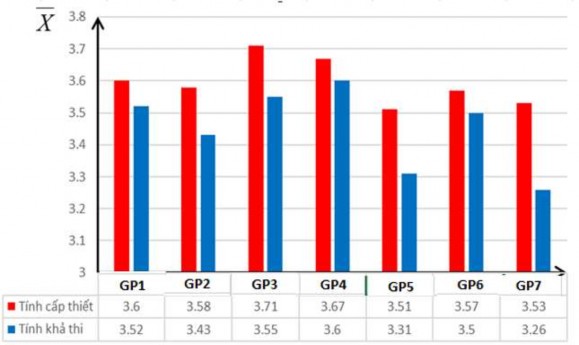
From the chart above, it can be seen that each solution for managing physical education activities for students at universities in Hanoi according to the DBCL approach proposed by the thesis has a higher level of urgency than feasibility. That partly reflects the difficulties and complexities in organizing the implementation of the solutions.
4.3. Testing the proposed solution
4.3.1. Testing organization
4.3.1.1. Purpose of testing
Verify the effectiveness of the solution "Managing physical education activities according to quality assurance process", thereby affirming the positive impact of the proposed solutions.
4.3.1.2. Test task
Organize to collect feedback from learners on teaching activities of GDTC lecturers before and after the trial according to Instruction No. 1276/BGDĐT-NG dated February 20, 2008 of the Ministry of Education and Training;
Conduct pilot impacts of the solution "Managing physical education activities according to quality assurance processes";
Process test results and draw scientific conclusions.
4.3.1.3. Test hypothesis
The quality of physical education is governed by the elements that make up physical education activities. If the process of managing the elements that make up physical education activities to ensure quality is implemented, the effectiveness of physical education activities will change in a positive direction.
4.3.1.4. Time and forces participating in the test
Testing period : February 2019: Preparation work; March to June 2019: Conducting test impacts; July 2019: Analysis of test results.
Testing force: Department of Physical Education - National Defense Education, Hanoi University of Natural Resources and Environment.
The target audience for feedback on the teaching performance of physical education instructors was 258 students who had completed course 1 before the trial and continued to study course 2 of athletics during the trial period.
4.3.1.5. Test procedure Test preparation:
(1) Develop a "Feedback form from learners on teaching activities of GDTC lecturers".
The feedback content used here closely follows the Instruction No. 1276/BGDĐT-NG dated February 20, 2008 of the Ministry of Education and Training. To implement the principle of “respecting teachers and valuing education”, the feedback form is labeled “Referendum form on students’ satisfaction with physical education activities” with 4 levels: very satisfied, satisfied, less satisfied, not satisfied [Appendix 5].
(2) Agree with the staff and lecturers of the Department of Physical Education - National Defense Education, Hanoi University of Natural Resources and Environment on the process of ensuring the quality of teaching activities of lecturers.
(3) Organize statistics on the exam results of semester 1 of 258 students before the experiment.
(4) Organize to collect feedback from 258 students about the teaching activities of GDTC lecturers before the experiment.
Test run:
Impact 1 : Organize discussions and conclusions in the Physical Education department/faculty to develop a process for preparing and practicing teaching each sport in the Physical Education program for students.
Impact 2 : Instruct lecturers to survey students' needs, experiences and sports talents as the initial stage of the Physical Education subject process, from which to develop lesson plans and teaching activity plans suitable for the learners.
Impact 3 : Deploy preparation content and carry out lesson plans and teaching plans for each topic in the course, guide learners in practicing the process and ensure safety in each lesson.
Impact 4 : Organize class observation and gain experience in teaching part 2 of Physical Education subject in the direction of developing students' physical capacity.
Impact 5 : Evaluate teaching performance results to serve as a basis for adjusting implementation plans accordingly.
End of test
(1) Organize the second semester athletics exam and collect feedback from 258 students on the teaching activities of physical education lecturers after the trial;
(2) Processing of test results.
4.3.2. Test results
4.3.2.1. Analysis of physical education exam results of 258 students at Hanoi University of Natural Resources and Environment, before and after the experiment
Based on the close relationship between teaching and learning activities in physical education activities, examining the effects of the pilot solution "Managing physical education activities according to the quality assurance process" requires taking into account changes in students' learning outcomes. Therefore, the pilot process was conducted from after students finished semester 1 to the end of semester 2. Comparing the results of the semester 1 exam (before the pilot) and the results of the semester 2 exam (after the pilot), we have the following table:
Table 4.2. Civic Education exam results of 258 students before and after the experiment
STT
Time of evaluation | Test score (Frequency / %) | X | |||||||
10 | 9 | 8 | 7 | 6 | 5 | 4 (repeat) | |||
1 | Before the test | 0 | 14 | 50 | 64 | 44 | 29 | 57 | 6.25 |
0 | 5.4 | 19.4 | 24.8 | 17.1 | 11.2 | 22.1 | |||
2 | After experiment | 0 | 18 | 56 | 70 | 51 | 27 | 36 | 6.53 |
0 | 7.0 | 21.7 | 27.1 | 19.8 | 10.5 | 14.0 | |||
Table 4.2 shows that the average score of students after the experiment was higher than before the experiment (6.53 compared to 6.25). The percentage of students achieving good and excellent scores after the experiment was higher than before the experiment, while the percentage of students having to retake the test after the experiment was lower than before the experiment (14% compared to
22.1%). This allows us to conclude that applying the solution "Managing physical education activities according to quality assurance processes" has had a positive impact on students' learning outcomes.
4.3.1.2. Analysis of survey results on students' satisfaction with physical education activities, before and after the experiment
According to the CIPO quality management model, the satisfaction of students' needs for developing knowledge, skills, and attitudes is considered one of the indicators of educational quality. To assess student satisfaction, one can rely on feedback on student satisfaction during the process. With that in mind, the author of this thesis asked for students' opinions on their satisfaction with the teaching activities of lecturers before and after the experiment. The results were as follows:
Table 4.3. Results of the survey on students' satisfaction with lecturers' teaching activities before and after the experiment
STT
Content and symbols | Time Referendum | Satisfaction level | X | t | ||||
Very satisfied | Satisfied | Less satisfied | Not satisfied | |||||
1 | Is a detailed course outline provided before the course (H1)? | Before experiment | 64 | 135 | 59 | 0 | 3.02 | 2.80885 |
After the test | 105 | 113 | 40 | 0 | 3.25 | |||
2 | Strictly follow the teaching schedule and content of the syllabus. section (H2) | Before experiment | 76 | 111 | 71 | 0 | 3.02 | 2,1527 |
After the test | 93 | 123 | 42 | 0 | 3.20 | |||
3 | The standards of teachers are demonstrated through: demeanor, dress, behavior and readiness. support learners (H3) | Before the test | 86 | 118 | 54 | 0 | 3.12 | 1,98748 |
After the test | 101 | 128 | 29 | 0 | 3.28 | |||
4 | The teacher's teaching methods are diverse, easy to understand, and use modern equipment. effective teaching aids help learners develop | Before the test | 81 | 127 | 50 | 0 | 3.12 | 2,1545 |
After the test | 106 | 121 | 31 | 0 | 3.29 | |||