
According to teachers' opinions on applying teaching methods to form socio-economic geography concepts for 10th grade high school students in Bac Kan province, the most effective methods are: open dialogue, discussion, problem-posing, using maps and visual aids.
The suggestions of the province's Geography teachers are: it is necessary to supplement reference materials, teaching aids for Geography, train students in self-study methods, form learning motivation for students, improve the teaching quality of secondary school Geography teachers. In particular, every year, training and fostering classes should be opened for teachers on innovation in Geography teaching methods and application of information technology in Geography teaching.
1.2.3.2. Student learning situation
To understand the situation of studying Geography and the ability to absorb the concepts of socio-economic geography of 10th grade high school students in the province, we interviewed teachers who directly teach 10th grade Geography and collected the results of the 1-period test of the second semester (Socio-economic Geography section) of a number of high schools. The results are as follows (Table 1.3):
Table 1.3. Statistics of 1-period test scores of 10th grade students in some high schools in Bac Kan province.
High School
Total number of students | Point | |||||||||
1 | 2 | 3 | 4 | 5 | 6 | 7 | 8 | 9 | ||
Specialized in Bac Kan | 50 | 1 | 5 | 14 | 22 | 8 | ||||
100% | 2.0% | 10.0% | 28.0% | 44.0% | 16.0% | |||||
Bac Kan | 310 | 5 | 18 | 57 | 56 | 54 | 64 | 45 | 11 | |
100% | 1.6% | 5.8% | 18.4% | 18.1% | 17.4% | 20.6% | 14.5% | 3.5% | ||
New Market | 329 | 2 | 6 | 33 | 84 | 61 | 54 | 47 | 38 | 4 |
100% | 0.6% | 1.8% | 10.0% | 25.5% | 18.5% | 16.4% | 14.3% | 11.6% | 1.2% | |
Na Phac | 232 | 9 | 17 | 55 | 77 | 47 | 24 | 3 | ||
100% | 3.9% | 7.3% | 23.7% | 33.2% | 20.3% | 10.3% | 1.3% | |||
Phu Thong | 301 | 1 | 7 | 15 | 38 | 69 | 74 | 65 | 29 | 3 |
100% | 0.3% | 2.3% | 5.0% | 12.6% | 22.9% | 24.6% | 21.6% | 9.6% | 1.0% | |
Total | 1222 100% | 3 0.2% | 18 1.5% | 75 6.1% | 196 16.0% | 242 19.8% | 264 21.6% | 237 19.4% | 158 12.9% | 29 2.4% |
Maybe you are interested!
-
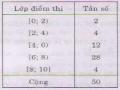
 The Average Scores of Grade 10A Students in Semester 1 Are Recorded in the Following Table:
 -
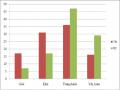 Compare Test Scores Between the Experimental Class and the Control Class
 -
 N-No2- Concentration (Mg/l) of Treatment Area and Control Area During the Test Period: (♦) Treatment Area, (■) Control Area.
 -
 Average Proportion of Enterprises by Size in the Period 2000-2009 (Source: General Statistics Office)
 -
 Test Results Statistics Table of Classes (Members)
Through the test results of students, it shows that most students only grasp the questions about remembering concepts. Students cannot do the questions and exercises that require deep understanding of concepts or require creativity. Many students grasp the concepts vaguely and only grasp the surface of the concepts. Many students get the questions about statistical data analysis skills and chart drawing skills wrong or cannot do them.
To better understand the situation of studying Geography, the concept of socio-economic geography and the causes of the above situation, we conducted interviews with 10th grade students of the 5 high schools above (as shown in Table 1.3). The total number of interviewed students was 519. Of which, 311 were female, 208 were male, and 411 were ethnic minorities (accounting for 79.2%). The results are as follows:
* Question: Do you like studying Geography? Why?
- 83.8% of students answered that they like studying Geography because it provides knowledge about natural geography, economy and society of the world and Vietnam.
- 16.2% of students do not like studying Geography because they think this is a long subject, difficult to learn and they are not interested in studying Geography.
* What are your comments when learning the concepts of socio-economic geography in the 10th grade Geography textbook? The student's answer is as follows:
- 35.5% of students said it was difficult to understand because of the abstract concept.
- 54.5% of students find it easy to understand because it is close to life.
- 10.0% of students answered that depending on the concept, some concepts are easy to understand and some are difficult to understand.
* To grasp new socio-economic geography concepts, students often rely on the following knowledge:
- 47.0% of students rely on previous lesson knowledge.
- 48.0% of students rely on accumulated geographical knowledge.
- 64.4% of students rely on practical knowledge.
- 74.2% of students rely on textbook knowledge.
- 77.5% of students rely on the knowledge imparted by teachers.
- 59.2% of students rely on knowledge from the media.
* In addition to textbook knowledge, students also acquire geographical knowledge from sources: Books and newspapers (68.4%), Internet (27.7%) and reference books (33.5%).
* Causes affecting the acquisition of socio-economic geography concepts of 10th grade students:
- 60.9% of students said it was due to limitations in abstract thinking.
- 22.9% of students have limited language skills.
- 33.9% of students think that teachers' teaching methods are not convincing.
- 52.2% of students have limited social knowledge.
- 58.4% of students lack teaching aids and reference materials.
- 48.2% of students think that school facilities are lacking.
Through investigation and survey, it is shown that there are many reasons affecting the learning of Geography and socio-economic geography concepts of 10th grade high school students in the province. In particular, the biggest limitation of students in understanding socio-economic geography concepts is poor abstract thinking, limited social knowledge, lack of teaching aids and reference materials, and lack of school facilities. On the other hand, due to inferiority complex, students do not dare to speak up in class lessons. Interview results show that 57.2% of students rarely speak up to build lessons because they do not know or know but are afraid to speak up, afraid to answer for fear of being wrong, ... leading to a quiet classroom atmosphere, less excitement and limiting students' understanding of concepts. That also reflects that the teaching methods of teachers have not promoted the students' initiative, the teachers' control of the teaching and learning process is not flexible and monotonous, so it has not encouraged all students in the class to participate in forming new knowledge.
Through investigation and interviews, we received many opinions and suggestions from students. Most of them suggested that more facilities should be provided.
and geography teaching equipment, especially visual aids. Some students commented that geography teachers need to expand their knowledge and make more practical connections so that students can understand the concepts of socio-economic geography.
1.2.4. The need to strengthen the application of the teaching method to form geographical knowledge and socio-economic geography concepts for grade 10 high school students in Bac Kan
1.2.4.1. Purpose of innovation in teaching methods
The implementation of innovation in general education programs requires synchronous innovation from goals, content, methods, teaching aids to ways of evaluating teaching results, in which the breakthrough is innovation in teaching methods.
The purpose of innovation in teaching methods in general schools is to change the one-way teaching method to teaching according to " Active teaching methods " to help students develop positivity, self-awareness, initiative, creativity, practice self-study habits and abilities, cooperative spirit, and skills in applying knowledge to different situations in learning and in practice. Create confidence, joy and excitement in learning for students; make "learning" a process of creation, students explore, discover, practice, exploit and process information, self-form understanding, capacity and qualities. Organize cognitive activities for students, teach students how to find the truth, focus on forming capacities (self-study, creativity, cooperation, ...), teach learning methods. Learn to meet the requirements of present and future life. What has been learned is necessary and useful for students themselves and for social development.
To innovate the way of learning, we must innovate the way of teaching, the way of teaching determines the way of learning. However, the passive learning habits of students also affect the way of teaching of teachers. On the other hand, there are also cases where students want to learn according to the method of teaching online but teachers have not met the requirements. Therefore, teachers need to foster and persevere in teaching according to the method of teaching online, organizing cognitive activities from simple to complex, from low to high to form habits for students. In
Innovation in methods requires the cooperation of teachers and students, and the coordination of teaching activities with learning activities to achieve results. PPDHTC contains both teaching methods and learning methods.
1.2.4.2. The situation of teaching and learning Geography and the concept of socio-economic geography in grade 10 high school in Bac Kan province
- For teachers: The team of Geography teachers has little professional training, the application of modern teaching methods in teaching and learning is still limited, not very effective, and not suitable for the students of the province. Teachers - especially long-time teachers have not actively updated theories on innovative teaching methods, the facilities for teaching Geography in many schools are still lacking, so the quality of teaching and learning Geography and socio-economic geography concepts is not high.
- For students: Learning motivation is not clear, besides, some teachers do not pay attention to orienting students' motivation and interest in learning. Students are shy, self-conscious, quiet, afraid of communication, have not mastered learning skills, do not have the right learning methods, have limited social knowledge... Therefore, students are not proactive in activities while teachers do not create conditions for students to be independent, proactive in acquiring knowledge, and their learning tends to be mechanical memorization.
- Learning tools, as means of cognitive activities for teaching and learning, are still lacking. The application of learned knowledge and practical knowledge to form new geographical knowledge and socio-economic geographical concepts of students is still weak, along with limited abstract thinking ability, causing difficulties in acquiring knowledge and socio-economic geographical concepts of students.
Therefore, in the teaching and learning process, Geography teachers need to orient the purpose and motivation of learning correctly for students, need to show students the importance of Geography, from which students will have the need to learn. Applying the teaching methods to stimulate students' interest in learning. In particular, because students in mountainous areas have weak abstract thinking, teachers need to connect with the knowledge they have learned and the knowledge of real life.
life, combined with the exploitation of visual aids such as maps, pictures, models and mass media so that students can clearly understand the nature of concepts and apply them in practice.
1.2.4.3. The role and significance of the socio-economic geography concept system in the 10th grade high school Geography program
Geography 10 is a program at the beginning of high school, called the General Geography program, consisting of 2 parts: Natural Geography and Socio-Economic Geography. The content of the Geography 10 program mainly includes general concepts, causal relationships and geographical laws. In which, the concepts of socio-economic geography belong to part two of General Socio-Economic Geography. In addition to the concepts of socio-economic geography, the textbook also has many concepts of other scientific subjects and these concepts form the foundation of the content of socio-economic geography knowledge. For example: "Birth rate" (Demography), "Export, import, market" (Economics), "Transport volume, circulation volume" (Transport science), concepts of means of production, division of labor, monopoly of production (concepts of philosophy, economics, ...).
The formation of such highly abstract concepts in students is a complex process, requiring teachers to flexibly use teaching methods, especially independent teaching methods, to promote students' active and proactive acquisition of socio-economic geographical concepts. In reality, when forming concepts, most teachers only independently explain and describe, causing students to not have to think, explore, or discover, so students absorb concepts passively, listlessly, and without interest because they do not directly participate in the process of concept formation.
1.2.5. Summary of Chapter 1
From the above analysis, we come to the following conclusions:
- Concept perception: Concept is the basic form of thinking, reflecting the general properties and nature of things and phenomena that have been
abstraction and generalization after carrying out thinking operations (comparison, analysis, synthesis, systematization, generalization).
- Socio-economic geographical concepts are a basic component of geographical knowledge. It is a reflection in thinking of socio-economic geographical objects and phenomena that have been abstracted and generalized based on essential signs after carrying out thinking operations (comparison, analysis, synthesis, systematization, generalization).
- The need to apply teaching methods to form socio-economic geography concepts for 10th grade high school students in Bac Kan province, because the current situation of teaching and learning Geography and socio-economic geography concepts in 10th grade of the province is not very effective. While the system of socio-economic geography concepts can be considered the "backbone" of the entire content of the socio-economic geography section in 10th grade high school. The correct formation of socio-economic geography concepts in the 10th grade Geography textbook is of particular importance for mastering the knowledge system of the entire high school Geography program, greatly affecting the learning results of Geography in 11th and 12th grade of students.
Chapter 2
SOME METHODS TO FORM SOCIO-ECONOMIC GEOGRAPHY CONCEPTS FOR 10TH GRADE HIGH SCHOOL STUDENTS IN BAC KAN PROVINCE
2.1. Objectives, program content, Geography 10 textbooks for high school
2.1.1. Program objectives
* General objectives:
- Contribute to perfecting general education for students to meet the goals of education and development of Vietnamese people in the period of industrialization and modernization of the country.
- Create conditions for students to continue studying at higher levels in the fields of natural sciences or social sciences and humanities.
- Consolidate and continue to develop some of the main capacities of students that have been formed in lower secondary school, including: the capacity to act effectively based on the knowledge, skills, and qualities acquired during the learning, training, and communication process; the capacity to cooperate and coordinate actions in learning and life, the capacity to be creative, to be able to adapt to changes in life, and the capacity to assert oneself.
* Specific objectives:
- Regarding knowledge, master general and basic knowledge about:
+ The Earth, in the sense of the human living environment, includes its components and their interactions, and some main laws of the geographic shell.
+ Population geography.
+ The main economic activities of humans on Earth.
+ The relationship between population, production activities with the environment and sustainable development.
- Regarding skills , continue to strengthen and develop in students:
+ Skills of observation, comment, analysis, synthesis, comparison of geographical objects and phenomena as well as skills of reading and using maps, statistics...
+ Skills in collecting and presenting geographic information.
+ Skills to apply knowledge to a certain extent to explain geographical phenomena.
- Regarding attitude and feelings : contribute to making students: love nature, people, have awareness and practical actions to protect the surrounding environment. Pay attention to some geographical issues at home and abroad. Clearly see their own responsibility in the socio-economic development of the locality and the country.
2.1.2. Program content
* General Natural Geography section
- In theory , including the following contents:
+ Maps: Basic map projections and some methods of representing socio-economic geographical objects on maps, using maps in study and life.
+ Universe: Consequences of Earth's movements.
+ Structure of the Earth, the layers of the crust.
+ Atmosphere, hydrosphere, soil and biosphere.
+ Some rules of the geographic crust.
- In terms of practice : the practical content focuses on clarifying theoretical knowledge, practicing reading skills, analyzing maps of natural components and analyzing charts related to natural phenomena.
* General Socio-Economic Geography Section
- In theory, this part includes the following 6 contents:
+ Population geography: population and population growth; population structure; population distribution, types of settlements and urbanization.
+ Economic structure: economic development resources and economic structure.
+ Agricultural geography: Role and characteristics, factors affecting agricultural distribution; Geography of agricultural sector (cultivation, animal husbandry, forestry, aquaculture) and some forms of agricultural territorial organization.
+ Industrial geography: Role and characteristics, factors affecting industrial development and distribution; Geography of some major industries and some main forms of industrial territorial organization.
+ Service geography: Role and characteristics, factors affecting the development and distribution of service industries. Geography of some service industries, namely transportation, communications and trade.
+ Environment and sustainable development: two basic contents are environment and natural resources, environment and sustainable development.
- In terms of practice : the program content aims to train skills in analyzing statistical data, building charts based on given data and skills in reading and analyzing population maps and socio-economic maps.
2.2. Identify the system of socio-economic geography concepts in the Geography Textbook 10 of high school (section on socio-economic geography)
2.2.1. Structure and content of Geography Textbook 10th grade high school (Socio-economic Geography section)
- Regarding content : the content of the 10th grade Geography textbook, the standard program, the section on Socio-Economic Geography, has changed compared to the old textbook, which is:
+ Add content that was not previously included in the textbook:
- Economic structure: economic development resources, components of economic structure.
- Service geography: additional information and communication industry articles.
- Environment and sustainable development: concept of sustainable development, environmental issues and sustainable development.
+ On the basis of Geography of economic sectors, more emphasis is placed on territorial organization.
+ Update new knowledge
- Regarding structure : The Socio-Economic Geography section in the Geography Textbook 10 consists of 6 chapters. The arrangement of chapters, lessons and duration of this section is as follows:
Chapter V: Population Geography (4 periods)
+ Lesson 22. Population and population growth.
+ Lesson 23. Population structure.
+ Lesson 24. Population distribution. Types of settlements and urbanization.
+ Lesson 25. Practice: Analyze the world population distribution map.
Chapter VI: Economic structure (1 section)
+ Lesson 26. Economic structure.
Chapter VII: Agricultural Geography (4 lessons)
+ Lesson 27. Role, characteristics, factors affecting the development and distribution of agriculture. Some forms of agricultural territorial organization.
+ Lesson 28. Geography of crop production
+ Lesson 29. Geography of livestock industry.
+ Lesson 30. Practice: Draw and analyze charts of food production in the world and some countries.
Chapter VIII: Industrial Geography (5 periods)
+ Lesson 31. The role and characteristics of industry. Factors affecting the development and distribution of industry.
+ Lesson 32. Geography of industries
Geography of industries (continued).
+ Lesson 33. Some main forms of industrial territorial organization.
+ Lesson 34. Practice: Draw a chart of the production situation of some industrial products in the world.
Chapter IX: Service Geography (6 sections)
+ Lesson 35. Role, influencing factors and distribution characteristics of service industries.
+ Lesson 36. Role, characteristics and factors affecting the development and distribution of the transport industry.
+ Lesson 37. Geography of transportation industries
+ Lesson 38. Practice: Write a short report about the Suez Canal and the Panama Canal.
+ Lesson 39. Geography of communications industry.
+ Lesson 40. Geography of commerce.
Chapter X: Environment and sustainable development (2 sections)
+ Lesson 41. Environment and natural resources.
+ Lesson 42. Environment and sustainable development.
- Total number of periods is 22, including 18 theory periods and 4 practice periods.
The core knowledge content of the Socio-Economic Geography section of the Grade 10 Geography Textbook is the concepts and laws of socio-economic development. These are difficult issues because they are abstract. In order for students to grasp the knowledge, teachers need to find specific examples to illustrate and focus on clarifying the concepts and laws.
The most difficult problem now is to innovate teaching methods to match the innovation of textbook content. Based on the orientation of teaching methods in textbooks and teachers' books (SGV) Geography 10, teachers need to increase the exploitation of visual channels, statistical tables, questions and exercises. It is necessary to diversify teaching methods with the support of teaching equipment and tools depending on each specific lesson to achieve the highest efficiency.
In the content of the Geography 10 textbook, the Socio-Economic Geography section is also quite diverse and new to students. The textbook has continued and developed the knowledge that students have learned in junior high school. With this approach, the knowledge content that has been presented thoroughly in junior high school will, in principle, not be repeated in the Geography 10 textbook. Therefore, when teaching, teachers should create conditions for students to reproduce the knowledge they have in junior high school, especially the Socio-Economic Geography of Vietnam (Geography 9).
2.2.2. Concept hierarchy
In Geography and Social Geography of Grade 10 High School, geographical knowledge is presented in a system of quite complex concepts, a lesson has one or several concepts. Whether teaching and learning Geography is effective or not depends on