
or the end of the previous lesson to guide students in planning the lesson organization.
- Teacher's activities: need to raise the project topic, orient the activity goals, build a set of guiding questions: " Based on the learning content, the teacher gives a topic with attractive suggestions, stimulating learners to participate in implementation " [25; p.125]. This step creates motivation and special attraction for students if the teacher accompanies and suggests problems with them. The choice of problem needs to ensure feasibility, practicality, and arouse curiosity and interest in students.
Here we carry out a project with the theme "Learning about the Hoa Lu Ancient Capital - the 42-year capital of the Dai Co Viet state during the Dinh - Tien Le - Ly dynasties (968 - 1010) and the early days of building an independent state in the 10th century" with the main content being to learn about the history of the formation and construction of the Vietnamese feudal state in the early days of independence in the 10th century through experiencing some local cultural heritages in Ninh Binh province:
+ Temple of King Dinh Tien Hoang in Gia Phuong commune, Gia Vien district, Ninh Binh province: Location, history, architecture and value of the relic. The life and background of Dinh Bo Linh when he was young.
+ Temple and tomb of King Dinh Tien Hoang in Truong Yen commune, Hoa Lu district, Ninh Binh province: Location, history of formation, architecture and value of the relic. Initial steps in building an independent state in the 10th century: Ngo and Dinh dynasties (Ngo dynasty - the state opened the period of independence and autonomy; Building and developing the feudal state of Dai Co Viet (Dinh - Tien Le) in the 10th century.
+ Temple of King Le Dai Hanh in Truong Yen commune, Hoa Lu district, Ninh Binh province: Location, history, architecture and value of the relic. Initial steps in building and consolidating an independent state in the 10th century: Tien Le period.
From there, the teacher chooses an appropriate time (maybe a class meeting or a previous lesson) to orient the problem: "With the topic of Learning about the Hoa Lu Ancient Capital - the 42-year capital of the Dai Co Viet state during the Dinh - Tien Le - Ly dynasties (968 - 1010) and the early days of building an independent state in the 10th century, what do you want to learn?". Students present their ideas, the teacher listens, skillfully guides them to form sub-projects, then divides the class into 3 groups to receive topics corresponding to the sub-projects:
+ Group 1: Field survey at King Dinh Tien Hoang temple - Gia Phuong commune, Gia Vien district, learn and report on the life and background of Dinh Bo Linh when he was young.
+ Group 2, 3: Field survey at the Hoa Lu Ancient Capital relic complex - Truong Yen commune, Hoa Lu district, research and report on the initial content of building an independent state in the 10th century.
Then, the teacher assigns tasks to each group through a set of guiding questions.
+ Group 1: Introduce the relic of King Dinh Tien Hoang Temple - Gia Phuong commune, Gia Vien district; Learn about the life and background of Dinh Bo Linh when he was young.
Products of group 1 must show the following contents:
About introducing the relic of King Dinh Tien Hoang Temple - Gia Phuong Commune, Gia Vien District: Geographical location, history of formation; Architecture; Religious characteristics, differences in beliefs of the relic in Gia Phuong Commune, Gia Vien District with the temples of King Dinh in other locations in the whole province; Festivals; Meaning and value of the relic in history and for the present; Personal connection about awareness and responsibility in preserving and promoting the value of the heritage.
About learning about the background and life of Dinh Bo Linh when he was young: Biography of hometown, country, family based on historical sources; Exploiting some typical folk tales associated with Dinh Bo Linh's background ("Con Rai Than", "Ma toc Ham Rong", "Su tu song Hoang Long"...)
+ Group 2: Introduction to the Hoa Lu ancient capital relic - the 42-year capital of Dai Co Viet state during the Dinh - Tien Le - Ly dynasties (968 - 1010): Geographical location, history of the relic's formation; Explain why King Dinh Tien Hoang chose Hoa Lu as the capital, why King Ly Thai To decided to move the capital to Thang Long; Special architecture of the relic (mainly King Dinh's temple and King Le's temple); General contributions of King Dinh Tien Hoang and King Le Dai Hanh; Value of the relic; Relate to yourself about awareness and responsibility in preserving and promoting the value of the heritage.
+ Group 3: About the early days of building an independent state in the 10th century - Dinh - Tien Le period. The presentation, pictures, and Powerpoint slides must show the following content: Affirm the role of Ngo Quyen and Dinh Bo Linh; Explain why the Dinh dynasty was considered a centralized feudal state.
The first in our country? The formation process of Dai Co Viet state (Basis of formation, formation, time, location, capital); State apparatus organization (diagram and comments, comparison of state apparatus organization in Ngo, Dinh - Tien Le period); Military situation, law, foreign affairs of Dinh - Tien Le period; Assess the role and historical position of Dinh - Tien Le state.
- Student activities: Work in groups to choose a sub-project topic. Student groups assign a group leader, secretary, and discuss and make a plan to carry out the sub-project tasks. This clearly defines the specific research problem, the work to be done, the expected time, assigns tasks to each member, discusses what means to use, the products to be achieved, etc.
After agreeing on a specific plan, the groups need to send representatives to present their plans to the teacher and the whole class, continue to discuss, give comments and complete them in front of the class.
Finally, the teacher and student groups develop and agree on specific criteria to evaluate the project.
Table 2.2. Assignment of tasks to each member of the project team
Status
Full name | Role | Mission | Expected products | Completion deadline | |
1 | Nguyen Van A | Team Leader | - General control of all work of the group. - Assign tasks to team members | Minutes of group task assignment | 1 week |
2 | B | Secretary | Record discussion ideas and feedback to send back to the group leader and teacher. | Group activity log | 1 week |
3 | C | IT expert | Typing, presenting on Powerpoint... | Presentation | 1 week |
4 | D | Reporter | Together with members, develop questions and conduct interviews with relevant people (historical researchers, relic site management board, etc.) | Interview Answer Sheets, Photos, Video Clips | 1 week |
5 | … |
Maybe you are interested!
-
 Applying Project-Based Learning to Organize Study Tours to the Hoa Lu Ancient Capital Cultural Heritage
 -
 Using the cultural heritage of Hoa Lu Ancient Capital in teaching local history in grade 10 high school in Ninh Binh province - 2
 -
 Analysis of Technical and Policy Gaps of Project 661 Applied in Hoa Binh Province
 -
 Domestic Research on Project Investment Management Using State Budget Capital.
 -
 Total Investment Capital of Phu My 2.2 Thermal Power Plant Project
The development of project evaluation criteria must ensure a comprehensive evaluation of the student group's product in terms of content (is it accurate, relevant, and extended to reality?), presentation layout (logical, clear, and appropriate?), presentation form (aesthetic, appropriate to the content, easy to understand?), and interaction organization (many members participating in the report, reasonable time allocation, flexible handling of situations, not dependent on media...).
Step 2: Implement the project (Collect information; Conduct investigation; Discuss with other members; Consult with instructor)
- Teacher's activities: Monitor, guide, and evaluate students during the project implementation process. The teacher is also the first person to approve the final products of the groups before reporting the project in class.
- For student activities:
+ Conduct data searches and collect information as assigned by the project. You can collect information directly by visiting sites, interviewing witnesses and related people... Or indirectly through books, newspapers, documents, the Internet...
+ Information processing: the information collected by the group must be processed skillfully and neatly based on a specific, objective, scientific historical perspective and must closely follow the content requirements of the sub-topic.
+ Finally, students in groups build and complete the product or report.
Regularly contact and provide feedback to teachers and other student groups.
For the project topic: "Learning about the Hoa Lu Ancient Capital relic - the 42-year capital of the Dai Co Viet state during the Dinh - Tien Le - Ly dynasties (968 - 1010) and the early days of building an independent state in the 10th century", the products of the student groups after carrying out the project and preparing the report are: Video, presentation, pictures, diagrams, Powerpoint slideshow introducing the heritage of King Dinh Tien Hoang Temple (Gia Phuong - Gia Vien) and the content of the life and background of Dinh Bo Linh; Video introducing the Hoa Lu Ancient Capital heritage; Presentation, pictures, Powerpoint slideshow about: The early days of building an independent, autonomous state in the 10th century.
Step 3: Project completion (Synthesize results; Present and evaluate results conducted in LSDP class; Teachers and students evaluate and draw lessons from the study tour at the heritage site).
- Teacher's activities:
Ask groups to discuss and agree on the product report.
Prepare facilities for project reporting session (Computer, projector, laser pen, speaker, microphone...; Group scoreboard, study cards; Ao paper, sticky notes (3 colors), markers, ballpoint pens, product hangers)...
Work with groups to monitor and evaluate project products. At the same time, provide suggestions, draw lessons, and provide specific directions for project groups to improve efficiency in future projects.
- Student activities: group discussion, determining the time to complete the product. Prepare and introduce the project product. Self-evaluate your group's product and evaluate the products of other groups according to the pre-agreed evaluation criteria. The project research results need to be presented by the group to the class, to the teacher and students in the LSDP lesson.
For post-study tour testing and evaluation when applying project-based learning, the main and final evaluation criteria are usually the groups' reports after implementing the study tour project at the heritage site. To accurately evaluate these products, it is necessary to develop specific and public evaluation criteria immediately after the project tasks are formed (students should participate in developing these criteria).
Finally, it should be noted that the project-based teaching activity of organizing a study tour at Hoa Lu Ancient Capital is also an in-class lesson, so it is necessary to ensure flexible organization of learning activities from warm-up activities to knowledge formation activities (project product reports) then practice - consolidation activities and application - expansion activities. The goal of this teaching method is to foster historical awareness in students through the task of directly researching and exploiting sources of documents on Hoa Lu Ancient Capital to create a report product in class. The process of implementing and completing the project has contributed to the development of information searching and processing skills, teamwork skills, communication skills and helped form essential competencies such as self-study skills, problem-solving skills in practice, linking book theory with real life.
History lessons thus become more vivid and attractive to each student and, more importantly, educate them about responsibility and positive actions to preserve and promote local heritage values.
2.3.2. Increasing the use of Hoa Lu Ancient Capital's cultural heritage to organize extracurricular activities
Extracurricular activities are a form of teaching organization that helps students deeply understand the historical issues they have learned, so they have the effect of supporting intracurricular activities, aiming to achieve the general educational goal. Specifically: "Extracurricular activities open up wide possibilities to recreate the past in description and in activities (drama, games, etc.)" [2; p.303]. In addition, extracurricular activities in history also " create the basis for linking the school with social life " [35; p.196].
When selecting and organizing this activity, the following main requirements must be followed:
- The content of extracurricular activities must aim at implementing the educational goals of the school level, performing the functions and tasks of the history subject. It is necessary to pay attention to the characteristics of learning history: based on accurate, basic, typical events to organize extracurricular activities.
- Extracurricular activities are an aspect, a part of studying in high school, so they must be related to the curriculum, and programs and plans for extracurricular activities must be developed with appropriate forms. Therefore, although the main activities of extracurricular activities are conducted outside of class hours, the content and topics of these activities must be close to the main curriculum and specified in the subject curriculum.
- Organizing extracurricular activities must be focused, avoiding ostentation and falling into formality. It is possible to coordinate with other subjects such as Literature, Geography, and Civic Education in organizing major national and local holidays of the year. The interdisciplinary nature of extracurricular activities makes students' learning outcomes comprehensive and profound.
- Using the Hoa Lu Ancient Capital Cultural Heritage to organize extracurricular activities can be carried out in many different and diverse forms such as:
Extracurricular activities are organized regularly in a class or group: reading books,
Make visual aids and collect local historical documents about relics of Hoa Lu Ancient Capital.
Large-scale activities are held on major holidays: heritage tours, camping on the occasion of Truong Yen Festival (March 10th of the lunar calendar every year), historical gala...
Social work: talking about history, participating in traditional festivals, taking care of relics...
Extracurricular activities through organizing historical games such as "History quiz", "crossword", "code game"...
The implementation of the above forms of extracurricular activities depends on the conditions (local circumstances, schools, classes, students' and teachers' abilities, local socio-political requirements, etc.). Within the scope of this thesis, we will explore some basic and popular extracurricular forms suitable for the conditions of high schools in Ninh Binh province.
2.3.2.1. Organizing extracurricular tours - experiences at the Hoa Lu Ancient Capital cultural heritage in the form of "I practice being a tour guide" according to the process:
First , plan for extracurricular activities and heritage experiences as follows:
- Determine the purpose and objectives for the visit.
- Prepare conditions for the tour, including:
+ Teachers propose to the school to plan extracurricular tours and heritage experiences right from the beginning of the school year. The tour content must be suitable for the program, student level and specific local conditions.
+ Teachers contact the relic management board (Hoa Lu Ancient Capital Monument Conservation Center), discuss with the officer in charge, and clearly state the purpose and requirements of the extracurricular visit.
+ Teachers estimate the budget for the field trip, can contact and mobilize funds from parents.
+ One day before the field trip, the teacher informs the students about the purpose and requirements of the field trip and what they need to do during the trip.
The teacher gives tasks to students, divides the class into 2 groups and assigns tasks to the groups with the requirement that students play the role of tour guides to introduce a typical artifact at the Hoa Lu Ancient Capital Relic Site.
Group 1: Introduction to Ngo Mon Quan at King Dinh Tien Hoang Temple. Group 2: Introduction to Long Sang in front of Bai Duong Temple of King Dinh Tien Hoang
King.
This task creates conditions to promote the positivity of each individual member and the whole group of students to participate in order to complete it. The groups learn about the relic in advance to prepare for the presentation at the relic.
Second , conduct the tour:
- Teachers need to plan the time for the visit to the heritage site to suit the health, level and cognitive ability of the students.
- Upon arrival, the teacher gathers the students in front of the relic site, organizes, checks attendance, re-informs the purpose and requirements of the visit and reminds students to strictly follow the rules of the relic site. In particular, one of the important requirements for students is to record the main content of the data and documents they receive from the visit (it can be paper and pen, or take photos, record audio, film).
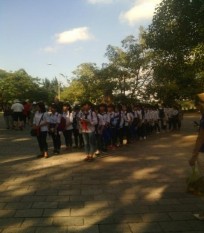
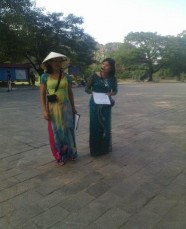
Figure 2.1. Teachers gather students in front of the gate of King Dinh Tien Hoang temple.
- Next, the teacher guides students to cover the entire Hoa Lu Ancient Capital relic site and gives students a general introduction to the formation process of the relic site.
- Teachers take turns leading students to visit and learn about the 17th century architecture at the two temples worshipping King Dinh Tien Hoang and King Le Dai Hanh, especially the Exhibition Area.