
It can be seen that the assessments of international organizations are the most objective comments on the prospects of attracting FDI in Vietnam in the coming years. When Vietnam officially became a member of the WTO, this prospect has become much more optimistic. At the same time, it creates conditions for expanding export markets and service business to the world, thereby promoting the image of a country of Vietnam full of potential and investment opportunities.
The investment environment of our country has been increasingly improved due to the completion of the economic legal system according to the market mechanism and the public and transparent implementation of management institutions according to WTO regulations. This has been done through the promulgation and application of a series of important new laws as well as the thorough decentralization of the issuance of investment and business certificates to local foreign investment management agencies. At the same time, the infrastructure system has received more attention and investment in recent years has been greatly improved.
The current trend of FDI investment in the world is to focus on developing countries, especially emerging economies with high economic growth rates and favorable investment environments. As a neighbor to a powerful country like China, we also enjoy some advantages such as becoming an ideal investment location to share the risks of focusing too much investment on China, large corporations have been adjusting their long-term investment strategies, allocating investment capital to another country in the region. Vietnam, with its open foreign policy and constantly improving investment environment, is becoming an attractive investment destination for powerful international corporations.
In the period of international economic integration, Vietnam is gradually becoming a harmonious country, cooperating and developing friendship with all other countries. We are also gradually moving deeper into the global integration process through agreements signed with other countries such as the trade agreement.
Bilateral BTA with the US, participation in the ASEAN framework agreement, successful organization of the 14th APEC Conference in Hanoi in 2006, becoming an official member of the WTO ... all of these efforts to integrate with the international economy have enhanced Vietnam's image in all economic, cultural and political fields. Currently, Vietnam is considered an attractive investment destination for most neighboring countries. Japan considers Vietnam a strategic partner in the ASEAN bloc for investment. Singapore and Vietnam have also signed an agreement to implement an economic linkage project. Taiwan continues to implement the Southern strategy - with Vietnam as the center of the strategy.
Table 9: Assessment of Vietnam's investment environment in the period 2007-2011
Criteria
Total score (out of 10) 2002-2006 | 2007-2011 | Rating (Out of 82) 2002-2006 | 2007-2011 | |
Overall Score and Ranking | 4.83 | 5.95 | 70 | 65 |
Political environment | 5.2 | 5.3 | 50 | 56 |
Political stability | 6.3 | 6.3 | 48 | 49 |
Efficiency of operations politics | 4.2 | 4.5 | 57 | 58 |
Macro environment | 6.9 | 6.9 | 56 | 64 |
Opportunities in the market school | 5.7 | 6.3 | 50 | 41 |
Policies towards private enterprises and competition painting | 3.8 | 5.5 | 67 | 58 |
Policy towards DTNN | 6.0 | 6.9 | 57 | 49 |
Rate control level and foreign trade | 5.1 | 7.3 | 66 | 59 |
Tax | 4.6 | 5.9 | 73 | 57 |
Financial issues | 2.5 | 5.5 | 76 | 66 |
Maybe you are interested!
-
 Assessment of the Situation of Attracting Korean Direct Investment in Vietnam's Real Estate Sector.
 -
 Development Orientation of Vietnam's Real Estate Market
 -
 General Assessment of Adjusting Vietnam's Investment Attraction Policy in the Face of the Trend of Forming Free Trade Agreements in Asia
 -
 Attracting FDI into Vietnam's real estate sector. Current situation and prospects in the period of international economic integration - 11
 -
 Lessons Learned for Attracting FDI into Vietnam's Real Estate Sector
Labor market
5.7 | 5.9 | 58 | 62 | |
Infrastructure | 3.0 | 4.1 | 78 | 77 |
(Source: Economist Intelligence Unit 2007-Outlook
world investment to 2011)
The above table shows that Vietnam's investment environment has improved in most areas, more opportunities in the market have opened up, and investors
FDI is favored in a more competitive and equal business environment. With positive progress in recent years, tax and financial issues will be significantly improved. These are really encouraging signs for investors. However, it can be seen that the stability of the macro environment and political environment has decreased, and if the labor market continues to fall into the state of "too many workers, not enough teachers", the lack of truly good skills as it is now will also reduce the ability to compete with other countries. Therefore, there needs to be more attention from the Government and the State on these important issues.
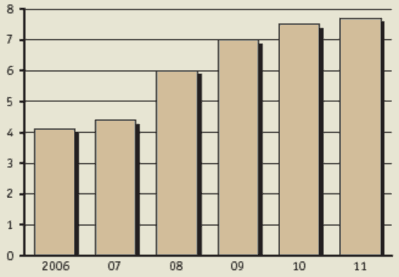
Regarding the total FDI capital into Vietnam in the next 4 years, until 2011, it is forecasted that there will be positive signals as follows:
Chart 10: Forecast of FDI capital flow into Vietnam in the period 2006-2011 billion USD
(Unit: billion USD)
year
(Source: Economist Intelligence Unit 2007-World Investment Outlook to 2011)
It is possible to see the inevitable trend of increasing FDI capital flows into Vietnam thanks to the positive impacts of international economic integration activities, thanks to progressive changes and economic situation in the renovation period in legal documents, regulations on direct investment and related documents. Strong economic growth combined with a stable political environment are decisive factors for the success of attracting FDI, strengthening the economy, bringing our country to the level of
new heights in the period of international economic integration. 29
2.2 Some challenges in attracting foreign direct investment for Vietnam in the period of international economic integration
Along with the benefits we will gain from integrating into the international economy, we also have to face the challenges that the integration process itself brings.
2.2.1 Competition will become increasingly fierce
Among domestic enterprises alone, when entering the market, they have to compete with very strong rivals to gain market share and their own market. When Vietnam joined the international economy, joined international organizations such as ASEAN, AFTA ... most recently joined the world economic organization WTO, along with the benefits that the
29 Appendix 3
In addition to the commitments other countries have made to us, we are also forced to make a number of mandatory commitments, including opening up in almost all fields. Currently, only national security and defense is our exclusive field. From the end of 2006 until now, we have successively opened up in many fields such as finance, banking, electricity, transportation, infrastructure construction ... at the same time allowing investors to be proactive in capital, proactive in deciding the form and method of investment. The more foreign enterprises penetrate our market, the greater the difficulties for domestic enterprises. With advantages in technology and abundant capital, foreign enterprises and companies will certainly dominate the market in some fields. Small and medium-sized domestic enterprises, not strong enough to compete, will also soon be eliminated from the game. However, integration is inevitable, and domestic enterprises are forced to improve themselves further to be ready to accept difficulties in the coming time.
2.2.2 Challenges from removing barriers
When globalization takes place in Vietnam, trade barriers and tariffs will be completely eliminated. And thus, incentives will no longer exist. Vietnam's investment environment will become less attractive to TNCs. This challenge poses a difficult problem for the government, which is to find timely measures and alternatives so that our investment environment will remain a destination for FDI investors around the world.
2.2.3 The benefits of the host country are increasingly limited.
Another impact is that investors are increasingly focusing on projects with high profit margins, quick capital recovery, and projects are mostly concentrated in areas with favorable socio-economic conditions. With
With such projects, the countries receiving the investment will not be able to make much profit, and will not contribute to the construction and improvement of the socio-economy in remote and disadvantaged areas. This will make the gap between rich and poor between people and regions across the country even more serious, causing imbalance and affecting the comprehensive development of the whole society.
II. SOLUTIONS TO INCREASE FOREIGN DIRECT INVESTMENT ATTRACTION IN THE REAL ESTATE SECTOR IN THE PERIOD OF VIETNAM'S INTERNATIONAL ECONOMIC INTEGRATION
1. Continue to build and further improve the system of policies and laws, enhance the effectiveness of State management.
In recent times, Vietnam has made remarkable reforms in building a system of legal policies related to FDI activities in general and FDI in the real estate sector in particular. Typically, a series of new laws have been issued such as: Land Law 2003, Investment Law 2005, Real Estate Business Law ... with the aim of creating a legal basis suitable for the continuous development of the economy in the current period of international economic integration.
To further enhance FDI attraction in general and in the real estate sector in particular, the State and Government need to plan to review all relevant regulations and policies to promptly adjust, complete and ensure the consistency of the legal system. At the same time, review international commitments on market opening and transparency of issues to carry out implementation according to schedule.
The decentralization of investment management has been clarified between the role of the State and the
The new Investment Law 2005 stipulates that the Provincial People's Committee shall grant investment certificates to investment projects located outside industrial parks, export processing zones, high-tech zones and open economic zones with a scale of less than 300 billion USD and not included in the list of conditional investments. This decentralization makes the processing and licensing of investment projects easier, faster and more convenient for foreign investors, avoiding the situation of multiple doors and levels, causing harassment in the investment licensing process as before. However, to further enhance efficiency, there must be unified supervision, management, and close coordination between the State, ministries and local authorities to ensure consistency, no overlap, and no exceeding the framework of current laws. The authority and responsibility of each agency in resolving arising issues must be clearly defined.
Real estate projects are projects with large investment capital, the procedures are carried out in many stages and steps, so the investment licensing agencies must regularly review and classify the projects to promptly help remove difficulties in site clearance, during operation, or necessary procedures to shorten the construction time to put the project into operation as quickly as possible.
For projects that have not been implemented but have a very good possibility of implementation, it is necessary to quickly promote implementation to proceed in the most favorable and fastest way.
In particular, harassment and negativity in investment in the real estate sector is still a burning issue in our investment environment. Therefore, ministries, branches and localities are required to clearly and publicly regulate administrative procedures, simplify and reduce unnecessary procedures, and strictly handle negative cases, abuse of power and irresponsibility of state officials.
A transparent and simple policy system is one of the important factors contributing to enhancing the attractiveness of any country to foreign investors. Currently, our procedures for granting land use permits, land planning, and site clearance are still poor, so it is necessary to have the cooperation of all levels of government from the central to local levels in providing a unified, concise schedule of regulations and clearly defining the powers and responsibilities of the relevant levels.
2. Maintain and strengthen economic stability
Investors always tend to invest in economies with high growth rates. A typical example is China with hot economic growth and the ability to attract FDI. A stable economic development will create favorable conditions for the penetration of foreign investment capital flows. The relationship between economic growth and FDI attraction can be seen as follows: in the period 1991-1995, when our country's economy grew strongly thanks to open-door measures, the US lifted the embargo, normalized relations with Vietnam, our growth rate at that time was about 8%, the FDI flow into Vietnam at that time was also very high, accounting for 24.5% of total social investment capital. During the period 1997-2000, when the economy declined severely due to the impact of the first financial and monetary crisis in Thailand, the growth rate was only about 5.5%/year, and FDI capital also decreased to a similar low level. From 2001 to present, when the economy showed signs of recovery and achieved high growth again, averaging 7.2%/year, FDI capital increased significantly. This shows the close relationship between economic growth and the ability to attract FDI. The government must further promote the efficiency of economic operations, promote and create favorable conditions for key economic sectors to develop, increase exports, and at the same time pay attention to developing the economy evenly across regions across the country to reduce the current unevenness between regions, in the areas of the provinces.