
The shift in employment structure by age group is also very diverse, the proportion of workers working in all industries. The data also shows that there is a relatively significant difference in the employment structure by age group: In farming, people in the 51-60 age group account for the highest proportion of 45.8%, while in the 15-24 age group only account for 6.4%. Working as workers in the 15-24 age group accounts for 38.9%, the 25-50 age group accounts for 22.7%, and in the 51-60 age group the lowest proportion is 1.1%. This is explained in reality, when recruiting workers, companies do not recruit older people and often prioritize young people who are just entering the labor market, are healthy and have training,
“In the past 5 years, most families have had someone change their job. Families with little fields still work, mostly the elderly. Old people are afraid to change jobs and don’t know what to do, let alone work as a worker.”
(Female, 50 years old, farmer in Ngoc My commune)
Thus, it can be seen that the number of young people doing non-agricultural work is higher than that of previous generations. The generations of grandparents and parents are old, have limited technical expertise, are agile, and have declining health, so it is difficult to switch to complex jobs, so they look for suitable jobs for themselves.
In the job transition people also expressed their concern about job stability.
I see that the change in people's jobs is not really good because there is still a group of workers whose land has been recovered who still do not have stable jobs, mainly doing spontaneous jobs such as: construction workers, street vendors, handicrafts... do not have stable jobs, including the elderly and the young.
(Female, 45 years old, small trader, Thien Ke commune)
The process of labor structure transformation is specifically expressed through the process of changing the employment structure of the people. The process of career transformation changes according to generations.
Table 3.14: Employment of people before land acquisition in 2010 by age group
People's work before land acquisition (2010)
Age group | Total | ||||
Age group 15-24 years old | Age group 25-50 years old | Age group 51-60 years old | |||
Farming | N | 40 | 269 | 186 | 495 |
Ratio % | 39.2 | 42.6 | 68.1 | 49.2 | |
Animal husbandry | N | 10 | 65 | 35 | 110 |
Ratio % | 9.8 | 10.3 | 12.8 | 10.9 | |
Rice milling | N | 0 | 9 | 4 | 13 |
Ratio % | 0 | 1.4 | 1.5 | 1.3 | |
Jobs related to agriculture | N | 2 | 13 | 1 | 16 |
Ratio % | 2.0 | 2.1 | 4 | 1.6 | |
Small business | N | 10 | 45 | 7 | 62 |
Ratio % | 9.8 | 7.1 | 2.6 | 6.2 | |
Street vendor | N | 0 | 0 | 4 | 4 |
Ratio % | 0 | 0 | 1.5 | 4 | |
Help | N | 0 | 1 | 0 | 1 |
Ratio % | 0 | 2 | 0 | 1 | |
Drive | N | 1 | 8 | 0 | 9 |
Ratio % | 1.0 | 1.3 | 0 | 9 | |
Repair items | N | 0 | 3 | 0 | 3 |
Ratio % | 0 | 5 | 0 | 3 | |
Teacher | N | 0 | 14 | 4 | 18 |
Ratio % | 0 | 2.2 | 1.5 | 1.8 | |
Army, police, officers | N | 3 | 9 | 8 | 20 |
Maybe you are interested!
-
 Some Studies on the Impact of Urbanization on Land Management and Use; Life and Employment
 -
 Solving employment and ensuring livelihood for workers after land acquisition in the process of industrialization and urbanization in Nghe An province - 25
 -
 Gaps in Employment and Life Assurance for Workers After Land Acquisition Need Further Research
 -
 Assessment of the current status of land acquisition, compensation and site clearance of the road construction project from Pham Hung Street to Le Duc Tho Street in My Dinh 1 and My Dinh 2 wards, Nam Tu Liem District, Hanoi City - 1
 -
 Environmental impact assessment of Thanh Minh industrial cluster infrastructure investment project, Phu Tho town, Phu Tho Province - 2
People's work before land acquisition (2010)
Age group | Total | ||||
Age group 15-24 years old | Age group 25-50 years old | Age group 51-60 years old | |||
government department | Ratio % | 2.9 | 1.4 | 2.9 | 2.0 |
Doctor, nurse | N | 1 | 8 | 1 | 10 |
Ratio % | 1.0 | 1.3 | 4 | 1.0 | |
Labor export | N | 0 | 4 | 0 | 4 |
Ratio % | .0 | 6 | 0 | 4 | |
Retirement | N | 0 | 1 | 1 | 2 |
Ratio % | 0 | 2 | 4 | 2 | |
Open your own company/employee administrative officer in business | N | 9 | 25 | 0 | 34 |
Ratio % | 8.8 | 4.0 | 0 | 3.4 | |
Porter | N | 0 | 9 | 1 | 10 |
Ratio % | 0 | 1.4 | 4 | 1.0 | |
General worker | N | 6 | 57 | 10 | 73 |
Ratio % | 5.9 | 9.0 | 3.7 | 7.3 | |
Worker | N | 19 | 75 | 1 | 95 |
Ratio % | 18.6 | 11.9 | 4 | 9.4 | |
Other | N | 0 | 8 | 9 | 17 |
Ratio % | 0 | 1.3 | 3.3 | 1.7 | |
Total | Ratio % | 100 | 623 | 269 | 993 |
N | 100.0 | 100.0 | 100.0 | 100.0 | |
(Source: Thesis survey data)
According to the 2010 survey results, the generational employment structure of households is also very diverse. Working-age members of surveyed households work in all types of jobs. But mainly agricultural workers (farming, raising livestock, jobs related to agriculture) and trade and services are the jobs with the highest proportion.
The labor force has the largest participation in the local employment structure. The research results show that before 2010, family members mainly worked in agricultural work, the proportion of members in the 3rd generation (15-25 years old) in the family mainly worked in farming, raising livestock, and doing small business, a few were workers, and other jobs were almost non-existent, and the labor force was mainly members of the 2nd generation household (25-50 years old). Although the jobs were relatively diverse, they were still mainly focused on farming, raising livestock, and working as workers. In the employment structure by generation, there is a relatively significant difference: In farming, the proportion of farm workers who are in the first generation (50 - 60 years old) accounts for the highest proportion of 68.1%, 22.3% higher than the number of workers in the same age group in 2015, while the third generation (15 - 25 years old) accounts for only 39.2%, 32.8% higher than in 2015. Workers in the first generation (15 - 25 years old) account for 18.6%, the second generation (25 - 50 years old) accounts for 11.9%, and workers in the third generation account for the lowest proportion of 0.4%. Other jobs also have differences between generations. However, family members still focus most on agricultural production, especially farming, accounting for 49.2%.
“...since the industrial zones were built in the commune, I have seen many changes in the commune, many new jobs have appeared such as renting out houses, hair cutting and shampooing services, and selling goods. Currently, in the commune, most of the younger generation, around 40 years old, are applying for jobs in companies or doing business, and no longer doing agriculture. Only the elderly, those with poor health, who are not as fast as the young, stay at home and do extra work. Also, now businesses do not hire old people like us, they only hire young people.”
(Male, 53 years old, farmer, Thien Ke commune)
It can be seen that the employment structure in 2010 focused mainly on agricultural production activities. In addition, vocational training is still limited and has not improved the skills of local workers, especially for households far from the center, so training is even more difficult.
3.3.2. Assessment of the impact of agricultural land acquisition on employment and multi-employment of people
The recovery of agricultural land in Ngoc My and Thien Ke communes as presented in section 3.2 shows that the impact on each household and each person is different in terms of area, compensation money and people's jobs. The assessment of the level of impact is clearly shown in the following table:
Table 3.15: Assessment of the impact of agricultural land acquisition on people's employment
Level of influence
Frequency rate | Percentage | Percentage cumulative | |
Absolutely no effect | 37 | 9.2 | 9.2 |
Little impact | 49 | 12.3 | 21.6 |
Normal | 83 | 20.8 | 42.4 |
Relatively large impact | 138 | 34.6 | 76.9 |
Very much affected | 92 | 23.1 | 100.0 |
Total | 399 | 100.0 |
(Source: Thesis survey data)
When asked how much the land acquisition affects people's jobs, the results showed that 9.2% of people said that the land acquisition process did not affect people's jobs, and 76.9% said that it was greatly affected. This shows that the land acquisition process has a great impact on people's jobs.
However, when separating the two research areas, the level of impact is different because each area has different economic and social characteristics.
Table 3.16: Relationship between survey area and assessment of impact on employment
Interview location
The impact of land acquisition on people's employment | Total | ||||||
Complete all | little impact | Normal | Image enjoy much | Image enjoy a lot | |||
Good Plan | N | 24 | 42 | 27 | 86 | 60 | 239 |
% | 10.0 | 17.6 | 11.3 | 36.0 | 25.1 | 100.0 | |
Ngoc My | N | 13 | 7 | 56 | 52 | 32 | 160 |
% | 8.1 | 4.4 | 35.0 | 32.5 | 20.0 | 100.0 | |
Total | N | 37 | 49 | 83 | 138 | 92 | 399 |
% | 9.3 | 12.3 | 20.8 | 34.6 | 23.1 | 100.0 | |
p=0.000, Tau-b=-0.18 | |||||||
According to the survey data, households assessed that the process of agricultural land acquisition had a relatively large impact on household employment. In the two survey areas, there was a difference in the level of impact, with Thien Ke being 61.1% and Ngoc My being 52.5%, a difference of 8.6%. Thus, people's assessment of the impact of agricultural land acquisition on household employment in Thien Ke commune was statistically stronger than in Ngoc My commune. However, the level of association between the two variables was relatively weak with the Tau-b association coefficient being 0.18.
In fact, the survey in two localities, the author observed an economic characteristic that has a stronger impact on the level of influence of Thien Ke commune than Ngoc My commune, which is that Ngoc My commune has a traditional profession of carpentry and hat making, so when the land is recovered, the people of Ngoc My commune can immediately solve the problem of employment.
This is a very significant feature that the author realized during the survey; meanwhile, Thien Ke commune has no secondary or traditional occupation.
In addition to assessing the impact of land acquisition on employment, people in the two communes, in order to ensure employment and life, must adapt to new conditions by changing jobs as well as ensuring income structure for the family, so people have done many jobs, or so-called multi-job nature. This is completely true to reality when up to 63.3% of respondents said that in addition to agriculture, they also do other jobs. The rate of people doing 2 or 3 jobs is very high at 57.5%, in fact, there are people doing 4 or 5 types of jobs.
(Unit %)
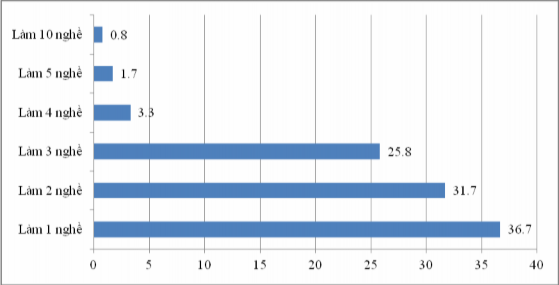
Figure 3.6. Multi-employment of people
(Source: Thesis survey data) Summary of chapter 3 : Thus, it can be seen that after the process of recovering agricultural land, the labor structure and employment structure of the people in the two communes of Ngoc My and Thien Ken have changed in the direction of reducing labor in the agricultural economic sector and increasing labor in the industrial and service economic sectors. In chapter 3, the thesis also delves into the analysis of the change in labor structure, employment
stratified by gender, education level and age to clarify the differences in socio-demographic factors.
The reality of the change in employment structure is quite clear when comparing from 2010 to 2015, the number of people working in farming, gardening, and raising livestock has decreased sharply and the number of people working as workers, drivers, teachers, etc. has increased. In particular, the study found a big difference in age with the change in employment structure; the age group of 15-24 doing non-agricultural work is very high, while the age group of 51-60 doing agricultural work is high. Reflecting the reality of job transition in the age group of 51-60 has many limitations and difficulties.
The assessment of the people of the two communes on the level of impact of agricultural land acquisition on employment, the data results show that the impact is high and very high, along with the level of impact showing a relationship with the multi-employment to ensure income and living of the people. And the people consider doing many jobs at the same time as a life strategy in the new era.