
The urbanization process affects the land use structure. Many studies have confirmed that there is a close relationship between urbanization and land use structure conversion. Increased urbanization means that the area of residential land and urban land types is expanded, while the area of agricultural land is narrowed (Nguyen Huu Ngu & cs., 2015; Nguyen Thi Hoai Phuong, 2017; Vu Van Anh & Nguyen Thi Thu Trang, 2020; Tran Trong Phuong & cs., 2019).
2.3. SOME STUDIES ON THE IMPACT OF URBANIZATION ON LAND MANAGEMENT AND USE; LIFE AND EMPLOYMENT
2.3.1. Some studies on the impact of urbanization on land management and use; life and employment in the world
Research by Christopher et al. (2017) shows that urban expansion often occurs on arable land. The results of the study predict that urban expansion by 1930 will result in a loss of 1.8-2.4% of arable land with significant regional variation. About 80% of global arable land loss due to urban expansion will occur in Asia and Africa, with the loss of more than twice the productivity of the national average. Asia will experience the highest absolute loss of arable land, while African countries will experience the highest percentage loss of arable land. The loss of arable land may be accompanied by other sustainability risks and threaten people's livelihoods. Therefore, managing urban expansion is an important issue for ensuring livelihoods in agricultural economies of the global South.
Research by Burak Guneralp & cs. (2017 in Africa shows that the expansion of urban areas to meet the needs of a growing urban population puts direct and indirect pressure on ecosystems. Although the physical expansion of urban areas, the concentration of people in urban areas may seem to reduce pressure on natural habitats, the impact of urban populations is far-reaching, affecting the quality of life of people from expanding transport networks and increasing dust concentrations. Supranational or regional bodies have the potential to contribute to ecological governance in Africa, although the challenges to Africa’s economy brought about by urbanization are understandable. However, if well managed, urbanization can act as a catalyst to shift local, regional, national and international governance mechanisms to the continent to effectively conserve biodiversity for the livelihoods of both rural and urban areas.
Maybe you are interested!
-
 Solving employment and ensuring livelihood for workers after land acquisition in the process of industrialization and urbanization in Nghe An province - 25
 -
 Strengthening the state's management role over land in the urbanization process in Hanoi city - 2
 -
 The impact of urbanization on socio-economic development of Pho Yen district, Thai Nguyen province - 2
 -
 Experience of Some Localities in Solving Employment and Ensuring Livelihood for Workers After Land Revocation During Industrialization and Urbanization
 -
 Assessment of the Impact of Land Acquisition on Employment and Multi-Employability of People
In India, there has been a massive migration from rural to urban areas and also from small urban areas to larger urban areas and then to mega cities like Delhi, Bangalore, Mumbai etc. Urbanization in India has been at a high level since the 1970s. According to the 2001 Census of India, the population of Delhi increased by 47.02 in the decade 1991-2001 (from 9.4 million in 1991 to 13.82 million in 2001). The increase in Delhi's population is mainly due to the migration of people to the capital in search of better living conditions. The population of Delhi reached 21.7 million in 2009 (an increase of 57 from 2001-2008). After independence, when Delhi witnessed a large influx of migrants, in a very short period of time, the population of Delhi almost doubled. To accommodate such a large number of migrants, cities have expanded unplanned and uncontrolled. Forests have been cleared, grasslands ploughed or leveled, wetlands drained and cultivated land encroached upon under the influence of rapidly expanding cities (Rahman, 2007). In the capital city of Delhi, the population density in 2001 was 14,387
people/km2 in urban areas and 1,627 people/km2 in rural areas. Year
In 1901, 47.34 of Delhi's population lived in rural areas and gradually decreased to 17.60 in 1951 and 6.99 in 2001. The rural area is shrinking, falling from 1,158 km 2 in 1961 to 592 km 2 in 2001. On the other hand, the urban area increased from 182 km 2 in the 1970s to over 750k m 2 in 2001. In 1992, the agricultural land area of the capital Delhi was 65,114 ha and decreased to 54,153 ha in 2004 (a decrease of 12%). During the same 12-year period, densely populated areas more than doubled, and similar land-use changes occurred around the fringes of Delhi, especially in the eastern, southwestern, and northern districts of the city. Medium- and low-density residential areas also declined. Furthermore, the Delhi Hills, once considered the lungs of the city, are rapidly deteriorating, falling from 6.69 percent of the city's total area in 1992 to 5.52 percent in 2004. This decline is due to continued tree-felling, illegal quarrying, and construction activity in the southeastern part of the city.
Urban expansion has directly affected the quality of the urban environment, the efficiency of land use by people and the overall socio-economic development (Netzband & Rahman, 2007).
2.3.2. Some studies on the impact of urbanization on land management, use, life and employment in Vietnam
In Vietnam, up to now there have been many research projects related to
urbanization issues as well as the impact of urbanization on some areas of life and socio-economic development. However, the impact of urbanization on land management is still very limited and in a very narrow scope. Research by Nguyen Thi Hai & Huynh Van Chuong (2015) shows that the urbanization process contributes to improving the efficiency of surveying and establishing cadastral maps, maps of current land use status; the work of granting land use right certificates; the work of managing public services on land and managing the development of the land use right market in the real estate market... In addition, the urbanization process has increased the pressure on land use planning, land financial management as well as the issue of resolving land complaints and denunciations... in Huong Thuy town, Thua Thien Hue province. Research by Dao Thi Thanh Lam & cs. (2013) in the topic of assessing the current status of the impact of the urbanization process on land management and use shows that the urbanization process has a strong impact on land allocation, land lease and land use planning in a positive direction to meet the demand for land for housing and developing production and business. However, the urbanization process also faces some difficulties and limitations such as: the construction of a 5-year long-term land use plan is not highly feasible; local authorities have not really paid attention to the work of making and implementing land use plans; the issue of compensation and site clearance in many urban areas is difficult and prolonged; the situation of prolonged complaints related to compensation, resettlement support, the situation of opposition and non-cooperation in the work of inventory, compensation and relocation... are becoming hot spots that need the participation of the entire political system. In addition, the issue of land management and use by investors in some urban areas is still loose, allowing people to reoccupy production land and build houses, leading to complaints and affecting local security and order.
Research by Nguyen Duy Thang (2009) in suburban areas shows that urbanization has affected the conversion of land use from agricultural to non-agricultural purposes to build industrial parks, residential areas, service areas and entertainment areas. Population growth due to immigration to suburban areas and the narrowing of cultivated land have made employment a pressing issue in suburban wards and communes. In particular, when Ha Tay was merged into Hanoi, a large part of rural residents who were previously considered as people from other provinces have now become residents of Hanoi, so they can officially participate in earning a living in the city as well as in suburban areas of Hanoi. Although close to
Although merging with Ha Tay, Hanoi's agricultural production activities are rapidly decreasing, replaced by industrial production, small-scale industry, services and trade.
Regarding the impact of urbanization on land use structure transformation at the provincial level, we can mention the research of authors Nguyen Thi Hoai Phuong (2017 in Binh Duong province; Vu Van Anh & Nguyen Thi Thu Trang (2020 in Thai Nguyen province. According to the research results of Nguyen Thi Hoai Phuong (2017), the urban population growth rate of Binh Duong province in the period of 2000-2015 was the highest among the three provinces in the Southeast region (including Ho Chi Minh City and Dong Nai, specifically in 2000 it was 100; in 2005 it was 141.5; in 2015 it was 635.4 (an increase of 535.4 compared to 2000). The rapid increase in urban population in Binh Duong province is mainly due to the form of in-situ migration, merging neighboring rural areas into new urban areas (from district-commune units to town-ward units). . The process of industrialization, modernization and urbanization has caused a large area of agricultural land and unused land to be converted into non-agricultural land to build public works and infrastructure to serve the socio-economic development process, especially industrial parks, traffic works and housing. Statistics show that in 2000, the area of agricultural land accounted for 84.7% of the total land area, by 2015 it had decreased to 77% of the total natural land area. Meanwhile, the area of non-agricultural land tends to increase very rapidly (in 2000 it reached 10.5% of the total land area, by 2015 it had more than doubled to 23%).
Research by Vu Van Anh & Nguyen Thi Thu Trang (2020) also shows that in the period 2010 - 2018, urban land use in Thai Nguyen province has changed in terms of area, use structure, and use space. Urban land area has increased 1.9 times, of which urban non-agricultural land increased 2.4 times, urban agricultural land increased 1.7 times. In 2018, non-agricultural land accounted for 35.7 in the urban land use structure, of which specialized land accounted for 17.2. The ratio of urban land to natural land of the whole province has increased from 9.8 (in 2010 to 18.5 (in 2018). Urban land area of Thai Nguyen province increased by 30,979.2 hectares in the period 2010 - 2018, of which urban agricultural land increased by 18,191.5 hectares, non-agricultural land Urban land area increased by 13,110.8 ha. The increase in urban land area is due to the expansion and upgrading of 3 major urban areas of the province. Pho Yen town accounts for 81.9 ha, the city
Thai Nguyen accounted for 11.8% and Song Cong city accounted for 4.5% of the additional urban land area of the whole province in the above period. The change in the urban land use structure of the whole Thai Nguyen province as well as the land use structure in Thai Nguyen city, Song Cong city and Pho Yen town all shifted towards increasing the proportion of non-agricultural land and decreasing the proportion of agricultural land.
At the district level, on the impact of urbanization on land use, many research results have also confirmed that the urbanization process has a clear impact on land use structure conversion and land fluctuations. Research by Nguyen Huu Ngu & cs. (2015 in Dong Hoi city, Quang Binh province showed that the land use structure of Dong Hoi city in the period of 2005 - 2013 had quite a big change, in which the proportion of agricultural land decreased from 66.29 in 2005 to 64.36 in 2013; the proportion of non-agricultural land increased from 24.46 in 2005 to 31.26 in 2013; the proportion of unused land decreased from 9.24 in 2005 to 4.37 in 2013. The total area of agricultural land converted to non-agricultural land in this period was 684.23 ha. The study by Tran Trong Phuong & cs. (2019 in Tu Son town, Bac Ninh province was conducted in 3 commune-level administrative units. The research results showed that the urbanization process in Tu Son town affected the land area. agricultural production in the period 2011 - 2017, in which Tan Hong ward area in 2017 decreased to 6.44 ha compared to 9.11 ha in 2011; Dong Ngan ward decreased from 6.54 ha in 2011 to 4.22 ha in 2017; Phu Chan commune decreased from 13.24 ha in 2011 to 3.76 ha in 2017.
In recent years, research on the impact of urbanization on people's lives and jobs has been quite diverse. Some studies focus on farmers who have lost their agricultural land, while others focus on the working class in industrial parks, export processing zones or immigrants to cities.
Research by Nguyen Anh Dung (2014) shows that the process of land acquisition for industrialization and urbanization in Da Nang has had positive impacts on employment, income and life of farmers whose land has been acquired; shifting the economic structure and labor structure towards modernity, improving infrastructure, creating many job opportunities to diversify occupations for people. Since then, people's living conditions have had positive changes. Household income and expenditure have increased, people have the conditions to build decent houses.
and purchase of household appliances, infrastructure such as electricity, roads, schools, stations, etc. are increasingly invested and upgraded. In addition to the positive impacts, land acquisition for industrialization and urbanization also has negative impacts on socio-economic development in general and the employment of farmers whose land is acquired in particular. In terms of society as a whole, the loss of farmers whose land is acquired is significant, but their practical and legitimate rights have not been properly addressed and resolved, especially the issue of job creation.
Research by Nguyen Huu Ngu et al. (2015) shows that the process of converting agricultural land to non-agricultural land under the influence of urbanization has a significant impact on the lives of people whose agricultural land has been recovered, with 5 households facing many difficulties in life after the State recovered all of their agricultural land. The study on the impact of urbanization on the economy of farming households in Phu Thuong commune, Phu Vang district, Thua Thien Hue province by Pham Thi Thanh Xuan & Nguyen Van Lac (2012) also showed that the urbanization process has reduced the agricultural land area of farming households and many farming households have not yet adapted to the new conditions to stabilize their lives. In addition, the labor force has tended to shift from agriculture to non-agricultural occupations, but it is still spontaneous and not very stable. Urbanization creates opportunities for many people to change jobs in the agricultural sector to the non-agricultural sector. According to Do Thi Thanh Huyen (2020), urbanization often goes hand in hand with land acquisition, especially agricultural land to implement investment projects using land and causing a part of farmers to lose agricultural land and have to switch to work in the non-agricultural sector. In other words, urbanization has an impact on the employment structure. Research by Tran Trong Phuong & cs. (2019 shows that the urbanization process in Tu Son town has contributed to solving the problem of surplus labor and idle agricultural labor, helping people have more choices of secondary occupations besides traditional agriculture (in 2011, income was 20.60 million VND/person/year, by 2017 it was 32.40 million VND/person/year.
Pham Thanh Thoi's study (2013) on the social life of young migrant workers in small production establishments in Ho Chi Minh City shows that housing is a major obstacle for young migrant workers.
common when they come to the city to make a living, of which 50.7% of workers eat and sleep at small production establishments, 3.7% of landlords rent rooms for them to stay and the remaining 37% rent rooms themselves. Cultural life, entertainment and access to health services are still poor. Production establishments do not have any policies or plans to improve this issue in their investment and economic development strategies. Once workers have work-related accidents or illnesses, they are all responsible, and the employer's help is only partial support. The research results also clearly show a picture of the growing stratification in the economic sector between employers and those who "sell" their labor. According to the survey results, there are currently over 61% who say they want to change jobs due to low income. The stratification is also reflected in terms of power, the owner of the facility can "kick" the workers out of the facility at any time without having to consider any legal responsibilities.
2.4. RESEARCH ORIENTATION OF THE TOPIC
The above authors have only focused on urbanization and the impact of urbanization on economic structure or on labor, employment, or changes in land structure in specific areas. Some studies have only focused on assessing the current state of urbanization and proposing criteria to assess the urbanization process or focusing on assessing the impact of agricultural land recovery on people's lives and jobs during the urbanization process. These studies have not simultaneously assessed the impact of urbanization on land management, use and people's lives and jobs, and have not yet delved into the factors affecting land management, use and life, employment and the level of impact of those factors.
Therefore, the thesis topic aims to address the above gaps. Specifically, it assesses the urbanization process, points out the factors affecting land management and use in the urbanization process from 2008 to 2019 in Vinh city. The thesis also deeply studies the impact of urbanization on the lives and jobs of people whose agricultural land is recovered for national defense, security and public interests in the urbanization process from 2008 to 2019 in Vinh city as a basis for proposing solutions to improve land management and use and ensure the lives and jobs of people whose land is recovered in Vinh city under the impact of the urbanization process.
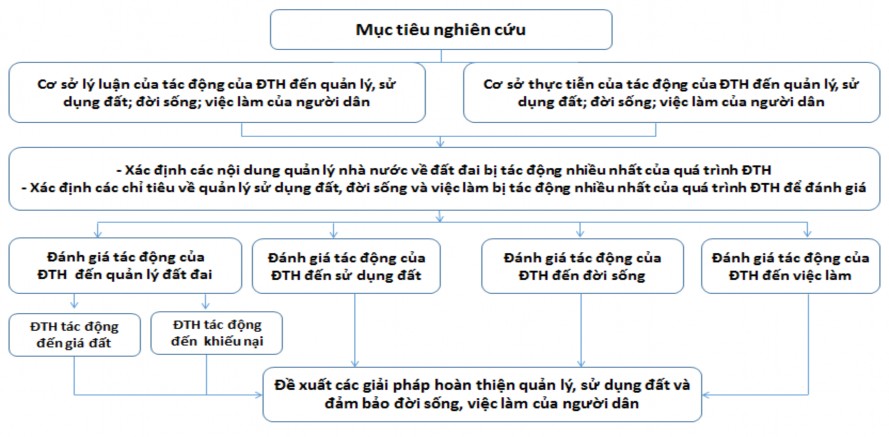
Figure 2.5. Research framework diagram
41