Connect measuring tools
Condition | Standard | ||
2 - 3 | Unlock | < 1 Ω | |
2 - 3 | Locked | > 10 kΩ | |
If not as specified, replace the trunk lid lock assembly. | |||
(1) | (2) | ||
Check the luggage compartment door lock. - Connect the positive battery terminal to terminal 3 and the negative terminal to terminal 2 and check that the lock is unlocked. - Connect the positive battery terminal to terminal 2 and the negative terminal to terminal 3 and check that the lock is engaged. If not as standard, replace the lock assembly. luggage compartment lid |
| ||
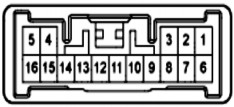
Check the switch assembly. - Check the control switch resistance. | |||
Connect measuring tools | Status switch | Pepper standard | |
10 (T1) - 13 (B1) | OFF | > 10 kΩ | |
11 (ED) - 12 (B1) | TAIL | < 1 Ω | |
10 (T1) - 13 (B1) 11 (ED) - 12 (RF) | HEAD | < 1 Ω | |
- Check the headlight mode switch resistance. | |||
Connect measuring tools | Switch status | Standard | |
9 (HU) - 11 (ED) | FLASH | < 1 Ω | |
8 (HL) - 11 (ED) 9 (HU) - 11 (ED) | LOW BEAM HI BEAM | < 1 Ω < 1 Ω | |
- Check the resistance of the turn signal switch. | |||
Connect measuring tools | Status switch | Pepper standard | |
6 (TR) - 7 (E) | Turn right | < 1 Ω | |
6 (TR) - 7 (E) 5 (TL) - 7 (E) | Intermediary | > 10 kΩ | |
5 (TL) - 7 (E) | Turn left | < 1 Ω | |
- Check front fog lights. | |||
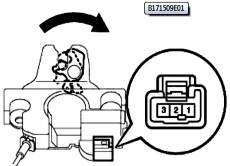
Connect measuring tools | Status | Pepper | |
Maybe you are interested!
-
 Complexity Assessment and Algorithm Implementation
 -
 Assessment of the Implementation of Bot Contract Law in Road Transport Projects in Vietnam
 -
 History Lesson Implementation Skills Group:
 -
 Assessment of the Implementation of the Role of Management for FDI
 -
 General Assessment of the Current Status of Credit Policy Implementation for Students at Vietnam Bank for Social Policies

switch | standard | ||
3 (BFG) - 4 (LFG) | OFF | > 10 kΩ | |
3 (BFG) - 4 (LFG) | Fog lights ON | < 1 Ω | |
If not as standard, replace the work. headlight mode off | |||
(1) | (2) | ||
Check the hazard warning switch. - Check resistance. |
| ||
Connect measuring tools | Switch status | Standard | |
6 - 8 | OFF | > 10 kΩ | |
6 - 8 | ON | < 1 Ω | |
- Check lighting operation. Connect the battery positive to 10 and negative to 14, check that the headlights light up. If not as standard, replace the cluster. hazard light switch | |||
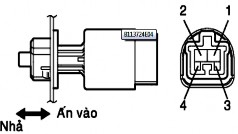
Check the brake light switch. Check resistance. |
| ||
Connect measuring tools | Status switch | Pepper standard | |
1 - 2 | Release the pin. | < 1 Ω | |
3 - 4 | > 10 kΩ | ||
1 - 2 | Press the button. | > 10 kΩ | |
3 - 4 | < 1 Ω | ||
If not as specified, replace the brake light switch. | |||
Check fog light relay. Check resistance. |
| ||
Connect measuring tools | Status switch | Pepper standard | |
3 - 5 | When battery voltage is lost. | > 10 kΩ | |
3 - 5 | Apply battery voltage to terminals 1 and 2. | < 1 Ω | |
If not as specified, replace the relay. | |||
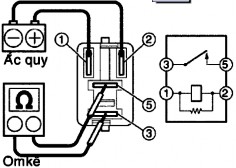

fog lights
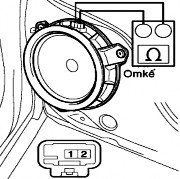
Check the audio speaker assembly. - Check tight assembly, check visually. - Check resistance. Disconnect the speaker jack and use an ohmmeter to measure the resistance. |
| ||
Connect measuring tools | Condition | Standard | |
1 - 2 | All conditions | 4 Ω | |
If not as standard replace the speaker. | |||
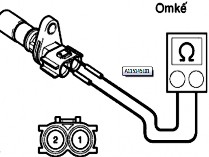
Check crankshaft position sensor. - Check resistance. |
| ||
Application measuring instrument | Condition | Standard | |
1 - 2 | -10 o C ÷ 50 o C | 985 ÷ 1600 Ω | |
1 - 2 | 50 o C ÷ 100 o C | 1265 ÷ 1890 Ω | |
- If not as specified, replace the crankshaft position sensor. | |||
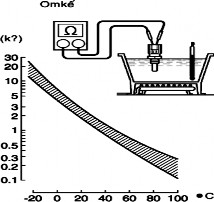
Check coolant temperature sensor - Check resistance. |
| ||
Connect measuring tools | Condition | Standard | |
1 - 2 | 20 o C | 2.32 ÷ 2.59 kΩ | |
1 - 2 | 80 o C | 0.310 ÷ 0.326 kΩ | |
- If not as specified, replace the coolant temperature sensor. | |||
Check the horn. - Check resistance. |
| ||
Measurement conditions | Standard | ||
Battery positive terminal - Terminal 1 (IG+) Battery negative terminal - Horn holder | Siren | ||
- If not as standard, replace the horn. | |||
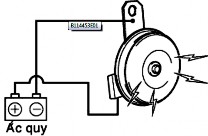
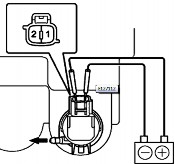
Check windshield washer pump.
- Connect the positive (+) battery terminal to terminal 1 of the pump, and the negative (-) battery terminal to terminal 2. Check that the windshield washer fluid flows out.
- If the results are not as specified, replace the motor assembly and windshield washer pump.
| |
Check the wiper motor. Check the auto stop position. Activate the wiper motor first then stop it. Check the automatic stop position during operation. The front window motor stopped. |
3. ANALYZE RESULTS AND MAKE CONCLUSIONS AFTER DIAGNOSIS.
Target:
Check and evaluate the completion of the body's electrical system diagnostics.
car.
After checking the vehicle electrical system, the actual values will be determined.
reality; compare with standard values (according to documents or repair manuals) to draw conclusions on repairing or replacing parts.
CONTENT, REQUIREMENTS FOR ASSESSMENT
1. Check assessment before doing the lesson.
- Knowledge: assessed through multiple choice and essay tests;
- Skills: refer to the results of the practical exercise assessment of lesson 7.
2. Test and evaluate during the lesson implementation.
Instructors observe during regular instruction on preparation, basic operations, workplace arrangement, etc. Keep a logbook to combine with evaluation of module implementation results in terms of knowledge, skills, and attitudes.
3. Test after finishing the lesson.
3.1 About knowledge.
Based on the module objectives, evaluate the results through written tests, oral tests, or multiple-choice tests that meet the following requirements:
- Correctly state the concepts, requirements and methods for diagnosing the technical status of the vehicle body electrical system;
- Present the steps and content of the vehicle electrical system diagnostic testing process;
- Distinguish methods for diagnosing the technical condition of the vehicle body electrical system.
3.2 About skills.
Evaluated by direct testing of machine operations, through the quality of practical exercises that meet the following requirements:
- Prepare materials, equipment and diagnostic tools according to the established plan;
- Operate and use diagnostic equipment and machines according to correct procedures;
- Correctly detect vehicle defects (if any) using diagnostic equipment and machines;
- Arrange equipment and tools reasonably, arrange the workplace scientifically.
Suggested practice exercises for students:
- Exercises to apply learned knowledge: concepts, requirements and methods to diagnose the technical condition of the vehicle body electrical system;
- Practice exercises for individuals and small groups: identifying and operating diagnostic equipment and machines according to procedures;
- Resources and time required to perform the job: have enough equipment, common diagnostic machines for car manufacturers, time according to the training program;
- Results and products to be achieved: identify and operate diagnostic equipment and machines, detect errors on cars through diagnostic methods;
- Standardized presentation of the product.
3.3 About attitude.
Evaluated through observation and through the monitoring book to meet the following requirements:
- Comply with labor protection regulations;
- Comply with internship regulations;
- Organize the workplace reasonably and scientifically;
- Awareness of savings and discipline;
- Spirit of cooperation in working in teams and groups.
4. Requirements for assessment of learning outcomes:.
- Provide main contents and products: concepts, requirements and methods for diagnosing vehicle electrical systems; operating diagnostic equipment and machines to detect faults on cars;
- Assessment methods and approaches: through multiple-choice, essay or oral tests to test theory, practical exercises to assess skills;
- Suggested study materials: references are at the end of the book.
Introduce
LESSON 9. DIAGNOSTIC OF TECHNICAL CONDITION OF POWER TRANSMISSION SYSTEM.
Article code: MD 38 - 09
Car diagnostics is a complex task, requiring the person performing the diagnostics to have a firm grasp of the specific structure. Therefore, in order to diagnose accurately, completely and logically, we will carry out diagnostics on each system of the car. In this article, we will learn about the content of the diagnosis of the technical status of the powertrain system.
Target:
- Correctly state the tasks and requirements of diagnosing the technical status of the powertrain system.
- Correctly analyze the types of power transmission system failures and methods for diagnosing those failures.
- Select appropriate methods and use equipment to diagnose the technical condition of the powertrain system.
- Comply with procedures and regulations in the automotive technology profession.
- Practice discipline, carefulness and meticulousness.
Main content:
1. TASKS, REQUIREMENTS AND METHODS OF DIAGNOSTICING THE TECHNICAL CONDITION OF THE POWER TRANSMISSION SYSTEM.
Target:
- Correctly state the tasks and requirements of diagnosing the technical status of the powertrain system.
- Correctly analyze the types of power transmission system failures and methods for diagnosing those failures.
1.1 Mission.
- Transmits motion from the engine to the driving wheels.
- Change the transmission ratio (change torque, traction) and direction of movement for the driving wheels.
- Ensures torque distribution to the driving wheels when the vehicle enters curves and roads with different grip levels.
- Is the frame that supports a car or tractor.
1.2 Requirements.
- Reliable transmission, high efficiency.
- Durable and economical.
- Simple, gentle control; easy to care for, maintain and repair.
2. PROCEDURES AND PRACTICES OF USING DIAGNOSTIC EQUIPMENT FOR TECHNICAL CONDITION OF POWER TRANSMITTANCE SYSTEMS.
Target:
- Select appropriate methods and use equipment to diagnose the technical condition of the powertrain system.
- Comply with procedures and regulations in the automotive technology profession.
- Practice discipline, carefulness and meticulousness.
2.1 Check the clutch.
Content
Drawings - technical requirements | |
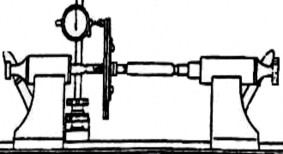
Check the friction disc: - Check for wear, burn, scratches. - Check rivets and hub keyways. - Check springs and shock absorbers. | - Wear ≤ [standard value] - Tap on the friction plate. - Use new shaft for testing.
|
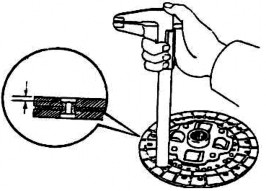
- Rivet penetration depth. | - Immersion depth ≥ [standard value]
|
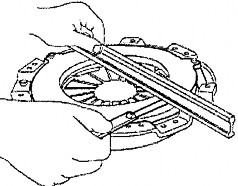
Check the pressure plate: - Check the surface of the pressure plate for burns, scratches, or cracks. - Check the flatness of the pressure plate. - Check the pressure of the pressure plate. |
|